
Banks & Fossil Fuel Financing
Discover how major global banks continue bankrolling the climate crisis with trillions in fossil fuel investments. Learn about solutions to end dirty energy financing.
BANKS & FOSSIL FUEL FINANCING - $906bn Funding Climate Chaos
Uncover the shortsighted, profit-hungry banks around the world fuelling the climate crisis through massive fossil fuel financing. Driven by record short-term profits, major financial institutions continue to enable the reckless expansion of new oil, gas, and coal projects.
By disregarding the devastating consequences for our planet, these banks continue to ignore the goals set out in the 2015 Paris Agreement.
Connect with valuable resources, reports, campaigns, and activist organisations dedicated to exposing how financial giants are retreating from COP26 climate commitments.
Banks must be held accountable and begin to shift billions from dirty energy toward a cleaner, more sustainable, and climate-safe future.
Jump straight to our resources on ➡️ Banks & Fossil Fuel Financing
"As long as private financial institutions treat fossil fuel expansion as a standard high-yield asset rather than a systemic threat, green capital is simply bailing out a sinking ship while banks drill new holes in the hull." - Environmental economist Aurelien Saussay.
*****
Banking on Climate Chaos Report 2026
Released in June 2026, the Banking on Climate Chaos Report revealed eye-opening statistics on the rate at which banks are financing the fossil fuel industry.
In a dramatic failure of net-zero pledges, the report announced that the world's 65 largest banks pumped $906 billion into fossil fuels in 2025, a whopping 8% increase from the previous year.
Most worryingly, financing for the expansion of fossil fuel projects jumped an enormous 27% in just one year, amounting to $508 billion. This will lock us into decades more of future carbon emissions and pollution!
“Nearly two-thirds of the world’s largest 65 banks continue to fuel a fragile and unstable fossil energy system.” - Banking on Climate Chaos
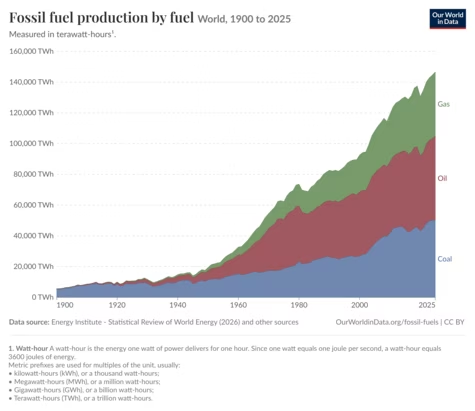
As scientists have proven for more than half a century, fossil fuels are the primary driver of climate change. Oil, coal, and gas account for around 68% of global greenhouse gas emissions and nearly 90% of all carbon dioxide emissions.
Top banks are also concentrating their fossil financing in fewer fossil fuel borrowers, concentrating their money into a shrinking set of oil, gas, and coal firms. This hands this small selection of firms outsized control over fossil fuel supply, pricing, and infrastructure decisions.
Another key finding was that many banks are actively scaling back their climate restrictions. They are quietly replacing rigid emissions caps with more flexible targets, delaying key timelines, and removing compensation incentives linked to climate goals. They have also dropped specific language related to the 1.5°C alignment to minimise their liability or risk of being accused of greenwashing.
In April 2021, the UN-convened Net-Zero Banking Alliance was established. It united global banks in their commitment to align their lending and investments with net-zero greenhouse gas emissions by 2050. The alliance was forced to end its operations in 2025 after an exodus of more than 20 high-profile banks left the group, reducing its asset backing by almost half.
Under political and market pressure, the weakening of voluntary climate frameworks, and energy security pressures, many banks chose to take the exceptionally lucrative yet short-term fossil fuel profits. High fuel prices, driven by major global conflicts in Ukraine and Iran, have also enticed banks to suck the remaining profits out of this fragile, weakening industry.
Without this huge financial backing and government subsidies, large-scale fossil fuel extraction could not expand and would quickly become unprofitable and unattractive to investors.
This report clearly exposed how the banking industry is responding to the climate crisis and that the current system isn’t working.
“Just twelve banks - the “Dirty Dozen” - control nearly 39% of all bank fossil deals in 2025, with the vast majority of almost 2,000 global banks (outside the top 65) providing only approximately 26%.” - Banking on Climate Chaos
One positive finding was that 26 out of the world's 65 largest banks actually reduced their fossil fuel financing in 2025. Of course, this pales in comparison to the banks that increased their bankrolling, but it is the start of an optimistic trend. Proving that it can be done even by large banks, La Banque Postale provided no funding to fossil fuels at all.
Who Are The Worst Offenders?
Private commercial banks are the largest institutional financiers of the fossil fuel industry.
Six financial regions account for 87% of global fossil fuel financing. These are the United States, Canada, Japan, China, the United Kingdom, and the European Union. These are the regions that can either help us change course or continue to push the planet well beyond its boundaries.
Since 2021, the top 5 biggest global financers of fossil fuels are:
- JPMorgan Chase - $248 billion
- Mitsubishi UFJ Financial Group (MUFG) - $211 billion
- Citigroup - $206 billion
- Bank of America - $205 billion
- Mizuho Financial Group - $204 billion
JPMorgan Chase takes the top spot among the worst offenders. They provided $58 billion in 2025 alone. This was an increase of 12% from the previous year as they continue to increase their backing of fossil fuel industry portfolios.
Barclays was the largest UK financer, funnelling around $34 billion into the industry. They were the only UK bank in the “dirty dozen". These 12 banks were responsible for 40% of all fossil fuel funding.
Where Is The Money Going?
- Project Financing - Directly funding new high-impact infrastructure, such as oil rigs, pipelines, fracking operations, and coal mines.
- Loans - Providing vast amounts of credit to fund the daily operations of oil, gas, coal, and industrial agriculture companies.
- Bond Underwriting - Managing and issuing bonds for fossil fuel corporations. This allows them to raise massive amounts of capital in public markets.
- Acquisition Finance - Loaning money specifically to energy companies to enable them to buy out or merge with other fossil fuel assets.
End Fossil Fuel Subsidies
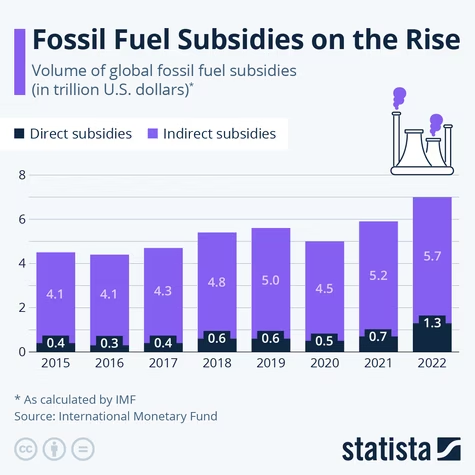
In 2022, global fossil fuel subsidies reached $7 trillion, equivalent to 7.1% of GDP. Following the rise in energy prices since the Russian invasion of Ukraine, subsidies have been on an upward trend to compensate for an increasingly inefficient industry.
The 2022 figure is a $2 trillion increase since 2020. Without serious reform, subsidies are expected to reach $8.2 trillion by 2030.
The social, environmental, and production costs of fossil fuels are always far higher than the cost at which they can be sold, making the whole fossil fuel industry little more than a farce.
Due to escalating costs, subsidies protect consumers by artificially keeping fossil fuel prices low. Still, they exact a heavy toll by draining government budgets, preventing funding for the renewable energy sector, and causing associated damage to our environment and climate.
Removing subsidies would directly reduce global CO2 emissions by an estimated 5% by 2030. Developers would most likely halt development and expansion projects as they would have to cover the remaining 91% of development costs, making them completely unviable.
Fossil fuel products must be priced accordingly. The industry must pay for the damage it is causing to people, the planet, and the fragile balance of our ecosystems and biodiversity. Both governments and banks must end their complicity.

Sustainable Finance - Moving Your Money Away From Fossil Fuels
To end our own complicity, we can make small changes to our personal finances.
By shifting bank accounts, savings, investments, and pensions away from financial institutions that fund coal, oil, and gas projects, you can begin to redirect your funds to ethical alternatives to support clean energy.
Helpful tools include Make My Money Matter, Ethical Consumer, and Bank.Green can help you track your current providers' carbon impact and then find certified sustainable alternatives such as Triodos Bank (Europe), Amalgamated Bank (U.S.A.), and Ecology Building Society (UK).
Money can help build a better world. If we choose to put our money into sectors that promote sustainability, social justice, health and wellbeing, resource protection, and limit the climate crisis, this can have a huge impact on the course that our planet is on.
Banks vs The 2015 Paris Climate Deal
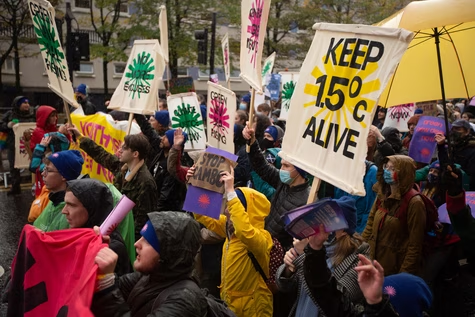
We are now more than ten years into the Paris Agreement. This was a landmark legally binding treaty on climate change. It was adopted by 195 parties (194 now that the U.S. has left under the administration of Trump) in 2015 with the overarching goal of keeping “the increase in the global average temperature to well below 2°C above pre-industrial levels” with the aim to “limit the temperature increase to 1.5°C above pre-industrial levels.”
With a total disregard for the agreement, banks have funnelled $8.7 trillion into oil, gas, and coal projects since the Paris Agreement was made.
This signals a deep misalignment between global banking practices and international climate targets. Their relentless financing has gone under the radar because private companies are exempt from the treaty, which only obligates national governments to meet the goals.
With little legal obligation to comply, they are only accountable to national laws, which, in most cases, are lacking. The vast majority of banking climate goals are voluntary and self-imposed, which makes them effectively their own regulators.
Banks often justify their heavy investments in fossil fuels by stating that they have a duty to their shareholders and clients to maximise profits. Only banks with solid moral standpoints, therefore, will seek out alternative, more sustainable financing.
Additionally, the high demand for oil and gas keeps projects lucrative and gives banks further justification for maintaining close ties to the industry.
Without strict regulations and decarbonisation targets for private companies, we cannot hope to end their support for fossil fuel development.
In a survey of respondents to the Intergovernmental Panel on Climate Change (IPCC), only 6% believed the 1.5 °C limit would be met. Almost 80% predicted at least 2.5C of global heating. The time for banks to divest is now!
Fossil Fuel Divestment For A Better World
“By directly financing fossil expansion, by helping fossil developers raise capital from bond investors, by concentrating debt in a small group of overleveraged firms, and by underfinancing the renewable alternatives that are now cheaper and more secure, the world’s largest banks are choosing to make our energy system more expensive, more fragile, and more unequal.” - Banking on Climate Chaos
The voluntary self-regulation by financial institutions is wholly inadequate if we are to have any hope of keeping to climate targets.
With the International Energy Agency (IEA) repeatedly stating that there is absolutely no need for a single new fossil fuel project or any fossil fuel expansion, there is no justification for pumping $906 billion into the industry every year.
This money would be far better invested in supporting those on the frontlines of climate change to adapt, to fund renewable energy, the electrification of grid systems, ecosystem restoration, public transportation, and affordable green housing.
Devastatingly, banks have provided 18 times as much funding to fossil fuel projects in the Global South as Global North governments have spent on climate change mitigation and adaptation.
Organisations such as Stop The Money Pipeline, Banking On Climate Chaos, the Rainforest Action Network, Banktrack, Oil Change, and Reclaim Finance are using hard facts to demand accountability in the financial sector. They are pushing for strict, legally binding regulations, legislation, and taxes on the global banking network.
The current financial system still rewards banks that invest in harmful activities. This needs to change.
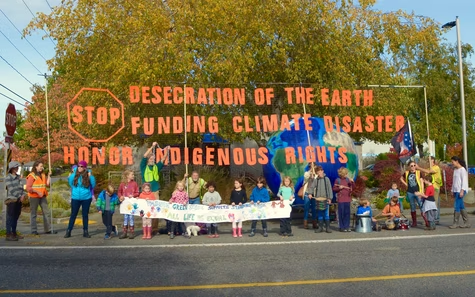
Communities are rising up and saying no to fossil fuel developments. Years of persistent resistance by Indigenous communities led to the cancellation of the Keystone XL Pipeline. The people of Ecuador voted to ban new oil drilling in the Amazonian Yasuní biosphere. Intense pressure from the community forced Shell to withdraw from their exploration of the Cambo Oil Field.
Even despite the vast pools of money being funnelled into the fossil fuel industry, there are still reasons for hope. Renewable energy overtook coal as the world’s largest source of electricity in 2025. Solar energy met an unprecedented 75% of total global electricity demand. Clean energy investment hit $2.2 trillion, almost double the global total for oil, gas, and coal. Imagine what we could do if the banks just stopped!
Spearheaded by the Fossil Fuel Treaty Initiative, Colombia and the Netherlands co-hosted the historic first International Conference for the Phase-Out of Fossil Fuels in April 2026. With 57 countries in attendance, the talks focused on coordinating an international effort to phase out fossil fuels. Dubbed the coalition of the willing, the treaty has already gained the support of 18 nations.
"The catastrophic unfolding of climate change will be linked to frequency, severity and loss. Companies that don't adapt - including the banks financing them - will go bankrupt without question." - Former UN Special Envoy for Climate Action and Finance Mark Carney
Author: Rachael Mellor, 12.08.26, licensed under CC BY-SA 4.0
More Resources
Curated Directory & Deep-Dive Resources on Banks & Fossil Fuel Financing
- Fossil Banks - Fossil Fuel Finance 519892
- Fossil Banks - Stop the money pipeline 520111
- Bank Track - Banks and Climate 520092
- 350 - Stop Fossil Finance 520114
- Ran - Stop banks funding climate chaos 520109
- Share Action - Banks need to ditch new fossil fuels 520107
- Market Forces - How to move your money away from fossil fuels 520108
- Protect us from climate-wrecking finance - New Economics Foundation 519894
- Report: Banking on Climate Chaos - Fossil Fuel Finance Report 2026 519890
- Report: Banking on Climate Chaos - Fossil Fuel Finance Report 2025 519891
- The World Bank has ditched its climate targets - Economist 06.07.26 520098
- Wall Street Just Won’t Stop Financing the Fossil Fuel Industry’s Expansion - Mother Jones 06.07.26 520116
- Banks are financing the fossil fuel industry’s next growth strategy - Grist 01.07.26 520103
- Bank financing to fossil fuels continues to creep up - CSO Futures 12.06.26 519900
- World's biggest banks increased fossil fuel financing by 8% in 2025 - Morning Star 09.06.26 520104
- World’s largest banks pledged $906bn to fossil fuel companies in ‘unfathomable’ increase in 2025, report finds - Guardian 09.06.26 519888
- Fossil fuel financing by big banks jumped 8% in 2025, analysis finds - Green Central Banking 09.06.26 519889
- Banks, climate change and the environmental crisis - Ethical Consumer 28.01.26 520091
- How banks affect the environment and the role your money plays in it - Conversation 28.10.25 520094
- Bankrolling the climate crisis: Which? reveals the high-street banks among the world’s biggest fossil fuel financiers - Which? 03.10.25 519899
- Banks provide more than twice as much finance for fossil fuels as energy transition - Bank Track 23.09.25 519897
- Video: Exposing the banks destroying the planet - Simon Clark 28.08.25 519898
- Finance on trial: how climate litigation against banks could drive systemic change - Green Central Banking 26.08.25 520099
- The World’s Banks are Still Betting on Fossil Fuel Industry Growth - Inside Climate News 17.06.25 520105
- Big Four UK Banks Continue to Finance Fossil Fuel Expansion, Despite Net Zero Commitments - Influence Map 28.05.25 519893
- Is your bank financing the climate crisis and what can you do about it? - BIJ 13.11.24 520100
- UK Banks still lending to oil and gas giant BP – despite climate pledges - Channel4 13.11.24 520102
- How “greenlaundering” conceals the full scale of fossil fuel financing - Tax Justice Network 11.09.24 519895
- The challenge of phasing-out fossil fuel finance in the banking sector - Nature 10.09.24 519896
- What to do if your bank is financing the climate crisis - Fossil Free Funds 27.08.24 520097
- Smaller banks increasingly involved in fossil fuel financing, study finds - The Banker 13.05.24 520106
- How Global Banks Fuel the Climate Crisis in Africa - UN Climate Summit 03.09.23 520101
- How Moving Your Money Out of Dirty Banks Hurts the Fossil Fuel Industry - Stand.Earth 20.03.23 520113
- Do banks fuel climate change? - Science Direct 10/22 520093
- Report: Climate change, central banking and financial supervision: beyond the risk exposure approach - SOAS 10/22 520095
- Banks are incentivised to fund climate chaos. Here’s how to change that - Open Democracy 18.07.22 520112
- Video: How to Stop Banks from Investing in Fossil Fuels | Lucie Pinson - TED 31.05.22 520110
- UK banks and investors responsible for nearly double the UK’s annual carbon emissions, report finds - Greenpeace 24.05.21 520096
- Will the dirty banks ever stop financing fossil fuels? - Carbon Market Watch 18.05.21 520115