
Conference on Transitioning Away From Fossil Fuels
Explore key takeaways from the Santa Marta Conference on Transitioning Away From Fossil Fuels (TAFF). Discover global solutions, barriers, and clean energy strategies.
CONFERENCE ON TRANSITIONING AWAY FROM FOSSIL FUELS (TAFF), 24-29 April 2026 - Charting A Path Beyond Fossil Fuels
Discover the ambitious vision of the Conference on Transitioning Away from Fossil Fuels and learn how a growing coalition of the willing is forging a direct path forward. Born out of frustration with the slow pace and deadlock of traditional UN COP conferences, our guide offers you in-depth insights into the urgent global movement to phase out oil, gas, and coal.
Connect with hundreds of valuable resources, initiatives, and organisations – for divestment, an end to subsidies, and genuine commitment to renewable energies.
Jump straight to our resources on the ➡️ Santa Marta Conference
*****
General Information
Also known as the Santa Marta Conference, this first-of-its-kind conference was co-hosted by Colombia and the Netherlands. With 57 countries in attendance, the talks focused on how to coordinate an international effort to phase out fossil fuels.
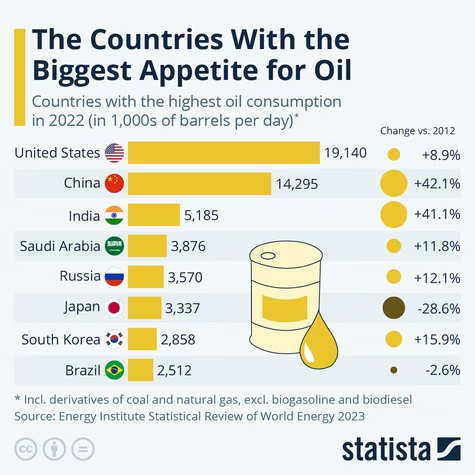
The countries present account for one-third of global GDP and have been branded the coalition of the willing. Notably, the U.S. (the world's largest oil consumer) and China (the world's largest coal consumer) were absent (not invited!).
Although the Santa Marta Conference was designed to complement the UN COP Conferences, the idea, spearheaded by the Fossil Fuel Treaty Initiative, was born out of frustration with the lack of action, lobbying by fossil fuel companies, and unwillingness to commit to concrete measures now synonymous with COP.
COP 30 in Belem, 2025 saw 80 countries demonstrate support for phasing out fossil fuels, but no plan for how to make it happen. Historically, the COP Conferences have focused on curbing emissions rather than directly addressing the need to end fossil fuel production.
Scientists, climate experts, activists, and now 57 willing nations all agree that a coordinated and carefully managed fossil fuel phaseout is the only way to reduce climate change, reduce high energy costs for consumers, promote energy security, and reduce conflict and instability directly linked to fossil fuels.
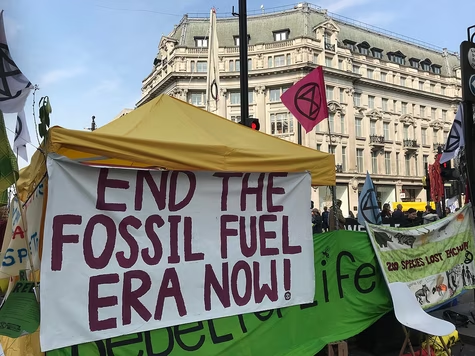
What Are The Main Barriers To The Energy Transition?
If the vast majority of nations agree that we must phase out fossil fuels, then why haven’t we already started to do so? Despite international climate goals, fossil fuel production continues to increase.
Emissions from coal, oil, and gas production all reached new highs in 2025. Driven by rising consumption, 17 of the 20 major producing countries plan to increase production of at least one fossil fuel by 2030.
One of the main barriers at the COP Conferences is the need for consensus. All countries must agree before an action plan can be put in place. These efforts, of course, are derailed by petro-states such as Saudi Arabia and Russia, which consistently block climate action to serve their own financial interests.
Even though the renewable sector is rapidly expanding, fossil fuels still account for approximately 80-82% of the world's energy consumption. Oil, gas, and coal are responsible for over 75% of global greenhouse gas emissions.
The war in Iran and the resulting closure of the Strait of Hormuz, which handles roughly 20% of global oil and liquefied natural gas traffic, have demonstrated the severe vulnerabilities of our global dependence on fossil fuels. Experts have described it as the largest energy supply disruption since the 1970s.
The immediate supply reduction sent oil prices surging to $140 per barrel, exacerbating inflation and creating a food security crisis. It is very clear that reducing our dependence on fossil fuels is critical, yet we still aren’t doing it.
In 2022, global fossil fuel subsidies reached $7 trillion, equivalent to 7.1% of GDP. Following the rise in energy prices due to the Russian invasion of Ukraine, subsidies have been on the rise to compensate for the increasingly inefficient industry.
Without serious reform, subsidies are expected to reach to $8.2 trillion by 2030. Due to escalating costs, subsidies protect consumers by artificially keeping the price of coal, oil, and gas low, but they lead to overconsumption, drain government budgets, diminish investment into the renewable sector, create energy insecurity, and cause widespread ecological damage.
We simply must stop propping up this industry, end massive tax relief, and close loopholes in overseas finance supporting fossil fuels. There must be a clear pathway to end negative financial flows into fossil fuels.
These subsidies merely serve to delay the switch to clean alternatives, which already face a severe funding gap. The energy transition needs approximately $2.2 trillion - $3 trillion in additional annual investment to meet 2050 net-zero goals.
The conference identified other major barriers such as ‘fiscal dependencies, debt constraints, the dependence of the financial architecture on fossil fuels and the need to enable fossil fuels-free trade systems’ all of which are preventing nations from taking greater steps towards the transition.
Away from the COP Conferences and the army of fossil fuel lobbyists, climate deniers and greenwashers that they attract, contributions from civil society, indigenous groups, and scientists were actually heard. In the past 4 years, over 5,000 lobbyists were granted high-level access to the COPs; their job is to influence policy, promote industry interests, and slow action on a fossil fuel phase-out.
It is clear that phasing out fossil fuels cannot be overcome through national action alone. It is only when countries act collectively that meaningful action can take place.

Key Takeaways From The First Conference
Led by Colombian President Gustavo Petro, the conference saw many significant advances. One of the most important developments was the official launch of the Science Panel for the Global Energy Transition.
The purpose of this panel is to provide countries with specific guidance on direct actions to meet the 1.5°C goals and to help them overcome legal, financial, and political barriers. This move represents a significant shift from negotiation to implementation.
While the conference never intended to produce a negotiated declaration, it has promised to deliver a summary report of prioritised solutions. These will be focused on the following three pillars:
- Overcoming dependence on fossil fuels
- Transforming supply and demand
- Advancing international cooperation
It was agreed that one energy source cannot be replaced with another; a broader economic transformation is needed. Plans to reduce dependence on fossil fuels must consider structural dependencies, debt constraints, energy access, and resilience.
The conference made clear that workers, communities, and marginalised groups will be at the heart of the transition. It must be fair, rights-based, and benefit wider society as a whole.
It was agreed that decarbonising economic, trade and energy systems is the best path forward to create societies which are more equitable, stable and resilient.
There are no specific details as yet, but one methodology is to allow countries to lead different alliances and initiatives to enable greater progress and then promote collaboration to expand this progress across the board.
Greater cooperation will enable pooled transition financing and capacity-building. It will also support greater North–South and South–South cooperation on technology and knowledge sharing.
All efforts will be complementary to the UNFCCC and their existing frameworks. Their conference report will be sent to the COP30 Presidency to help build their roadmap. The Conference plans on working alongside all COP presidencies to align with the Global Climate Action Agenda and to channel the second Global Stocktake.
Participants stressed the importance of moving from fiscal lock-in and debt-constrained fiscal spaces to sovereign transition capacity. This would give nations a greater ability to plan, finance, and implement changes to a low-carbon, climate-resilient economy while reducing the economic risks associated with climate change.
Ideas include debt-for-climate swaps, greater oversight of fossil fuel assets, and diversification of revenue sources, such as taxation. There is a great need to reform national fossil rents, fossil-related revenue, fossil fuel-related incentives, taxes, and windfall profits.
We must also ensure that extractive industries for the new green economy coincide with new local value chains and economic diversification, as well as coordinated international investment. Decentralised energy systems were highlighted as a good example of new, community-led sustainable energy production.
The conference highlighted the need for a future-proof electricity grid, connecting the issues of the climate crisis, energy security, affordability, sovereignty, and industrial transformation. The transition is not limited only to energy but also to transport, buildings, industry, tourism, freight, petrochemicals, fertilisers, and food.
Cooperation must also extend to transboundary grid integration, which would provide mutual support for infrastructure, financing, and technology.
Regarding the phaseout of fossil fuel extraction, discussions focused on how to manage this in a fair and politically viable way. Ideas included closure plans, fossil-fuel-free zones, halting the issuance of new extraction licenses, asset management, and the fair distribution of closure costs. The Coalition on Phasing Out of Fossil Fuel Incentives Including Subsidies (COFFIS) is ready to support countries taking the first steps.
Subsidy reform and closure of fossil fuel production sites must go hand in hand with financial incentives for cleaner alternatives and ensure a balance of energy supply and demand.

What Is Next For The TAFF?
The 2026 conference was dubbed a ‘safe space’ for like-minded governments to come together, focus on action, and support each other in the transition away from fossil fuels. It set in motion the beginnings of a realistic action-oriented course.
The conference proceeded without the hindrance of major fossil fuel producers and consumers such as the U.S., China, India, and Russia, as well as industry lobbyists, allowing for candid discussions focused on real change.
The second Conference on Transitioning Away has already been planned for 2027 and will be co-hosted by Tuvalu and Ireland. Tuvalu is one of the most vulnerable nations to rising sea levels, with 95% of its landmass predicted to be underwater by 2100. The TAFF will continue to strengthen cooperation between the coalition of the willing and take stock of their progress so far.
Global growth in renewable energy is surging. The worldwide capacity in 2025 was almost 50% higher than in 2023. Nearly all new energy demand is met through renewables. This is the proof that a clean energy transition is possible.
This new era of international cooperation helps to limit the political and economic risk of acting alone, and puts huge weight on the world to finally commit to phasing out fossil fuels.
Author: Rachael Mellor, 11.05.26, latest update 22.07.26, licensed under CC BY-SA 4.0
More Resources
Curated Directory & Deep-Dive Resources on Conference on Transitioning Away From Fossil Fuels
- 1st Conference: Transitioning Away From Fossil Fuels 24-29 April, 2026 514584
- Global Science & Policy Conference on Transitioning Away from Fossil Fuels - 24-25 April 2026 514847
- Fossil Fuel Treaty Initiative ! 514855
- Treaty Options Papers: Exploring possible elements of a Fossil Fuel Treaty. 523111
- Fossil Fuel Treaty Initiative - YouTube Kanal 515137
- IISD 514586
- @fossilfueltreaty 514845
- YouTube Search - Transitioning Away ... 515127
- YouTube Search - Santa Marta + fossil fuels 515136
- Google News - Transitioning Away ... 515128
- Google News - Santa Marta + fossil fuels 515135
- VIDEOS: 1st Conference Transitioning Away from Fossil Fuels - We Don't Have Time 515132
- VIDEO: The closing sessions from transition Away from Fossil Fuels April 29 515133
- There is No Just Transition Under Occupation: The Santa Marta Conference on Transitioning Away from Fossil Fuels - Palestinian Institute for Climate Strategy 03.07.26 519992
- Santa Marta report by 57 nations defines rapid fossil fuel transition path - Mongabay 02.07.26 519994
- What the First Conference on Transitioning Away from Fossil Fuels Means for the Duty to Co-operate - Opinio Juris 29.06.26 519995
- Santa Marta Conference: Final Outcome Report Shows Strongest Global Support to Date for a Fossil Fuel Treaty - Fossil Fuel Treaty 23.06.26 519991
- Resisting the Corporate Grip on Climate Action - Transnational Institute 10.06.26 519993
- How Santa Marta Showed The World A New Way Forward - Forbes 26.05.26 517310
- The outcomes and lessons of the Transition Away from Fossil Fuels Conference in Santa Marta - WECF 21.05.26 517311
- Beyond Fossil Fuels in Santa Marta: The Importance of Ambitious Action for Climate Governance - Plant Based Treaty 21.05.26 517312
- WILPF in Santa Marta: A Historic Beginning for Fossil Fuel Phaseout - WILPF 19.05.26 516633
- From Santa Marta to Scotland: the line we must not cross on fossil fuels - Stop Climate Chaos Scotland 18.05.26 516635
- Letter From Santa Marta - Tribune Mag 17.05.26 516230
- Beyond Fossil Fuels: Reflections from the Santa Marta Conference - Women's Environment and Development Organization 16.05.26 516634
- Gustavo Petro’s Last Push to Phase Out Fossil Fuels - Jacobin 14.05.26 516231
- Transitioning away from fossil fuels: creating space for those willing to move first - Quakers in Britain 14.05.26 516229
- Peaceful Blockade at Santa Marta Calls for a Just Transition and Global Justice - Pax Christi 14.05.26 516232
- Santa Marta talks focused minds on exit from fossil fuels. Now the hard part begins - Reuters 13.05.26 515933
- The Conference That Named the Problem: Santa Marta and the Beginning of the End of Fossil Fuels - Progressive International 12.05.26 515934
- Key outcomes from the first summit on ‘transitioning away’ from fossil fuels - Resilience 12.05.26 515936
- Fossil fuel transition summit seeks progress beyond stalled COP talks - Mongabay 11.05.26 515935
- How Santa Marta Finally Made Fossil Fuel Phase-Out Politically Discussable - IPS 06.05.26 515672
- As Santa Marta Leads the World Into the Energy Future, the US Clings to the Past - Bill McKibben 02.05.26 (must read) 515124
- As Energy, War and Climate Collide, a Conference in Colombia Charts a Path Beyond Fossil Fuels - Inside Climate News 01.05.26 515613
- Santa Marta conference unlocks historic political momentum for just transitions that must translate into rights-centric action - Amnesty 30.04.26 515967
- Santa Marta: Key outcomes from first summit on ‘transitioning away’ from fossil fuels - Carbon Brief 30.04.26 515130
- ‘Only the Beginning’: Santa Marta Summit Heralded as New Dawn in Fight to End Fossil Fuel Era - CD 30.04.26 515126
- ‘Historic breakthrough’: Colombia climate talks end with hopes raised for fossil fuel phaseout - Guardian 30.04.26 514904
- VIDEO: 1st Conference on Transitioning Away from Fossil Fuels - Santa Marta Colombia 29.04.26 515131
- Santa Marta was just the beginning - 350 29.04.26 516582
- ‘Suicidal’ model of capitalism leading to war and fascism, climate summit told - Guardian 29.04.26 515113
- In the midst of an energy crisis, countries make plans to ditch oil, gas and coal - npr 29.04.26 515129
- Organisers of high-level climate summit in Colombia say 'we must transition away from fossil fuels' - Euronews 29.04.26 514667
- Video: Colombia Hosts First Global Summit on Transitioning from Fossil Fuels in Attempt to Break U.N. Deadlock - DN! 28.04.26 514663
- Video: 1st Conference on Transitioning Away from Fossil Fuels - @WeDontHaveTime 28.04.26 515811
- Colombia climate conference highlights lack of financing for shift from fossil fuels - AP 28.04.26 514666
- Global energy crisis front and centre at Santa Marta conference to end fossil fuels - Greenpeace 27.04.26 514665
- Wait, Could This Be a Climate Conference That Actually Works? - The Nation 27.04.26 514853
- The age of fossil fuels must end. Here is how a Fossil Fuel Treaty can help - Amnesty 27.04.26 514843
- 60 Countries to Meet on Phasing Out Fossil Fuels but Are Excluding the U.S. - NY Times 27.04.26 514844
- Nations backing fossil fuel exit 'a new power': conference host Colombia - France24 27.04.26 514849
- New global panel aims to accelerate move away from fossil fuels - Guardian 25.04.26 514664
- Santa Marta Fossil Fuel Conference Must Emphasize Scourge of Illegal, Unpopular Iran War - CD 25.04.26 515125
- How frustration at Cop stalemates inspires first global talks on phasing out fossil fuels - Guardian 24.04.26 514572
- ‘Leaving the US Behind,’ 50+ Nations Gather in Colombia to ‘Phase Out Fossil Fuels’ - CD 24.04.26 514583
- First ever talks to ditch fossil fuels as UN deadlock deepens - BBC 24.04.26 514587
- The world is searching for oil. This summit is looking to get rid of it - Politico 24.04.26 514589
- Can Countries Create a Roadmap for Ditching Fossil Fuels? - Time 24.04.26 514852
- Here’s what to expect from the first Conference on Transitioning Away from Fossil Fuels - Conversation 23.04.26 514585
- Santa Marta 2026: aligning ambition with action in fossil fuel phase-out - SEI 23.04.26 514846
- Here’s what to expect from the first Conference on Transitioning Away from Fossil Fuels - Conversation 23.04.26 514848
- First global conference on transitions away from fossil fuels: shift in climate diplomacy - IDS 23.04.26 514850
- To avoid COP mistakes, Santa Marta conference must be shielded from fossil fuel influence - Climate Home News 21.04.26 514851
- Revealed: Scientists tell Colombia fossil-fuel transition summit to ‘halt new expansion’ - Carbon Brief 20.04.26 514588
- Fossil fuel transition talks must address militaries - CEOBS 20.04.26 514854
- Colombia convenes climate ‘coalition of the willing’ to break global fossil fuel deadlock - Guardian 17.04.26 515134
- Closer to the edge - Lancet 4/26 517309