
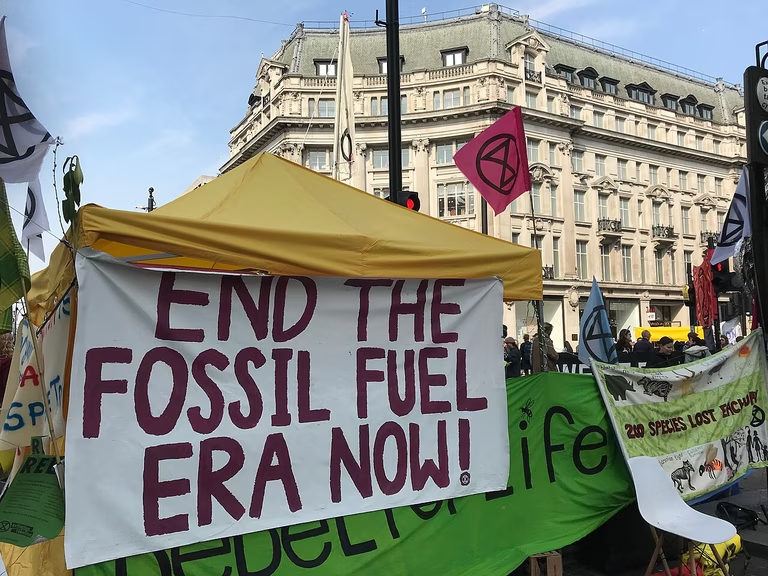
STOP Fossil Fuel SUBSIDIES
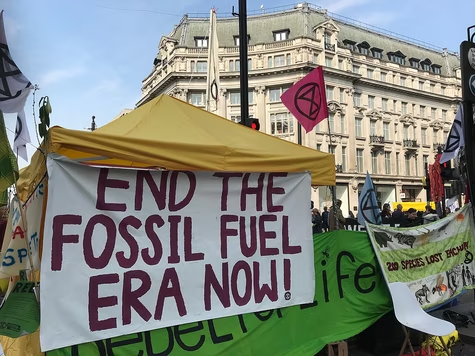
➡️ SUBSIDISING OUR OWN DESTRUCTION – End the Billion Pound Fossil Fuel Crutch
The UK fossil fuel industry has received substantial government support and tax breaks for decades. Recent estimates put the value of UK subsidies to prop up oil, gas, and coal production at approximately £17.5 billion per year. Financial support is at its highest level since 2016.
During the COP29 climate conference in 2024, the UK joined the Coalition on Phasing Out Fossil Fuel Incentives Including Subsidies (COFFIS). Not only has this initiative failed to make any progress, but in a testament to its lack of commitment, UK subsidies have actually increased.
Governmental support for the fossil fuel industry completely undermines net-zero targets, the energy transition, the Sustainable Development Goals, and the best interests of the British public.
Jump straight to our resources on ➡️ Fossil Fuel Subsidies
Explore our comprehensive guides on -
It is no secret that the UK, compared with major European nations, spends the least on low-carbon energy and climate action.
Research by the Climate Change Committee estimates that, for the UK to reach Net Zero by 2050, the cost would be less than 1% of GDP annually – an amount significantly lower than the cost of subsidising our costly, dirty, and deadly fossil fuel industry.
Not only is UK climate action weak, but they are actively stalling it by propping up industries that cause the largest greenhouse gas emissions. By increasing subsidies year on year, we are heading in the total wrong direction.
"For every $1 spent to support renewable energy, another $6 are spent on fossil fuel subsidy and only 8 per cent of the money spent on fossil-fuel consumption subsidies reaches the poorest 20 per cent." - IEA, World Energy Outlook 2015.
Subsidies Cannot Solve the Energy Crisis
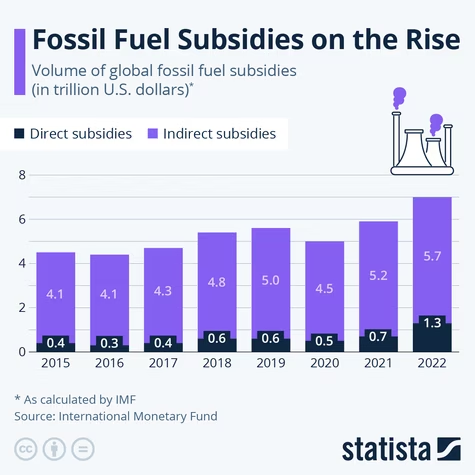
In 2022, global fossil fuel subsidies reached $7 trillion, equivalent to 7.1% of GDP. Following the rise in energy prices due to the Russian invasion of Ukraine, subsidies have been on an upward trend to compensate for the increasingly inefficient industry. The 2022 figure is a $2 trillion increase since 2020. Without serious reform, subsidies are expected to reach to $8.2 trillion by 2030.
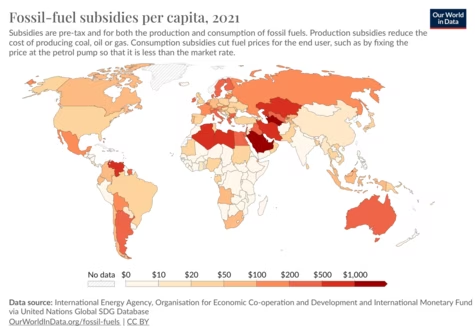
Subsidies come in two forms – explicit and implicit. Explicit subsidies occur when the retail price to consumers is below the production cost, including infrastructure and distribution costs. In the case of oil, which can be sold internationally, explicit subsidies also cover the costs of consuming the product domestically rather than selling it abroad.
Implicit subsidies occur when the retail price fails to reflect external costs, such as the industry's contribution to climate change through greenhouse gas emissions, health impacts, air pollution, the release of harmful pollutants, and even traffic congestion.
The social, environmental, and production costs of fossil fuels are always far higher than the cost at which they can be sold, making the whole fossil fuel industry little more than a farce.
Due to escalating costs, subsidies protect consumers by artificially keeping the price of coal, oil, and gas low, but they carry a heavy toll -
-
Overconsumption: Lowering the price of coal, oil, and gas encourages wasteful consumption, driving up emissions and accelerating climate change.
-
Drains government budgets: Vast amounts of taxpayer money are diverted from social services such as healthcare, education, social care, and infrastructure.
-
Skewing of the market: With the availability of cheap fossil fuels, investment into the renewable sector is diminished.
-
Energy Insecurity: Subsidies promote fossil fuel dependence, locking us into an unsustainable future.
-
Ecological damage and climate consequences: Funding fossil fuel exploration, production, and distribution is in direct opposition to global climate goals.

Benefits of Scrapping Fossil Fuel Subsidies
Removing subsidies would directly reduce global CO2 emissions by an estimated 5% by 2030. Without them, the artificial price of fossil fuels would no longer exist, and renewable energies such as wind and solar power would become much more attractive options to investors and consumers.
In the UK, many oil and gas projects would become economically unviable, and the North Sea industry decline would be accelerated dramatically reducing our contribution to global emissions.
The billions of pounds saved could be redirected towards clean energy technologies and infrastructure, and also supporting the most vulnerable during the transition, especially those struggling with their energy bills.
The controversial Rosebank oil field, located 80 miles west of the Shetland Islands, is the UK's biggest undeveloped oil and gas field. It is estimated to hold 300 to 500 million barrels of oil. If it gets the greenlight, billions in taxpayer subsidies would be handed over in tax breaks to its owners, the Norwegian giant Equinor. As the oil will be exported, it will not lower UK fuel bills or help to safeguard energy security.
The "emissions from this one UK field would be more than those created by the 700 million people in the world's poorest countries in a year" - Stop Rosebank
If these subsidies were scrapped, developers would most likely halt development as they would have to cover the remaining 91% of development costs, making the project completely unviable.
Other benefits of a fossil fuel subsidy phaseout include:
-
Improved public health
-
Enhanced energy security
-
Long-term job creation and economic growth
-
More equitable distribution of costs and benefits across society
-
Increased competition and innovation in the renewable sector
The Path to Subsidy Reform & Phaseout
"The UK has the biggest fossil fuel subsidies of the whole of the EU" - European Commission report, 2019
If we have any chance of hitting our net-zero goals, securing our energy future, improving public health, and funding our social sectors, we simply must commit to a phaseout of fossil fuel industry subsidies, tax relief, and the closure of all loopholes in overseas finance supporting the industry.
Several countries have already removed explicit subsidies and begun implementing taxes and other measures to cover external costs. Indonesia has introduced three reforms since 1997, resulting in a 10.6% saving in public expenditures. India has slashed subsidies by 85% since 2013 and has since tripled public investments in renewable energy.
Additionally, Morocco, Saudi Arabia, and Ukraine have phased out explicit subsidies and Bangladesh and Sri Lanka have both introduced plans for a gradual phaseout.
In the latest round of National Determined Contributions (NDCs), which were announced in 2024/25, only 9 countries included subsidy reduction or reform. Of all the G7 and G20 countries, not one mentioned subsidies at all.
We must hold the UK accountable to the Glasgow Climate Pact, the Paris Agreement, the G7 and G20 Commitments, COFFIS, and Friends of Fossil Fuel Subsidy Reform. Signatures don't mean anything without meaningful action.
The G7 countries, disregarding even their own targets to eliminate inefficient subsidies, continue to siphon record amounts of money into them. Tax subsidies for coal, oil and gas in the G7 have increased by 15% since they first set this goal. This phenomenon is not just a UK issue.
The main obstacle is political.
There must be a clear pathway to end negative financial flows into fossil fuels, one that incorporates tax reliefs, subsidies, loopholes, and investments. Choosing not to tax something equates to subsidising it; convincing us otherwise is just clever greenwashing propaganda.
UK energy industry profits surge past £125 billion, while 12 million households live in fuel poverty.
The subsidies must end.
Fossil fuel products must be priced accordingly. Big Oil must pay for the damage it is causing to people, the planet, and the fragile balance of our ecosystems and biodiversity. The government must end its complicity.
Author: Rachael Mellor, 26.01.26 licensed under CC BY-SA 4.0
For further reading on Fossil Fuel Subsidies see below ⬇️
More Resources
Curated Directory & Deep-Dive Resources on STOP Fossil Fuel SUBSIDIES
- Price of Oil / Oil Change International 125047
- Facebook - Oil Change International 125048
- Dirty Energy Money 125052
- Shift the Subsidies 125053
- Refinery Report 125054
- Sevengen 2019 194833
- Student Energy 194832
- Coal generation in the EU ‘plummeted by 19% in first half of 2019’ 187691
- Declaration of Climate Finance - Not A Penny 125058
- Global Subsidies Initiative (IISD) - Fossil Fuel Subsidies 125059
- Phase out 2020 - Climate Action Network Europe 125060
- BailoutWatch - Tracking government support for fossil fuel industry 259661
- @bailoutwatchorg - A nonprofit, nonpartisan clearinghouse for news and analysis on federal stimulus and recovery efforts, and how energy companies are cashing in 259660
- Fossil fuel subsidies are the ‘worst energy policy in the world,’ researchers say - Mongabay 25.09.26 523483
- World’s largest banks pledged $906bn to fossil fuel companies in ‘unfathomable’ increase in 2025, report finds - Guardian 09.06.26 517961
- Out of Pocket: How Fossil Fuels are Draining Households and Economies - 350.org 11.05.26 520810
- Trump and Israel’s War on Iran Once Again Exposes the Folly of Fossil Fuel Dependence - CD 19.03.26 512276
- Fossil Fuel Subsidies Are Detrimental to Prosperity, Public Finances and the Climate - Sonnenseite 15.07.25 482298
- Government efforts to reduce fossil fuel subsidies have failed at a very high rate - Nature 21.04.25 473274
- Scotland to abandon pledge to cut carbon emissions by 75% by 2030 - Guardian 18.04.24 407932
- How the Dutch climate movement is leading Europe's fight against fossil subsidies - Ecologist 11.04.24 408033
- End fossil fuel subsidies - Ecologist 08.12.23 390314
- Europe’s banks helped fossil fuel firms raise more than €1tn from global bond markets - Guardian 26.09.23 374400
- 'End Fossil Fuels' Protests Kick Off Worldwide Ahead of UN Climate Ambition Summit - CD 15.09.23 373279
- G20 Nations Dished Out at Least $1 Trillion in Fossil Fuel Subsidies in 2022 - cd 23.08.23 368016
- World’s richest countries gave record sums of public money to fossil fuel industry last year - LFF 23.08.23 369851
- Sunak's £755mn oil tax giveaway - Ecologist 14.08.23 367517
- Vast fossil fuel and farming subsidies causing ‘environmental havoc’ - Guardian 15.06.23 352886
- World Bank Confirms Reallocating Fossil Fuel, Factory Farm Subsidies Key to Solving Climate Crisis - CD 15.06.23 352767
- Abolish fossil fuel tax breaks - Ecologist 27.03.23 338479
- The Fight to End Fossil Finance Has Changed - CD 15.02.23 329879
- G7 countries to stop funding fossil fuel development overseas - Guardian 30.05.22 288909
- Database Shows Rich Governments Funding Fossil Fuels Over Clean Energy - CD 20.04.22 284159
- Nationalize the US Fossil Fuel Industry Now! - CD 11.04.22 291065
- Humanity Subsidizing 'Our Own Extinction,' Warns Study - CD 17.02.22 273833
- House Progressives, Climate Coalition Demand End to 'Fossil Fuel Handouts' - CD 15.12.21 265318
- Forget any COP26 promises you heard. Just Look at the $6 trillion in fossil fuel subsidies - CD 16.11.21 263803
- Dinosaur Warns Nations Are “Driving Themselves to Extinction” with Billions in Fossil Fuel Subsidies - Democracy Now! 02.11.21 262982
- European Investment Bank to end all loans to oil and gas firms - Guardian 28.10.21 264132
- With Fossil Fuel Subsidies Intact, Climate Groups Decry BBB Framework as 'Failure of Leadership' - Common Dreams 28.10.21 259695
- Europe's Largest Pension Fund Announces Fossil Fuel Divestment - CD 26.10.21 262427
- Video: Jewish youth arrested while shutting down BlackRock 's headquarters in NYC - Green Faith 20.10.21 273220
- Fossil fuel industry gets subsidies of $11m a minute, IMF finds - Guardian 06.10.21 256952
- EU lawmakers vote to prolong fossil fuel gas subsidies until 2027 - Guardian 28.09.21 258410
- Harvard University will divest its $42bn endowment from all fossil fuels - Guardian 10.09.21 256996
- Harvard to Divest From Fossil Fuels After a Decade of Pressure - CD 10.09.21 257766
- Central Banks Still Fueling Climate Crisis: New Report - Oil Change 24.08.21 256254
- Dirty Dozen Central Banks Are Still Fuelling Climate Chaos - CD 24.08.21 256250
- Q&A on fossil fuel subsidies - HRW 07.06.21 247152
- G7 governments: End fossil fuel subsidies - HRW 07.06.21 247151
- Richest nations agree to end support for coal production overseas - Guardian 21.05.21 250320
- No new oil, gas or coal development if world is to reach net zero by 2050 - Guardian 18.05.21 256020
- Fossil fuel subsidies are a ‘disgrace’, Greta Thunberg tells US House panel - Guardian 22.04.21 242111
- Sanders, Omar Unveil Bill to End 'Absurd Corporate Handouts' to Fossil Fuel Industry - CD 15.04.21 241925
- Biden Eyes Tax Hikes for Rich, Ending Fossil Fuel Subsidies to Fund Infrastructure - CD 23.03.21 233761
- Denouncing 'Handouts to Big Oil,' Biden Calls on Congress to End $40 Billion in Taxpayer Subsidies for Fossil Fuels - CD 27.01.21 233760
- UK to stop funding overseas fossil fuel projects - Guardian 11.12.20 228127
- "Time to Cut Dirty Energy's Lifeline": Report Details How Fossil Fuel Industry Feasted on Covid-19 Relief Programs - CD 23.11.20 225255
- Could New York’s youth finally convince the state to divest its pension of fossil fuels? - Inside Climate News 15.05.20 207972
- How fossil fuel subsidies are helping trash the planet - Emagazine 16.04.20 205888
- Fossil Fuel Industry Shifts from Climate Denial to “Youthwashing” - Real News Network 31.12.19 194834
- Boost for Fossil Fuel Divestment as UK Eases Pension Rules - The Guardian 18.12.17 125064
- Scores of Leading Economists Demand End to All Fossil Fuel Investments - CD 12/17 125065
- Europe providing more than €112 billion a year in fossil fuel subsidies, with almost half benefitting the transport sector – new report - Sonneseite 9/17 125066
- Report: Phase-out 2020: monitoring Europe's fossil fuel subsidies - Overseas Development Institute 09/17 125070
- Environmentalists Urge Democrats to Join Sanders in Opposing Dirty Energy Bill - Common Dreams 7/17 125071
- Fossil fuel subsidies: G20 spends billions to push us closer to climate disaster - YouTube 11/15 125072
- How Large Are Global Energy Subsidies? - Coady, D et al 05.15 125076
- Fossil-Fuel Subsidies: Problems, Opportunities and Making Reform Work Sustainably - IISD 30.01.15 125077
- Global Subsidies Initiative - Fossil Fuel Subsidies Policy Briefs 125078
- Global Subsidies Initiative Article Series - Tracking Progress: International Cooperation to Reform Fossil-Fuel Subsidies 125082
- Global SubsCase studies: Lessons Learned From Attempts to Reform Fossil-Fuel Subsidies 125083
- A Guidebook to Fossil-Fuel Subsidy Reform - GSI 125084
- Just 10% of Fossil Fuel Subsidy could fund renewables 187685
- Stuttgart pulls out of fossil fuels – Fossil Free UK 20.07.16 125088
- Keep Fossil Fuels in the Ground - Bernie Sanders 11/15 125089
- #StopFundingFossilFuels 125090
- #EndFossilFuelSubsidies 125094
- #KeepItInTheGround 125095
- Greenpeace - Quit Coal 125096
- Sierra Club - Beyond Coal 125100
- Sierra Club - Beyond Oil 125101
- Sierra Club - Beyond Natural Gas 125102
- Heat pumps twice as efficient as fossil fuel systems in cold weather, study finds - The Guardian 11.09.23 373176
- #youthwashing: the fossil fuel industries latest marketing tool - UKYCC 07.12.19 194835
- As World Burns, Richest Nations Can't Decide When to End Fossil Fuel Handouts 7/16 125106
- OECD: leading countries spend $200bn a year subsidising fossil fuels - Guardian 09/15 125107
- Report: How Large Are Global Energy Subsidies? - IMF 05/15 125108
- Report: Fossil-Fuel Subsidies and Climate Change: Options for policy-makers within their Intended Nationally Determined Contributions - Nordic Cooperation 13.02.15 125112
- Report: Delivering on G-20 Commitments: The Path to Fossil-Fuel Subsidy Reform - GSI 12/10 125113
- Report: A How-to Guide: Measuring Subsidies to Fossil-Fuel Producers - GSI 07/10 125114
- Report Series (5 papers): Untold Billions: Fossil-Fuel Subsidies, Their Impacts and the Path to Reform - GSI 2009 125118
- Fuel Subsidies Are the World's Dumbest Policy - Bloomberg 09/16 125119
- Africa: G20 Spends Over 15 Times More On Fossil Fuels Than Developed Countries Spend Helping Poor Countries Adapt to Climate Change 11/15 125120
- Fossil fuels subsidised by $10m a minute, says IMF - Guardian 05/15 125124
- US taxpayers subsidising world's biggest fossil fuel companies - Guardian 05/15 125125
- Fossil Fuel Subsidy Reform can Reduce Greenhouse Gas Emissions Globally by 6-13% - ISSD 10.02.15 125126
- Rich countries subsidising oil, gas and coal companies by $88bn a year - Guardian 11/14 125130
- Stop Paying the Polluters - Project Syndicate 3/13 125131
- Making a Killing: Oil Companies, Tax Avoidance and Subsidies 2/13 125132