USA & Israel War on Iran 2026
Explore key analysis and over 800 resources on the 2026 US-Israel war on Iran. In-depth coverage on Middle East regional turmoil, nuclear history & peace.
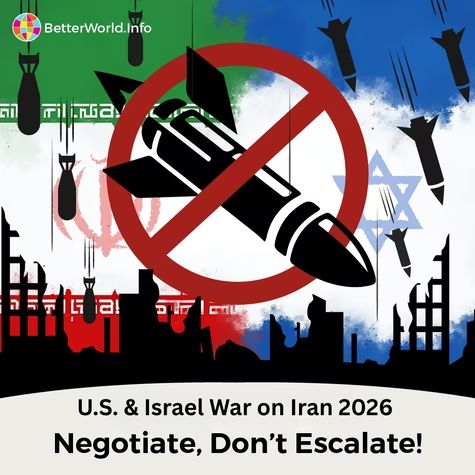
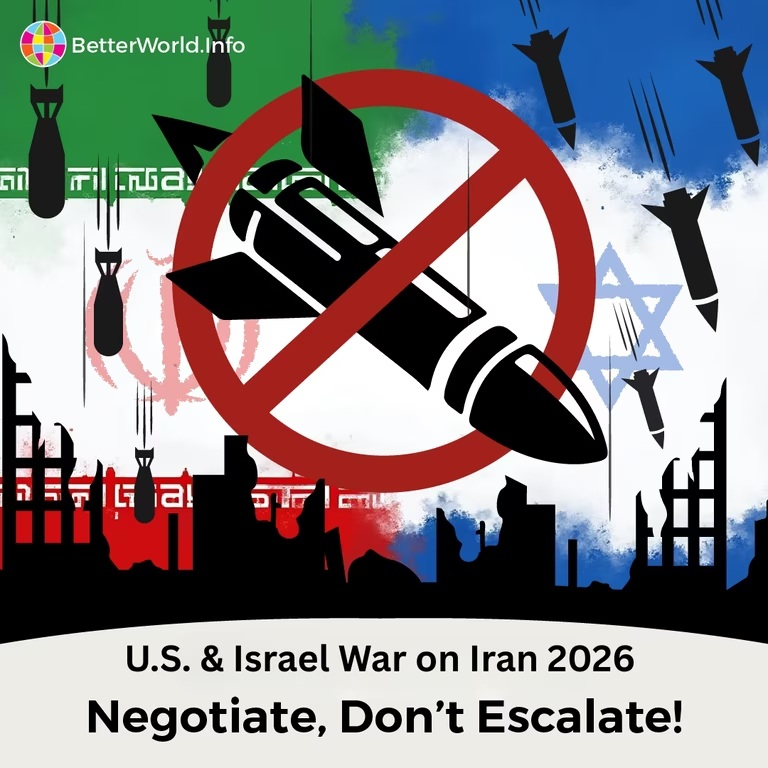
ISRAEL & USA WAR ON IRAN - Illegal, Reckless & No Clear Endgame
Discover the critical realities of the US–Israel war on Iran and learn how diplomatic breakdowns are shaping the region. Our comprehensive guide offers you in-depth information on the failed nuclear talks, collapsed ceasefires, and the alarming spread of war across the Middle East.
Connect with hundreds of valuable resources, analytical reports, and peace initiatives – for genuine conflict resolution, regional de-escalation, and a stable future.
Jump straight to our 850 resources on the ➡️ Israel & U.S. War on Iran
February 28, 2026, marked the end of hopes for productive talks after Israel and the U.S. conducted a series of air strikes on Iran and assassinated their Supreme Leader, Ayatollah Ali Khamenei. The international community is now rightly very concerned about a major war in the Middle East, with widespread human suffering and regional turmoil.
This is an illegal and unprovoked war in clear violation of international law and the UN Charter.
Please share this useful resource via ➡️ Twitter, Bluesky, Facebook, Instagram, and LinkedIn!
Benjamin Netanyahu's mission seems to be destroying Iran's ballistic missile capabilities in their entirety, a plan which will require months of extensive and relentless bombardment. Seemingly acting under the puppeteering of Netanyahu and giving in to Israeli lobbying, Trump has followed suit. In a similar narrative to the recent attack on Venezuela, Trump has cited regime change as his motive. Presumably expecting Iran to bow down to his every whim once their leader was assassinated.
The Middle East is the most volatile region in the world, and these attacks have unleashed a dangerous chain of events. With Iran already conducting retaliatory attacks on American military bases in the surrounding Gulf States, we now await to see if they will be drawn into the Middle East's newest war.
Explore more with our guides to the Twelve-Day War (13-24 June 2025), the War on Gaza, human rights abuses in Iran, and Iran's Military.
*****
International Reactions
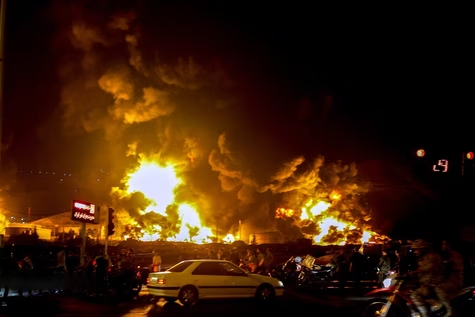
This latest war in Iran is expanding rapidly, pulling in U.S. allies, adversaries, and peaceful bystanders alike.
The UAE has received 800 projectile missiles since the start of the war and is considering military action. Qatar has shot down two Iranian fighter jets and has had to stop gas production after its facilities were hit. Kuwait was attacked on the first day and has mistakenly shot down American fighter jets. U.S. bases and residential buildings have been struck in Bahrain. U.S. bases in Oman were struck on day 2 of the fighting, the country which has been mediating the U.S.-Iran nuclear talks. The U.S. embassy and one of the world's largest oil refineries were struck in Saudi Arabia. U.S. bases in Jordan were targeted.
Hezbollah which is staunchly on the side of Iran, has broken the ceasefire with Israel by launching missiles and drones at Israel. Israel has responded with heavy airstrikes across Lebanon. Iraq, which has strategic alignments with the U.S., has been struck by Iran.
Dragging the UK and Europe into the fold, the British Air Force Base in Cyprus was struck by drones, which are believed to have been deployed by Hezbollah. British Prime Minister Keir Starmer, despite prioritising regional stability, has now authorised the use of British air bases to defend against Iranian missiles.
France and Germany, who initially supported a return to negotiations, have hinted at striking Iran after their personnel were hit in Jordan.
Russia has labelled the escalation by Israel and the U.S. as reckless and a betrayal of diplomacy. China, perhaps worried about its oil supply, has called for the "sovereignty, security, and territorial integrity of Iran and other regional countries to be respected."
In a statement from Iran on February 28th, Iran's Ambassador Amir Saeid Iravani. "This morning, the United States regime - jointly and in coordination with the Israeli regime - initiated an unprovoked and premeditated aggression against the Islamic Republic of Iran for the second time in recent months."
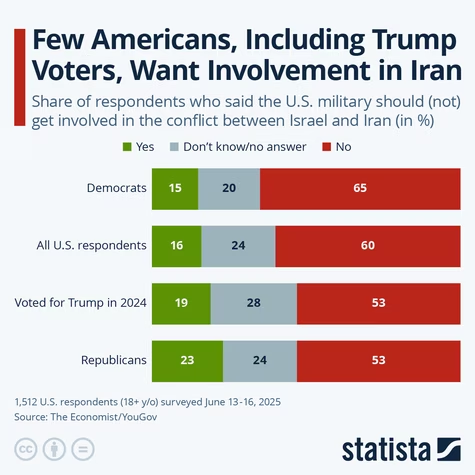
Despite the involvement of more than a dozen countries after just one week of fighting, Israel is adamant in their goal of eliminating the 'existential threat' that is Iran, claiming that their initial round of attacks was an 'act of necessity'. Following a similar narrative and empowered by their recent abduction of Venezuelan president Nicolás Maduro, U.S. ambassador Mike Waltz said their attacks were to ensure that "the Iranian regime can never, ever threaten the world with a nuclear weapon."
Ironic given that both the U.S. and Israel are nuclear states themselves, and the U.S. has the second-largest nuclear weapon arsenal in the world.
Six diplomats from the Gulf States of Qatar, Saudi Arabia, the United Arab Emirates, Kuwait, Oman and Bahrain held an emergency meeting, which called on Iran to halt its attacks and stressed their right to self-defence. Syria, which in the past was a close regional ally of Iran, has also condemned their retaliation.
Much of the Global South condemned the actions of Israel and the U.S. as illegal and has questioned their "pre-emptive" justification. Pakistan, South Africa, Brazil, Chile, Cuba, Türkiye, and Indonesia have cited their regrets about the failure of negotiations and opposed the actions of Israel and the U.S., who have made the world less safe for all of us.
The Nuclear Issue
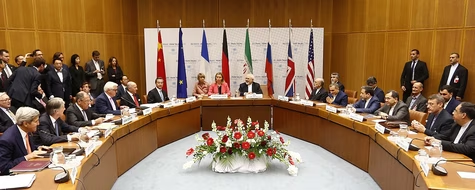
In 2015, the Iran Nuclear Deal framework was agreed upon by the Islamic Republic of Iran and the permanent members of the United Nations Security Council (The U.S., the UK, Russia, France, and China) plus Germany and the European Union. From this framework, the Joint Comprehensive Plan of Action (JCPOA) between Iran and the 7 other parties was announced on July 14, 2015.
In this deal, Iran agreed to redesign, convert, and reduce its nuclear facilities in exchange for an end to all nuclear-related economic sanctions. This agreement was hailed as a huge win for global stability, given the suspicions that Iran was stockpiling uranium for use in weapons, and it freed up billions of dollars in frozen assets.
As part of the JCPOA, Iran was required to provide the International Atomic Energy Agency (IAEA) access to all of its nuclear facilities to assure them that their nuclear program was solely for civilian energy use.
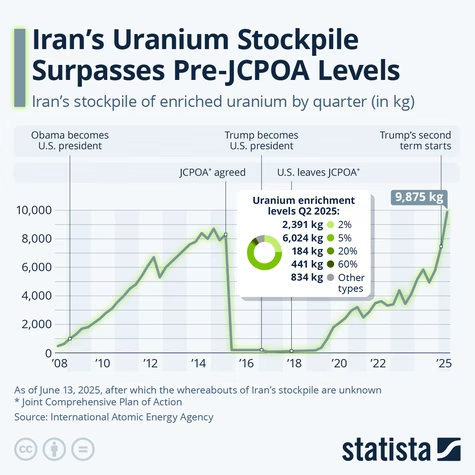
Issues arose in 2018 when President Trump withdrew the U.S. from the deal. He claimed that it was not doing enough to curtail their nuclear program. Within the year, Iran quickly expanded their production, exceeding the 300 kg stockpile limit, began using advanced centrifuges which were previously banned, and started enriching uranium to much higher levels.
Both the U.S. and Iran have supported a return to the original deal, but after 3 rounds of talks, they could not reach a consensus on how to get there. With Trump's insistence on limits to Iran's ballistic missiles, Iran's insistence on only discussing the nuclear issue, and with the threat of military action looming, the talks appear to have been merely a facade.
As of June 2025, Iran had amassed almost 10,000 kg of enriched uranium, 4% of which is enriched to 60%. To build an atomic bomb, this would have to be enriched to 90%. Although the secrecy around their nuclear programme and their significant uptick in uranium stockpiling are major global concerns, there is no verified evidence that Iran plans to produce nuclear weapons.
While Trump is not the first president to fail to secure a nuclear deal with Iran, he is most definitely the first to respond with military action after its failure.
Iran has been repeatedly criticised by the IAEA for failing to explain their stockpiles of uranium, which were found at undeclared sites, restricting their access to nuclear facilities, and the secrecy surrounding their new centrifuges. They maintain that Iran is "the only non-nuclear-weapon state in the world that is producing and accumulating uranium enriched to 60% remains a matter of serious concern" but also state that they have found "no credible indications of an ongoing, undeclared structured nuclear programme".
With Israel's longstanding policy of nuclear opacity and non-disclosure, it is also guilty of secrecy surrounding the issue. It is sort of an open secret that Israel is a nuclear-armed state, but they neither publicly confirm nor deny the fact.
*****
This preemptive military action is a senseless approach to a complex, delicate situation with serious ramifications. It sets an incredibly dangerous precedent for other nations to act outside of international law and carry out a war of aggression with complete impunity just to serve their own ends.
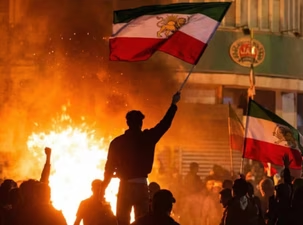
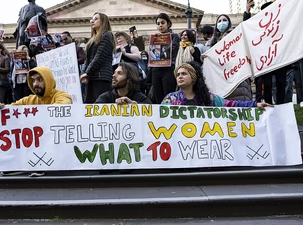
A substantial majority of Iranian people agree that regime change was needed. Nationwide unrest erupted on December 28, 2025, due to widespread discontent with the Islamic Republic government, its mishandling of the ongoing economic crisis, and its brutal stronghold on the country.
These protests were the largest uprising since the 1979 Islamic Revolution. Demonstrations took place in all 31 provinces across 186 cities. The Iranian government responded with deadly force, killing more than 6,000, injuring thousands more, and arresting more than 24,000. For years, Iran has struggled under brutal repression, critical water shortages, power outages, unchecked air pollution, chronic corruption, and economic mismanagement.
Change is needed, but not like this.
More than 500 civilians have already lost their lives, and more than 1,000 targets have been struck, including hospitals and schools. Trump and Netanyahu yet again act with impunity, relying on military force instead of genuine attempts at diplomacy and peace, with the age-old excuses of defending the American and Israeli people and with total disregard for the citizens of Iran and the now threatened Gulf States.
"Who can trust the Trump administration now? It acts unilaterally in total defiance of international law and any norms of diplomacy," - Maleeha Lodhi, Pakistan's former ambassador to the U.S.
Trump thought that change would come with the assassination of Iranian Supreme Leader Ayatollah Ali Khamenei, who was already planning his succession due to ill health. Yet, as proven time and time again, leadership assassinations in the Middle East do not lead to peaceful outcomes.
Missiles and bombs do not bring freedom.
They cause civilian suffering, retaliation, and further destabilisation. We need de-escalation and diplomacy, not violence, if we are to achieve sustainable peace in the Middle East and indeed the rest of the world.
Watch Al-Jazeera for ongoing coverage, also Wikipedia. As a first analysis, we recommend Jeffrey Sachs. For more video commentary & analysis go here.
Author: Rachael Mellor, Date: 04.03.26, latest update 21.07.26 licensed under CC BY-SA 4.0
More Resources