
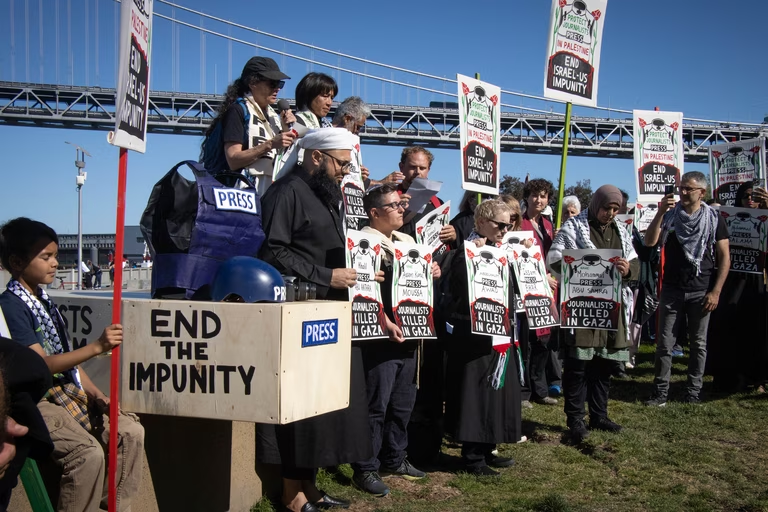
Impunity
Explore the global challenge of impunity and why it is on the rise. This systemiatic failure to hold those in power accountable is a threat to justice, democracy, and our human rights.
➡️ THE RISE OF IMPUNITY – The Systematic Failure to Hold Political, Corporate, & Military Leaders Accountable
Impunity occurs when high-level officials are allowed to commit criminal offences, engage in corruption, or facilitate human rights abuses without consequence. This systematic failure to hold those in great positions of power accountable fuels injustice and global instability. In the most serious of cases, it manifests as abuse of power, disrespect for international law, war crimes, and the total breakdown of democracy.
The UN Secretary-General, António Guterres, has labelled the global rise in impunity "politically indefensible and morally intolerable".
Without accountability, crimes continue without punishment or consequence. While the main offenders are usually those wielding the most power, those who suffer are ordinary citizens. Impunity has now become a defining characteristic of modern armed conflicts. Over the last few years, wars have raged in Ukraine, Gaza, Sudan, Myanmar, and Yemen where culture of impunity has become normalised.
In the 2024 Atlas of Impunity, Syria takes the top spot with a score of 3.43 out of 5. Their civil war lasted 14 years until the fall of the Assad regime in December 2024. Syrians are hopeful for a new era of accountability after enduring decades of violence, human rights abuses, and unaccountable governance.
"Nothing predicts future behaviour as much as past impunity" - Investigative journalist Jane Mayer
Jump straight to our resources on ➡️ Impunity
Explore our comprehensive guides on -
-
The International Court of Justice (ICJ)
-
The International Criminal Court (ICC)
-
The Rise of Autocracy
-
International Day to End Impunity for Crimes Against Journalists
-
The Israel War on Gaza & Netanyahu Government Accountability
-
Conflict Regions – Afghanistan, Syria, Yemen, Myanmar, Sudan
International Law & the Fight Against Impunity
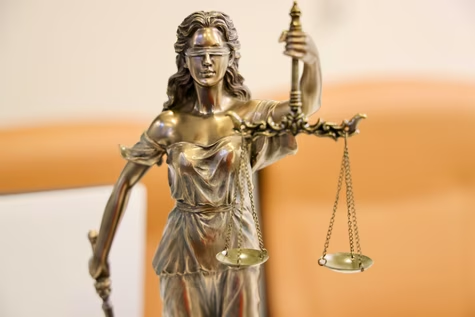
International mechanisms such as the International Criminal Court, specialised tribunals, the UN Security Council, universal jurisdiction, treaties, and conventions are designed to uphold international standards and eliminate impunity. These tools, however, often fail to hold the worst offenders accountable due to a lack of central enforcing bodies, their voluntary nature, state sovereignty, geopolitical rivalries, slow and costly proceedings, lack of political will, and immunity doctrines.
The 1949 Geneva Conventions are four international treaties ratified by all 196 states and form the foundation of modern International Humanitarian Law (IHL). IHL is in place to regulate the conduct of armed conflict; it covers everything from what constitutes a lawful target, the treatment of prisoners and injured people, and even the testing of new weapons.
The Rome Statute is the international treaty that established the International Criminal Court (ICC) in 1998. It entered into force in 2002 to prosecute individuals for grave international crimes, including genocide, war crimes, crimes against humanity, and the crime of aggression.
The states that have signed and ratified it are under an obligation to arrest those wanted by the ICC. Despite this, several opportunities to arrest Vladimir Putin and Benjamin Netanyahu have been overlooked. Arrest warrants have far-reaching political consequences, but it is doubtful that either of them will ever face trial.
As of early 2026, over 120 countries are parties to the Rome Statute, but several major nations are missing, including the U.S., China, Russia, India, Israel, Pakistan, Iran, Iraq, Türkiye, Yemen, Qatar, Syria, and Libya. These countries do not recognise the ICC's jurisdiction, and coincidentally are the ones enjoying impunity, while citizens suffer under the grips of war, rights violations, and sliding democracies.
Forms of High-Level Impunity
UNCHECKED GOVERNMENTAL POWER - Governments must be transparent and accountable to their citizens within all their political processes. An accountable government will demonstrate institutional strength, a fair and efficient justice system, effective regulation, and adherence to the rule of law. There must be constraints on governmental power. Elections must be fair, allow the participation of all members of society, and be free from external intervention.
ABUSE OF HUMAN RIGHTS - Citizens must be protected from abuses by the state's adherence to human rights obligations. A nation free from rights violations will have respect for civil rights and legal protections. It must have constraints on the use of torture, capital punishment, political terror, and forced disappearances. All citizens are entitled to equal treatment without discrimination and have a right to life and security.
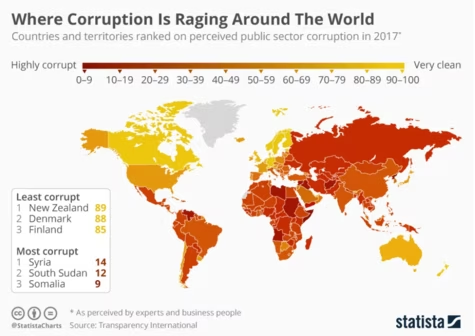
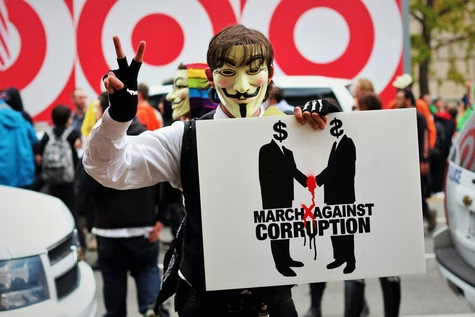
ECONOMIC EXPLOITATION & CORRUPTION - States must exhibit an economic framework which ensures government integrity, zero corruption, property rights, and fair working conditions. There should be no tolerance for class-based discrimination or labour exploitation. The government should have policies in place to work towards eradicating poverty, hunger, extreme income inequality, child labour, and modern slavery. The misappropriation of public resources by high-level officials must be dealt with in a transparent, accountable manner, with legal consequences.
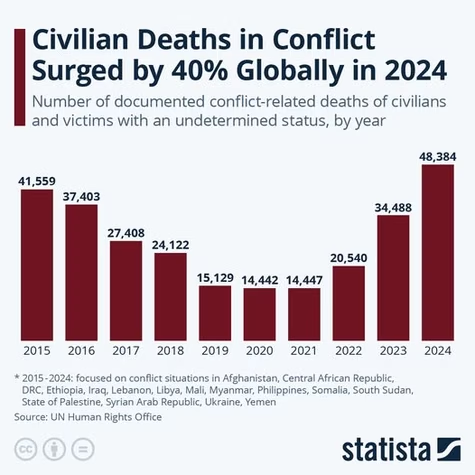
CONFLICT & VIOLENCE - Citizens experience impunity through violent events such as armed conflict, riots, and police brutality. Citizens always suffer the worst consequences of violence as their homes, communities, livelihoods, families, education, and basic services are torn apart. Whilst conflicts are allowed to rage for decades, humanitarian crises take hold, women and children's safety is taken away, partner violence spirals, famine, disease, and poverty spread, and the numbers of refugees, asylum seekers, and internally displaced people become unmanageable.
Impunity Through History
-
The Armenian Genocide (1915–1917): After the Ottoman government systematically erased its Armenian population, many of those responsible escaped international justice. Some even went on to hold political and military leadership roles in the newly formed Republic of Turkey.
-
The Jewish Holocaust (1939–1945): The Nuremberg Trials successfully prosecuted high-ranking Nazi officials, but left thousands of other perpetrators, such as guards, administrators, and Nazi scientists, to live out their lives without consequence.
-
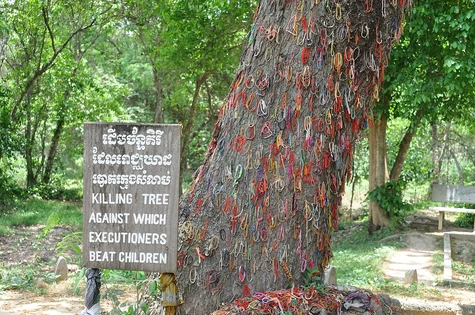
The Khmer Rouge, Cambodia (1975–1979): In an attempt to rid the country of Western influence and create a 'year zero', this brutal regime marched Cambodians in their millions to labour camps where they were subjected to forced labour, physical abuse, torture, malnutrition, disease, and ultimately mass execution. Despite killing nearly a quarter of the country's population, legal action through international tribunals was delayed for decades, allowing many of the leaders to die of old age before ever facing trial.
-
The Rwanda Genocide (1994) - Over 800,000 members of the Tutsi community and political opponents were killed in just 100 days by Hutu extremists. They took thousands of women to be used as sex slaves. These horrific crimes took place with little international intervention, and even though the International Criminal Tribunal for Rwanda (ICTR) was established, many perpetrators had already fled to neighbouring countries.
-
The Bosnian Genocide (1992–1995): The Bosnian war erupted following the breakup of the former Yugoslavia. In July 1995, the Bosnian Serb army overran Srebrenica and brutally murdered 8,000 Bosnian Muslim men and boys. It then took over a decade to arrest key figures like the president of Republika Srpska, Karadžić and military officer Mladić. It eventually led to the creation of the International Criminal Tribunal for the former Yugoslavia, but it clearly demonstrated the slow pace of international justice.
-
Pinochet's Chile (1973–1990) - Pinochet's military junta was responsible for thousands of forced disappearances, tortures, and murders during his military leadership. Despite international efforts, Pinochet escaped trial and lived out his days in relative freedom in Chile for years after his rule ended.
-
The Annexation of Crimea by Russia (2014) - Although the international community widely condemns and does not recognise the annexation, and it is recognised as a breach of international law, Russia was never held accountable for its actions and has since continued its reign of impunity with the 2022 invasion of Russia.
-
The Sudan Conflict (2003 - ongoing): The former Sudanese President Omar al-Bashir was given an arrest warrant by the ICC for genocide and crimes against humanity in 2009, but has travelled internationally with impunity for years. His only punishment came in 2019, when he was convicted of corruption and sentenced to two years in a reform facility in Sudan.
-
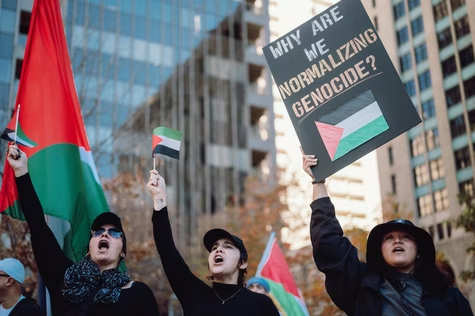
Netanyahu, the Israeli Government & IDF - Amnesty International, the Palestinian Center for Human Rights, the Al-Mezan Center for Human Rights, the Center for Constitutional Rights, Francesca Albanese, the UN special rapporteur on the situation in Palestine, and 14 countries have all officially concluded that Israel is committing genocide. The ICJ ruling on January 26, 2024, stated that Israel must take all measures to protect civilians and avoid genocide. Netanyahu rejected the charge and continued with the bombardment and blockade of Gaza. Western governments, corporations, the media, the arms industry, and institutions are all complicit.
-
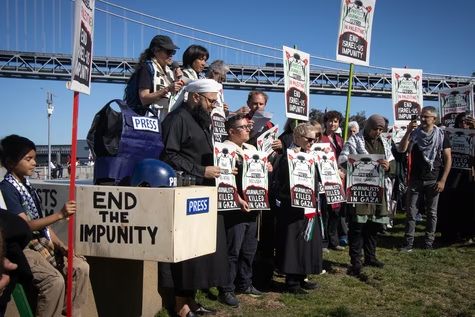
Attacks Against Journalists - Since 1993, more than 1,700 journalists have been killed for bringing truth to the public. Killers go unpunished in nine out of ten cases. Other ways to silence the press include widespread intimidation, harassment, torture, kidnapping, and unlawful surveillance, all of which again continue unabated. Although this epidemic is a global issue, almost half (43%) of the journalists murdered in the past 12 months were killed in Gaza by Israeli armed forces.
Other examples of impunity include Nixon and Kissinger's actions in Cambodia, Chile, and Bangladesh, Blair and Bush in the 2003 Iraq War, former Syrian President Bashar al-Assad for atrocities in the Syrian Civil War, and Donald Trump for his attacks on Venezuela and Iran.
*****
Addressing impunity requires a concerted effort to strengthen international legal frameworks and ensure that violators face real consequences in a timely manner. We must begin to address the root causes of impunity and establish the rule of law not only as the norm but also as a set of principles against which nations are held accountable.
Impunity Watch is a nonprofit organisation based in the Netherlands which was founded in 2008. They work with victims to help combat systematic impunity, deliver redress, and promote justice and peace. They work to empower local communities in post-conflict areas to seek accountability for atrocities. By doing so, justice and accountability will become the norm as those in power realise they cannot act without repercussion.
Transformative justice is the exact opposite of impunity. We must now allow this rising tide of impunity to continue to shake global justice and set the precedent for future abuses.
International law needs robust enforcement mechanisms and unwavering commitment from the global community to ensure that no one is above the law, once and for all. The fight against impunity is a fight for a just and equitable world.
"Accountability matters – not only because it provides justice for victims and punishment for perpetrators. It matters because ending impunity is central to ending genocide," - UN High Commissioner for Human Rights Michelle Bachelet
Author: Rachael Mellor, 01.03.26 licensed under CC BY-SA 4.0
For further reading on Impunity see below ⬇️
More Resources
Curated Directory & Deep-Dive Resources on Impunity
- Civil Rights Defenders - Global Initiative Against Impunity 505336
- Anti-Impunity Fund 234280
- Impunity Watch - Journal 109065
- MSF - Impunity 505347
- EU Day against Impunity - 23rd May 234242
- Impunity - Wikipedia 109064
- Immunity for State Officials - Wikipedia 109067
- International Criminal Court (ICC) 234259
- Amnesty - International justice 505345
- YouTube search - impunity in geopolitics 501089
- YouTube search - impunity for international crimes 501091
- Open Global Rights - From impunity to justice and back again in Guatemala 234248
- Podcast: Ending impunity for global crimes - International Bar Association 234243
- TRIAL (Track Impunity Always) 234256
- Universal Jurisdiction - Wikipedia 109066
- UN - The role of the International Criminal Court in ending impunity and establishing the Rule of Law 234239
- Advocates Against Impunity: A case study on human rights organizing in Guatemala - WOLA 234278
- Denialism - Wikipedia 501081
- Accountability versus impunity - LA Progressive 234266
- Google Scholar - impunity for international crimes 501090
- International Day to End Impunity for Crimes Against Journalists (IDEI), November 2 - Wikipedia 501082
- The Global Epidemic Of Violence In An Age Of Impunity - TFF 12.05.26 516383
- Global impunity fueling Israel’s unlawful annexation measures in the West Bank - Amnesty 26.02.26 510991
- The Death of Law: Israel’s Permanent State of Exception is a Warning to the World - PC 12.02.26 509881
- Losers of the world - unite! - FPIF 14.01.26 505328
- The UN must step up as a multilateral force again, or bow to Trump’s world order - The Observer 09.01.26 505326
- UN report Repression and impunity impacting right to participation in leadup to elections UN Human Rights Spokesperson Marta Hurtado comments - OHCHR 09.01.26 505331
- Ushering in the age of impunity: Venezuela, Palestine, and the end of international law - 07.01.26 505335
- Ushering in the age of impunity: Venezuela, Palestine, and the end of international law - MR Online 07.01.26 505334
- Politics of Impunity - NLR 07.01.26 505318
- The ICC, Non-Cooperation and the Cost of Impunity in Libya: Lessons from 2025 - Coalition for the ICC 06.01.26 505418
- The world needs to ensure leaders are not immune from criminal prosecution - The Globe and Mail 02.01.26 505333
- Welcome to our age of impunity – where the ICC prosecuting atrocities is a rare feat - Guardian 14.12.25 505325
- ICC: Defying impunity - Civicus 11.12.25 505426
- A World Without Accountability: The Global Leadership Integrity Crisis - Medium 07.11.25 505351
- Podcast: Holding World Leaders Accountable - Justice Matters 03.11.25 505341
- Study: Mechanisms of international justice to fight impunity - Europarl 11/25 505425
- Video: Israel is “drunk on Western impunity” - Al Jazeera 18.09.25 505437
- The fine line between presidential impunity and rule of law - Diplomatic Courier 02.09.25 505337
- Why the laws of war are widely ignored - Economist 05.08.25 505435
- When power shields atrocity: rethinking justice in a multipolar world - BSG 23.07.25 505416
- Are we witnessing the death of international law? - Guardian 26.06.25 505434
- Global: Leaders must unite to resist all who undermine the international legal order, in Ukraine and beyond - Amnesty 26.03.25 505324
- Video: Combatting Impunity: Holding World Leaders Accountable - Chicago Council on Global Affairs 25.02.25 505323
- Report: The Atlas of Impunity 2024 A People’s Perspective - Security Conference 02/25 505319
- The Slowdown in Enforcing International Law - Arab Center DC 29.01.25 505436
- How to Hide a Genocide: Modern/Colonial International Law and the Construction of Impunity - T&F 22.01.25 505344
- Ending impunity: Advancing accountability for heads of state at the ICC - Redress, 2025 505420
- Gaza impunity a Western 'moral failure': Italian expert - AA 10.12.24 505438
- Law School on Law, Justice, and Human Rights - UN Office of the High Commissioner for Human Rights 18.11.24 441822
- Video: ‘Genocide is only possible because of impunity’: Palestine’s UN envoy - Al Jazeera 29.10.24 505343
- UN Chief: World Has Entered “Age of Impunity” as Israel’s Aggression Spreads - Truth Out 24.09.24 505330
- Rise in Impunity Worldwide ‘Politically Indefensible and Morally Intolerable’, Secretary-General Says as General Assembly Begins Annual High-Level Debate - UN 24.09.24 505317
- Holding Leaders Accountable Is an Essential Feature of Democracy - Brennan Center 23.04.24 505338
- A chance for Africa to counter the pitfalls of international criminal justice? - Amnesty 22.04.24 505419
- Why the United Nations is impotent in the face of genocide — and what needs to change - Analyst News 04.04.24 505431
- Fighting Impunity: International Criminal Court President Describes Triumphs and Challenges - UC Berkeley Law 13.10.23 505417
- World leaders and war crimes: A historic lack of accountability - Michigan Daily 05.04.23 505327
- Here's when other countries have charged former leaders - PBS 03.04.23 505352
- Holding World Leaders Like Trump Accountable Is Democratic - Time 23.03.23 505350
- The Atlas of Impunity is here – and the rankings may surprise you - Kofi Annan Foundation 17.02.23 505322
- Wagner Group Operations in Africa: Trends in Targeting Civilian Populations in the Central African Republic and Mali (August 30, 2022) - Armed Conflict Location, Event Data P… 302916
- Briefing: 'The state of impunity in the world' Summary of the 2021 report on global rights by Fight Impunity - Europarl, 2022 505321
- The UN anti-impunity framework: A critical appraisal - UN Today 08.04.21 505430
- Colombia’s peace tribunal issues a crushing judgment against the FARC - The Economist 06.02.21 234264
- Sri Lanka’s UN efforts to stave off justice for war crimes - Just Security 03.02.21 234262
- DPR Korea: Impunity prevails in prisons, amid potential ‘crimes against humanity’ - UN News 02.02.21 234261
- Central African Republic: Rights expert welcomes transfer of war crimes suspect to ICC - UN News 27.01.21 234260
- Trump’s impunity reflects the impunity of the entire class of American elites - Jacobin 05.01.21 234265
- The overseas impunity bill - Prospect 14.12.20 234282
- Why can politicians so easily dodge accountability for their mistakes? The troubling answer: because they can - Conversation 03.12.20 505415
- Seven years of impunity for war crimes. What should Ukraine do? - Center for Civil Libereties 01.12.20 234253
- Australia confronts its war crimes in Afghanistan: Britain should do the same - Open Democracy 23.11.20 234277
- Nepal stalling prosecutions on war crimes - Al Jazeera 20.11.20 234271
- ICC prosecutor tells UN Security Council to stop impunity - Info Migrants 16.11.20 234275
- Watch: Seven years of impunity for war crimes. What should Ukraine do? - Ukraine Crisis Media Center 12.11.20 234249
- 10 years after Iraq war logs, it's impunity for war criminals, war on whistleblowers - CD 22.10.20 234272
- UK getting dangerously close to providing impunity for war crimes - ASPI 21.10.20 234254
- UK Parliament must not introduce impunity for war crimes, say UN experts - OHCHR 05.10.20 234246
- Democratic Republic of Congo: Take concrete steps to end impunity - Amnesty 01.10.20 234273
- UK seeks to stop justice for war crimes - HRW 23.09.20 234270
- What is the future of the UN in the age of impunity? - Guardian 23.07.20 234274
- ICC oversight chief ‘deeply regrets’ US decision to target officials investigating Afghanistan war crimes - UN News 13.06.20 234269
- Fifth EU Day Against Impunity for genocide, crimes against humanity and war crimes - Coalition for the ICC 26.05.20 234240
- Increase in cumulative charges for terrorism and war crimes - Eurojust 23.05.20 234268
- COVID-19: No excuse for impunity for those convicted of crimes against humanity - OHCHR 29.04.20 234247
- Closing the “Impunity Gap” and the Role of State Support of the icc - Brill 09.04.20 505421
- War crimes, torture and impunity - Open Democracy 11.01.20 234244
- ‘Violence, atrocities and impunity’ reign throughout Libya, ICC prosecutor tells UN Security Council - UN News 06.11.19 234276
- The New Arrogance of Power: Global Politics in the Age of Impunity - IRC 19.06.19 505332
- Doha conference seeks to address impunity for war crimes - Al Jazeera 15.04.19 234257
- Saving Guatemala’s fight against crime and impunity - International Crisis Group 24.10.18 234279
- The Observer view on politicians who refuse to accept blame - Inkl 19.08.18 505349
- The politics of impunity: A study of journalists’ experiential accounts of impunity in Bulgaria, Democratic Republic of Congo, India, Mexico and Pakistan - Sage 05.06.18 505320
- The trouble with impunity: War crimes and a humanitarian agency - Conversation 22.04.18 505432
- ‘Pervading toxic culture of impunity’ for alleged war crimes at root of Darfur conflict - UN News 08.06.17 234281
- Can A Leader Who Accepts No Responsibility Lead? - Forbes 27.03.17 505353
- A 10-point guide to responsible leadership in the age of populism - WEF 12.01.17 505339
- The international criminal court is vital to our fight against impunity in Africa - Guardian 17.07.16 505427
- Immunity = impunity - Coalition for the ICC 29.01.15 505329
- International Court of Justice (ICJ) @ UN
- International Criminal Court - ICC
- International Day to End Impunity for Crimes Against Journalists - November 2
- Benjamin NETANYAHU (Israel) & Likud
- Netanyahu Government Accountability
- Blair's War Lies ! - confirmed
- RACISM / Xenophobia
- Autocracy
- The Pinochet Case !