
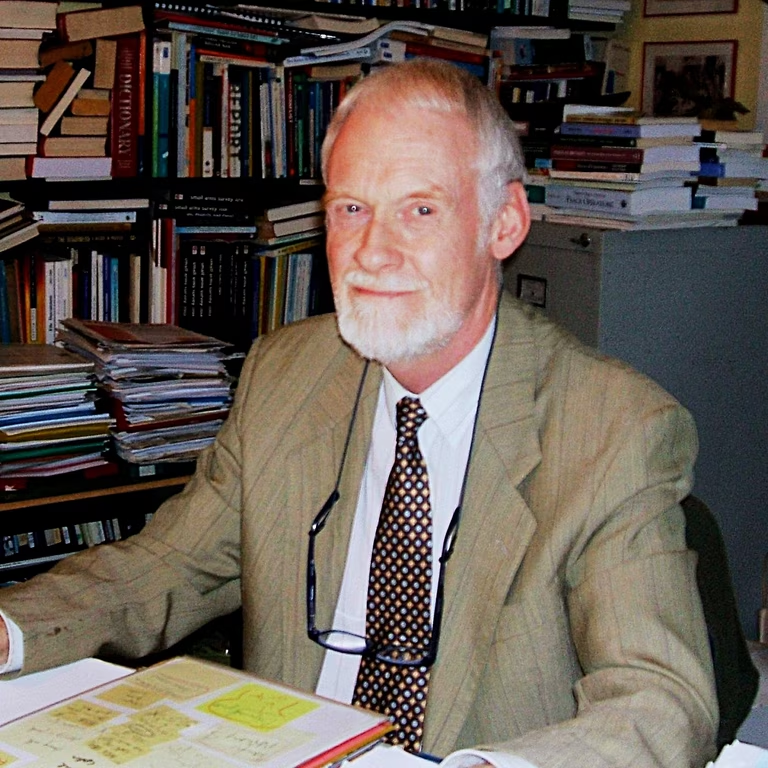
Colin Archer (UK)
Discover the life and legacy of Colin Archer, the long-serving IPB Secretary-General. Learn about his global work in disarmament and peace advocacy.
Profile of ➡️ Colin Archer
Colin Archer, a prominent advocate for global peace, served as the Secretary-General of the International Peace Bureau (IPB) from 1990 to 2017.
His leadership was marked by a steadfast commitment to disarmament and fostering international cooperation to resolve conflicts peacefully. Archer's tenure at the IPB was characterized by significant achievements in promoting global peace initiatives and raising awareness about the importance of reducing military expenditures.
We need to move the money from the military to the social and environmental sectors - Colin Archer
Born in the United Kingdom, Archer's early life was influenced by the values of social justice and humanitarianism. He pursued studies in modern languages and teaching, and in social science (development studies), equipping him with a deep understanding of global issues. Before joining the IPB, Archer was actively involved in various non-governmental organizations, where he worked on issues related to nuclear disarmament, human rights, and sustainable development.
As Secretary-General, Archer played a crucial role in revitalizing the IPB, expanding its reach and influence on the international stage. He was instrumental in organizing campaigns against the proliferation of nuclear weapons and advocating for the reallocation of military budgets towards social development programs. Under his guidance, the IPB became a leading voice in international forums, influencing policy decisions and fostering collaborations with other peace organizations.
Archer's strategic vision was evident in his efforts to engage with policymakers, governments, and civil society. He emphasized the importance of dialogue and diplomacy as tools for conflict resolution. His leadership style was characterized by inclusivity and collaboration, bringing together diverse stakeholders to work towards common goals. Archer's ability to navigate complex geopolitical landscapes made him a respected figure in the peace movement.
Education and awareness-raising were central to Archer's mission. He believed that informed citizens were essential for achieving lasting peace. To this end, he championed initiatives that promoted peace education, encouraging dialogue across cultural and national boundaries. His efforts were instrumental in building a global community of peace advocates, united in their pursuit of a more harmonious world.
Beyond his work with the IPB, Archer was a prolific writer and speaker. His contributions to publications and forums on peace and disarmament reflected his deep conviction in the power of diplomacy. Archer's eloquence and clarity made him a sought-after voice in discussions on international security and peacebuilding.
After retiring from the IPB in 2016, Archer continued to be active in the peace movement, offering his expertise and insights to various initiatives. His legacy is one of resilience and hope, inspiring countless individuals and organizations to persist in their efforts to create a world where conflicts are resolved through negotiation rather than violence.
Colin Archer's impact on the IPB and the broader peace movement is a testament to the power of dedicated leadership. His life's work serves as a reminder of the importance of perseverance in the face of adversity and the enduring belief that a better world is possible through collective action and understanding. His contributions to the cause of peace have left an indelible mark, inspiring future generations to continue the pursuit of a more peaceful and just world.
You cannot build a sustainable future on a foundation of weapons - Colin Archer
Author: Dr. Norbert Stute with the help of ChatGPT 4.0, fact-checked by Colin Archer, Date: 16.01.26, licensed under CC BY-SA 4.0
IPB awards Sean MacBride Peace Prize 2016 to ➡️ Colin Archer
Tip: Our guide on the International Peace Bureau - ➡️ IPB
Tip: Our guides on GCOMS - Global Campaign on Military Spending
and ➡️ GDAMS - Global Campaign on Military Spending
____________________________________________________
Key writings by Colin Archer:
SUMMARY:
1) A short history of the International Peace Bureau: 1990 – 2017
This features 8 major campaign/programme areas that they worked on during Colin's time at IPB. There is also a useful bibliography and list of Nobel winners.
It is linked to/based on the next two surveys of IPB's work over at least 100 years:
CHAPTERS:
2) HISTORY/LAW: a chapter contributed to the 3rd edition of Nuclear Weapons and International Law, ed. Geoffrey Darnton (Aug. 2020); see: https://nuclearweaponsandinterntionallaw.com, and on
3) HISTORY/MILITARY SPENDING: a chapter contributed to the volume (Nov. 2020) edited by the Global Campaign on Military Spending, entitled Military Spending and Global (in)Security: Militarising conflicts, climate change and people’s lives.
BOOKS:
4) Warfare or Welfare? - Colin Archer and David Hay-Edie, 2005, 96pp. Disarmament for Development in the 21th Century. A human security approach
Warfare or Welfare (pdf) sets out information and arguments that form the basis of our DforD programme. The two main issues addressed are military spending and the effects of weapon systems on development. Translations in French, German and Arabic are available on request.
5) Whose priorities? A guide for campaigners on military and social spending - Colin Archer, 2007, 74pp
Whose-Priorities sketches some approaches to campaigning in opposition to militarism, and offer summary accounts of 18 projects undertaken by civil society groups around the world.
This book is available in Arabic, Catalan, German and Spanish.
6) Opportunity Costs: Military Spending and the UN Development Agenda - Colin Archer and Annette Willi, 2012
IPB wrote a Position Paper entitled Opportunity Costs: Military Spending and the UN’s Development Agenda (pdf). It makes the case that military spending should be taken into consideration in the debate now under way on the UN’s Post-2015 Development Agenda (following on from the Millennium Development Goals). In IPB’s view, militarization is a significant factor in the sustainable development equation, often undermining the security of citizens. At the same time, the massive resources devoted to the military sector could – if even a small portion were reallocated – make a major contribution to meeting the challenges of mass poverty, unemployment and climate change.
7) Disarmament, Peace and Development Vol: 27
Edited by: Reiner Braun (International Peace Bureau, Germany), Colin Archer (International Peace Bureau, UK), Ingeborg Breines (International Peace Bureau, Norway), Manas Chatterji (Binghamton University – State University of New York, USA), Amela Skiljan (International Peace Bureau, Germany) - December 2018, 188 pp
Series: Contributions to Conflict Management, Peace Economics and Development
For further reading on Colin Archer see below ⬇️
More Resources
Curated Directory & Deep-Dive Resources on Colin Archer (UK)
- International Peace Bureau - IPB 513634
- A short history of the International Peace Bureau: 1990 – 2017 513729
- Google Scholar 505201
- GCOMS - UK 512442
- Yorkshire CND 505261
- Movement for the Abolition of War - MAW 505257
- BOOK: Whose Priorities? A guide for campaigners on military and social spending - IPB 2007 *.pdf 513722
- BOOK: Warfare or Welfare? (2005) 513635
- Book: Alternatives to War - Colin Archer et al. 6/25 475394
- VIDEO: War, Law & Cash: Colin Archer on the War in Ukraine - Abingdon Peace Group 5/22 505253
- Webinar: “Defund the military. Defend the people & the planet” - AEPF 5/21 505235
- VIDEO: Colin Archer on International Peace Bureau - ToSaveTheWorld 12/20 505239
- Video: Interview to Colin Archer on the occasion of the 7th edition of GDAMS 11/20 505246
- Disarmament, Peace and Development Vol: 27 - IPB 12/18 513723
- Fact Check: Has the media ignored good news about Jeremy Corbyn? - Channel 4 News 12/17 505236
- Video: GDAMS 2017 - Interview to Colin Archer 4/17 505245
- IPB awarded Sean MacBride Peace Prize 2016 to Colin Archer - IPB 192600
- IPB to award Sean MacBride PEACE PRIZE 2016 to Colin Archer - IPB 21.10.16 (Archive) 505238
- 'Peace is possible' - says Colin Archer Int'l Peace Bureau Secretary General - Ed News 5/16 475393
- Video: How much are we spending on War? - Act Local Think Global 5/15 505256
- Video: IPB Secretary General Colin Archer responding to President Higgins at Sean MacBride Peace Prize 2012 12/12 505255
- Colin Archer‘s Page - Peace and Collaborative Development Network 78061
- Doubts cast on democracy of Myanmar vote 11/10 78063
- Whose Priorities? - A guide for campaigners on military and social spending (2007 by Colin Archer) 78062
- YouTube Search 505237
- Google Images 78064
- BELOW you find RELATED LINKS in blue 518074
- International Peace Bureau - IPB
- Sean MacBride Peace Prize
- The GDAMS Campaign - divest from war
- GCOMS - Global Campaign on MILITARY SPENDING
- IPB World Congress: Disarm! - Berlin 2016
- LIBYA
- AFGHANISTAN
- IRAQ
- International Criminal Court - ICC
- SMALL ARMS : 90 % of victims in wars since 1945
- Hague Appeal for Peace 1999
- EUROFIGHTER
- 9/11 Attacks & the WAR on terror
- ARMS TRADE = the business of death
- DISARMAMENT
- LandMINES
- Peace EDUCATION
- CND (UK)
- BRITAIN - Politics
- Refugees / Migrants
- Nuclear Disarmament
- World COURT Project 1996
- Women & Peace