Culture of Peace
Culture of Peace: Explore reports on progress, obstacles, and global movements for a peaceful future. Discover nonviolence and conflict resolution.
➡️ BUILDING A CULTURE OF PEACE – Global Movement Prioritising Non-violence & Respect for Human Rights
Devastatingly, 2 billion people — a quarter of humanity — live in areas affected by violent conflict. The world is currently experiencing the highest number of armed conflicts since 1945. With global military expenditure reaching new highs of $2.7 trillion in 2024, military-first approaches are increasingly the norm.
Building a culture of peace offers an alternative approach, avoiding the suffering of millions and widespread destruction that we have become so familiar with seeing.
"Peace is not an absence of war, it is a virtue, a state of mind, a disposition for benevolence, confidence, justice." - 17th-century Dutch philosopher Baruch Spinoza
It emphasises the importance of dialogue over aggression, collaboration over conflict, and tolerance over violence. In a society built upon peace, differences are celebrated, and diversity is valued. Education plays an essential role in promoting empathy and a respect for human rights.
For a culture of peace to survive, society must be built upon strong foundations of justice, equality, transparency, and integrity.
Jump straight to our resources on building a ➡️ Culture of Peace
Explore our comprehensive guides on -
-
Peace Movements & NGOs
UNESCO & The Culture of Peace
The United Nations Educational, Scientific and Cultural Organisation has promoted peace since 1992, when it began its Culture of Peace Programme. Just before the International Year for the Culture of Peace started in 2000, the United Nations General Assembly adopted the Declaration and Programme of Action on a Culture of Peace.
They identified eight areas of action that "have been priorities of the United Nations since its foundation; what is new is their linkage through the culture of peace and non-violence into a single coherent concept." The declaration works to connect all of these separate issues for the first time and highlights their importance in achieving a culture of peace.
The eight action areas include:
-
Building a culture of peace through education
-
Sustainable economic and social development
-
Respect for all human rights
-
Equality between women and men
-
The democratic participation of everyone
-
Understanding, tolerance, and solidarity
-
The free flow of information and knowledge
-
International peace and security
The UNESCO Manifesto 2000 for a Culture of Peace and Non-violence asked individuals to make a pledge to promote non-violence and sustainability "in my daily life, in my family, my work, my community, my country and my region." It is a series of commitments which help us all work towards creating solidarity, peace, and respect in our daily lives. The manifesto was translated into more than 50 languages and was signed by over 74 million individuals.
The 8 Pillars of Positive Peace
Positive Peace is a concept developed by the Institute for Economics & Peace (IEP). It describes the necessary conditions for peace and society to flourish and provides a theory of social change. It also highlights the fact that once peace is established, society reaps additional benefits such as higher GDP growth, improved well-being, and greater resilience.
By analysing global data, the Positive Peace Index (PPI) measures societal resilience across 163 countries, covering 99.7% of humanity. The index defines and measures the many factors that help build peaceful societies, as well as the drivers of violence and conflict.
The pillars are as follows:
1. Well-Functioning Government -
Effective governance means that rules are applied fairly and openly. A government must foster transparency and be responsive and accountable to citizens. They must also promote trust and stability.
2. Equitable Distribution of Resources -
Fair distribution of resources reduces social disparities and promotes inclusivity and harmony. Equitable access to essential services such as education, healthcare, and economic opportunities creates a society where humans can reach their potential.
3. Free Flow of Information -
Trustworthy, timely information supports transparency in governance and informed decision-making by citizens. Access to information without bias or influence builds trust and understanding, reduces misinformation, and helps prevent conflicts.
4. Good Relations with Neighbours -
Strong, positive relationships with local and international neighbours enhance community bonds, mutual support, and cooperation. Better-connected societies tend to be much more tolerant and peaceful.
5. High Levels of Human Capital -
A well-educated, skilled population supports growth, resilience, stability, and prosperity. Investment in education enhances economic productivity, civic engagement, and social cohesion.
6. Acceptance of the Rights of Others -
Inclusivity and mutual respect occur when everyone's rights are respected, accepted, and protected. Embracing diversity and protecting human rights creates a solid foundation of trust and cooperation.
7. Low Levels of Corruption -
Corruption erodes trust, integrity, and transparency. Without these things, peace can not hope to thrive.
8. Ethical Business -
A fair and stable business environment supports the economy, reduces inequalities, and lowers the risk of conflict.
*****
Cultivating a Culture of Peace has never been more important. As of January 2026, the Doomsday Clock was moved its closest ever to midnight - 85 seconds to midnight.
Three conflicts, all involving nuclear states, put the planet on the brink of disaster in 2025. India and Pakistan clashed in May, the Russian invasion of Ukraine continues, and in June, Israel and the U.S. attacked 3 nuclear facilities in Iran. The Bulletin of the Atomic Scientists have labelled this a massive failure of leadership.
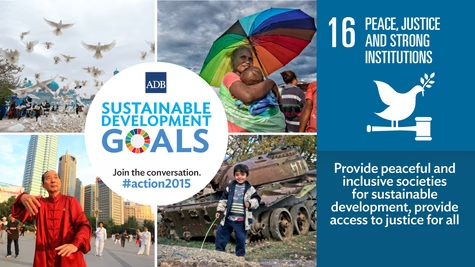
Sustainable Development Goal 17, 'Peace, Justice, and Strong Institutions,' highlights the importance of peaceful and inclusive societies for sustainable development and justice. Progress towards meeting the goal, however, is critically off-track. None of its 23 targets are currently on track to be met by 2030, and 15% are actually regressing.
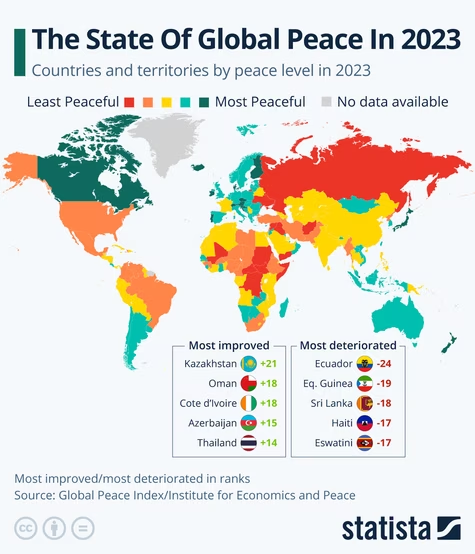
On a positive note, several countries have already embraced the culture of peace, including Iceland, Austria, New Zealand, Singapore, and Malaysia. These countries repeatedly take the top spots in the Global Peace Index and are shining role models for how it is done.
We must continue to fight against war machines, autocratic leaders, greed, corruption, imperialism, forever wars, oppression, racism, and colonialism. There is another way. We must start creating environments where individuals and communities can thrive in harmony and stability.
"Peace cannot be kept by force; it can only be achieved by understanding" - Albert Einstein
Author: Rachael Mellor, 03.02.26 licensed under CC BY-SA 4.0
For further reading on the Culture of Peace see below ⬇️
More Resources
Curated Directory & Deep-Dive Resources on Culture of Peace
- UNESCO - Documents & Resources on the Culture of Peace 505025
- General Assembly of the UN - Culture of peace 505027
- World Report on the Culture of Peace and Youth for Culture of Peace 80232
- Progress and Obstacles as seen by International Organizations 80233
- Advice to the Secretary-General and the General Assembly 80234
- Building 'The Culture of Peace' - Early Childhood Peace Consortium 505029
- Civil Society Report at Midpoint of Culture of Peace Decade 80235
- International Day of Peace - Building a culture of peace 505022
- Civil Society Report at Midpoint of Culture of Peace Decade *pdf 80236
- World Beyond War - Category: Culture of Peace 301972
- Peace Pledge Union - Culture of Peace 505024
- Culture of Peace - Wikipedia 505023
- Cultivating a Culture of Peace in the Nakivale Refugee Camp - WBW 01.02.26 508864
- Cultivating a culture of peace - UNDP 20.09.24 505026
- Cultivating a Culture of Peace - Education Cannot Wait 20.09.24 505028
- Cultivating a Culture of Peace: Local Actions for Global Impact - Vision of Humanity 20.09.24 505031
- 6 young leaders explain how they're building a culture of peace through inclusion and participation - WEF 16.05.23 505033
- Building a Culture of Peace in Everyday Life With Inter- and Transdisciplinary Perspectives - Frontiers In 23.06.22 505030
- Ten Practical Ways to Build Peace in Your Life and in the World Around You - Everyday Peacebuilding 10.03.20 505032
- Handbook on building cultures of peace - APA, 2009 505034
- Youth for Alliance of Civilizations:*pdf 80237