
Other Sustainability Frameworks
Explore key sustainability frameworks that help address global resource use, promote emission reductions, and support sustainable practices.
➡️ SUSTAINABILITY FRAMEWORKS - Alternatives to Earth Overshoot Day
Earth Overshoot Day is widely praised for raising public awareness of sustainability, but it faces significant scientific and methodological criticism from environmental scientists, economists, and think tanks such as The Breakthrough Institute.
Earth Overshoot Day marks the date when humanity’s demand for ecological resources in any given year exceeds what Earth can regenerate in that same year. In 2025, this date was July 24th, indicating that humanity is using resources 1.8 times faster than ecosystems can replenish them.
Its methodology is criticised for being overly reliant on carbon emissions, using overly simplified carbon metrics, and consolidating multiple complex environmental issues. This generalisation and compromise in pressure has led researchers and international bodies to seek out alternative, peer-reviewed sustainability frameworks.
Jump straight to our resources on ➡️ Sustainability Frameworks
Explore our comprehensive guides on -
- Sustainability
- Earth Overshoot Day & Criticism
- The Sustainable Development Goals
- Doughnut Economics
- The Climate Crisis & Tipping Points
- Environment & Nature
- ESG - Environmental, Social & Governance
Below, we detail some of the most important sustainability guidelines that can be used by governments, organisations, and even individuals. They provide the overarching principles and structures to help identify, manage, and communicate their environmental, social, and governance (ESG) impacts.
*****
The Planetary Boundaries Framework
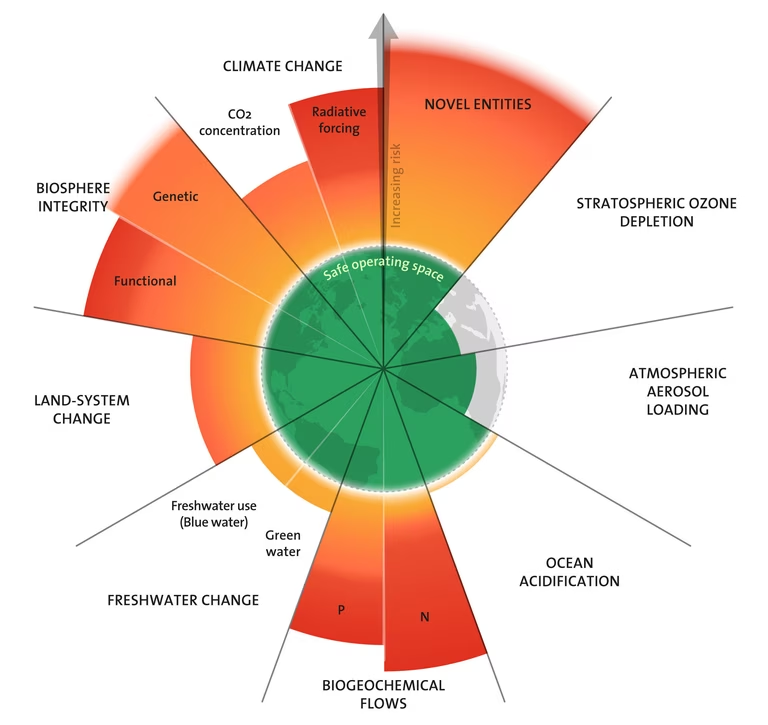
Developed by the Stockholm Resilience Centre, this framework abandons the idea of a single calendar date. Instead, it measures human pressure on nine critical Earth systems that support life on the planet.
Exceeding a defined boundary triggers a "danger zone" of potentially irreversible environmental collapse. We are now at the point where human activities have pushed Earth beyond its Safe Operating Space. To safeguard the Earth's resilience and stability, this framework states that we must bring the planet back into its Planetary Boundaries.
The nine critical processes are as follows:
- CLIMATE CHANGE (Breached) - Disruption to the Earth's energy balance, primarily through the release of greenhouse gas emissions.
- BIOSPHERE INTEGRITY (Breached) - Loss of species, ecosystems, and ecological functions that sustain and regulate the overall state of the Earth.
- LAND SYSTEM CHANGE (Breached) - The transformation of forests, grasslands, and other natural areas through deforestation, agricultural expansion, and urbanisation.
- FRESHWATER USE (Breached) - Disruptions to global surface and groundwater cycles that regulate the climate, maintain ecosystems, and support the fundamental conditions required for people and societies to thrive.
- BIOGEOCHEMICAL FLOWS (Breached) - The disruption of nutrient cycles that regulate soil fertility and the health of water ecosystems, through excessive fertiliser use and pollution.
- OCEAN ACIDIFICATION (Breached) - Increasing carbon dioxide absorption is making the oceans more acidic, threatening marine ecosystems and their inhabitants.
- ATMOSPHERIC AEROSOL LOADING (Safe Zone) - The concentration of fine particles in the atmosphere that influences climate and human health.
- OZONE DEPLETION (Safe Zone) - The thinning of the protective ozone layer that shields life from harmful ultraviolet radiation.
- POLLUTION (Breached) - The introduction of synthetic chemicals, plastics, and other human-made materials into Earth’s systems.
As of September 2025, we officially crossed 7 of the 9 Planetary Boundaries. While breaching boundaries does not necessarily mean immediate catastrophe, it significantly increases the risk of abrupt, potentially irreversible environmental change.
The more we push the limits, the more likely we are to trigger tipping points. Ocean acidification was the seventh planetary boundary to be crossed.
The 2025 Planetary Health Check revealed that since the start of the industrial era, the ocean’s surface pH has experienced a 30-40% increase in acidity. This dramatic change has degraded the oceans’ ability to act as Earth’s stabiliser.
Doughnut Economics
This concept was first published in a report by Oxfam written by Kate Raworth, a self-proclaimed ‘renegade economist’ known for her expertise and rejection of traditional economic thinking. The Doughnut Economic model, for the first time, incorporated human well-being in economic models.
It has gained significant international attention and has even garnered support from the UN General Assembly, Extinction Rebellion, and the late Pope Francis. Her 2017 book “Seven Ways to Think Like a 21st Century Economist” further developed the idea of bringing humanity into the Doughnut.
Her book became an international bestseller and has been translated into over 20 languages, helping shift the economic conversation and shape sustainability policy.
No country has fully adopted Doughnut Economics at a national level, but over 50 local governments worldwide have adopted the framework to guide their policies.
Amsterdam adopted the Doughnut as its official framework for post-COVID economic recovery. Local governments in the UK, Belgium, Sweden, Spain, Mexico, Malaysia, and Australia have also formally integrated the framework.
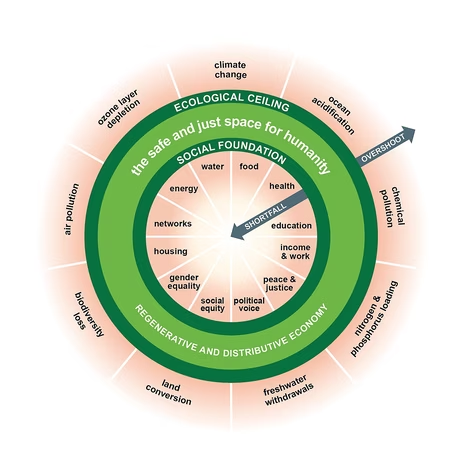
The Doughnut of Social and Planetary Boundaries offers a visual monitor of progress towards the goal of meeting the needs of all people whilst staying within the planet's boundaries. Rather than just tracking depletion, it seeks a balance between economic necessity and ecological limits.
The model consists of two concentric rings:
- ECOLOGICAL CEILING (The Outer Ring) - This is comprised of 9 planetary boundaries. Staying within the limits of this ring ensures that humanity does not destabilise the life-supporting systems that sustain all life on Earth.
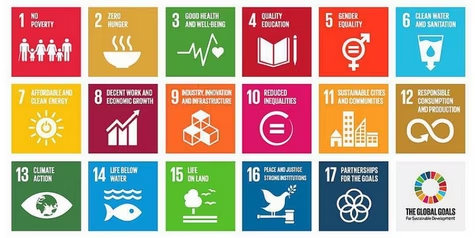
- SOCIAL FOUNDATION (The Inner Ring) - This consists of 12 basic human requirements adapted from the UN Sustainable Development Goals (e.g., food, water, housing, healthcare, equality). If these needs are not met, there is a shortfall which results in human deprivation, where many people are left behind.
- THE DOUGHNUT SPACE - Between these two sets of boundaries, there is a doughnut-shaped space. This represents a space which is ecologically safe and socially just, where humanity can thrive without destroying the environment.
Absolute Environmental Sustainability Assessment (AESA)
AESA is an engineering- and life-cycle-based framework designed specifically for businesses and industries at the local level. It evaluates whether the environmental footprint of an activity, product, or organisation is within Earth's ecological capacity.
AESA compares environmental impacts against a scientifically defined, allocated share of global limits, such as the Planetary Boundaries. The goal is to determine if an impact is truly sustainable using these global physical thresholds as guidance.
It can also be used to decipher if current reduction targets are ambitious enough. For example, a company may reduce its carbon footprint by 30%, but then AESA could reveal that a 70% reduction is required to stay within its assigned share of the global carbon budget.
An AESA is carried out in three main phases: the environmental impact estimation, the carrying capacities allocation, and finally the results interpretation.
AESA has attracted significant interest, but the lack of a harmonised and comprehensive framework has inhibited its practical application. In 2025, the Joint Research Centre, the science and knowledge service of the European Commission, created a publication to help provide guidance.
They build on existing environmental accounting guidelines and standards, including the International Life Cycle Data (ILCD) Handbook and the Greenhouse Gas Protocol.
UN Sustainable Development Goals (SDGs)
The SDGs and the 2030 Agenda were adopted by United Nations member states in 2015. The SDGs are centred on 17 goals for sustainable development, with the aim of achieving them by 2030. These goals are universal, apply to all countries regardless of their level of development, and require global cooperation.
These goals are the most widely adopted sustainability framework. They treat sustainability as an interconnected web, where one goal cannot be achieved without achieving the others.
They cover a wide range of social and environmental issues, including the eradication of poverty and hunger, gender equality, clean water and energy, education, climate and environmental protection, access to quality healthcare, decent working conditions, and peace.
Many of the SDGs are seriously behind target, or even in reverse. In fact, we are on track to meet only 15% of targets by 2030. The 2025 SDG Report revealed that progress on 48% of the targets is weak, and 18% have either stalled or actually worsened - a reassessment and expansion of the SDGs is urgently needed.
Many experts claim that the SDG targets are not ambitious enough to bring about the profound changes needed to address deep-rooted, consequential global issues. The environmental goals, in particular the goal of limiting global average temperatures, are simply not enough to prevent the catastrophic consequences of climate change.
Many of the current failings and omissions are down to the unwillingness of states and large companies, which hold the biggest influence, to implement and monitor the goals.
The SDGs remain a vital framework for improving the quality of life for everyone and addressing the planet's most pressing global challenges. They serve as guiding principles for governments, civil society, and the private sector to work together towards a more sustainable and just world.
One Planet Living Framework
This framework was developed by Bioregional, a British charity focused on practical solutions to deliver sustainability. Founded in 1992, their core belief is that overconsumption of resources is the main driver of environmental degradation, and that they can counter this by exploring ways people can meet their needs with local resources.
One Planet Living is the concept that everyone, everywhere can live happy, healthy lives within the limits of the planet, leaving space for nature. The programme was developed in partnership with the WWF and serves as a framework for sustainable community projects.
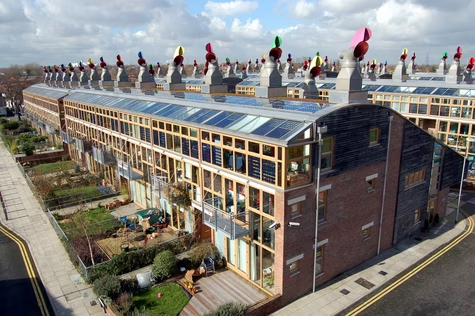
It is based on the success of the UK’s BedZED ecovillage in South London. This was the UK’s first large-scale, mixed-use sustainable community and has become a blueprint for green design, reducing resident utility footprints, and environmentally friendly housing developments around the world.
The framework is comprised of ten simple principles and details goals which are flexible in their nature and designed to inspire creativity and innovation. It has become a powerful tool for target-setting and thousands of organisations across the world have used it to create meaningful change.
The principles include key themes of health and happiness, equity, culture, transport, nature, food, water, materials, zero waste, and zero-carbon energy.
Greenhouse Gas (GHG) Protocol
This is now the world’s most widely used greenhouse gas accounting and reporting tool. It was co-created by the World Resources Institute (WRI) and the World Business Council for Sustainable Development (WBCSD).
It provides a standardised framework for companies, cities, and governments to track their carbon emissions and other greenhouse gases across operations, supply chains, and climate initiatives. It also helps them pinpoint the most impactful areas to cut emissions.
As GHG Protocol standards are internationally recognised, they ensure that efforts to reduce emissions are transparent, credible, and comparable. In 2023, 97% of disclosing S&P 500 companies reported to the Climate Disclosure Standards Board using this protocol.
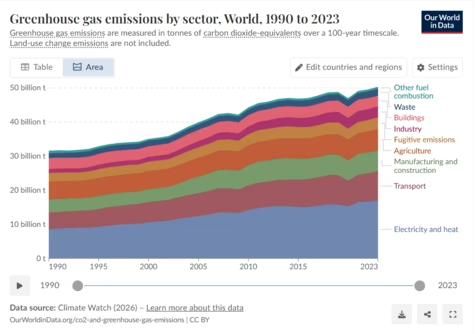
They categorise emissions into three distinct scopes:
- Scope 1 (Direct): Emissions from sources owned or controlled by the company, city, or government.
- Scope 2 (Energy Indirect): Emissions from the generation of purchased or acquired energy (e.g., electricity, steam, heating, and cooling consumed by the business).
- Scope 3 (Value Chain Indirect): All other indirect emissions across the value chain. This includes purchased goods and services, business travel, employee commuting, transportation of products, and the use of sold products.
The GHG Protocol has become more than just a reporting tool. They also provide essential guidance on fossil fuel reserves, agriculture, land use, forests, electricity projects, for the public sector, and for estimating and reporting avoided emissions.
If you can’t measure it, you can’t manage it. This data gives organisations a way to control their carbon footprints and environmental impacts. It also helps prevent carbon-accounting corruption by requiring audits, transparency, and standardised metrics.
Global Reporting Initiative (GRI)
The GRI is an independent not-for-profit organisation that develops frameworks for sustainability reporting. More than 14,000 organisations in over 100 countries use the platform. It is utilised by 73% of the world's top 250 global corporations, making it the world’s most widely used framework for sustainability and ESG reporting.
The GRI supports businesses, governments and other organisations to clearly communicate their environmental impact. GRI differs from investor-focused frameworks that prioritise financial risks over broader environmental, economic, and societal risks.
This initiative has proved particularly useful for tracking and reporting an organisation’s efforts (or lack thereof) to reach net-zero emissions targets. As they use a comparable standardised reporting language, they are especially important for multinational corporations that operate across regions with varying sustainability requirements.
The GRI has a set of universal standards which are required for every report. Sector standards are tailored guidelines for high-impact fields such as oil, gas, mining, and agriculture. Topic standards are then used to report detailed metrics on specific issues such as biodiversity, emissions, and tax transparency.
Conclusions
Sustainability frameworks are essential in our shift towards living in greater harmony with our planet. Experts have long agreed that the endless plundering of our natural resources would risk the health and prosperity of future generations.
These frameworks help to make our broad environmental and economic goals more tangible, as a universal common language for sustainable practices is established.
Sustainability is no longer a wishful concept, but rather a structured, manageable, and measurable goal. They help to identify risks before they develop and help governments and organisations to make informed decisions about how to become more sustainable.
Regulation has made this type of reporting mandatory and has helped to curb corruption, greenwashing, bribes, and harmful business practices by promoting a culture of transparency.
They force organisations to track their ecological and carbon footprints, reduce their emissions, minimise waste, adopt responsible supply chain practices, and drive concrete action.
Author: Rachael Mellor, 01.06.26 licensed under CC BY-SA 4.0
For further reading on Sustainability Frameworks see below ⬇️
More Resources
Curated Directory & Deep-Dive Resources on Other Sustainability Frameworks
- Stockholm Resilience Centre - Planetary Boundaries 516941
- Enviro Pass - ESG vs. Planetary Boundaries 516944
- One Planet Living Framework 516961
- Bioregional - One Planet Living 516962
- Bioregional - One Planet Living Resources 516964
- Greenhouse Gas Protocol 517102
- WRI - GHG Protocol 517103
- Science Direct - Greenhouse Gas Protocol 517104
- Global Reporting Initiative 516948
- Global Reporting Initiative - Wikipedia 517100
- Science Based Targets 516951
- Introduction to the ISSB and IFRS Sustainability Disclosure Standards - IFRS 517098
- International Sustainability Standards Board 517095
- Doughnut Economics Action Lab 516995
- Doughnut (economic model) - Wikipedia 516997
- International Sustainability Standards Board - Wikipedia 517096
- WEF - Key sustainability frameworks and initiatives 516959
- European Commission - Natural capital accounting 516966
- Planetary boundaries - Wikipedia 516953
- IFRS, GRI Expand Collaboration to Align Sustainability Reporting Standards - ESG Today 27.05.26 517101
- Big Tech splits over proposed shake up of clean energy accounting - Reuters 26.05.26 517105
- Two steps back, but three forward for sustainability reporting - Reuters 26.05.26 517097
- The latest GHG protocol proposal raises the bar for “100% renewable” reporting in data centers - DCD 10.05.26 517108
- Climate Reporting is Key to Decarbonization, Says New CEO of Greenhouse Gas Protocol - WSJ 28.04.26 517107
- Journal: Theorising Nature Education Policy Within Planetary Boundaries: A Posthumanist Transformative Governance Framework - Cambridge Core 23.04.26 516988
- Greenhouse Gas Protocol mulls dramatic expansion of emissions accounting - Trellis 14.04.26 517109
- The Doughnut Has a Hole: A Major Empirical Test of Degrowth Framework - The Unseen and The Unsaid 08.04.26 517082
- Allocation and characterisation factors for absolute environmental sustainability assessment - Sciety 26.03.26 517094
- What are planetary boundaries and why on earth should we care? - Sustainability Agency 22.03.26 516950
- Environmental Economic Accounting: Why Nature is Entering the Balance Sheet as GDP Fades - Intellegent Living 13.03.26 516975
- Data measures farms’ true sustainability - La Trobe 19.02.26 516974
- GHG Protocol unveils long-awaited guidance on emissions accounting from land - Edie 02.02.26 517106
- Natural capital accounting for sustainable cities - Springer 21.01.26 516972
- Nature on the balance sheet: Accountability for Nature Positive - BES 20.01.26 516973
- Towards a unified framework for measuring sustainable and inclusive wellbeing in the EU - Nature 16.01.26 517001
- In harmony with the planet: Framework for nine global food system boundaries - Potsdam Institute 03.11.25 516989
- Ocean Acidification: 7th Planetary Boundary Now Breached, Scientists Warn - Earth 13.10.25 516987
- ‘Doughnut economics’ shows how global growth is out of balance – and how we can fix it - Conversation 12.10.25 517002
- Video: Towards standardized absolute environmental sustainability assessment - Life Cycle Center 10.10.25 517091
- Doughnut of social and planetary boundaries monitors a world out of balance - Nature 01.10.25 516943
- Reimagining doughnut economics for the Global South - WEF 18.09.25 517003
- Accounting for Natural Capital: How African Nations are Redefining Economic Value for Resilient Development - World Bank Group 09.09.25 516976
- The Planetary KPIs That Inform Eco-Friendly Strategies - MIT Sloan 13.08.25 516990
- Connecting planetary boundaries and planetary health: a resilient and stable Earth system is crucial for human health - The Lancet 26.07.25 516986
- Video: Living within planetary boundaries: the circular economy - Ellen MacArthur Foundation 16.05.25 516949
- Exploring pathways for world development within planetary boundaries - Nature 14.05.25 516983
- Guidance for applying absolute environmental sustainability assessment on activities at different scales - JRC 07.05.25 517089
- Absolute environmental sustainability assessment of emerging industrial chains within planetary boundaries: A systematic literature review - Science Direct 05/25 517088
- Understanding Natural Capital and the Accounting for Nature Framework - Anthesis 06.03.25 516979
- Understanding Doughnut Economics: A framework for sustainable development - Institute of Sustainability Studies 17.12.24 516996
- Harnessing Biodiversity: Integrating Natural Capital Accounting for a Sustainable Future - World Bank Group 12.11.24 516969
- Report: Stepping back from the precipice: Transforming land management to stay within planetary boundaries - UNCCD 11/24 516945
- A comprehensive Beyond-GDP database to accelerate wellbeing, inclusion, and sustainability research - Nature 24.10.24 517084
- 3 science-based frameworks that explain planetary system disruptions and the pathways for action - WEF 25.09.24 516939
- How the planetary boundaries can inspire innovation that is sustainable, by design - CPI 18.09.24 516942
- ‘Doughnut economics’: 4 questions for industry leaders - MIT 01.08.24 517004
- Doughnut Economics: A Blueprint for Sustainable Construction - Green Circle 18.07.24 517000
- How Planetary Boundaries Captured Science, Health, and Finance - Breathrough Institute 14.06.24 516994
- The planetary boundaries framework: helpful for shaping human futures? - OBN 23.05.24 516985
- Brief: From Planetary Boundaries to Planetary Politics - Concito 05/24 516952
- The UN Sustainable Development Goals Are Unsustainable; Here’s Why the World Needs Alternative Approaches - Earth 19.04.24 517086
- Report: Leveraging natural capital accounting to support businesses with nature-related risk assessments and disclosures - TNFD 04/24 516970
- Planetary boundary pioneer Johan Rockström awarded 2024 Tyler Prize - Mongabay 29.02.24 516993
- Aiming for 100% circularity: Amsterdam - Ellen Macarthur Foundation 10.01.24 517083
- Doughnut: what’s enough… or too much? - Resilience 10.10.23 517008
- Earth beyond six of nine planetary boundaries - Science Advances 13.09.23 516981
- Beyond Circularity: What is Doughnut Economics? - Sustainability Agency 25.07.23 516999
- The planet’s economist: has Kate Raworth found a model for sustainable living? - Guardian 08.06.23 517006
- Safe and just Earth system boundaries - Nature 31.05.23 516992
- Planetary Boundaries and the Doughnut frameworks: A review of their local operability - Science Direct 09/22 516940
- Rethinking Endless Growth With Doughnut Economics - Current Affairs 06/22 517007
- Journal: Planetary metrics for the absolute environmental sustainability assessment of chemicals - RSC 27.10.21 517092
- Nine Planetary Boundaries - EcoEnclose 09.02.21 516947
- Amsterdam Is Embracing a Radical New Economic Theory to Help Save the Environment. Could It Also Replace Capitalism? - Time 22.01.21 517085
- Amsterdam to embrace 'doughnut' model to mend post-coronavirus economy - Guardian 08.04.20 517081
- The Planetary Boundaries framework: how it all come about - SRC 01.10.19 516984
- A complex systems framework for the sustainability doughnut - BES 13.09.19 517080
- A Framework for Development and Communication of Absolute Environmental Sustainability Assessment Methods - Wiley 07.11.18 517090
- A Framework for Development and Communication of Absolute Environmental Sustainability Assessment Methods - ResearchGate 11/18 517093
- No Country On Earth Is Sustainably Meeting Its Basic Needs - Fast Company 02.08.18 517087
- The wealth of nature: Increasing national wealth and reducing risk by measuring and managing natural capital - Oxford Martin School 28.11.17 516977
- A Doughnut for the Anthropocene: humanity's compass in the 21st century - The Lancet 05/17 517005
- Report: The UK Doughnut: A framework for environmental sustainability and social justice - Oxfam 19.02.15 516998
- Planetary boundaries: Guiding human development on a changing planet - Science 15.01.15 516991
- Video: Global Sustainability & Planetary Boundaries-World Economic Forum Discussion-Ideas - Wired 11.02.14 516957
- Report: Linking planetary boundaries to business - CISL 516946
- One planet, nine boundaries - Suston 516954
- Video: Earth has crossed 6 of 9 dangerous planetary boundaries, says this leading climate scientist - WEF 516958
- 7 Climate Frameworks You Need to Know - World Favor 516960
- What can I do to help achieve One Planet Living? - Bioregional 516965
- The natural capital framework for sustainably efficient and equitable decision making - Nature Sustainability 516967
- UN adopts landmark framework to integrate natural capital in economic reporting - UN 516978
- GPS Global Policy Forum on Natural Capital - World Bank 516980
- Planetary Boundaries – defining a safe operating space for humanity - Potsdam Institute 516982
- Getting to Know the International Sustainability Standards Board - The Compliance Digest 517099