

Earth Overshoot Day
What is Earth Overshoot Day? Learn how humanity exceeds nature’s annual budget, explore global resource limits, and discover ways to #MoveTheDate.

EARTH OVERSHOOT DAY - The Imbalance Between Human Demand & The Planet's Biocapacity
Discover the global impact of Earth Overshoot Day and how we must stop the over-exploitation of our natural resources. Our sustainability guide offers you in-depth information on Earth’s biocapacity, a critique of Overshoot Day, and other important sustainability frameworks.
Connect with hundreds of valuable resources for genuine ecological protection, balanced resource consumption, and a sustainable future.
Jump straight to our resources on ➡️ Earth Overshoot Day
Please share this valuable resource via Bluesky, Facebook, Instagram, and LinkedIn
*****
General Information
Earth Overshoot Day is an initiative of Global Footprint Network, an international research organisation that works to change the way the world measures and manages its vital natural resources.
Earth Overshoot Day marks the date when humanity’s demand for ecological resources in any given year exceeds what Earth can regenerate in that same year.
In 2026, this date is July 30th, indicating that humanity is using resources 1.8 times faster than ecosystems can replenish them. The date is calculated by dividing resources produced by consumption and multiplying by 365 days.
Every year, the global calculations are announced on June 5 - World Environment Day. The country-specific ecological deficit dates for 2026 have also been published. The dates vary significantly by country; Qatar was the first country to exceed its limit on February 4th, and Honduras was the last on November 27th.
Of note, if a country does not exceed the planet’s regenerative capacity within a year, they are omitted from the results. For this reason, many African nations are not listed.
Be sure to explore our comprehensive guides to Earth Day on April 22, climate tipping points, measuring our carbon footprints, and issues with capitalist economies.
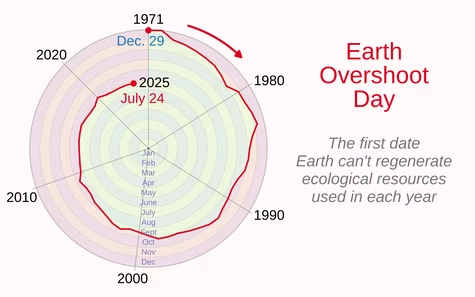
Deficit Day - Earlier Every Year
The steady shift of this date to earlier in the year illustrates increasing rates of consumption and a widening gap between human demand and the planet's biocapacity. Here is a list of key dates from the beginning of Earth Overshoot Day calculations in the early 1970s.
- 1970: December 29th
- 1985: November 4th
- 2000: September 23rd
- 2015: August 6th
- 2018: August 1st
- 2019: July 29th
- 2020: August 22nd
- 2025: July 24th
- 2026: July 30th
The Global Footprint Network were clear that his year’s slightly later date is the result of revised data rather than any easing of resource use. Humanity is still using nature 73% faster than ecosystems can regenerate.
The damage from this overshoot is cumulative, meaning that every year’s deficit adds to the already existing ecological debt.
The Earth is not being given enough time to regenerate and sustainably replenish its resources. The consequences for the environment are deadly air pollution, plummeting fish stocks, shrinking forests, warming oceans and rising sea levels, soil acidification and erosion, biodiversity loss, food insecurity, and water scarcity.
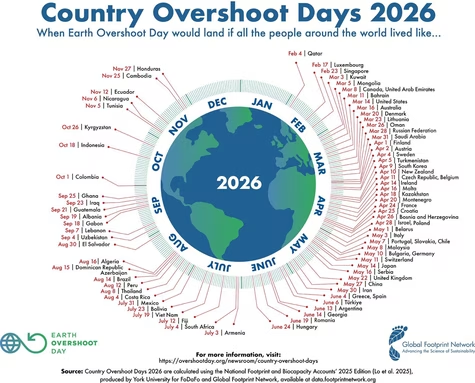
Country Deficit Days 2026
Measuring a country's consumption is much more relevant to governments and citizens, who can use this information to implement policies and instigate change at the individual level.
A country’s Deficit Day is the day by which its residents have taken as much from nature as the country’s ecosystems are able to regenerate in the entire year. It is important to consider that countries do not have equal levels of biocapacity.
When comparing hectares of biocapacity, countries like Bangladesh or Rwanda use approximately ¼ of a global hectare per resident. In Panama, Austria, and France, this number is much higher at around 3 global hectares per resident. Countries with a larger number tend to be higher consumers and have larger areas of urbanisation.
In financially rich nations, they can purchase the remaining resources they need from abroad. For example, many wealthy countries are heavily reliant on food imports; in some cases, up to half of their food is imported. These imports emit even more CO₂, but with very little cost to themselves.
As a result, competition for the planet’s biocapacity is intensifying. It raises important questions about how these nations will secure the resources they currently depend on in the future.
Three countries reached their overshoot day by just the first two months of 2026, the vast majority of the rest fall before the six month mark.

Solutions - What Can We Do To #MoveTheDate
We must not continue to ignore our planet's boundaries through short-sighted policies and weak governance on environmental protection.
#MoveTheDate is a global campaign led by the Global Footprint Network to start pushing back Earth Overshoot Day. The campaign focuses on solutions that slow down consumption, promote ecological restoration, and provide a sustainable approach to our ecosystems.
The campaign focuses on reversing the trend through:
Decarbonising The Economy -
By focusing more on renewable energy sources such as solar and wind power, we can continue to reduce our dependence on fossil fuels. This lowers greenhouse gas emissions and prevents us from consuming finite resources such as coal, gas, and oil.
Electrifying the transport and heating sectors would also go a long way to reducing the demand for fossil fuels. Strengthening public transport, expanding cycle paths, and promoting electric vehicles are great options to help the energy transition.
Smart Cities -
Over 70% of the world’s population lives in cities. Over time, they have become overpopulated concrete jungles that are choked with cars.
The urban heat island effect means that most cities retain large amounts of heat and can be up to 12°C warmer. Cities lose millions of square meters of vegetation each year as housing developments, commercial expansion, and infrastructure projects strip away trees, parks, and green spaces.
We could postpone Earth Overshoot Day by 29 days if buildings, industrial processes and electricity distribution used smarter technolgies to improve energy efficiency and reduce our dependence on fossil fuels.
Industry -
Factories, construction, and agriculture are all fossil fuel-heavy industries. Promoting a circular economy must become a top priority; this includes reducing waste, promoting recycling, and utilising secondary raw materials.
Food & Agriculture -
The intensive agricultural industry and our broken food systems are in dire need of overhaul. The focus simply must switch to more sustainable farming practices, such as organic farming and agroforestry.
Modern farming practices are incredibly harmful to our environment and are one of the main causes of biodiversity loss. Reducing food waste and shifting to more sustainable diets are essential steps toward reducing overconsumption.
A shift to plant-based diets would dramatically reduce land use and CO2 emissions. If everybody on the planet replaced 50% of their meat consumption with plant-based alternatives, we would postpone Earth Overshoot Day by seven days.
Strict Policy & Regulation -
Policy measures such as environmental taxes, subsidies for sustainable technologies, and stricter environmental regulations for businesses can support the transition to a more sustainable economy. Education and awareness-raising about environmental issues and sustainable development are also crucial for changing consumer behaviour and contributing to a more environmentally friendly lifestyle.
*****
Earth Overshoot Day highlights the responsibility on the national and global stage. Countries with the highest per capita consumption and highest CO₂ emissions, like Qatar, Kuwait, the U.S., and Saudi Arabia, have a global responsibility to change their habits at every level.
These countries utilise global resources at the expense of others, who are then the disproportionately affected by resource depletion and the consequences of climate change.
This video by DW offers a range of solutions for living within the planet’s limits.
"Overshoot is not a permanent condition. Humanity’s demand will eventually be brought back in line with Earth’s budget. The only question is whether we will get there by design or by disaster." - Mathis Wackernagel, Swiss environmentalist and President of the Global Footprint Network.
Author: Rachael Mellor, 19.05.26, latest update 30.07.26, licensed under CC BY-SA 4.0
More Resources
Curated Directory & Deep-Dive Resources on Earth Overshoot Day
- Earth Overshoot Day (Official) 468496
- Earth Overshoot Day - Quiz 481655
- Global Footprint Network 468495
- Good Energy - What is Earth Overshoot Day 468498
- Earth Overshoot Day - Geneva Environment Network 481848
- Jimmy Joy - World Overshoot Day 516440
- The Carbon Almanac 516443
- WWF 468499
- Wikipedia 481659
- Google News 481656
- #EndOvershoot 519774
- #MoveTheDate 468503
- #EarthOvershootDay 468504
- Earth Overshoot Day - Wikipedia 467402
- YouTube Search 467403
- Bank Austria - Earth Overshoot Day 516441
- Made In Britain - Earth Overshoot Day 2025 468506
- Earth Overshoot Day - Country overshoot days 2025 468512
- Britain’s Prince William reveals finalists for Earthshot environmental prize - Mongabay 18.09.26 523494
- Tweet: Earth Overshoot Day lands on July 30 according to the #WorldEnvironmentDay announcement by Global Footprint Network - @SustPopAus 29.06.26 519773
- PRESS RELEASE: Earth Overshoot Day 2026 falls on July 30 - Earth Overshoot Day 05.06.26 519775
- Earth Overshoot Day Reaches Record for Earliest Date - EcoWatch 28.07.25 490544
- Tweet: As of Thursday, humankind has used up more natural resources than can be renewed this year. The Earth’s natural systems cannot keep up with our demands. - @antoniogute… 481849
- We’ve Just Shot Past Earth Overshoot Day - CounterPunch 25.07.25 481658
- Video: 'Earth Overshoot Day': What can we do to try live within the planet’s limits? - DW News 24.07.25 517680
- What is Earth Overshoot Day and Why does it Matter? - UNU 24.07.25 516442
- Earth Overshoot Day: Using Up The Earth’s Annual Resources - Sustainability Magazine 24.07.25 481657
- Earth Overshoot Day Is Coming Sooner and Sooner - Statista 23.07.25 481793
- Video: Where are we on Earth Overshoot Day 2025? - The Club of Rome 22.07.25 481789
- Earth Overshoot Day 2025 falls on July 24 - Footprint Network 05.06.25 481790
- Estimating the Date of Earth Overshoot Day 2025 - Footprint Network 06/25 481791
- Earth Overshoot Day and citizens’ powers to make a difference - Interreg 26.04.25 481792
- Earth Overshoot Day: Humanity burns through planet's yearly resources in 7 months - EuroNews 01.08.24 468505
- Campaigners call for action on consumption as Earth Overshoot Day arrives - Independent 01.08.24 468507
- Earth Overshoot Day 2024: What Is It and Why Is It Important? - Earth 01.08.24 468497
- Earth Overshoot Day highlights unsustainable trends - IMD 01.08.24 468508
- The Countries With No Earth Overshoot Day - Statista 01.08.24 468510
- How Fast Are Countries Burning Through Natural Resources? - Statista 01.08.24 468513
- Earth Overshoot Day: humanity consumes a year's worth of resources by August 1st - Trend Watching 18.07.24 468511
- Earth Overshoot Day Is Coming Sooner and Sooner - Statista 05.06.24 468509
- Earth Overshoot Day. What is it and why do we need it? - WEF 03.08.23 468502
- Earth Overshoot Day: Choosing the path of self-sufficiency - Greenpeace 02.08.23 468501
- Earth Overshoot Day and EMAS: Moving the Date for a Sustainable Future - European Commission 01.08.23 468500
- Earth Overshoot Day: What it is and why it keeps arriving earlier - WEF 03.08.22 468851
- ‘Earth Overshoot Day’ comes earlier every year - France24 28.07.22 468847
- Earth Overshoot Day: When consumption outstrips the planet's eco resources - BBC 22.08.20 468845
- Coronavirus Pandemic Delays 2020 Earth Overshoot Day by Three Weeks, But It’s Not Sustainable - EcoWatch 21.08.20 468852
- For The First Time in Years, Earth Overshoot Day Has Been Pushed to a Later Date - Science Alert 20.08.20 468850
- Earth Overshoot Day 2019 is July 29th, the earliest ever - Footprint Network 26.06.19 468844
- Earth’s Annual Resources Budget Consumed in Just 7 Months - UNFCCC 31.07.18 468849
- Earth Overshoot Day: humanity exceeds nature's budget for 2015 - WWF 13.08.15 468846
- Admit it: we can't measure our ecological footprint - New Scientist 20.11.13 468853
- Sobering News – What Earth Overshoot Day Being 8 Days Earlier Tells Us - Advetec 481794