
Earth Overshoot Day - Criticism
Praised as an important educational and awareness tool on resource depletion and sustainability, it is also criticised for oversimplification, over-reliance on carbon emissions, and understating local issues.
Earth Overshoot Day ➡️ METHODOLOGY CRITIQUE
Earth Overshoot Day is an initiative of the Global Footprint Network, an international research organisation that works to change the way the world measures and manages its vital natural resources.
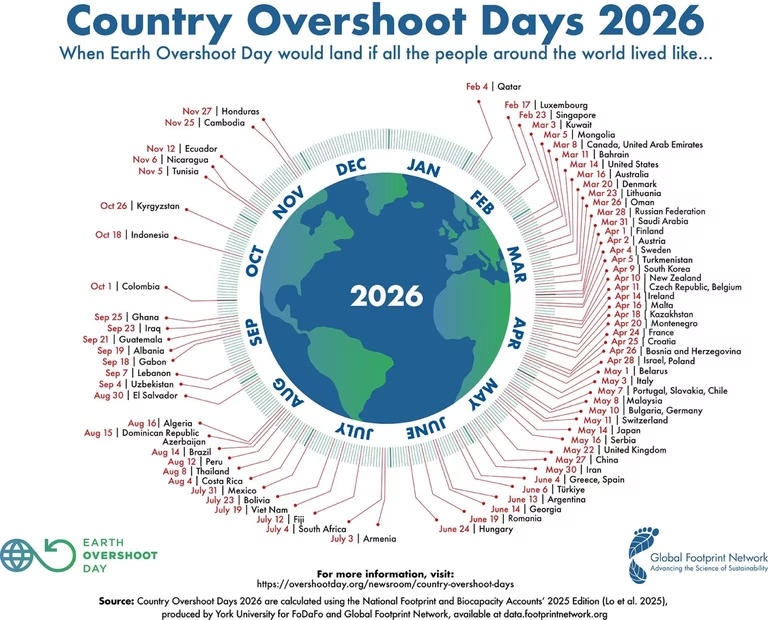
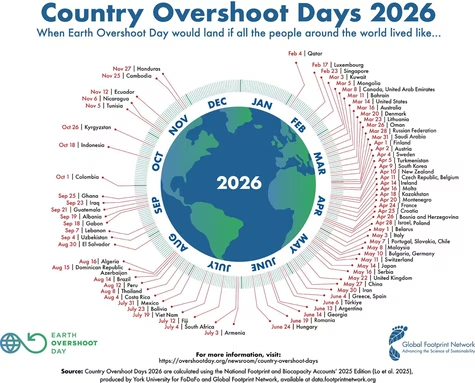
Earth Overshoot Day marks the date when humanity’s demand for ecological resources in any given year exceeds what Earth can regenerate in that same year. In 2025, this date was July 24th, indicating that humanity is using resources 1.8 times faster than ecosystems can replenish them.
The campaign is widely praised for raising public awareness of sustainability, but it faces significant scientific and methodological criticism from environmental scientists, economists, and think tanks such as The Breakthrough Institute.
Jump straight to our resources on ➡️ Earth Overshoot Day Critique
Explore our comprehensive guides on -
- Earth Overshoot Day
- Alternative Sustainability Frameworks
- Earth Day - April 22
- The Climate Crisis & Tipping Points
- Sustainability, Environment & Nature
*****
Over-Reliance On Carbon Emissions
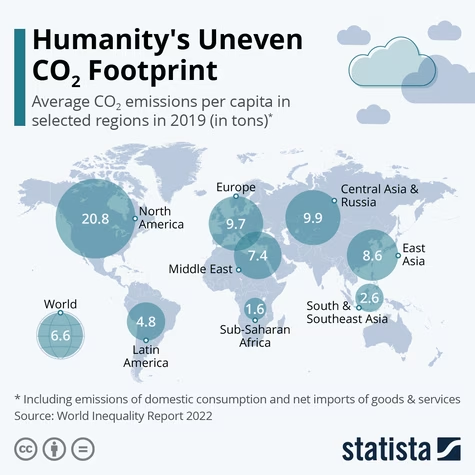
One of the main criticisms of Overshoot Day is the use of a single variable to determine the entire metric - carbon dioxide. This, of course, skews the data, but it also fails to capture all our other planetary issues that are not carbon-related.
The methodology used converts carbon emissions into a hypothetical forest area that would be required to absorb them. It does not take into account whether this forest was sustainably grown or the species of treesgrowing, which is important due to different rates of ability to absorb carbon dioxide.
The United Nations data confirms that overall cropland, pastures, and forests are regenerating fast enough to meet human consumption. The Overshoot Day, therefore, does not mean that we will run out of food or wood by July 24th, but rather that after this day, we are emitting more cumulative carbon than our ecosystems can sequester.
For this reason, many experts have labelled the term ‘Earth Overshoot Day’ misleading.
Over-Simplification Of Methodology
The methodology for creating a global hectare requires combining very distinct environmental issues, such as deforestation, soil erosion, and overfishing, into a single generalised metric. This, of course, leads to compromises in precision.
Their methods of sequestration are also heavily generalised, assuming they all have the same carbon-absorption rate. Using this method assumes that forest growth in Congo offsets the impact of deforestation in the Amazon and that increasing tuna populations offset the depletion of salmon.
A further example of oversimplification is failing to factor in oil production. The Global Footprint Network lists Canada as having biocapacity credit, meaning its biocapacity exceeds its population's ecological footprint. What this fails to consider is that Canada ranks 4th among the world's top oil-producing countries.
Understating Local Ecological Issues
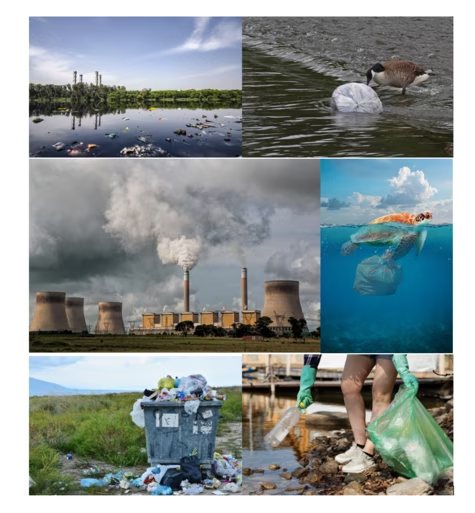
The sweeping approach to our planetary boundaries fails to adequately analyse important environmental crises such as chemical pollution, biodiversity loss, microplastics, and the depletion of fresh water. Without measuring these localised environmental issues, the true damage is seriously understated.
By trying to quantify everything on one scale, it ironically underestimates the true scale of ecological destruction in non-carbon categories. In creating a single metric to encompass all human impacts on the planet, simplification is unavoidable.
Unsuitable For Policy Guidance
One of the main flaws of the Earth Overshoot campaign is the lack of actionable data for governments. By focusing solely on carbon emissions, we can only assume that the solution is to create massive carbon sinks, rather than promoting a clear message of switching to clean, renewable energies or electricifying our power grids.
Offering no localised technological solutions, many have labelled the campaign a mere publicity stunt with a focus on a set doomsday. Many have been quick to dismiss the metaphor behind the initiative and instead promote the use of the more practical tools, such as the UN’s Sustainable Development Goals.
Although not recommended for policy guidance, Overshoot Day metrics are useful for countries to compare themselves with other nations with similar population sizes, economies, and export levels. If one country has an overshoot day much later in the year than the other, they can learn from their policies and practices to become more sustainable themselves.

A Powerful Public Relations Tool
Relevant criticism of Earth Overshoot Day is welcomed by its creators, as even they admit there is room for improvement in their methodology. Their work is based on basic scientific principles, which they describe as ‘pedestrian’ and as such encourage constructive feedback as a driver of scientific progress.
The Global Footprint Network has published a comprehensive Limitations and Criticism Guidebook that provides further information on their trustworthiness, accounting principles, and the improvements they are working on. All their key results are open access, and statistics are accompanied by an indication of data quality.
With such important awareness tools as this one, there must be a careful balance between the demand for strict scientific methodology and the benefit of greater public awareness of overconsumption. Ultimately, the core premise of Overshoot Day is accurate: humanity emits more carbon dioxide than the planet's ecosystems can naturally sequester.
Whilst urgent issues are somewhat masked by this approach, the overall message that we must shift towards decarbonisation and more sustainable practices worldwide certainly hit home. It acts as an essential metaphor and successfully drives massive media engagement.
The Overshoot Day campaign generates between 7 and 10 billion media impressions worldwide every year.
In a world where industry lobbyists, climate deniers, politically swayed media, corporate propaganda, and lacklustre politicians dominate, this is no small feat.
This easy-to-grasp concept is also widely used in schools and educational settings to teach learners about planetary boundaries and individual resource footprints.

Earth Overshoot Day - An Advocacy Tool For A Better World
Overshoot Day is not a governmental policy-making tool nor is it an alarm clock for humanity. It is an educational awareness campaign that highlights the world's unsustainable carbon trajectory. An easy-to-understand concept that communicates our planet's sweeping environmental issues.
The initiative is endorsed by major figures such as Greta Thunberg, Christiana Figueres, the former Executive Secretary of the UNFCCC, the late Pope Francis, and the late Jane Goodall.
A perfectly precise scientific index with thousands of localised data points would fail to capture public attention. Earth Overshoot Day successfully translates a massive, intangible crisis into a single, easily digestible headline.
Furthermore, the campaign #MoveTheDate can be used broadly to promote renewable energy sources, sustainable transport, regenerative agriculture, protecting natural carbon sinks, water conservation, and a shift to plant-based diets. Even if the message draws criticism, the outcome has important benefits for both people and the planet.
Author: Rachael Mellor, 21.05.26 licensed under CC BY-SA 4.0
For further reading on Earth Overshoot Day A Methodology Critique see below ⬇️
More Resources
Curated Directory & Deep-Dive Resources on Earth Overshoot Day - Criticism
- Global Footprint Network - Limitations and Criticism 516915
- Earth Overshoot Day: Should Aotearoa New Zealand be more like Uruguay? - PHCC 30.04.25 516910
- Why I Hate Earth Day: by an Environmental Writer - Medium 19.04.23 516914
- Ecological footprint accounting and its critics - Trellis 05.08.19 516917
- Why Earth Overshoot Day And The Ecological Footprint Are Pseudoscientific Nonsense - Forbes 29.07.19 516908
- Earth Overshoot Day May Seriously Underestimate Humanity's Ecological Footprint - Science Alert 30.07.18 516913
- Is "Earth Overshoot Day" a useful or reliable metric of humanity's effect on the world? - Skeptics 25.07.18 516909
- By what empirical data is Earth Overshoot Day based on? - Research Gate 08.08.16 516918
- It’s Time to Scrap the Ecological Footprint - Breakthrough Institute 13.08.15 516907
- Admit it: we can't measure our ecological footprint - New Scientist 20.11.13 516916
- Earth Overshoot Day: a day to forget or a day to remember? - Guardian 19.08.10 516911
- Ever wondered why Earth Overshoot Day comes early each year? - Editage 516912