
Earth Day - April 22
Discover Earth Day 2026: Our Power, Our Planet. Explore climate action toolkits, grassroots campaigns, local events, and resources to fight for a sustainable world.
EARTH DAY, April 22 - #OurPowerOurPlanet
Discover the essential movement of Earth Day and learn how we can all help to protect our planet. Our environmental guide offers you in-depth information on grassroots activism, climate action, and sustainability.
Connect with valuable resources, initiatives, and organisations – for genuine climate action, ecosystem restoration, and a more sustainable future.
Jump straight to our resources on ➡️ Earth Day
*****
General Information
Earth Day is now the largest international civic event on the planet, as millions stand up to safeguard our planet and build a better future. Now in its 56th year, the event began in 1970 as millions of Americans united to stand against rampant pollution and indifference towards environmental protection.
Today, over 1 billion people across 200 countries participate in Earth Day activities.
The Global Tipping Points Report in 2025 revealed that we have already crossed the first major tipping point, the widespread mortality of warm-water coral reefs, with several others on the brink of tipping.
"We do not inherit the earth from our ancestors, we borrow it from our children." - Native American Proverb
Please share this unique resource via ➡️ Twitter, Bluesky, Facebook, Instagram and LinkedIn!
Explore our comprehensive guides on the United Nations Climate Conferences (COP), the UN Treaty on Plastic Pollution, the fossil fuel industry, and renewable alternatives.
German speakers are invited to visit our sister site Bessere Welt Info zum ➡️ Tag der Erde.
Earth Day continues to raise huge public awareness and has led to the establishment of major landmark environmental laws in the U.S., such as the Clean Air, Clean Water, and Endangered Species Acts. The first nationwide demonstration sparked political action, which led to the creation of the EPA. Earth Day also played a pivotal role in creating global commitments such as the 2015 Paris Agreement on climate change.
The 2026 theme 'Our Power Our Planet' emphasises that real change does not always come from policy negotiations, but rather from everyday people, community leaders, and activists. Local grassroots efforts add up to create lasting, sustainable change.
*****
The State Of Our Planet
-
The Earth is approximately 1.42°C warmer than pre-industrial levels.
-
Greenhouse gas emissions reached a record high of 57.7 gigatonnes in 2024.
-
The ocean absorbs 90% of the planet's excess heat, resulting in a 30-40% increase in its acidity.
-
Ice sheets and glaciers are losing about 1.2 trillion tons of ice annually.
-
Sea levels are rising at an accelerating rate of 4.4mm per year.
-
Humanity is using resources 1.7 times faster than the planet can regenerate them.
-
An estimated 11.2 billion tonnes of waste are generated annually. Only 9% of all plastic ever produced is being recycled.
-
Total fossil fuel consumption remains roughly 31 times higher than wind and solar.
-
Global wildlife populations have declined by an average of 73% between 1970 and 2020.
-
Approximately 1 million animal and plant species are now threatened with extinction, many within the next few decades.
-
Sustainable Development Goal 13, Climate Action, is severely off track. Wars and global crises have hindered international cooperation, and investment in climate solutions needs to increase by 58% for us to reach a net-zero pathway.
What Are The Planet's Most Pressing Environmental Issues?
CLIMATE CRISIS
Climate change is now the single biggest health threat facing humanity.
Extreme weather events have become more frequent and severe due to climate change. The Emergency Events Database reports a record rise in natural disasters globally since the 1960s, detailing over 26,000 mass disasters.
The consequences of climate change include wildfires, rising sea levels, hurricanes, flooding, heatwaves, melting of the Arctic and Antarctic ice, drought, hunger, increased conflict over land, the widespread displacement of climate refugees, and the huge financial cost of inaction.
There are currently 250 million people displaced by environmental changes.
A 2024 report by the International Chamber of Commerce estimates that climate-related extreme weather events have cost the global economy more than $2 trillion over the past decade.
BIODIVERSITY LOSS
Biodiversity loss refers to the decline in the biological diversity of all living things on the planet. It encompasses endangered animals but also the loss of their habitats, their food supply, and everything around them that they need to survive.
We are in the midst of a biodiversity crisis caused by large-scale land use changes for agricultural systems, the illegal wildlife trade, the logging industry, wildfires, ocean pollution, coral bleaching, deforestation, intensive farming, and climate change.
Nature provides the very foundation that humans need to survive, yet we continue to exploit it beyond sustainable limits.
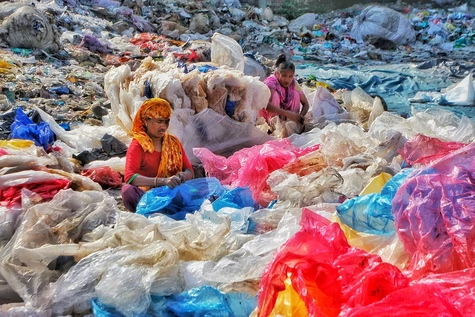
PLASTIC POLLUTION
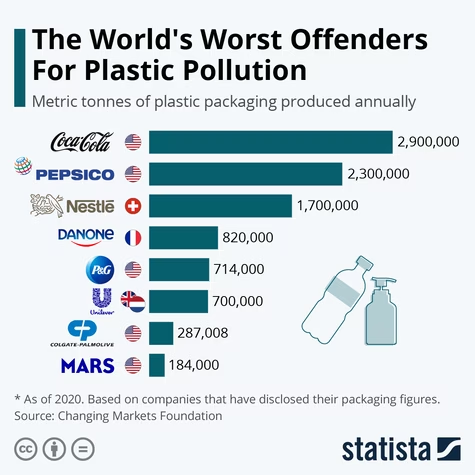
The world produces around 430 million tonnes of plastic waste a year. Fourteen million tonnes of it end up in our oceans. As the vast majority of plastics are not recycled and take between 20 and 500 years to decompose, this is one of our biggest environmental problems.
Plastic is one of the world's most devastating marketing failures. Future generations will be left dealing with the irreversible effects of today's irresponsibility for their whole lives.
Microplastics are found in water, soil and the air. In 2020, an estimated 2.7 million tonnes of microplastics seeped into the environment. This amount is expected to double by 2040. Microplastics are incredibly damaging to plants, animals, humans, and the wider environment.
AIR POLLUTION
Air pollution kills an estimated seven million people worldwide every year. Nine out of 10 people worldwide are breathing in high levels of pollutants, with Bangladesh, Pakistan, and India taking the top spots as the most polluted countries. In these places, air pollution cuts life expectancy by 5 years.
Industrial emissions, transport, and waste burning are the biggest contributors, which are then exacerbated by poor governmental regulation, ageing infrastructure, and insufficient healthcare.
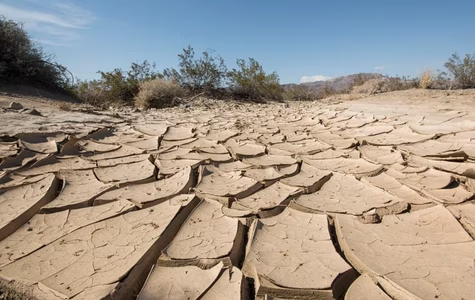
FOOD & WATER INSECURITY
An estimated 800 million people suffer from chronic hunger due to decades of unsustainable farming practices, the impacts of climate change, massive economic inequalities, and rampant food waste.
The world currently produces enough calories to feed the entire population, yet we are facing an unprecedented hunger crisis. Sudan, South Sudan, Yemen, and the Gaza Strip are all experiencing crisis-level food shortages.
Topsoil laden with fertilisers and pesticides is being eroded 100 times faster than it can naturally be replenished. As well as seriously limiting the soil's ability to produce food, it is also a key factor in the contamination of drinking water.
Roughly 2.2 billion people, one in four globally, lack access to safely managed drinking water. Driven by climate change, population growth, and poor management, the world is entering a water crisis in which 4 billion people face severe water scarcity for at least 1 month of the year.
NUCLEAR WEAPONS & WAR
The military is one of the largest consumers of fossil fuels, as tanks, aircraft, ships, submarines, and other vehicles consume vast amounts of fuel on their warpath. It now accounts for 6% of global greenhouse gas emissions, not to mention the devastating impact it has on the environment, water sources, and biodiversity.
With military spending reaching unprecedented highs of $2718 billion in 2024, the focus of militaries around the world is very much on expansion and upgrades, with emission reductions and environmental considerations a mere afterthought.
Oil is fuelling today's national security. In the ultimate paradox, military actions are not only a cause of the climate crisis, but the climate crisis is now officially a cause of war.
In war, ecocide has been used for decades to cripple the enemy and civilian populations. A population simply cannot survive without a healthy and clean environment.
Clean air, safe water, fertile soil, and arable land sustain life. Without these things, the survival and well-being of a population, its ecosystems, and biodiversity are at serious risk.
The scorched earth policy is a military strategy to destroy anything of value which might enable armed forces or civilians to fight a war. It is considered a war crime under modern international humanitarian law.
Even just one nuclear warhead is capable of destroying an entire city and all of its inhabitants. Radiation exposure results in devastating long-term health implications, birth defects, and untold damage to the environment and atmosphere. Fallout contamination remains a hazard for many decades.
A study by International Physicians for the Prevention of Nuclear War (IPPNW) calculated that the detonation of 100 nukes would lead to a nuclear winter and the starvation of 2 billion people. The predicted 9% reduction in rainfall and cooling temperatures would be enough to trigger global crop failures and famine.
How Can I Get Involved In Earth Day?
-
Join activities prepared by environmental organisations near you.
-
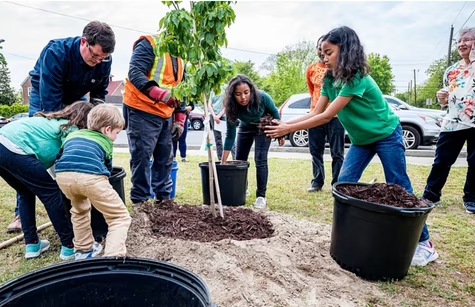
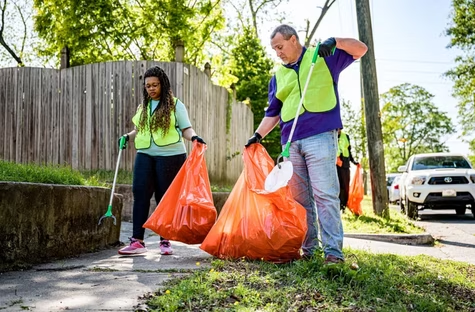
Plant trees, join or organise a local litter collection or clean up.
-
Show your support at a local protest.
-
Get active on social media, spread awareness and use your voice.
-
Write to representatives in your country responsible for environmental and climate policy.
-
Share Better World Info's platforms for Earth Day and the Climate Crisis with your peers.
-
Use the Earth Day tool kits for further inspiration.
While individual actions may seem small, global participation in Earth Day creates a powerful force for change, influencing policy, corporate practices and raising public awareness of environmental issues that require the urgent attention and action of global leaders.
Earth Day For A Better World
As an essential platform for dialogue among nations, Earth Day helps to foster a collaborative approach to address global environmental challenges and push for stronger environmental governance and commitments.
It serves as a call to action to reduce greenhouse gas emissions, end fossil fuel subsidies, transition to renewable energy sources, protect the planet's precious natural resources, end nuclear proliferation, and divest from the military.
This Earth Day, let us commit to the future of our planet for a healthy, sustainable, equitable, prosperous, and peaceful future for everyone.
"What you do makes a difference, and you have to decide what kind of difference you want to make" - Jane Goodall
Author: Rachael Mellor, 22.04.24, latest update 21.08.26, licensed under CC BY-SA 4.0
More Resources
Curated Directory & Deep-Dive Resources on Earth Day - April 22
- EARTH DAY 2026 513203
- Earth Day HUB - Resources 513211
- Earth Day - TOOLKITS 513233
- Earth Day 2026 Theme - Our Power, Our Planet 466018
- Earth Day - Climate Mental Health 513213
- Climate Junction - Earth Day 513214
- Earth Day - Campaigns 282927
- Earth Day - Our History 513212
- #earthday2026 513204
- Earth Day 2025 513202
- Earth Action Day 2025 - Social Media Guide 466019
- Earth Day 2024 407828
- Planet vs. Plastics 2024 407829
- Earth Day 2024 - Action Toolkit 407830
- DuckDuckGo 115026
- United Nations 282935
- Earth Day - Footprints for the future - 20/20 pledge 282942
- Earth Day Initiative 282929
- EPA - Earth Day 282933
- Friends of the Earth - Earth Day 282941
- Earth Day - HuffPost 114987
- EarthDayNetwork - Facebook 115000
- Earth Day Network ! 114970
- Earth Day Canada 114976
- Earth Day India 114980
- Earth Day Journal - PlanetPals 115005
- Denis Hayes - Wikipedia 221633
- Earth Day - Wikipedia 114982
- John McConnell (peace activist) - Wikipedia 282954
- @EarthDayOrg 465603
- #EarthDay2025 465599
- #EarthActionDay 465601
- #MotherEarthDay 466032
- #OurPowerOurPlanet 465600
- #climateactionday 480795
- #ProtectOurPlanet 465972
- #EarthDay2024 407822
- #InvestInOurPlanet 281305
- #ForPeopleForPlanet 465968
- #ClimateAction 465969
- Google News 114969
- Green Cities Campaign 114986
- Nat Geo Kids - History of Earth Day 282931
- International Mother Earth Day - Wikipedia 114981
- YouTube 114988
- YouTube Channel - EarthDayNetwork 114992
- Twitter - #EarthDay 114994
- Twitter - #MotherEarth 114998
- Earth Week live 2023 341562
- Earth Day 2022 Fesitival & Virtual Stage - April 21st NYC & Worldwide - Earth Day Initiative 281309
- Earth Day: The battle to save a drowning Pacific island nation - UN News 22.04.26 515464
- NASA Shares Unseen Artemis II Photos to Mark Earth Day - Peta Pixel 23.04.26 514180
- Photos: Reclaimed by Nature - Atlantic 22.04.26 514337
- This Earth Day and Every Day, We Need to Talk About Climate - CD 22.04.26 514315
- Why Earth Day Matters More Than Ever - CD 22.04.26 514313
- Power and Purpose on Earth Day - CFR 22.04.26 514176
- In ‘Major Earth Day Win,’ House GOP Cancels Vote on Gutting Endangered Species Act - CD 22.04.26 514310
- The best thing you can do for the planet on Earth Day - Vox 22.04.26 514175
- The Nine Best Climate and Sustainability Books to Read This Earth Day - Vogue 22.04.26 514174
- Disney Marks Earth Day by Recognizing 10 Young Leaders and 30 Years of Conservation Impact - Walt Disney Company 22.04.26 514173
- I counted every gadget in my home for Earth Day — and the results surprised me - Tech Radar 22.04.26 514169
- Earth Day Coalition closes Whitehall – ‘Everything we love depends on a liveable planet’ - Canary 22.04.26 514170
- Earth Day: The battle to save a drowning Pacific island nation - UN News 22.04.26 514177
- This Earth Day, Progress Is In Your Hands - Plant Based News 22.04.26 514168
- Earth Day 2026: Conservation is human-powered - Conservation International 22.04.26 514167
- WCC champions water as a human right on Earth Day 2026 - ICN 22.04.26 514166
- His Majesty The King awarded Green Blue Peter Badge at Dumfries House on Earth Day - BBC 22.04.26 514164
- On Earth Day, remember the people defending the planet - Al Jazeera 22.04.26 514146
- Earth Day 2026: A moment for a new generation to reimagine climate action - WEF 22.04.26 514179
- Earth Day 2026: How Resources for the Future Contributes to a Better World - Resources 21.04.26 514171
- 6 Five-Minute Jobs You Can Do on Earth Day – To Help Wildlife, Your Plants, and the Planet - Homes and Gardens 21.04.26 514163
- Earth Day started as a US 'teach-in' 56 years ago. Now it's a global event - Independent 21.04.26 513909
- Warning Climate Action Is Moving Too Slow, Secretary-General Mother Earth Day Message Urges Governments, Business to Follow Lead of Indigenous Peoples, Scientists - UN 20.04… 513818
- 12 Earth Month documentaries from National Geographic & Disneynature - Disney Plus 07.04.26 514172
- For Earth Day, I asked AI to show me what the future looks like - Creative Bloq, 2026 514165
- Our GERMAN Links on Earth Day 513205
- Why Is It Important To Talk About Military Spending On Earth Day? - GDAMS, 2026 514676
- 'We Will Not Cooperate': Earth Day Puts Focus on Need to Resist Trump's Planet-Destroying Policies - CD 22.04.25 466068
- Tweet: “Together, let’s get to work and make 2025 the year we restore good health to Mother Earth." - @UN 22.04.25 466031
- Tweet: 2025 is critical to tackle pollution, biodiversity loss & seize the benefits of clean energy. All countries must create new #ClimateAction plans to limit global temper… 466033
- What It Will Take to Fulfill the Promise of Earth Day - TIME 22.04.25 466070
- Tweet: What if our world lost its biodiversity? This is not just a distant possibility — it is a growing risk that underscores the urgent need to restore balance between peop… 466034
- Earth Day 2025: Agriculture’s Universal Challenges - Forbes 22.04.25 466066
- Earth Day marks the chance to help save the planet. The environment was already on the edge before Trump took office - Independent 22.04.25 466067
- A sequoia forest in Detroit? Earth Day plantings seek to improve air quality - LA Times 22.04.25 466069
- Tweet: Glaciers are shrinking faster than ever before. Why? Because of climate change impacts such as rising temperatures, shorter snow accumulation and increased rainfall. -… 465967
- Tweet: 15 years ago, the BP Deepwater explosion killed 11 rig workers & released ~210 million gallons of oil into the Gulf—one of the worst environmental disasters ever. With… 465971
- Tweet: Glaciers cover 10% of Earth's land and exist on every continent, except Australia. We might not see them from where we live, but we depend on them to thrive. - @UNDP 2… 465966
- 55 Years Of Earth Day, So What Did We Accomplish? - Forbes 20.04.25 465973
- Tweet: 4 topics. 7 changemakers. This #EarthDay, press play on 22 minutes...— a fast-paced interview series spotlighting the people driving real climate solutions. - @EarthDa… 465735
- Tweet: “We don't want this dataset to just stay in a scientific paper.” 87% of bycatch the Southeast Pacific is based in Ecuador alone. This #EarthDay, discover why @Ilumina… 465970
- Trump Weighs Earth Day Move Against Green Groups - Political Wire 18.04.25 465732
- Trump May Target Environmental Nonprofits in Executive Orders Expected on Earth Day - InsideClimate News 18.04.25 465731
- Earth Day Massacre? Environmental Groups Fear Trump Ready to Take Aim at Nonprofit Status - CD 17.04.25 465734
- Lectric eBikes Are (Almost) All on Sale for Earth Day - VICE 17.04.25 465733
- Earth Day 2025: Time To Embrace Green Beauty - Forbes 17.04.25 465595
- Agriculture documentary 'Common Ground' to premiere on Earth Day - UPI 16.04.25 465598
- Green Groups Organizing 'All Out on Earth Day' Protests Against Trump Authoritarianism - CD 14.04.25 465596
- Earth Day Is Really Earth ‘Action’ Day: Here’s A Taste of What’s Happening Globally – Climate Action 14.04.25 465602
- Inside the Big Issue: Earth Day 2025 - Big Issue 14.04.25 465597