
Biodiversity Loss
Explore the global biodiversity crisis and animal species extinction. Discover expert research, climate drivers, and practical conservation solutions.
THE GLOBAL BIODIVERSITY CRISIS - Are We Facing A Sixth Mass Extinction?
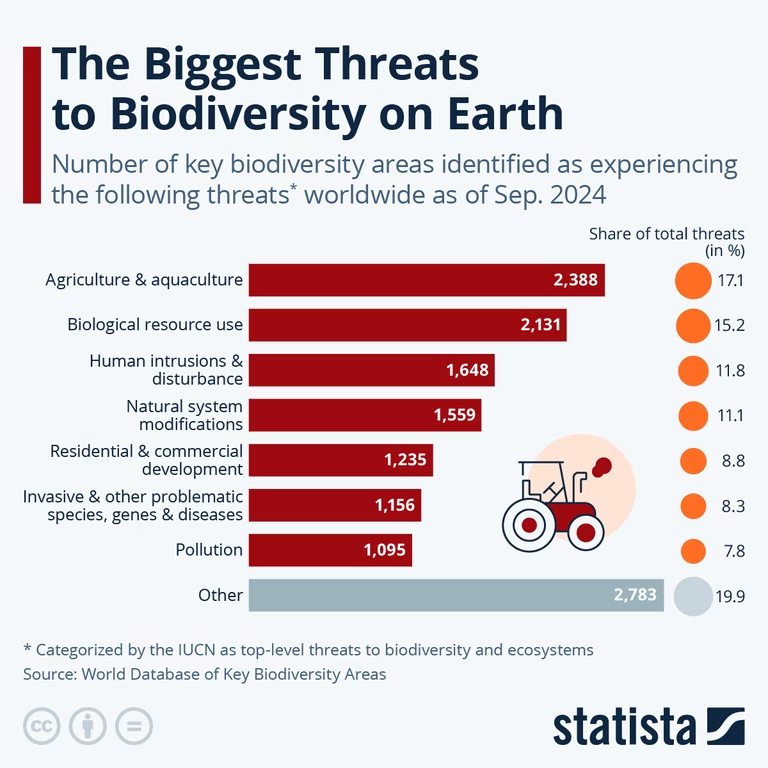
We are in the midst of a manmade biodiversity crisis triggered by climate change, widespread habitat loss, environmental degradation, intensive agriculture, deforestation, and overfishing.
WWF's Living Planet Report shows that monitored wildlife populations fell by an average of 73% globally between 1970 and 2020.
Species are disappearing 10 to 1,000 times faster than the normal extinction rate. Over 41,000 species are currently threatened with extinction.
Human activity has altered 75% of land-based environments and 66% of marine ecosystems since the Industrial Revolution, leaving very little space for wildlife, insects, birds, and marine life to thrive.
To help address the unprecedented decline in global animal species, the United Nations held the first-ever Summit on Biodiversity in 2020. Every two years, world leaders come together to review progress and set new rules to carry out the Convention on Biological Diversity.
Humans quite literally need the natural world to survive. Freshwater, food, healthy soil to grow crops, timber for construction, medicines, carbon storage, jobs, and the very air we breathe. Not to mention the beauty, joy, and wealth of health benefits we enjoy from spending time in nature.
For many years, humans have valued nature solely for its market worth.
These summits finally recognise the importance of preserving our natural world. If funding is secured, used effectively, and all nations commit to their pledges, this could be the breakthrough nature has been waiting for.
We have seen endangered animals come back from the brink, barren lands rewilded, and concrete jungles transformed into green havens. It can be done.
“Now is our chance to shore up and strengthen the web of life, so it can carry the full weight of generations to come.” - Inger Andersen, executive director of UNEP
More Resources
Curated Directory & Deep-Dive Resources on Biodiversity Loss
- UN - International Day for Biological Diversity 290450
- International Union for Conservation of Nature’s Red List of Threatened Species 435094
- World Preservation Foundation - Biodiversity loss 290456
- The Conversation 290455
- UNEP - International Day for Biological Diversity 2022 290451
- Biodiversity loss - Wikipedia 290443
- Northern Spotted Owl - ABC Birds 376836
- @UNBiodiversity 431523
- #BiodiversityLoss 431522
- #Biodiversity 431519
- Comebacks for wild tigers, tuna and sea turtles prove nature loss can be reversed, scientists say - Guardian 08.10.26 524453
- ‘Nature can recover’: Inside the race to rescue world’s crisis-hit wildlife - Al Jazeera 08.10.26 524425
- Africa’s monitored wildlife populations declined 80% since 1970, new report says - Mongabay 07.10.26 524478
- ‘The future is bright’: breeding programme brings world’s heaviest insect back from the brink - Guardian 05.10.26 524149
- A third of animal habitats on land could experience multiple extreme events by 2085, new study - PIK 24.04.26 514594
- Species on east-west coastlines are more likely to go extinct than those on north-south shores – new study - Conversation 17.02.26 509230
- Baby giant tortoises thrive in Seychelles after first successful artificial incubation - Guardian 10.10.25 493479
- Insects are dying: here are 25 easy and effective ways you can help protect them - Guardian 17.06.25 474558
- Thousands of Animal Species Threatened by Climate Change, Novel Analysis Finds - ENN 20.05.25 471021
- 'Catastrophic and Saddening': Research Shows US Butterfly Population Dropped 22% in Two Decades - CD 06.03.25 460737
- Rapid butterfly declines across the United States during the 21st century - Science 06.03.25 460735
- Britain has a new snake species – should climate change mean it is allowed to stay? - Conversation 07.02.25 456445
- How finance can be part of the solution to the world’s biodiversity crisis - Conversation 22.10.24 437199
- Wildlife populations have declined by 73% since 1970 - WEF 16.10.24 435448
- Collapsing wildlife populations near ‘points of no return’, report warns - Guardian 10.10.24 436773
- 'The Fabric of Nature Is Unraveling,' Warns New Report on Wildlife Population Decline - CD 10.10.24 435382
- Report: 2024 Living planet - WWF 01.10.24 435095
- What does the decline of insect-eating bats have to do with infant mortality? More than you think. - Anthropocene Mag 18.09.24 434919
- A Semantic Knowledge Graph of European Mountain Value Chains - Nature 07.09.24 431517
- Halting Africa’s vulture populations declines - Birdlife 07.09.24 431516
- Tweet: A recent study in @sciencemag proved nature conservation works. Explore why scaling up conservation action is key to halting #biodiversity loss & fighting climate ch… 431520
- New bone-crushing Tasmanian tiger species dug up by paleontologists - Popular Science 06.09.24 431515
- Tweet: The destruction of our last standing rainforests drives human rights abuses, biodiversity loss, & the climate crisis that affects us all. @GovKathyHochul , now is you… 431521
- Biodiversity loss: Many students of environment-related subjects are partly unaware of the causes - Sonnenseite 04.09.24 431942
- Why repairing forests is not just about planting trees - Nature 02.09.24 431514
- Perceptions of biodiversity loss among future decision-makers in 37 countries - Nature 30.08.24 431518
- The biodiversity crisis — 101 - EcoJustice 30.08.24 435092
- Where Have All the Butterflies Gone? Low Count Portends Sad Future for Biodiversity - CD 29.07.24 426898
- Biodiversity loss is a bigger risk to businesses than carbon emissions - GreenBiz 01.07.24 421378
- Conserving Just 1.2% of Earth's Land Could Save Most Threatened Species From Extinction - CD 25.06.24 420967
- We’re using drones to map the temperatures of lizards and this could boost reptile conservation - Conversation 20.06.24 420956
- Climate Change Could Become the Main Driver of Biodiversity Decline by Mid-Century - ENN 25.04.24 408989
- 44,000 Reasons to Phase Out Fossil Fuels - CD 23.04.24 413550
- Octopuses could lose eyesight and struggle to survive if ocean temperatures keep rising, study finds - Guardian 10.04.24 406740
- Survey reveals UK butterfly winners and losers in the wake of record high temperatures - Conversation 03.04.24 406522
- Bats are in trouble. That’s not good for anyone who likes mezcal, rice or avocado - Guardian 21.03.24 403418
- Why are one-fifth of the world’s migratory species facing extinction? - Al Jazeera 16.03.24 402631
- World’s migratory species in decline, UN report warns - UN News 12.02.24 397757
- ‘Grief is a rational response’: the 21 US species declared extinct this year - Guardian 29.12.23 391671
- 'A Wake-Up Call': 21 Species Declared Extinct by US - CD 17.10.23 379484
- Dominica’s mountain chicken frog faces disappearance in ‘fastest track to extinction ever recorded’ - Guardian 15.10.23 383244
- Canada rejects request to protect northern spotted owl habitat - Guardian 11.10.23 376832
- One in six species at risk of extinction in Great Britain, say wildlife experts - Guardian 27.09.23 374111
- Biodiversity and Human Rights: A Binding Legal Obligation to Stop Biodiversity Loss - Sonnenseite 26.09.23 374527
- New extinction study should be a wake-up call to end the Global North’s exploitation of nature - Canary 20.09.23 373365
- ‘Mutilating the tree of life’: Wildlife loss accelerating, scientists warn - Guardian 19.09.23 372982
- Biodiversity: state of habitats and species - European Environment Agency 12.09.23 377633
- The Race to Save the World’s DNA - New Yorker 09.08.23 365847
- ‘Shameful loss’: wolves declared extinct in Andalucía - The age of extinction 01.08.23 363415
- Vegan diets produce quarter of high-meat diets’ greenhouse gases – study - Independent 20.07.23 361194
- Tweet: Global food systems need systemic change to address biodiversity loss, climate change, and inequality. Discover how agroecology in Andhra Pradesh, India is nurturing n… 361195
- Walking the Talk: How Will Canada Halt and Reverse Biodiversity Loss? - NRDC 19.07.23 361199
- Tweet: #SDG15 focuses specifically on managing forests sustainably, halting and reversing land and natural habitat degradation, successfully combating desertification and sto… 361193
- Tweet: The rate of global change in nature during the past 50 years is unprecedented in human history. But what are the drivers of that change? - @UNBiodiversity 17.07.23 361192
- We must stop climate solutions from killing biodiversity - Financial Times 16.07.23 361189
- Global Trade Protections Don't Cover 900+ At-Risk Plant, Animal Species - CD 11.07.23 360816
- UNDP deploys record US$500 million of Global Environment Facility funds to ramp up the fight against biodiversity loss and climate change - UNDP 03.07.23 361197
- UK Insurance Group Tells Members to Act on Biodiversity Loss - Bloomberg 03.07.23 361191
- Deep-Sea Mining Could Cause 25x the Biodiversity Loss of Land-Based Mining, Report Warns - EcoWatch 29.06.23 361190
- Tweet: History will not be kind to those who vote against #RestoreNature - biggest risks to Food Security + resilience of #EU Agriculture are Climate Change + Biodiversity lo… 361196
- Global study of 71,000 animal species finds 48% are declining - Mongabay 05.06.23 350000
- Mapping the Conflict Between Farming and Biodiversity - ENN 31.05.23 349766
- Why the climate crisis is making our insects run for the hills - Guardian 28.05.23 348083
- Global loss of biodiversity is significantly more alarming than previously suspected - Sonnenseite 25.05.23 348131
- Global loss of biodiversity is significantly more alarming than previously suspected - QUB 22.05.23 350204
- Insect decline also occurs in forests - Sonnenseite 12.04.23 340541
- ‘Alarming’ rate of mountain forest loss a threat to alpine wildlife - Guardian 17.03.23 335897
- U.N. talks to safeguard the world's marine biodiversity will pick back up this week - NPR 19.02.23 332400
- Mapping Iran’s biodiversity hotspots to create new protected areas covering 20% of the landscape - Conversation 17.02.23 330437
- Biodiversity loss, the sixth great extinction and the need for action - Pressenza 15.02.23 329974
- Insects are vanishing worldwide – now it’s making it harder to grow food - Conversation 15.02.23 329828
- Habitat loss and climate change increase the risk of new diseases - Economist 31.01.23 333350
- The plight of the Japanese giant salamander: ‘23m years of DNA might die out’ - Guardian 12.01.23 324438
- Chimpanzee born at Chester zoo offers ‘real hope’ for world’s rarest subspecies - Guardian 12.01.23 324337
- Madagascar’s unique wildlife faces imminent wave of extinction, say scientists - Guardian 10.01.23 324069
- Fuelling biodiversity collapse - Ecologist 09.01.23 323974
- Five ways you can help stop biodiversity loss in your area – and around the world - Conversation 20.12.22 325889
- DINA study shows loss of insect diversity in nature reserves due to surrounding farmland - Sonnenseite 19.12.22 320585
- More than 1 in 10 species could be lost by end of century, study warns - Guardian 16.12.22 319934
- Business will help halt and reverse biodiversity loss - WEF 12.12.22 319870
- Climate change is hammering insects — in the tropics and everywhere else - Mongbay 09.12.22 319198
- The collapse of insects - Reuters 06.12.22 320283
- Human justice element is key to stemming biodiversity loss, study says - Mongabay 06.12.22 319202
- COP15: These are the latest biodiversity stories you need to read - WEF 05.12.22 319873
- What are the extent and causes of biodiversity loss? - London School of Economics 02.12.22 377632
- Podcast: How reporters uncovered a massive illegal shark finning operation - Mongabay 01.12.22 319205
- Biodiversity credit market must learn from carbon offset mistakes - Mongabay 30.11.22 319206
- Mussels are disappearing from the Thames and growing smaller – and it’s partly because the river is cleaner - Conversation 28.11.22 317880
- Another critical failing of the COP27 climate talks is brought to light - Canary 25.11.22 317237
- Animals bred in captivity develop physical changes that may hinder survival in the wild, research finds - Guardian 20.11.22 316258