SDGs Review & Reform
Critical look at the limits and deficits of the SDGs and the areas which need expanding - nuclear weapons, arms trade, biodiversity, corruption, and freedom of the press
➡️LIMITS & DEFICITS OF THE SDGs - A Critical Perspective
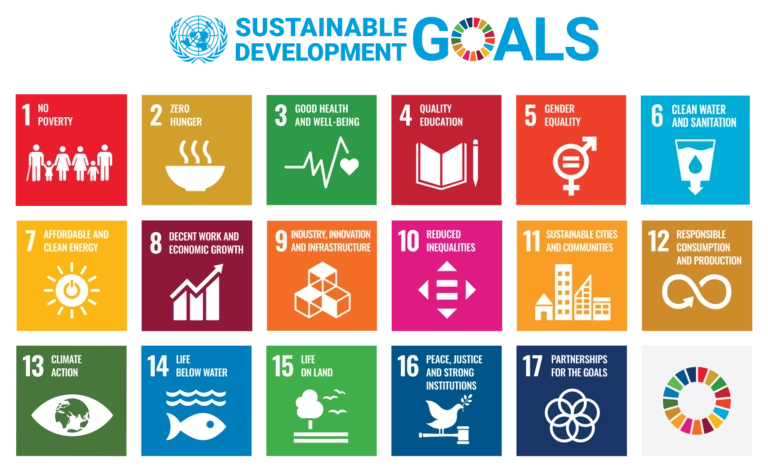
The 17 Sustainable Development Goals address a wide range of issues, including poverty, hunger, education, gender equality, and the environment. Many of the SDGs are currently seriously behind target, or even in reverse.
In fact, we are on track to meet only 17% of targets by 2030. The 2024 SDG Report revealed that progress on 50% of the targets is weak, and 30% have either stalled or actually worsened - a reassessment and expansion of the SDGs is urgently needed.
Jump straight to our resources on the ➡️ Limits & Deficits of the SDGs
Explore our comprehensive guides on -
-
The Sustainable Development Goals in General
Many of the current failings and omissions are down to the unwillingness of states and large companies, which hold the biggest influence, to implement and monitor the goals.
Major military powers such as the USA, Great Britain, and Russia have no interest in the abolition of nuclear weapons. Authoritarian states such as Saudi Arabia and China do not want to give their citizens a voice through free elections. Large fossil fuel companies are blocking the energy transition and preventing sustainable environmental protection.
Other hugely influential factors, such as unfair global trade agreements, the dominance of multinational corporations, and the destabilisation of financial markets, are not addressed by the SDGs, nor recognised as barriers to sustainable development.
Neoliberal capitalism feeds off profits, greed, power, and corruption. They have taken precedence over social interests for far too long. As long as capitalism is king, unchecked pollution and climate change will continue unchecked, as well as vast economic inequality, austerity, tax havens, repression, the inhumane treatment of refugees, and modern slavery.
The annual State of Food Security and Nutrition in the World report by the UN revealed that the number of people suffering chronic hunger has barely changed over the past year. 733 million people faced hunger in 2023 – the equivalent of one in 11 people.
Militarisation, Arms Exports & Nuclear Weapons
As the biggest threat facing humanity, nuclear weapons are only very indirectly referred to in the SDGs under Goal 16, which promotes peaceful and inclusive societies for sustainable development and the reduction of all forms of violence.
Not one of the SDGs calls for the complete abolition of nuclear weapons. When we consider that nuclear weapons have the ability to destroy all life on Earth, this is a terrifying omission.
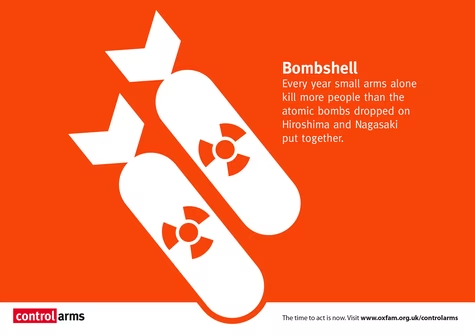
The SDGs also do not adequately address global defence spending, which is currently at a record high of $2.2 trillion. Increasing international tensions, militarisation, the military-industrial complex, and the greed of private weapons contractors have caused military budgets to bloat at the expense of other societal needs, such as education, healthcare, and infrastructure, which are drained of financial resources.
International arms trade agreements are another notable omission. Strong global arms trade policies are essential to prevent weapons from finding their way into unstable areas. Arms exports fuel conflict, human rights abuses, violations of international humanitarian law, repression, displacement, death, and suffering.
The business of arms exports alone is worth a staggering $112 billion annually.
How can we possibly aim for sustainable development while the world is being flooded with weapons of death and destruction?
The principle of Goal 16 is to "Build peaceful, just and inclusive societies", but without conflict prevention, de-escalation, disarmament and nonviolent resolutions, we can't possibly hope to hit this target. One quarter of the human population is currently living in areas experiencing violent conflict - the equivalent of two billion people. While this is the case, all of the other SDGs are compromised.
Climate Action, Life on Land, and Below Water
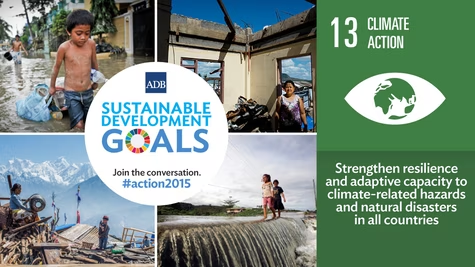
A key deficit of the SDGs is the lack of emphasis on the urgency of climate change. While Goal 13 of the SDGs addresses "combating climate change and its impacts," it does not emphasise the immediate threat, focusing instead on resilience and adaptation.
We are drastically off track from limiting global warming to 1.5°C. Emissions need to be already decreasing, and by 2030, need to be cut in half in order to achieve this goal. The current pace and scale of climate action are entirely insufficient to address climate change. Extreme weather events are already significantly more frequent and intense. No region on Earth is unaffected.
Goal 13 also fails to specify quantifiable targets for emission reductions or time frames to work towards. This contrasts with the scientific recommendations of the Intergovernmental Panel on Climate Change (IPCC), which advocate for a drastic reduction in greenhouse gas emissions by 2030 and net-zero emissions by 2050. Without specific and monitored targets, governments and industry will continue with impunity, and the energy transition will become impossible.
The SDGs are interconnected in their nature. One cannot succeed without the other. Failure to meet Climate Action targets has negative implications for the Clean Water, Sustainable Cities, Life Below Water, Life on Land, Reduced Inequalities, Clean Energy, Hunger, Responsible Consumption, and Peace goals. The implementation of climate protection measures, therefore, requires a holistic view and coordination with the other development goals.
The absence of biodiversity as a goal is another gaping oversight. Although Life Under Water and On Land are featured, neither of them explicitly mentions species, habitat, or ecosystem protection. We are currently experiencing a rate of species loss 1,000 to 10,000 times higher than the natural extinction rate.
More than 45,000 animal species worldwide are threatened with extinction. Loss of coral reefs, overdevelopment, agriculture and deforestation have led to a 47% decline in natural ecosystems.
Animal rights are another important issue that the SDGs do not address. Every creature on Earth has the right to exist free from pain, suffering, fear, and abuse. Practices such as the illegal wildlife trade, factory farming, industrial agriculture, animal testing, and the fur industry must be challenged. The view that animals are here solely for the exploitation of humans is not only morally wrong but also hinders sustainable development.
Social Justice
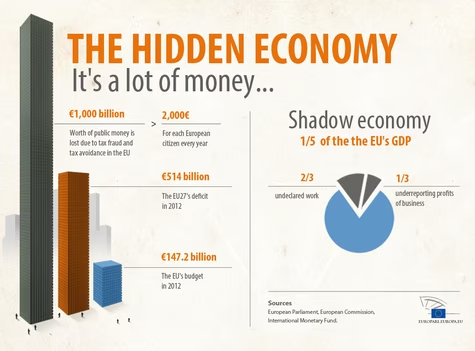
Corruption and tax havens undermine trust in our institutions and make it more difficult to implement the SDGs. Current global tax justice is inadequate and failing to control spiralling inequalities. Although the SDGs do include reduced inequalities in Goal 10, the problem of tax avoidance and evasion by multinational companies is not directly addressed.
Globally, 25% of public spending is lost to corruption. It affects every corner of our society, purging money from healthcare systems, education, infrastructure, social protection, governance, and the energy transition.
There are now 117 million people who have been forcibly displaced from their homes, and over 36 million refugees. We need to meet the needs of refugees and migrants, as well as address the root causes. Safe and orderly migration is included in goal 10, but there is no mention of addressing the specific challenges and needs of people caught in dire circumstances.
Other notable absences in the social aspects of the SDGs include a lack of mental health goals, recognition of senior citizens, culture, the role of communities, and the importance of science and research.
One in four people will struggle with mental illness in their lifetimes. With increasing numbers of people enduring conflict, displacement, loss of livelihoods, human rights abuses, poverty, and many other issues, we expect this number to grow. Quality, accessible mental health care will improve the quality of life for millions and, therefore, positively impact our society as a whole.
With ageing populations in many parts of the developed world, we must not overlook this valuable yet vulnerable demographic. The SDGs focus on future generations; however, many social issues affect senior citizens, such as social isolation, poverty, lack of social security, ageism, and the costs of healthcare.
The SDGs mention promoting tolerance and cultural diversity, but they do not address in detail the preservation or protection of cultural identities, languages, and knowledge. Cultural activities and the arts contribute to social integration, fortify cultural heritage, tackle social injustice, bring prosperity, raise awareness of important issues, and can form the beating heart of a community.
We believe that the SDGs should focus more on the role of cities and local communities, as they are the ones facing the impacts of global challenges and play a key role in implementing the SDGs at the regional level. There should also be greater emphasis on the importance of science, scientists, and research, as without investment in these fields, we will not be able to overcome any of the world's greatest challenges.
Politics & Democracy
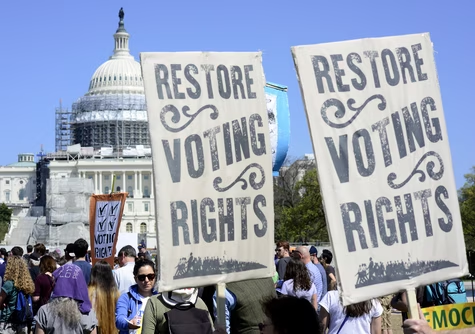
Despite the essential role that democracy plays in achieving sustainable development, it is not mentioned at all in Agenda 2030. Goal 16 mentions building effective, accountable, and inclusive institutions at all levels and access to justice for all. But the emphasis on democracy as a tool for peace and sustainable development is missing. Citizen participation, political education, the involvement of women, equality, and the rule of law are all crucial factors for achieving the SDGs.
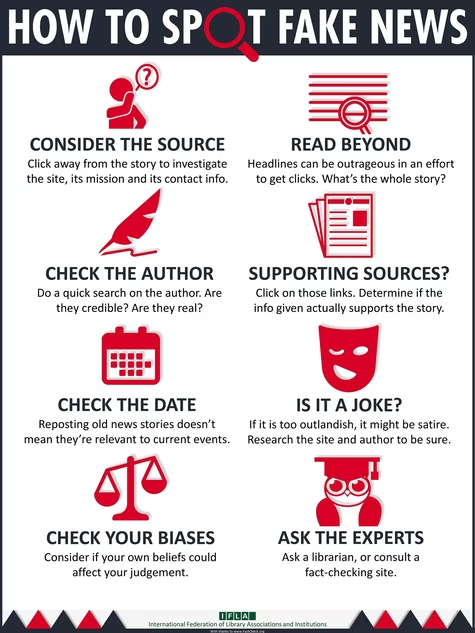
Freedom of information and freedom of the press are key in democratic, fair governance and elections. In a world where fake news and disinformation are becoming increasingly common, free and independent news sources, as well as media literacy, are essential for a functioning democracy and an informed citizenry.
Goal 4 places great emphasis on inclusive and quality education for all, as well as lifelong learning, but civic education is not mentioned. Political understanding is crucial to creating an active and informed population able to participate in democratic processes and make informed decisions.
Political awareness helps citizens to understand the world, their rights and responsibilities, and to strive for a fairer and more sustainable planet.
The need for transparency is essential; again, it is not stressed as an important factor in the SDGs. It has proven to be the number one tool in the fight against corruption and in the strengthening of citizens' trust in public institutions.
Governmental transparency has now become much easier with the concept of open source and modern technology. Open government allows free access to government-held information and enables citizens to be informed about and involved in government proceedings.
Technology & Digitalisation
Automation, computers, robotics, and artificial intelligence are changing our world at a breathtaking pace, yet these technological advancements barely feature in the SDGs. The potential advantages and use of these tools to solve our biggest problems have been overlooked entirely.
We must also be aware of the risks and dangers that unregulated technological development could pose. Artificial intelligence and robotics are already fundamentally changing the way we work and live. Issues such as cybersecurity and data protection are completely overlooked despite global challenges already arising.

Sharpening the SDGs for a Better World
We fully support the SDGs as an essential framework for a better world. However, given the number of shortcomings and the lack of specific timeframes, we believe the goals must be further developed and aligned with the complex challenges of our time.
As today's global problems become increasingly connected and multi-layered, we must ensure that issues such as pandemics, the consequences of climate change, and digitalisation are integrated into the goals.
Given how rapidly things change in today's modern world, a critical reassessment of the SDGs would ensure that deficits are addressed and the goals expanded to incorporate missing areas.
The unequal distribution of wealth and access to opportunities between the global north and south must also be taken into consideration. Geographical location, political circumstances, and resource availability all affect a country's ability to implement actions towards the goals.
One thing is for sure: if large companies and world leaders continue to block sustainable environmental protection, comprehensive human rights, the energy transition, and disarmament projects, the implementation of the SDGs will fail.
Strict timelines, sanctions, and legally binding penalties for non-compliance are the only way to promote consistent pursuit of the goals. However, without a global consensus, there is little hope of ending impunity.
By highlighting the SDGs' shortcomings, we hope to raise awareness and instigate change. Through greater synergy, cooperation, and knowledge sharing, our aligned goals of peace and a better world for future generations will become achievable.
Author: Rachael Mellor 06.10.23 (Updated 12.01.26) based on the original German article by Maximilian Stark & Norbert Stute 26.09.23 licensed under CC BY-ND 4.0
For more information on the Limits and Deficits of the SDGs see below ⬇️
More Resources
Curated Directory & Deep-Dive Resources on SDGs Review & Reform
- *Must read* - Limits and Deficits of the SDGs - a Critical Perspective by BETTER WORLD INFO, 2023 * 425069
- UNDP - Anti-Corruption and SDGs 425124
- Goals not guns - ATT Monitor 425077
- SDG 18 - It’s time to add Zero Animal Exploitation to the Agenda 425111
- Efforts to track illicit financial flows need scaling up - UN Trade 425083
- Securing SDG progress and inclusion for refugees - IRC 425138
- Three ways we need to change to meet the SDGs by 2030 - UN Global Compact 425146
- Don't Bank on the Bomb - Controversial weapons VS the SDGS 425072
- Mapping the impact of illicit trade on the SDGs - UNCTAD 425120
- Putting Animals into the 2030 UN Sustainable Development Goals - Animal Interfaith Alliance 425109
- Farm animal welfare - The canary in the mine for the UN's SDGs - Food Ethics Council 425107
- Runaway military spending and emissions: an urgent overlooked development issue - Transform Defence 425078
- The Missing Pillar – Culture's Contribution to the UN Sustainable Development Goals - British Council 425080
- The Peace Goal: Goal 16, the conflict trap and missing statistical capacity - Vision of Humanity 425074
- Salvaging SDGs still possible, but countries must act now: Guterres - UN News 21.07.25 483414
- Scaling up or losing steam? Parliamentarians debate the future of the SDGs - UN News 13.02.25 456922
- A Proposal for SDG 18: Integrating Indigenous Knowledge - NewSecurityBeat 22.01.25 454035
- Why Funders Must Step Up Financing for Development in 2025 - Global Issues 19.12.24 446411
- Researchers call for reform to UN Sustainable Development Goals ahead of 2030 deadline - University of Bath 14.09.24 425065
- Global finance system: Reforms urged to meet SDGs by 2030 - APA 23.07.24 425148
- The Sustainable Development Goals: can they be made smarter? - Nature 19.06.24 425145
- Digital skills within the Public Sector: A missing link to achieve the Sustainable Development Goals - ResearchGate 12/23 425141
- SDG Summit: A missed opportunity for freedom of expression and information - Article19 21.09.23 425131
- If the SDGs are to survive, multilateral development banks must embrace reform - Chatham House 21.09.23 425066
- 10 criticisms of the UN’s Sustainable Development Goals - The Africa Report 18.09.23 425101
- It's halftime for the SDGs but girls are left on the sidelines - Malala Fund 13.09.23 425118
- Missing the Sustainable Development Goals - Citizen Good 12.07.23 425087
- Missing the SDGs: Political accountability for insufficient environmental action - Wiley 25.04.23 425088
- SDGs without food system reform are missing the elephant in the room - Sentience 31.03.23 425114
- Anti-corruption is the missing SDG - Accounting Today 27.03.23 425095
- Why we can’t meet the SDGs without ending the digital divide - WEF 22.03.23 425143
- “The Sustainable Development Goals under scrutiny” - Open Edition 03/23 425150
- Including animal welfare targets in the SDGs: the case of animal farming - OUCI, 2023 425108
- Revisiting the Goals of Sustainable Development - Counterpunch 25.11.22 423463
- The effect of taxation on sustainable development goals: evidence from emerging countries - Science Direct 09/22 425122
- Missing in our SDG goals: The welfare of animals - HT 23.07.22 425092
- Mainstreaming animal welfare in sustainable development - EU Agenda 05/22 425113
- Journal: UN Sustainable Development Goals and the “Refugee Gap”: Leaving Refugees Behind? - Oxford 03/22 425132
- Animal Welfare Matters for Sustainable Development: UNEA 5.2 is an Opportunity for Governments to Recognize That - IISD 26.02.22 425115
- Entrepreneurs as essential but missing actors in the Sustainable Development Goals - Elgar Online 11.02.22 425130
- Why include animal welfare in the 2022 declaration? - WFA 07.09.21 425110
- Developing nations push to define ‘unacceptably vague’ adaptation goal - Climate Home News 19.08.21 425102
- Report: Guns or growth? Assessing the impact of arms sales on sustainable development - Amnesty 08/21 425076
- Beyond Cruelty Urges United Nations to Add Zero Animal Exploitation to its Sustainable Development Goals - Plant Based News 21.06.21 425106
- Tax Havens Are Sabotaging the SDGs - Project Syndicate 01.03.21 425121
- Alleviating debt distress and advancing the sustainable development goals - Wiley, 2021 425151
- Room for one more? Why tax justice should be the eighteenth SDG - Responsible Investor 21.10.20 425117
- The World’s Sustainable Development Goals Aren’t Sustainable - FP 30.09.20 425105
- The Missing SDG: Ensure the Digital Age Supports People, Planet, Prosperity & Peace - SDA 10.09.20 425142
- The Global Goals: Much nicer than guns - Karma Colonialism 08/20 425089
- Priority reforms to advance SDGs and counter illicit financial flows - TI 24.07.20 425123
- Time to revise the Sustainable Development Goals - Nature 14.07.20 425147
- How Animal Protection Impacts All 17 U.N. Sustainable Development Goals - Animal People Forum 01.07.20 425112
- Publication: Military spending and the achievement of the 2030 agenda for sustainable development - UN-iLibrary 06/20 425084
- The Missing Middle: Connected action on agriculture and nutrition across global, national and local levels to achieve Sustainable Development Goal 2 - Science Direct 03/20 425096
- The new indicator on refugees in the SDG indicator framework is a game-changer - JIPS 04.12.19 425135
- Including forced displacement in the SDGs: a new refugee indicator - UNHCR 02.12.19 425137
- The Missing SDG – what should be added? - TOP 15.11.19 425086
- Expansion of sustainability science needed for the SDGs - Nature 24.09.19 425071
- Serious about sustainability? Get serious about corruption - WEF 23.09.19 425125
- Report: Missing Persons: Refugees Left Out and Left Behind in the SDGs - IRC 23.09.19 425098
- Journal: The Importance of the Arms Trade Treaty for the Implementation of the Sustainable Development Goals - Oxford 03.06.19 425082
- ‘Missing SDG’ is theme of latest Media Development journal - WACC 15.05.19 425100
- Missing Persons: Refugees Left Out and Left Behind in the SDGs - Migration Data Portal, 2019 425133
- ‘Invisible problem’ to global priority: The inclusion of mental health in the Sustainable Development Goals - White Rose, 2018 425139
- Arms trafficking / Curbing illicit arms is key to achieving the SDGs - Enact Africa 01.12.17 425081
- The missing ingredient? Adding knowledge to Agenda 2030 and the Sustainable Development Goals - The Broker 08.11.17 425094
- What's missing from action on sustainable development - GreenBiz 17.10.16 425129
- Why are languages missing from the Sustainable Development Goals? - University of Reading 09.10.17 425091
- Data: The Missing Link in Meeting the SDGs - ADB 17.08.16 425144
- Leaving no one (apart from migrants and refugees) behind - New Humanitarian 25.07.16 425134
- No sustainable development without tackling corruption: The importance of tracking SDG 16 - TI 17.07.17 425128
- Sustainable development goals and mental health: learnings from the contribution of the FundaMentalSDG global initiative - Cambridge 09.09.16 425140
- If you really care about sustainable development, you better think about defense - Transparency International 07.06.16 425079
- What's missing from the SDGs - Devex 30.05.16 425085
- Briefing: Why criminal justice reform is essential to the 2030 UN Agenda for Sustainable Development - Penal Reform, 2016 425068
- Effective evaluation for the Sustainable Development Goals - IIED, 2016 425070
- Report: Move the nuclear weapons money - IPB, PNND, WFC, 2016 425075
- What works and what's missing in the new global goals - Devex 03.11.15 425097
- Sustainable Development Goal 16: Am I the Only One Who Thinks It Is a Major Setback in the Fight Against Corruption? - GAB 30.09.15 425127
- Five reasons to think twice about the UN’s Sustainable Development Goals - LSE 23.09.15 425116
- A missing target in the SDGs: Tax systems should not reduce the income of the poor - IGC 23.06.15 425119
- UN warned of pitfalls of vague SDG targets - Sci Dev Net 16.02.15 425103
- First goal of UN sustainability targets should be to not conflict with each other - Conversation 07.10.14 425104
- Transforming the development agenda requires more, not less, attention to human rights - OpenDemocracy 09/14 145553
- 7 reasons we need a Sustainable Development Goal on reducing economic inequality - NEF 07/14 145562
- Unifying Sustainable Development Goals: How Cultural and Creative Engagement are the Missing Links to Advancement - ECSDEV 01.02.12 425099