Neoliberalism & Globalization
Your ultimate directory on neoliberalism, globalization, and capitalism. Find essential books, podcasts, and independent research on profit over people.
WHAT IS NEOLIBERALISM?
Discover the ideology of neoliberalism and free-market competition and learn how governments and businesses are beginning to challenge its dominance. Our economic guide offers you in-depth information on the erosion of social welfare, the privatisation of vital public services, and the rising global inequality it creates.
Connect with hundreds of valuable resources, initiatives, and organisations – for genuine economic alternatives, revitalized public systems, and a sustainable future that puts collective well-being before corporate profit.
Neoliberalism is a political and economic ideology that advocates for free-market competition. Capitalism, deregulation, and reduced government intervention and social spending are characteristics typically associated with this approach.
Jump straight to our resources on ➡️ Neoliberalism
One of the main criticisms of neoliberalism is that it prioritises corporate growth over social welfare. The ideology may be a key driver of corporate growth, but it is at the expense of massive wealth inequality, public services, labour rights, and democratic institutions.
Foundations of Neoliberalism
- Privatisation - The control of public services and state-owned industries is shifted to the private sector.
- Deregulation - To encourage market entry and trade, government oversight, restrictions, and red tape on businesses and financial markets are reduced.
- Fiscal Austerity - Government spending is minimised, resulting in funding cuts for social safety nets and public welfare programs.
- Free Trade - To enhance globalisation and international economic cooperation, tariffs, trade barriers, and capital controls are eliminated.
- Individual Accountability - As consumer-citizens, we are responsible for our own economic outcomes, health, and education.
Brief History of Neoliberalism
The origins of neoliberalism came from mid-20th-century economists such as Friedrich Hayek and Milton Friedman. Believing that state planning and government-managed economic models led to inefficiency and a lack of personal freedoms, they developed this new concept as an alternative.
The term was coined in the 1930s as a middle ground between pure laissez-faire capitalism and state socialism. By the late 1970s and 1980s, it was embraced by global institutions such as the International Monetary Fund (IMF) and the World Bank, which began pushing for market liberalisation in developing countries.
It went on to become the dominant global economic policy model during the 1980s after being embraced and popularised by leaders such as Margaret Thatcher and Ronald Reagan.
Criticisms of Neoliberalism
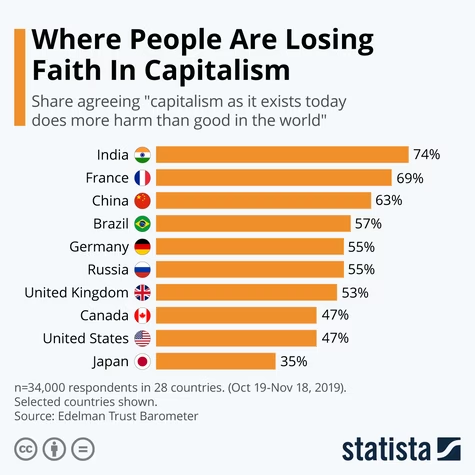
Despite the known benefits that neoliberalism sparks economic growth, global trade, and innovation, these advantages come at a high price. Major criticisms outlined by political scientists and economists include:
- Profit Over People & the Planet - This pro-corporate ideology prioritises wealth over human welfare. Workers' rights are compromised by relaxed protections. Individuals are reduced to mere consumers as decision-making power is stripped from elected governments and vested in corporate entities that prioritise wealth. Environmental resources are treated as commodities to be exploited in the pursuit of economic growth.
- Tax Evasion - Market deregulation has enabled the rapid growth of tax havens, allowing large corporations to avoid taxation, thereby further starving public services and enriching the few. Corruption is now fundamentally built into neoliberalism.
- Rising Inequality - Capital deregulation suppresses wages for low-skilled workers, increasing income and wealth disparities. Privatisation further excludes marginalised communities, increases consumer costs, reduces service quality, and exacerbates inequality.
- Market Failures in Public Goods - Applying market logic to vital public sectors like healthcare and education often leads to underfunding and unequal access based on income. Treating healthcare as a market product fails to prioritise clinical need. Schools and universities are pressured to work like businesses. Funding cuts lead to understaffing, staff burnout, and crumbling infrastructure. Private and outsourced services then step in, siphoning further money from public services and excluding low-income groups from access to quality services.
- Financial Instability - The reduction of economic regulations has historically contributed to large-scale global financial crises and market volatility. It promotes excessive risk-taking, drives debt accumulation, and makes developing economies particularly dependent and vulnerable.
- Erosion of Community - The focus on individualism and consumer identity leaves collective well-being an afterthought. Neoliberalism weakens social bonds and collective civic institutions. Reduced public spaces and community areas worsen the issue. Stagnant wages and poor worker protection mean that more time is spent trying to survive economically than in building community and participating in society.
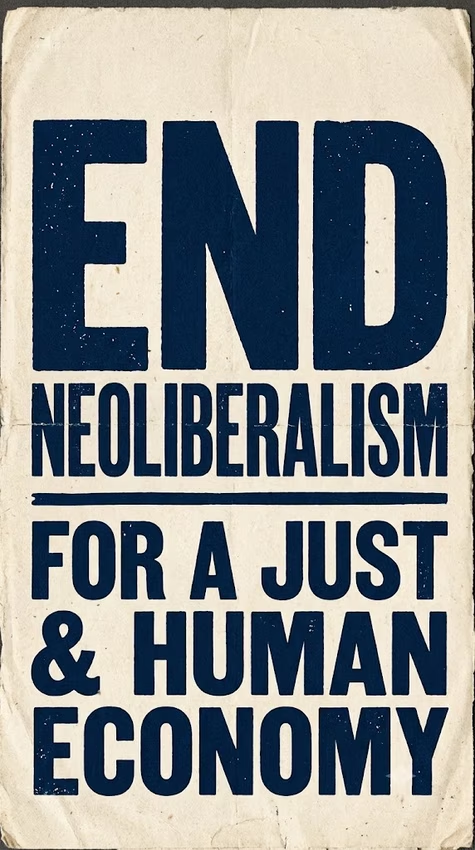
The End of Neoliberalism
Experts have been touting the need for a replacement for years to reduce inequalities, protect developing economies and the environment, and rein in the destructive monopolies of multinational and transnational corporations.
Western nations are increasingly seeking ways to shift away from policies that prioritise profit over everything else. The increasing dominance of Big Tech and its unexpected influence on politics are causing global alarm, prompting nations to act more quickly to implement state intervention.
Calls for renationalisation, expansion of trade unions, taxes for the rich, economic redistribution, and a global minimum corporation tax are growing louder.
As neoliberalism faces a profound crisis of legitimacy, economists are left asking what the alternative is. A clear replacement is yet to take shape, but current trends show that nations have begun to prioritise security and regional resilience over global integration.
The challenges of the 21st century, such as climate change, increasing conflict and tensions, and the COVID-19 pandemic, have exposed its core vulnerabilities. A transition toward something new is almost inevitable.
With the rise of right-wing leaders such as Trump, Erdoğan, Netanyahu, Le Pen, and Farage shaping the global political landscape, the future hinges on whether governments use their power to entrench their own nationalist control or, alternatively, begin to sufficiently invest in public healthcare, education, wealth equity, and climate survival.
Author: Rachael Mellor, 12.07.26, licensed under CC BY-SA 4.0
More Resources
Curated Directory & Deep-Dive Resources on Neoliberalism & Globalization
- Information 21
- Guides 13
- Critical Voices 141
- Trilateral Commission 12
- Bilderberg Group 49
- Research Institutes 7
- United Nations 2
- Supply Chain Crises 51
- NI 4/98 15