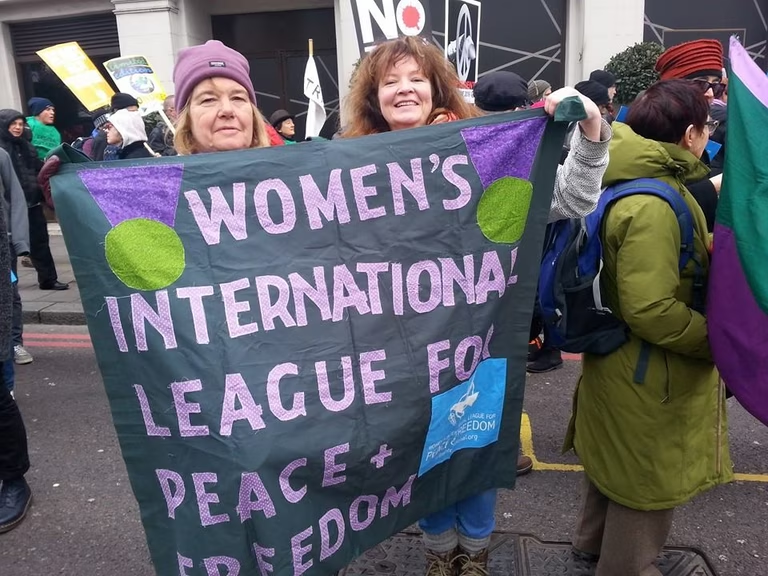
Women's International League for Peace and Freedom - WILPF
Discover WILPF's century of feminist peace activism. Explore how they address root causes of conflict, promote disarmament, and advance gender justice.
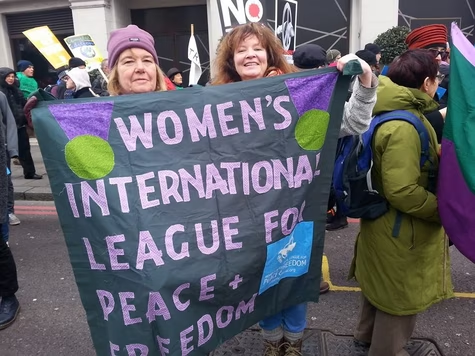
WOMEN’S INTERNATIONAL LEAGUE FOR PEACE & FREEDOM (WILPF) - Promoting Peace Through a Feminist Lens
Discover the vital role of women in peacebuilding and learn how you can actively support the movement toward permanent peace. Our guide offers you in-depth information on WILPF and their century-long commitment to disarmament, gender equality, and non-violent conflict resolution.
Connect with hundreds of valuable resources for meaningful feminist peace activism, systemic social justice, and a more peaceful future.
In September 2026 WILPF US was awarded the U.S. Peace Prize
Jump straight to our resources on ➡️ WILPF
*****
General Information
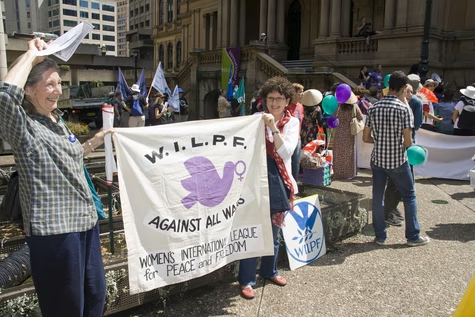
Founded in 1915, WILPF is the oldest women's peace organisation in the world. They now have operations in 40 countries and have more than 4,500 members.
Their goal is to create permanent peace by addressing the root causes of violence and conflict - "Together women from around the world who are united in working for peace by non-violent means, promoting political, economic and social justice for all".
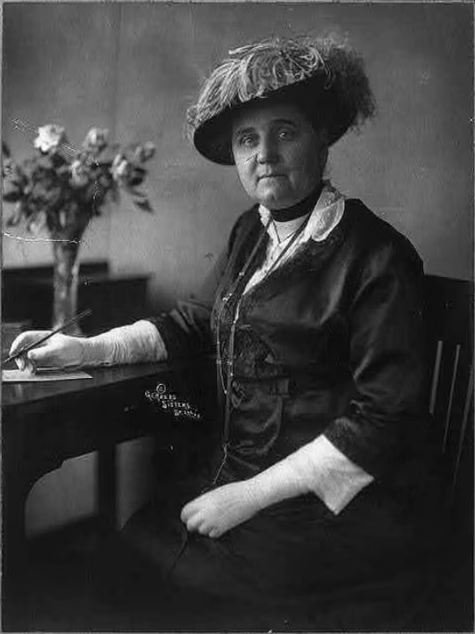
The organisation was founded by prominent peace advocates during World War I. The founders were pacifists Jane Addams, Emily Balch, and Marian Cripps, who refused to accept war as an inevitable fate.
For over a century, these courageous women and all of their members since have been at the centre of the women's peace movement. WILPF puts dialogue, justice, and cooperation at the forefront of peace discussions - not violence. Gender justice and social change are integral to their movement.
Explore our comprehensive guides to feminism, inspiring feminists, organisations, and pacifism.
The current president of WILPF is Sylvie Jacqueline Ndongmo. With more than 2 decades of experience and as the founder of WILPF Cameroon, she has seen firsthand the devastating consequences of war. She is a firm believer in the UN 'Leave no one behind' principle – the central commitment of the 2030 Agenda and Sustainable Development Goals.
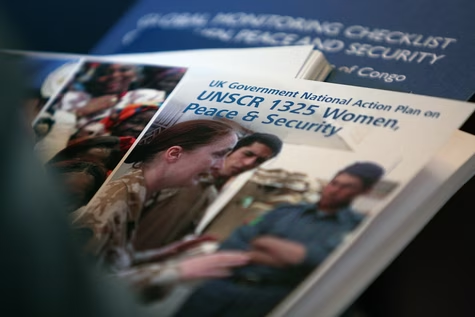
One of WILPF's most significant achievements was its advocacy for the drafting and adoption of ➡️ UN Security Council Resolution 1325 on Women, Peace, and Security.
Adopted in 2000, this was the first time the Security Council formally addressed the impact of conflict on women and recognised their essential role in peacebuilding and conflict resolution. The resolution ensures the equal participation of women in peace processes, conflict prevention, and reconstruction post-conflict.
Included in its core pillar is the protection of women and girls during and after conflict. Women suffer disproportionately from rights abuses such as sexual and gender-based violence as well as other issues such as displacement, hunger and poverty – yet historically they have been left out of the peacebuilding process.
Methods To Achieve Permanent Peace
Human Rights - Within the various United Nations human rights bodies, WILPF highlights the human rights impacts of the arms trade, nuclear weapons and rampant military spending. Militarism diverts resources into weapons and conflict, causing untold harm and draining social funding. They also support women human rights defenders and feminist activists working within these bodies.
Women, Peace & Security (WPS) - WPS advocates for feminist solutions that prevent and respond to conflicts. Through monitoring, analysis, campaigning, and advocacy, they challenge traditional male power dynamics with the aim of integrating feminist collective power, shifting social norms, and instigating policy change. They also promote the meaningful participation of women in peace and security on a global level.
Disarmament - (The Reaching Critical Will Programme) - By promoting feminist and anti-militarist values, WILPF challenges and prompts change to the policies surrounding militarism. Weapons are a leading contributor to armed conflict and violence, and the international arms trade continues to soar. In 2024, revenues from the sales of arms and military services by the 100 largest companies reached a record $679 billion.
Mobilising Men – With partners in Afghanistan, Cameroon, Colombia, the Democratic Republic of the Congo, Nigeria and Yemen, this project focuses on the forces that contribute to men's violence. Issues include patriarchal norms, colonialism, poverty, inequalities, land dispossession, climate change, food insecurity, corruption, and the war on drugs. WILPF works with advocacy, awareness and activism to tackle these causes at the root and mobilise men to join the feminist peace movement.
Ecological Justice – Without environmental and climate justice, there can be no permanent peace. The two factors are inextricably linked. War and conflict are significant contributors to the climate crisis, and now climate change is exacerbating tensions, leading to more violence and conflict. WILPF analyses the impacts of militarism on the environment and people. The fight for justice for the communities on the frontlines of climate change, environmental devastation, and war.
Feminist Political Economy – Peace is not just the absence of war and violence. It is achieved when societies are thriving, sustainable, just, equal and inclusive. Capitalism is the enemy of this objective, a system built on greed, consumerism, exploitation, rights abuses, oppression, and environmental destruction. The concept of a feminist political economy challenges and seeks to transform our current system of inequalities and injustices. Instead, it aims to create an economy built upon ecological sustainability and solidarity within and across borders.
Countries In Focus - MENA
In the last five decades, WILPF has turned its attention to the MENA region (Middle East and North Africa), a part of the world which has suffered generations of political instability, humanitarian crises, displacement, militarisation, and harmful patriarchal norms. WILPF's aim in this region is to 'define, defend and develop a space for the advancement of peace, equality, justice and demilitarised security' which is currently severely lacking.
They unite women's rights activists and organisations across the entire region to empower and amplify women's voices and build a culture of lasting, sustainable peace.
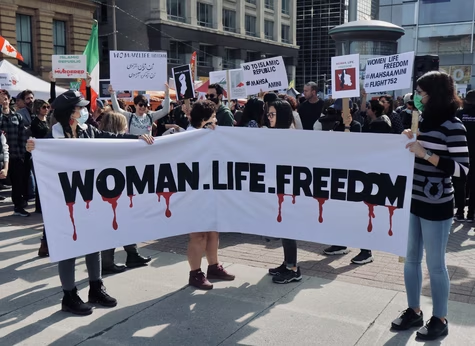
Iran - Since the death of Mahsa Amini in 2022, widespread non-violent protests under the slogan 'Woman, Life, Freedom' have erupted across Iran, demanding an end to gender discriminatory laws and the oppressive regime. Authorities have responded with brutal force, resulting in over 500 deaths, numerous injuries, thousands of arrests, and at least 26 death sentences. Many Iranians have fled to neighbouring countries to escape persecution. Amid a deepening economic crisis, anti-governmental protests have gained new momentum in 2026.
Afghanistan - Since the Taliban takeover in 2021, the rights of Afghans, especially women and girls, have been stripped back. Women are denied education and freedom, and are excluded from all aspects of society. The country is in the grips of a dire humanitarian crisis worsened by the Taliban's control of massive arms and weapons stockpiles left behind by the U.S. after the war. This weaponry is worth an estimated $7.12 billion and is now fuelling Taliban atrocities and securing their grip on power.
WILPF is working to secure humanitarian aid, assist refugees, and fight for the rights of women and their participation in the political arena.
Ukraine - Since the latest round of conflict began in 2022, thousands of civilians have been killed, and millions have been forcibly displaced. The war has exacerbated poverty and deepened gender inequalities. Structural reforms and austerity measures have further diminished the space for women to participate in Ukraine's peace efforts. Female voices have, for the most part, been excluded from formal peace processes.
Palestine - Palestinians have spent more than 7 decades under Israeli occupation, where they face daily human rights violations which disproportionately impact women and girls. Israeli policies promote violence, land theft, restrictions on movement, poverty, and discrimination against Palestinians in all aspects of their lives.
WILPF works with grassroots women's organisations that are resisting these injustices, with the goal of amplifying women's voices, advocating for peace, and dismantling systemic discrimination.
Why Is The Role Of Women In Peace So Important?
History tells us that the vast majority of wars are started by men. In a study which analysed gender differences in military aggression from 1875 to 2004, men were found to be responsible for 694 acts of aggression and 86 wars. The same figures for women were 13 and 1.
Not only are women much less likely to initiate conflict, but their involvement in the peace process significantly increases its success. Women's participation increases the probability of a peace agreement lasting at least 2 years by 20% and lasting at least 15 years by 35%.
Despite this, between 1992 and 2019, only 13% of negotiators and 6% of mediators were women.
WILPF is dedicated to addressing this gap and ensuring that peace has the greatest possible chance of success. By campaigning and advocating for women, peace, and security at the national and global levels, WILPF has become a pioneer of feminist peace activism.
Their long history, intersectional approach, commitment to grassroots efforts, and success in shaping policy give us hope for a more peaceful and just future.
We stand up for the empowerment and inclusion of women in the peace movement and all sectors of society.
Author: Rachael Mellor, 15.01.25, latest update 28.09.26, licensed under CC BY-SA 4.0
More Resources
Curated Directory & Deep-Dive Resources on Women's International League for Peace and Freedom - WILPF
- Women's International League for Peace and Freedom - WILPF 503765
- WILPF International - YouTube Channel 503768
- WILPF US - YouTube Channel 503769
- X 505037
- Facebook 505035
- LinkedIn 505036
- Wikipedia 503764
- WILPF: Then And Now 505043
- WILPF - 2010 High-Level Review 505056
- Sylvie Jacqueline Ndongmo - Facebook 505039
- Peace & Pluralism - Sylvie Jacqueline Ndongmo 505040
- Peace Women - WILPF's approach 505044
- YouTube Search 503767
- #WILPF 503770
- Women's Peace Train - Wikipedia 505053
- WILPF International Programme (2026–2029) 523609
- The Choice Is Ours. We Choose Peace. - WILPF 21.09.26 523608
- 10 things you need to know about Women, Peace and Security - WILPF 13.10.25 505057
- On 29 August, the International Day against Nuclear Tests, WILPF calls for the end of nuclear weapons - Pressenza 29.08.25 505049
- Women’s International League for Peace and Freedom (WILPF) & Women’s Power to Stop War - Pressenza 25.08.25 505045
- Lessons from the WILPF Peace Train: A Q&A with Former Secretary-General Barbara Lochbihler - WILPF 20.08.25 505052
- Peace Trailblazer: "Peace and equality are inseparable. We will not achieve equality without peace, nor peace without equality" - UN Women 30.06.25 505047
- Video: WILPF 110 Anniversary: Message from WILPF Secretary-General and International President - WILPF International 24.04.25 505038
- Video: WILPF at the 2025 UN CSW: "Peace Train to Beijing's 30th year" - WILPF US 07.04.25 505054
- WILPF’s Statement on the Ceasefire in Gaza: A Call for Long-Term Peace and Justice in Palestine - Relief Web 23.01.25 505051
- ISHR and WILPF urge States to use Afghanistan's UPR to denounce gender apartheid - ISHR 13.02.24 505050
- The archive of the Women’s International League for Peace and Freedom - LSE 30.05.18 505048
- All aboard the peace train 1915-1919 - Arming All Sides 06/14 505055
- WILPF’s New President: Get to Know Sylvie Jacqueline Ndongmo - WILPF 505041
- 9 Ways Fossil Fuels Are Tied to Conflict — and How Feminist Peace Action Through the Fossil Fuel Treaty Can Stop It - Fossil Fuel Treaty 505046