
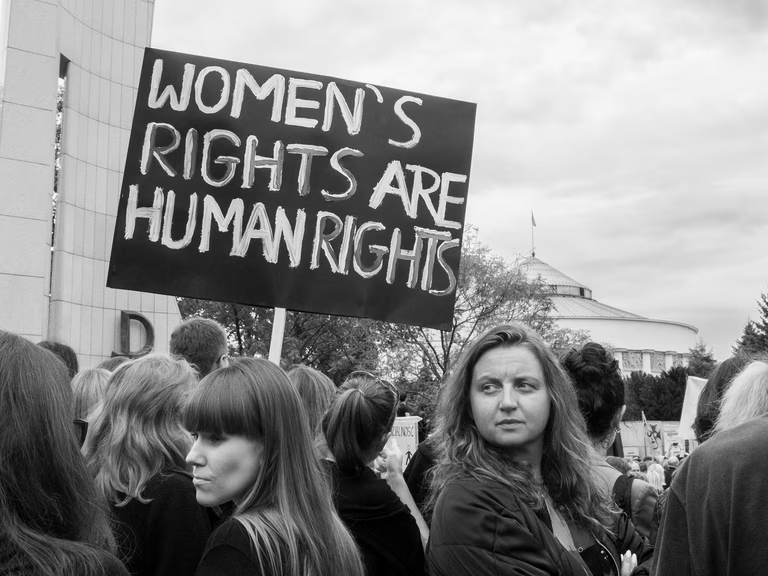
Violence against Women -
Explore comprehensive resources on eliminating violence against women. Learn about domestic abuse, femicide, gendercide, acid attacks, and war crimes.
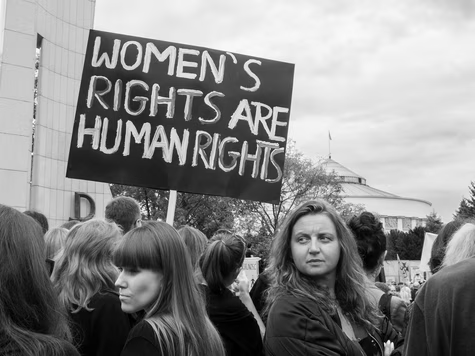
VIOLENCE AGAINST WOMEN - A Violation Of Women's Rights
Discover the epidemic of gender-based violence and the organisations and movements working to protect women's rights. Our comprehensive guide offers you in-depth information on gender equality, femicides, domestic abuse, and the great need for legal reform. Connect with hundreds of valuable resources, reports, initiatives, and organisations – for genuine societal change, robust protections, and hopes of a safer future for everyone.
Jump straight to our resources on ➡️ Violence Against Women
*****
General Information
Violence against women is a grave violation of human rights and a pervasive issue affecting societies worldwide. It manifests in various forms, including physical, sexual, and psychological abuse, and cuts across all social, economic, and cultural boundaries. The impact is profound, not only for the victims but also for families, communities, and societies at large.
Addressing this issue requires a comprehensive approach. Education plays a crucial role in changing societal attitudes and breaking the cycle of violence. Legal frameworks must be strengthened to ensure perpetrators are held accountable, and support systems for victims need to be robust and accessible.
Raising awareness is vital. By shedding light on the realities of violence against women, we can foster a culture of zero tolerance and empower individuals to speak out and seek help. Collective action, involving governments, organisations, and individuals, is essential to create a safer and more equitable world for all.
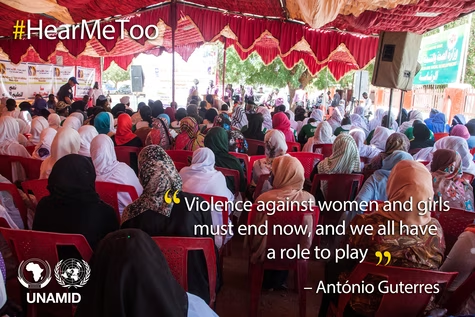
Global Trends In Violence Against Women
Violence toward women is not an isolated incident or a spontaneous occurrence; rather, it is a reflection of societal structure, and social, cultural, and legitimised institutional acceptance. Violence against women, instead of being recognised as a grave event, is tragically normalised within society. This normalisation stems from the persistent devaluation of women, perpetuated through a continuous cycle of oppression. It is reinforced by the collective rejection of women as equals and as human beings, with societal structures often condoning and minimising the violence inflicted upon them.
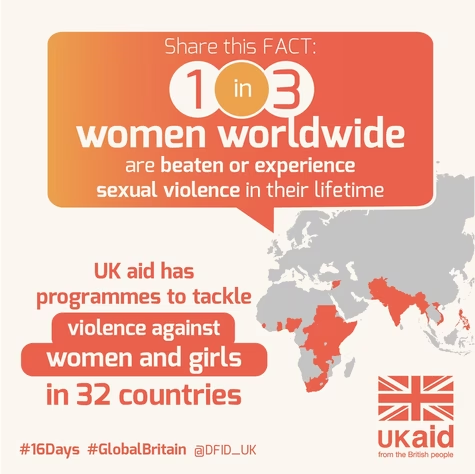
According to a report by UN Women, almost one in three women has been subjected to physical harassment or sexual intimate partner violence, or non-partner violence, at least once in their lifetime. The report further revealed that an estimated 263 million females aged 15 years and older report being subjected to sexual violence from someone other than their partner at least once in their lifetime.
Additionally, an Oxfam report stated that despite the absence of a singular reason fuelling such gender based violence, existing social norms continue to remain as consistent factors behind such inhuman acts. These norms, which are set forth by society, reflect the common understanding and expectations of how individuals should behave within the existing societal arrangement marked by male privilege and gender rigid roles in some countries of the world, including but not limited to parts of the Indian subcontinent, Latin America, the Caribbean and the Pacific.
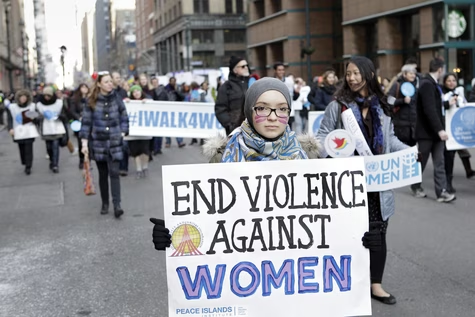
16 Days Of Activism For The Elimination Of Violence Against Women
Established by the United Nations General Assembly in 2000 and coordinated by the Centre for Women’s Global Leadership, the 16 Days of Activism Against Gender Based Violence is an annual global initiative that begins on 25th November (International Day for the Elimination of Violence against Women) and concludes on 10th December (Human Rights Day).
For 2025, the global theme is “UNiTE to End Digital Violence against All Women and Girls”. From online harassment and cyberstalking to deepfakes, cyberstalking, doxxing, and coordinated misogynistic attacks, technology-facilitated gender-based violence has emerged as a disturbing new form of abuse.
What Is Digital Abuse?
Any form of violation of human rights that occurs or is assisted or amplified through platforms or tools of communication and information technology which can result in any form of physical, sexual, psychological, social, political, or economic harm, can be termed as ‘digital abuse’. As technology has become an inalienable part of our everyday lives, it is being misused in troubling ways that harm women and girls. While this isn't a completely new phenomenon, the rise in tech-facilitated violence against them has escalated dramatically in recent years, creating serious risks to their safety and well-being all around the world.
The digital revolution has both exacerbated prevalent methods of gender-based violence paving the pathway for novel forms of abuse and harassment including but not limited to hacking, astroturfing, video and image-based abuse including deepfakes, doxing, cyberbullying, and online grooming among others. The very fact that digital tools make violence cheaper, anonymous and infinitely scalable makes digital abuse more concerning.
Different Forms Of Violence Against Women
While violence against women can manifest in different forms, we will keep our focus concentrated on domestic, psychological and sexual violence.
Domestic Violence
'Domestic' or 'family' violence, also referred to as 'intimate partner violence', encompasses any form of violence perpetrated by individuals within close social relationships. Domestic violence is commonly thought of as taking place in the home, however, much of the violence occurs in the greater family system or from an ex-partner. Thus, the perpetrator defines domestic violence, not the location of the incident. Most violence of this type is perpetrated to exert power and control over the victim, often a woman.
Psychological Violence
Psychological violence may include: intimidation by means of one's gaze and/or through one's body language, gesture or shouting at someone; coercing someone; and threatening to harm them. Emotional violence is usually accompanied by domination or subjugation, leading the affected to isolate themselves. In contemporary times, psychological violence increasingly manifests in online spaces, often escalating into overt forms of cyber violence.
Sexual Violence
Sexual violence refers to any form of sexual act that is non-consensual, forced or against the will of the other person. This is a crime against the legally protected right to sexual self-determination. This form of sexual violence ranges from verbal harassment through unwanted touching all the way to rape and female genital mutilation. Sexualized violence constitutes a profound violation of human rights. Employed as a weapon during crises and wars, it persists unabated even in peacetime, deeply entwined with entrenched patriarchal structures that transcend cultures, societies, and borders and and it is intricately linked with and embedded in patriarchal systems that exist beyond cultures and boundaries.
Case Studies From South Asia
Cases of violence against women are rampant across South Asia, a crisis further charged by religious interpretations that, in certain contexts, reinforce patriarchal dominance. As much as the feminine gender has been revered in different cultures and religions, there are facets of Hinduism, Islam and even Buddhism that subordinate women through patriarchal rules and interpretations. The rigidity of the Asian customs and traditions deters reporting and seeking justice, despite the existence of legal frameworks. Cross-cultural anthropological and ethnographic studies of violence against women found that physical chastisement of women was often necessitated by different cultures. A study conducted by Campbell in 1985 revealed a “macho” notion of masculinity linked with either dominance, ruggedness, or the honour of males, who were also seen to commit more violence against women.
Dowry-Related Violence in India
An estimated 20 women die every day owing to dowry-related violence. Dowries have been in India for the past sixty years. This however, is still prevalent today, and the deaths occurring because of dowry demands are not lessening. Talking about violence and torture from relatives regarding dowry is considered taboo in India. A dowry is defined as money, property, or security offered to a groom's family by a bride's family prior to their wedding (or also after their wedding). Such gifts are typically used as an incentive for potential brides to marry; however, as the dowry is given under duress, it should not be considered a gift or gift-like.
The Dowry Prohibition Act came into force in 1961. This retrogressive practice was prohibited by this legislation, and dowry giving or receiving was made a crime punishable by law. On the legal side, there are very strict laws to deal with the issues of domestic violence and dowry torture. Section 498 A of the Indian Penal Code, which is now Section 85 of the Bharatiya Nyay Samhita, makes physical or mental cruelty by the husband or the relatives a crime punishable by a three-year sentence with a fine.
Afghanistan’s ‘Baadal’
This type of marriage in Afghanistan involves a practice whereby girls are exchanged between families by marrying them differently in marriage, particularly to avoid the payment of the bride-price. Such marriages, though not very peculiar from child marriage, can also involve minors, especially daughters. In addition to that, such a culture can also lead to very early marriage due to the involvement of fathers, who might trade their daughters for a bride for themselves. Sometimes, such transfer marriages may put young girls at risk because the young girl is the vehicle through which revenge is exacted upon her natal family for any abuse of her husband's sister; however, a girl may also be less at risk since her in-laws have sent a daughter to the exchanging family, who would be treated reciprocally. This has been further corroborated by Deborah. J. Smith in 2009 in her seminal work titled ‘Decisions, Desires and Diversity: Marriage Practices in Afghanistan’.
Women's Rights For A Better World
Violence against women, whether physical, psychological, sexual, or digital, is not a mere expression of individual deviance but a manifestation of entrenched structural inequality. It is perpetuated by the interplay of patriarchal socialisation, cultural sanction, and institutional complicity that normalise subjugation and silence. Despite decades of activism and legal reform, the persistence and mutation of gender-based violence into new digital forms expose enduring systemic fragilities and the unfinished agenda of gender justice. Campaigns such as the ‘16 Days of Activism Against Gender-Based Violence’ reaffirm the global commitment to transforming outrage into sustained action. Yet, the ultimate success of such movements depends on their ability to provoke introspection, solidarity, and transformative governance that centres women’s lived realities in policy and public discourse.
Explore our article on the ➡️ International Day for the Elimination of Violence against Women for more information.
Recommended Reading:
- Global norms and standards: Ending violence against women - UN Women
- International Day for Elimination of Violence Against Women: Building a Safer, More Inclusive Digital India for Women (Press Information Bureau)
- Trapped by tradition: Why dowry still kills in India - Deccan Herald
- Witch-Hunting in Assam: Myth or Reality - Space and Culture, India
- Genital Mutilation or Genital Cutting, Female
Author: Tanuj Samaddar, Date: 21.12.25, latest update 07.09.26, licensed under CC BY-SA 4.0.
More Resources
Curated Directory & Deep-Dive Resources on Violence against Women -
- General Info 55
- Reports / Papers / Studies 47
- Domestic Violence 255
- One Billion Rising - February 14 24
- Femicide / Gendercide 248
- Women as Victims of War 314
- 16 Days of Activism Against Gender Violence - November 25 81
- International Violence Against Women Act (USA) 13
- Resolution 1325 on Women, Peace and Security 23
- Abuse during childbirth 72
- Acid attacks 50
- International Day for the Elimination of Violence against Women - November 25 74
- International Women Human Rights Defenders Day - November 29 55
- Istanbul Convention 7
- Selected Articles 74