
Veganuary
Discover your ultimate guide to Veganuary. Explore easy plant-based recipes, beginner tips, and how going vegan helps animals, your health, and the planet.

VEGANUARY – Go Vegan This January!
Discover the inspiring concept of Veganuary and learn how making the switch is much easier than you might think. Our guide offers you in-depth information on veganism and vegetarianism, healthy recipes, and the truth about the meat industry and factory farming.
Connect with hundreds of valuable resources, news sources, initiatives, and organisations – for genuine species conservation, improved animal welfare, and a sustainable future.
Jump straight to our resources on ➡️ Veganuary
*****
General Information
This 31-day challenge is the perfect way to start a healthier and more delicious new year. It pushes people to try new foods and learn to cook new meals, with the hope of encouraging people to integrate them into their lifestyles 365 days a year.
Established in 2014, the initiative is run by a British nonprofit organisation to make veganism more visible and accessible.
"Our mission is to inspire and support people to try vegan, drive corporate change, and create a global mass movement championing compassionate food choices with the aim of ending animal farming, protecting the planet, and improving human health." - Veganuary
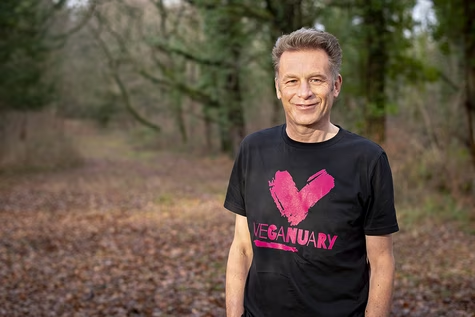
The campaign is supported by brands and restaurants that get on board by creating cookbooks, giving discounts, and releasing new products. Veganuary also has the backing of many high-profile celebrities, including Joaquin Phoenix, Billie Eilish, Paul McCartney, and Chris Packham.
The Veganuary effect means that the amount of animal suffering caused by the meat industry is massively reduced in January, and so is the devastating environmental impact that meat-based diets have on our planet.
"Veganism is not a sacrifice. It is a joy" - Gary L. Francione
Explore our comprehensive guides to the environmental impact of meat, animal rights, and the concept of a meat tax.
The Impact Of Veganuary
-
In January 2024, meat sales declined by 12.5% and 14.3% in January 2023.
-
Initially a UK-based initiative, there are now active campaigns in 20 countries.
-
During January 2025, 25.8 million people tried out the vegan diet.
-
Increasing the visibility and variety of vegan products, 1,480 new products were launched for Veganuary 2025.
-
After the 2025 campaign, 81% of participants planned a significant diet change. Of these, 32% remained vegan, and 33% reduced their animal consumption by at least 75%.
-
Regarding health benefits, 45% of participants reported improvements, including increased energy and improved mood.
-
The workplace challenge encourages employees to try vegan in January. Participating workplace cafeterias experienced a 57% increase in plant-based product sales.
-
A 2020 study estimated that for every 350,000 participants, 45,000 tons of CO2-equivalent are avoided.
-
In 2022, Veganuary participants saved over 2.16 million animals from suffering.
-
For every one million participants, an estimated 6.2 million litres of water are saved.
The Benefits Of Veganism
NO LONGER SUPPORT FACTORY FARMING
If the demand for meat and dairy products is reduced, the supply will inevitably fall. This reduced supply will lead to the deintensification of the industry and less needless suffering.
SECURING THE WORLD'S FOOD SUPPLY
The farming of animals for livestock is incredibly energy inefficient. Roughly 80% of the world's soybean crops are used for beef, chicken, egg and dairy production. Animal farming is a leading cause of food waste, with global food insecurity a growing crisis, and 828 million people suffering from hunger. Massive reductions in meat consumption could transform our food systems and alleviate hunger for millions.
REDUCED ENVIRONMENTAL IMPACT
The raising of livestock, along with their subsequent transportation and processing, contributes massively to the destruction of our natural world. Animal husbandry is a leading cause of soil degradation, biodiversity loss, greenhouse gas emissions, consumption and pollution of water sources, particulate matter pollution, deforestation, and the spread of infectious diseases.
SAVE THE PLANET!
Vegan diets release one-fifth of the CO² emissions that an omnivore diet does. The UN confirms that, as one of the top three contributors to the global climate crisis, a powerful way to help protect our planet is by dramatically reducing our consumption of meat, eggs, and dairy products.
HEALTH BENEFITS
Studies have proven that those following a well-balanced vegan lifestyle have a lower risk of diabetes, certain types of cancer, heart disease, and being overweight. A healthy vegan diet is actually richer in specific nutrients, including fibre, antioxidants, potassium, magnesium, folate, and vitamins A, C, and E.
Other benefits include lower levels of cholesterol and lower blood sugar levels, and switching to a plant-based diet can support weight loss.
By avoiding meat and fish, we can also avoid other issues which are not yet fully understood. Antibiotic resistance, for example, is a growing concern. The overuse of antibiotics in livestock is blamed for the emergence of resistant bacteria and potential superbugs.
Regarding fish and other seafood, the devastating ocean plastic crisis means that seafood eaters are ingesting up to 11,000 microplastics a year. Again, the consequences of which have not been fully researched.
*****
We believe that animals should not be exploited for our own benefit. They are not commodities to eat, wear, abuse, and profit from. After all, if we can't tell our children what we are doing to farm animals, then maybe what we are doing is wrong.
"If slaughterhouses had glass walls, the whole world would be vegetarian." - Linda McCartney
Better World Info supports the Veganuary initiative and all of its participants who are helping to make our world a kinder and more sustainable place.
Author: Rachael Mellor, 13.01.26, latest update 29.08.26, licensed under CC BY-SA 4.0
More Resources
Curated Directory & Deep-Dive Resources on Veganuary
- Veganuary (Official) 504950
- Veganuary - Recipes 504951
- BBC Food - Veganuary recipes 504952
- Peta - Veganuary Recipes: 20 Vegan Meal Ideas 504957
- @veganuary 504958
- Veganuary - Wikipedia 504953
- Matthew Glover - Wikipedia 504974
- Google Scholar 504257
- The ultimate Veganuary recipe bundle to avoid a boring, beige month - Independent 13.01.26 504961
- Veganuary 2026: Over A Third Of People In The UK Plan To Buy Plant-Based This Month - Plant Based News 11.01.26 504959
- Veganuary 2026: Over A Third Of People In The UK Plan To Buy Plant-Based This Month 11.01.26 504256
- Why Veganuary needs a broader conversation - In Good Taste 10.01.26 504972
- Veganuary Hopes You’ll Resolve to Ditch Meat, at Least for One Month - Good Men Project 09.01.26 504962
- Video: The Veganuary Podcast - Samantha Renke - Veganuary 08.01.26 504966
- My restaurant might not survive Veganuary - Telegraph 03.01.26 504960
- Veganuary can be a piece of cake: cooks and dietitians share 12 ways to make delicious plant-based food - Guardian 01.01.26 503234
- 20 Of The Very Best Recipes For Veganuary 2026 - Plant Based News 06.12.25 504955
- What Is Veganuary? Everything You Need To Know About - Health 29.09.25 504954
- Meat-eaters more likely to be disgusted by meat after taking part in Veganuary, study reveals - Guardian 21.12.24 447488
- Video: Launching Veganuary: Behind the Scenes with Jane Land - Jane Thurnell-Read 10.07.24 504978
- Video: Veganuary founders Matthew Glover and Jane Land reflecting on the past and envisioning the future - How I Learned to Love Shrimp 21.05.24 504979
- ‘I feel healthy, physically and mentally’: five people on how Veganuary changed their lives - Guardian 31.01.24 504981
- Government-Backed Meat Ad Campaign Targets Gen Z in Veganuary - DeSmog 19.01.24 395942
- ‘It worked because it’s an upbeat campaign’: Veganuary’s founders on 10 years of changing minds - Guardian 21.01.24 394679
- Veganuary at 10: it completely changed my life – but has the vegan bubble now burst? - Guardian 04.01.24 393778
- Veganuary - has veganism truly hit the mainstream? - DW 02.01.24 391935
- Video: It'll Never Catch On: The Veganuary Story - Veganuary 05.12.23 504971
- I went completely vegan for a month - and this is what happened to my body - Glamour 27.06.23 504965
- 13 Best New Vegan Foods To Try For Veganuary 2023 - Forbes 06.01.23 325589
- Veganuary 2023: What It Is and How You Can Get Involved - Veg News 05.01.23 325587
- 10 things that surprised me about going vegan - Business Insider 24.02.22 504968
- Love meat too much for Veganuary? Try Regenuary instead - Guardian 1/22 269681
- Vegan Entrepreneur Matthew Glover: From Fast Cars to Compassion! - Unchained TV 13.07.21 504976
- My Veganuary experience: will I fully commit to the lifestyle? - The Vegan Review 31.01.21 504969
- Veganuary recipes: Meera Sodha's weekly meal plan - part 1 - Guardian 12/19 194952
- It’s boomtime for Veganuary as retailers rush to join the trend - Guardian 12/19 194960
- Veganuary: What did it cost you? - BBC 03.02.19 504970
- 'How we survived going vegan for a month' - Sky News 31.01.19 504967
- Year of the vegan? Record numbers sign up for Veganuary - Guardian 31.12.18 504956
- Conversation with Jane Land and Matthew Glover, Founders of Veganuary - Animal Charity Evaluators 28.11.16 504977
- Matthew Glover & Jane Land, Veganuary - REAL 03.09.15 504975
- Veganuary changed my life - Veganuary 504963
- A mother and daughter share their Veganuary story - Veganuary 504964
- Taking part in Veganuary in your 50s - Veganuary 504973
- Podcast: Could you go vegan for January? - Hero Movement 504980