
Chernobyl Meltdown Disaster 1986 (Ukraine) - April 26
Explore the 1986 Chernobyl meltdown, radioactive fallout, Soviet cover-ups, global humanitarian aid projects, modern nuclear threats in Ukraine today.
CHERNOBYL DISASTER, 1986 – 40 Years Since The World's Worst Nuclear Accident
Discover the catastrophic reality of the Chernobyl meltdown and learn how secrecy, cover-ups, and systemic lack of government accountability fueled the world's worst nuclear disaster. Our Chernobyl guide offers in-depth analysis of radioactive fallout, hidden design flaws, and the toxic legacy that still threatens surrounding ecosystems.
Connect with essential resources, critical analysis, and initiatives exposing pro-nuclear misinformation, unresolved radioactive waste hazards, and armed conflict risks.
Jump straight to our resources on the ➡️ Chernobyl
*****
General Information
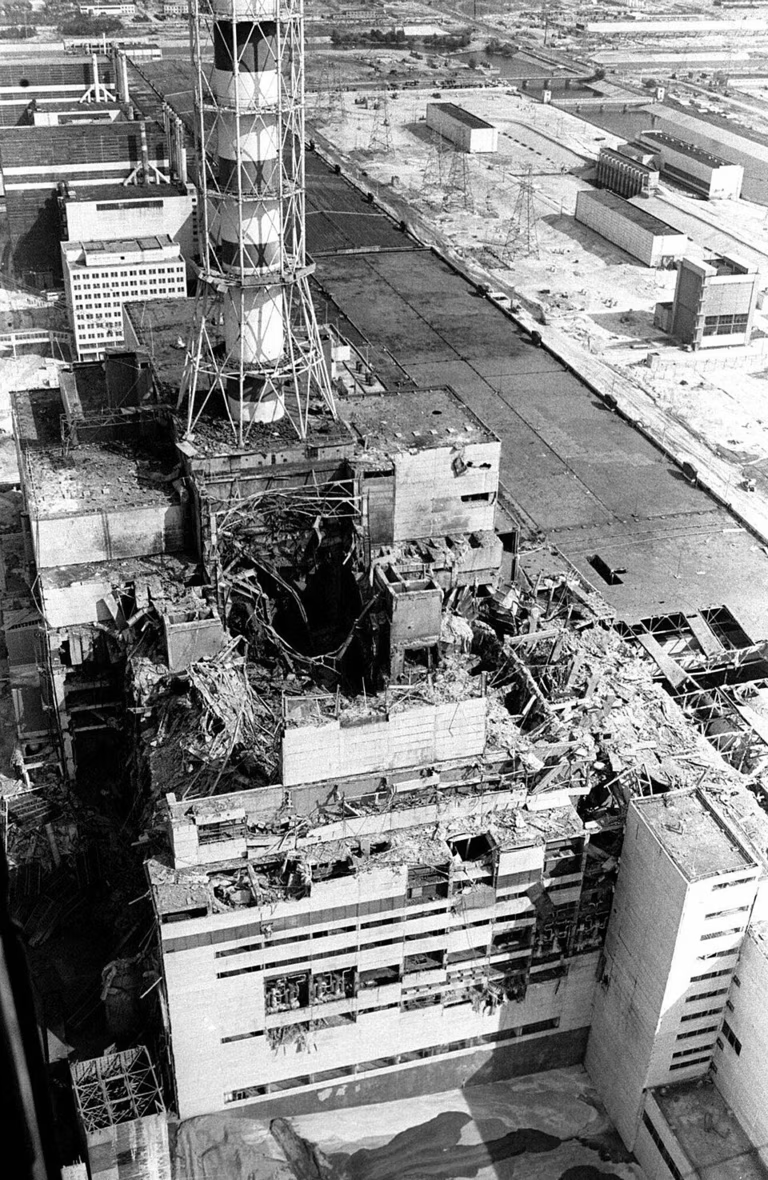
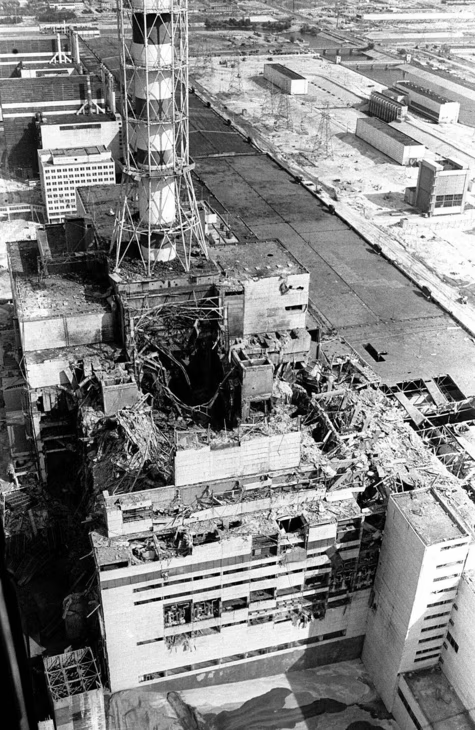
On 26 April 1986, reactor number 4 of the Chernobyl Nuclear Power Plant exploded, causing the world's worst nuclear disaster. The fallout has created the world's longest humanitarian and environmental emergency. It was also the most expensive disaster ever recorded, costing an estimated $700 billion.
The Chernobyl Nuclear Power Plant is located near Pripyat, in the former Soviet Union (now Ukraine). The UN designates April 26th as International Chernobyl Disaster Remembrance Day. This year marks the 40th anniversary.
The disaster occurred ironically while running tests to simulate cooling the reactor during an accident. The operators were inadequately trained, and their efforts led to a dramatic power surge that ultimately destroyed the reactor building. A reactor core fire then spread radioactive contaminants far and wide across the Soviet Union and Europe.
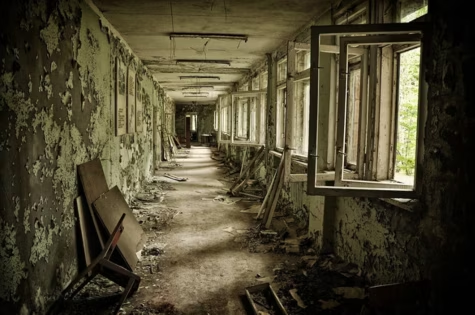
Exclusion zones resulted in the evacuation of approximately 350,000 people. Today, these restricted zones still exist and cover approximately 2,600 square kilometres. It is far too radioactive for safe, permanent habitation.
The most dangerous isotopes will have decayed in around 300 years; the immediate area around the reactor will remain hazardous for up to 20,000 years.
"The accident at the Chernobyl nuclear plant…has painfully affected the Soviet people, and shocked the international community. For the first time, we confront the real force of nuclear energy, out of control." - Former President of the Soviet Union Mikhail Gorbachev
Explore our comprensive guides to other major nuclear disasters including Fukushima, the nuclear energy industry, and how nations are using nuclear energy as a mask for nuclear weapon production.
Please share this unique resource via ➡️ Twitter, Bluesky, Facebook, Instagram and LinkedIn
Fallout Of The Disaster
The Chernobyl disaster has left a long-term, "forever" legacy that requires ongoing international collaboration, containment, decommissioning, and environmental intervention.
-
Two workers died immediately, within 3 months, 28 emergency workers and firefighters died from Acute Radiation Syndrome.
-
The accident caused over 4,000 cases of childhood thyroid cancer.
-
Radioactive fallout travelled as far as Scandinavia and the UK.
-
The graphite-fuelled fire burned for 10 days after the initial explosion. During this time, it released 5% of its radioactive core into the environment, which was spread by wind and rainfall deposition.
-
Radioactive materials (mainly radioactive strontium-90 and caesium-137) entered surface and groundwater, impacting the Dnieper River system that supplied water to millions. Closed lakes in Belarus, Russia, and Ukraine contain elevated levels of long-lived radionuclides to this day.
-
Around 600,000 firefighters, military, and miners were involved in cleaning up the site from 1986 to 1990.
-
Relocated workers and their families now live in the new town of Slavutych, 30 km from the plant.
-
The IAEA confirmed that the explosion released 400 times more radioactive material than the Hiroshima bomb.
-
In forest ecosystems, radiocaesium continues to recycle.
-
The exclusion zone is now essentially a unique nature reserve. Wildlife such as wolves, boars, horses, beavers, and birds are thriving in the absence of humans. Some of these animals show increased levels of genetic mutations.
-
In the early 1990s, $400 million was spent on the remaining reactors to significantly enhance their safety. The last one was still in operation until December 2000.
-
A massive New Safe Confinement structure was completed in 2018.
-
In February 2022, Russian forces took control of the power plant on the first day of the Russian Invasion of Ukraine. It caused a brief spike in local radiation levels due to soil disturbance by heavy military machinery. It was returned to Ukrainian personnel on March 31st, five weeks later.
-
The site now has a permanent rotating mission led by the IAEA to monitor safety and security.
-
On 14 February 2025, the New Safe Confinement (NSC) was struck by a Russian drone breaching the external and internal steel cladding. It caused a major fire, a hole 15 square meters in diameter, and the NSC temporarily lost its primary confinement capability.
Misinformation, Lies & Coverups
Even before the Chernobyl disaster, the Soviet Union operated with a shield of secrecy, censorship, and propaganda to maintain its power and reputation. Investigations after Chernobyl revealed the extent to which misinformation was used both internally and internationally.
It came to light after the disaster that the government was fully aware of the dangers of the RBMK-type reactors. There were multiple incidents in 1982 and 1984 that were kept quiet to prevent rumours.
Moscow was also aware that, due to a lack of safety equipment, Chernobyl was one of the most dangerous power plants in the USSR. Even during the plant's construction in 1972, warnings by scientists about cost-cutting and shortcuts were largely ignored.
Immediately after the Chernobyl disaster, dosimeters read 'off the scale' due to such high levels of radiation. This was twisted into false reports claiming the situation was under control. Information was completely hidden from the public, including the inhabitants of the surrounding areas.
The nearby city of Pripyat was not evacuated until 36 hours after the explosion. With no announcement of the accident, residents did not know there was anything to fear. They were exposed to toxic radiation unknowingly for an unacceptable duration of time.
The USSR only admitted to the incident after radiation was detected in Sweden. It then took them 3 months to disclose the full extent of the damage. This information, which was kept from citizens, was potentially life-saving.
The denial even went so far as to have officials insist on holding the May Day parade just 5 days later, during which residents marched through the streets of Kyiv. Moscow preferred to put thousands of people at additional risk rather than reveal the severity of the situation.
In an attempt to downplay the health effects, Soviet officials reportedly ordered doctors to remove 'radiation sickness' from patient files. There were also allegations of evidence tampering regarding soil and water samples taken by a French journalist, which were reportedly switched with clean ones.
There are allegations that the WHO, alongside the IAEA, failed to conduct a comprehensive and independent health study. Their investigations also failed to take into account the long-term health consequences for residents in Belarus, Ukraine, and Russia.
Several senior plant managers were held criminally responsible for the disaster, including Viktor Bryukhanov, Anatoly Dyatlov, and Nikolai Fomin. The Soviet government has never been held accountable for its role.
Chernobyl 40 Years On – What Did We Learn?
The Chernobyl disaster triggered a global re-evaluation of nuclear safety protocols, and it transformed how nuclear power is managed, regulated, and designed around the world. For the first time, nuclear safety was regarded as a global responsibility.
It led to the creation of the World Association of Nuclear Operators (WANO), designed to facilitate safety audits and promote information sharing between the East and West. Early notification systems around the world were implemented, and international emergency protocols became mandatory and are regularly tested
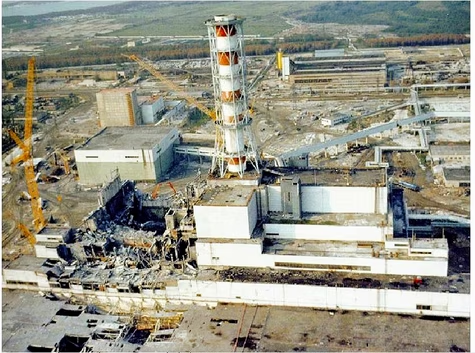
By October 1986, a large concrete shelter had been hastily erected to allow for the other reactors to continue operation. The New Safe Confinement (NSC) structure was completed in 2017 and covers unit 4 and the initial shelter. It will allow for the eventual removal of 200 tonnes of highly radioactive material and the complete dismantling of Unit 4.
Chernobyl exemplified the dangers of political secrecy, which worsened the disaster. Not only does this make the USSR complicit in the fallout of the disaster, but it also took away residents' right to freedom of information and the ability to make informed choices.
International transparency has improved, but we only have to look as far as Israel and Iran to see how secrecy in the nuclear sector leads to increased risk, instability, aggression, and further proliferation.
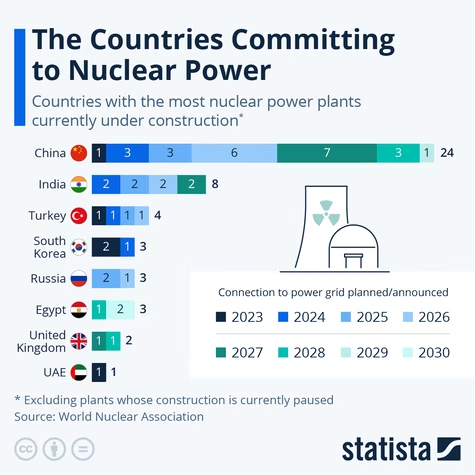
Under increasing pressure to meet climate targets and transition to low-carbon energy sources, the nuclear power sector is experiencing a resurgence. In early 2026, over 40 countries are actively exploring or expanding nuclear capacity. Global nuclear power generation reached record highs in 2025.
This new era of nuclear energy delays any chance of a nuclear phaseout. It creates even greater unsolved issues for future generations, and, with increasing instability and geopolitical tensions, puts our planet at even greater risk of nuclear catastrophe.
Chernobyl may have improved nuclear emergency planning and highlighted the impact disasters have across borders, but it has not stopped shortsighted and irresponsible investment into the industry.
The Nuclear Debate – Nuclear is Not Clean Energy
The nuclear renaissance is now a key obstacle to the renewable energy transition. Touted as a clean alternative to fossil fuels, it ignores the major risks and costs of nuclear energy.
Despite their enormous cost, the nuclear weapons proliferation risk, decades-long construction time, and reliance on cancer-causing uranium mines, there are currently 65 reactors under construction and a further 90 planned.
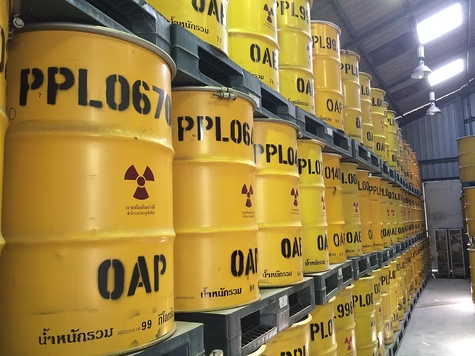
The issue of radioactive waste remains unresolved. Claims of permanent deep underground storage are still very much a fantasy. Current solutions still face issues with geological instability, containment breaches, and transportation risks.
No storage solution for radioactive waste is guaranteed. We cannot keep passing this problem on to generations hundreds and thousands of years into the future.
A Nuclear Free World
The 40th anniversary of the Chernobyl disaster comes at a time of heightened geopolitical tensions and the highest number of armed conflicts since the end of World War II. Nuclear safety concerns are high regarding the Russian invasion of Ukraine and the U.S.-Israel war in Iran.
In this increasingly volatile world, it seems that regarding nuclear energy and nuclear weapons, we have still not learned our lesson, as both are experiencing significant growth. Global nuclear weapons spending in 2024 surpassed $100 billion.
The nuclear energy sector is increasingly serving as a cover for uranium stockpiling. This dual-use dilemma means that civilian programs legitimise the development of the infrastructure needed to build a nuclear weapon.
Targeting nuclear power sites in armed conflict has become more frequent and normalised. Whilst nuclear energy exists, the world is at great risk.
We are still feeling the effects of Chernobly today, and we will be for 20,000 years. It is time to end the nuclear madness and start investing in real renewable energy solutions like solar and wind power.
"As we approach the 40th Anniversary... the World must remember that nuclear catastrophe is not a theory. It is a lived reality for millions of people. Chornobyl is forever." - Irish activist Adi Roche.
Author: Rachael Mellor, Date: 31.03.26, latest update 20.08.26, licensed under CC BY-SA 4.0
More Resources