
Fukushima Nuclear Meltdowns 2011 (Japan) - March 11
Explore the long-term impact of Japan's Fukushima disaster: health effects, cover-ups, economic costs, and why nuclear energy risks remain high today.
FUKUSHIMA NUCLEAR DISASTER, 2011 – Radioactive Fallout & Consequences For Nuclear Energy
Discover the devastating reality of the Fukushima disaster and the consequences that still plague Japan today. Our nuclear guide offers you in-depth information on radioactive fallout, displaced communities, and attempts to hide the truth from the public.
Connect with valuable resources, initiatives, news sources, and organisations – for genuine nuclear phaseout, improved public safety, and a sustainable, renewable future.
Jump straight to our resources on ➡️ Fukushima
*****
General Information
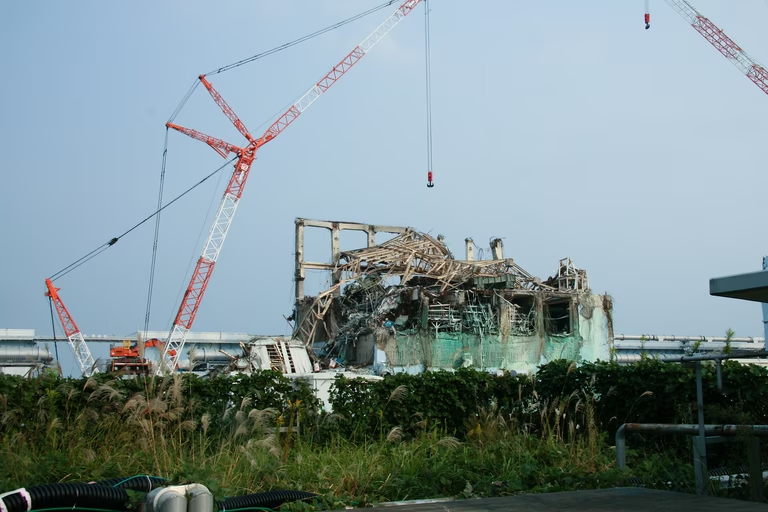
On March 11, 2011, a magnitude 9 earthquake struck off the northeastern coast of Japan, followed by a devastating tsunami. This tidal wave hit the Fukushima Daiichi nuclear power plant, triggering one of the worst nuclear disasters in history. The tsunami flooded the plant's facilities, resulting in a complete power outage.
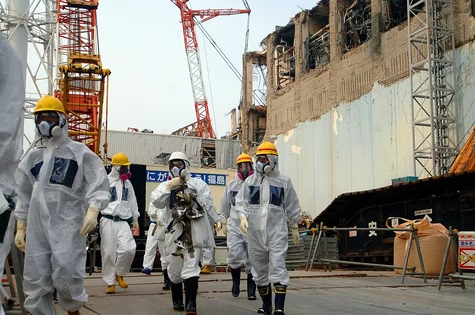
The loss of power had catastrophic consequences for the reactors. Without electricity, the cooling systems failed, causing temperatures in the reactor cores to rise. As a result, partial core meltdowns occurred in reactors 1, 2, and 3, during which time the nuclear fuel melted. Massive explosions caused significant damage and the release of radioactive substances into the Pacific Ocean and the north-west of the plant.
The combined disaster (earthquake, tsunami, and nuclear accident) resulted in over 20,000 deaths. Over 164,000 residents were evacuated, and although no immediate deaths occurred, thousands of related deaths followed. Decommissioning is still ongoing and is not expected to be completed until 2050. Fuel debris, site cleanup, and contaminated cooling water remain significant challenges.
Please share this useful resource via ➡️ Twitter, Bluesky, Facebook, Instagram, and LinkedIn !
Explore our comprehensive guides to the economic fallout of Fukushima and the international fallout, as well as other major nuclear disasters, the health effects of radiation, and the issue of radioactive waste.
Lessons From The Fukushima Disaster
The lessons from Fukushima have not been fully learnt as nations continue to turn to nuclear solutions for the renewable energy transition. Global investment in nuclear energy is experiencing a significant resurgence, with annual spending rising by over 50% since 2020. This is driven by decarbonisation goals, energy security needs, and the new AI demand.
Currently, 60 reactors are under construction. Significant investment is coming from China, Russia, the U.S., France, India, South Korea, and the UAE. Türkiye and Egypt are starting nuclear projects for the first time.
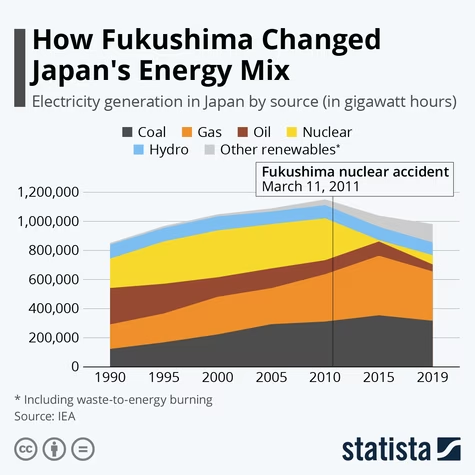
Even Japan has recently flipped its stance. In their 7th Strategic Energy Plan (Feb 2025), they have formally committed to maximising nuclear power, a stark contrast to their previous policy of reducing dependency. As of late 2025, 15 reactors have been restarted, with 10 more in the approval process.
Nuclear is neither a clean nor a safe source of energy.
Naoto Kan, former Prime Minister of Japan on nuclear power - "Before the Fukushima accident, with the belief that no nuclear accident would happen as long as the safety measures were followed properly, I had pushed the policy of utilising nuclear power," he went on "Having faced the real accident as prime minister, and having experienced the situation which came so close to requiring me to order the evacuation of 50 million people, my view is now changed 180 degrees."
Improved risk assessment and planning before the construction of the Fukushima Daiichi nuclear power plant would have better protected the facilities against natural disasters. The plant's tsunami safety was inadequately assessed with no analysis of the geological and meteorological risks. Improved safety and rigorous assessment, inspection, and monitoring must be implemented worldwide, including enhanced cooling systems, protective measures against external influences, and advanced emergency and evacuation procedures.
We must establish common standards and promote international cooperation and knowledge sharing in nuclear safety. The IAEA's programs provide the foundation for nuclear safety, but often still fail due to unilateral actions by national policies and geopolitical interests.
Fallout Of The Fukushima Disaster For Japan
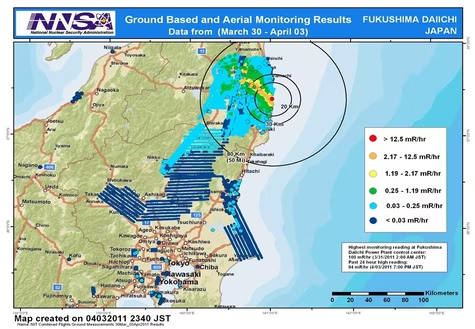
The Japanese government declared a nuclear emergency and ordered the evacuation of the population within a 20km radius of the nuclear power plant. The tsunami destroyed hundreds of thousands of homes, leaving half a million people homeless. A 300-square-kilometre exclusion zone remains in place today. By 2020, only 26% of the evacuated residents had been able to return to their homes.
The nuclear disaster had a direct impact on the health of the affected population. Radiation sickness, increased cancer risks, and other health problems were observed in some residents. Studies on thyroid cancer in children in the affected area recorded 20 times more cases than the baseline incidence (Aerzteblatt 2021). However, these studies are controversial and have been partially refuted.
Long-term studies on other illnesses, such as leukaemia or congenital disabilities, are lacking. The psychological effects of the uncertainty and trauma caused by evacuation and the loss of livelihoods are considerable. Rates of depression, suicidality, and post-traumatic stress disorder remain elevated among the evacuated population.
The release of radioactive substances also had significant environmental impacts. Soil, water, and air were contaminated, leading to long-term ecological damage. Fishing in the region is severely affected, as the waters around Fukushima are highly polluted. In 2023, despite protests from fishermen and neighbouring countries, Japan began releasing treated cooling water from the nuclear power plant into the sea. Greenpeace refers to this as "deliberate water pollution with radioactive substances".
Studies of animals and plants living in the affected areas have also revealed cell damage, increased mutation rates, and population decline. On the other hand, the exclusion zone and the absence of humans have led to a significant increase in the wildlife population.
International Consequences
Many countries reacted to the Fukushima disaster by reviewing their own nuclear power plants and revising their safety standards. Some countries, including Germany and Italy, have even decided to phase out nuclear energy or abandon plans to expand it. In 2023, the last three nuclear power plants in Germany were shut down. Although this is an excellent decision, the question of how to store the vast amounts of nuclear waste remains.
International organisations such as the International Atomic Energy Agency (IAEA) and the World Health Organisation (WHO) played a role in monitoring and assessing the global impact of the Fukushima disaster. Increased efforts were made to develop common standards and strengthen international cooperation, but these efforts have achieved only limited success.
Many European countries still rely on nuclear energy. Belgium recently extended the operating lives of its nuclear power plants; Poland and the Czech Republic are planning to build new ones. France, which already operates half of all nuclear power plants in the EU with 56 reactors, is planning a 60-year extension and six new construction projects by 2035.
Governments use the positive climate impact of nuclear power plants and their low CO2 emissions to justify their continued investments, but then shortsightedly ignore the serious dangers and risks. Chernobyl and Fukushima have tragically demonstrated exactly what a worst-case scenario looks like.
A Better World Without Nuclear Power
Currently, 440 nuclear reactors are operating worldwide – and this number is rising. Transparent policies, citizen participation, and democratic decision-making should be integral to ensuring that the current use of nuclear energy meets societal needs and is operated in accordance with the highest possible safety standards.
We must not abandon research and development in renewable energy to facilitate a long-term transition to more sustainable energy sources. Despite their generally positive environmental record, nuclear power plants are fraught with problems, including nuclear waste disposal, the risk of health consequences, and the risk of nuclear weapon development. The risks are so severe that insurance companies won't even cover them. In the event of a disaster, taxpayers are liable for the massive costs.
Meeting our planet's energy demands through nuclear power is not feasible without far more power plants or new concepts like Small Modular Reactors, which are still not yet a reality. Ultimately, this investment is better spent fighting the climate crisis.
The advantages and opportunities of renewable energy far outweigh those of nuclear energy. Effective climate protection must be implemented promptly to protect the Earth from the devastating environmental damage already manifesting itself in floods, heat waves, and crop failures. A consistent and determined shift to renewable energy is the solution. The price of which has fallen so low that a CO2-neutral electricity system would be possible as early as 2035 (Klimareporter 2021).
"In spite of the various measures taken in order to prevent accidents, it is technically impossible to eliminate accidents, especially if human factors such as terrorism are taken into account. Actually, it is not all that difficult to eliminate nuclear power plant accidents. All we need to do is to eliminate nuclear power plants themselves. And that resolution lies in the hands of the citizens." - former PM of Japan Naoto Kan.
Author: Maximilian Stark, 22.02.24, translated and edited by Rachael Mellor 24.02.26, latest update 20.08.26, licensed under CC BY-SA 4.0
More Resources
Curated Directory & Deep-Dive Resources on Fukushima Nuclear Meltdowns 2011 (Japan) - March 11
- News 79
- Twitter & Facebook 21
- Our Links
- General Info 126
- Videos & Images 76
- Citizen Evacuations 21
- Health Effects of Radiation 70
- International Fallout 25
- Economic Fallout / Costs 20
- Selected Articles 158
- Tepco Cover-ups 16
- Politics & Cover-ups 30
- Mainstream Media Cover-ups 3
- We got it all under control ... ? 12