
Financial Costs of Climate Change
Discover the financial impact of climate change on our economies as costs spiral into the trillions. Adaptation is a far cheaper option yet funding falls far short of global needs.
➡️ THE FINANCIAL COST OF CLIMATE CHANGE – How Much are Extreme Weather Events Costing the Planet?
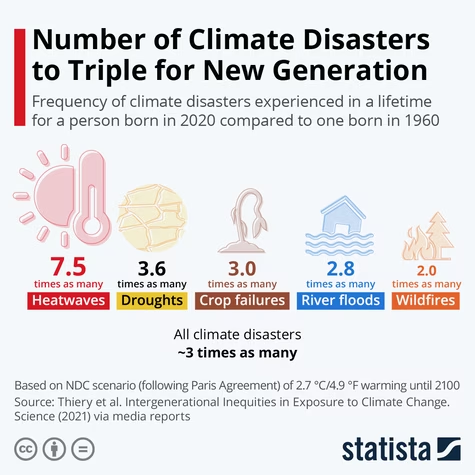
Climate change is now the single biggest health threat facing humanity, with far-reaching consequences. No corner of the Earth has been left untouched by the impacts of our changing climate. The Emergency Events Database reports a record rise in natural disasters globally since the 1960s, detailing over 26,000 mass disasters.
The number of reported natural disaster incidents increased from 39 in 1960 to 399 in 2023. An estimated 218 million people are affected by natural disasters every year, and 68,000 lose their lives. The consequences of climate change are complex, interconnected, and unevenly distributed.
Rising temperatures and sea levels, ocean acidification, increased intensity and frequency of wildfires, hurricanes and flooding, drought, biodiversity loss, and reduced agricultural yields are the direct repercussions of our changing climate. These events are putting economies at an enormous risk of collapse, as models massively underestimated the impact they would have.
A 2024 report by the International Chamber of Commerce estimates that climate-related extreme weather events have cost the global economy more than $2 trillion over the past decade.
In the last two full years alone, global economic damages reached $451 billion – representing a 19% increase compared to the previous eight years of the decade.
According to the World Economic Forum climate-related extreme weather events will cost the global economy over $2 trillion annually by 2030, with costs escalating dramatically to an estimated $38 trillion per year by 2050 (Potsdam Institute for Climate Impact Research)
For comparison: U.S. debt in 3/26 is $39 trillion and the U.S. federal budget for fiscal year 2025 is $7 trillion. The U.S. GDP was $29 trillion and the global GDP was $111 trillion in 2024.
"Climate change will cause massive economic damages within the next 25 years in almost all countries... We have to cut down our emissions drastically and immediately – if not, economic losses will become even bigger in the second half of the century, amounting to up to 60% on global average by 2100." - Leonie Wenz, scientist at PIK.
Jump straight to our resources on the ➡️ Financial Cost of Climate Change
Explore our comprehensive guides on -
-
The Climate Crisis
-
Consequences of the Climate Crisis
*****
Climate Damage Costs
Climate change is not a future problem; it is affecting each and every one of us today. The consequences of climate inaction are a high price to pay. Literally.
According to the National Bureau of Economic Research, climate change costs the world 12% in gross domestic product (GDP) losses for every 1°C of warming. This puts the social cost of carbon at around $1,056 per metric ton of carbon dioxide emissions. The report predicts that by the "end of the century, people may well be 50% poorer than they would've been if it wasn't for climate change."
Heatwaves, wildfires, droughts, and storms cost the world more than $120 billion in 2025 alone. This was the costliest year for climate disasters on record, as 55 billion-dollar weather disasters hit the Earth. The U.S. bore the brunt with the devastating Californian wildfires, which caused $60 billion of damage and led to the deaths of more than 400 people.
No continent, however, was spared from crippling climate disasters in 2025. It was also noted that disasters are becoming increasingly expensive and their impact underestimated. The Global Assessment Report on Disaster Risk Reduction (GAR) 2025 calculates the cost of weather disasters at $202 billion annually. When other impacts, such as ecosystem costs, are taken into account, the true cost is likely to exceed $2.3 trillion.
In terms of financial costs, the U.S. has taken the greatest hit, with over 426 events since 1980 totalling over $3.1 trillion. We should, however, not let this distract us from the plight of other smaller economies, as the financial costs in wealthy countries tend to be much higher due to property values and insurance.
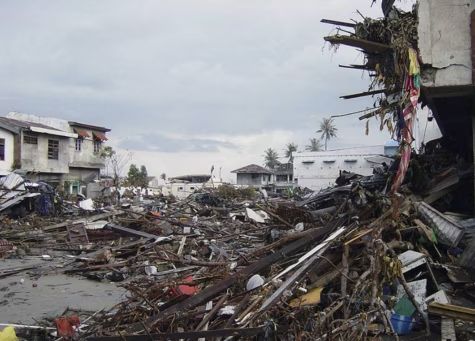
Some of the most damaging climate events in 2025 hit poorer nations, including the Philippines, Thailand, Indonesia, Sri Lanka, and Vietnam. These countries have historically contributed little to the climate crisis, have the fewest resources to respond, and are often on the front lines of weather disasters.
Who Should Pay For Climate Disasters?
"On climate finance, the world must pay up, or humanity will pay the price... Climate finance is not charity, it's an investment; climate action is not optional, it's imperative." - António Guterres, UN Secretary-General.
In relation to the climate crisis, the Polluter Pays Principle states that those who have historically contributed the most to greenhouse gas emissions should bear the costs of repairing the damages caused and adaptation measures. It also acts as a deterrent to end massive investment and subsidies into the fossil fuel industry and instead promotes the development and integration of clean energy sources.
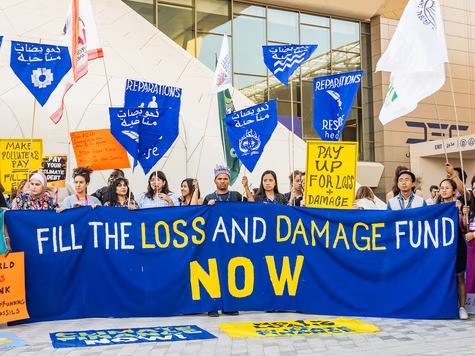
The Loss and Damage fund was created at COP27, the 2022 climate conference. This fund is to compensate developing countries for losses and damages (L&Ds) from natural disasters caused by climate change, for which wealthy countries are disproportionately responsible. Hailed as a major milestone at the time, financial commitments have fallen well short of the $400 billion needed annually to address L&Ds and climate injustices adequately.
The Most Expensive Climate Disasters
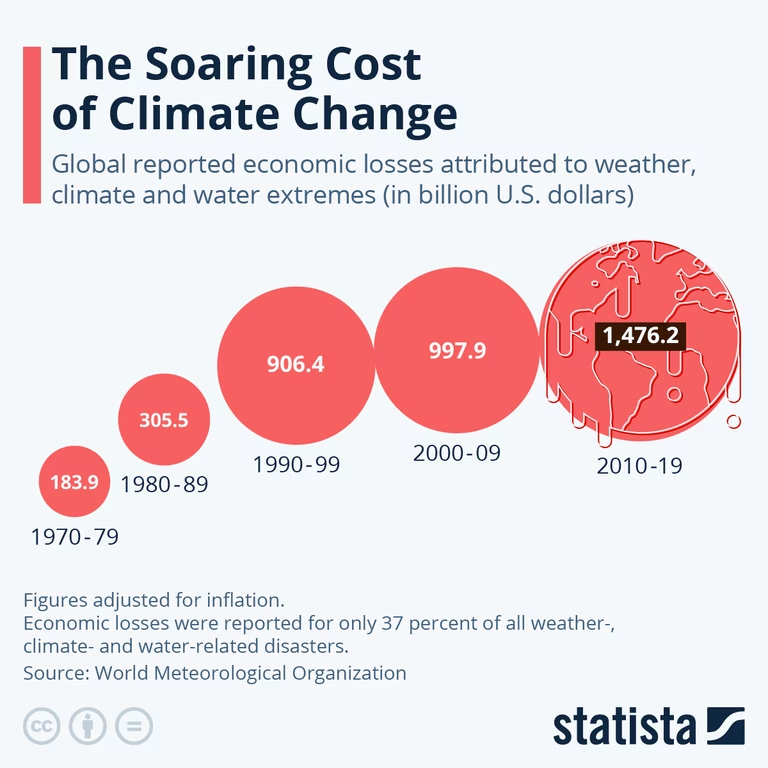
Over the past four decades, the costs of wildfires, storms, hurricanes, droughts, and floods have spiralled. These disasters have become more frequent and far more severe. The cost of all disasters between 1985 and 1995 was $299 billion. Yet the same figure for between 2014 and 2025 was $1.4 trillion.
Below, we list the most costly disasters over the last 3 decades. The figures provided are estimates, and likely the true cost was much higher. They are adjusted for inflation and, of course, do not include the social costs, such as the devastating human toll, the health crises that follow, the psychological impact, massive displacement, ecosystem destruction, resource depletion, habitat loss, and agricultural fallout.
-
Hurricane Katrina, 2005 - $125 billion (U.S. & Cuba)
-
Hurricane Harvey, 2017 - $125 billion (U.S., Central America, the Windward Islands, parts of South America, the Cayman Islands, Mexico)
-
Hurricane Ian, 2022 - $112 billion (U.S. & Cuba)
-
South Asian Floods, 2020 - $105 billion (India, Bangladesh, Nepal, Pakistan, Sri Lanka, Afghanistan)
-
Hurricane Sandy, 2012 - $98 billion (U.S., Cuba, The Greater Antilles)
-
Hurricane Maria, 2017 - $91 billion (Puerto Rico, Dominica, U.S. Virgin Islands)
-
Hurricane Helene, 2024 - $78 billion (U.S., Cuba, Cayman Islands, Mexico, Honduras)
-
Hurricane Ida, 2021 - $75 billion (Cuba, Cayman Islands, Jamaica)
-
Hurricane Andrew, 1992 -$65 billion (U.S. & the Bahamas)
-
Los Angeles Wildfire, 2025 - $61 billion, but likely much more (U.S.)
-
Hurricane Irma, 2017 - $50 billion (U.S., Greater Antilles, Leeward Islands, Lucayan Archipelago)
-
European Floods, 2021 - $46 billion (Germany, Belgium, the Netherlands, Luxembourg, Switzerland, Austria)
-
Pakistan Floods, 2022 - $30 billion
Adaptation Is Cheaper Than Inaction
Climate adaptation is the process of adjusting to the impacts of climate change to reduce damage, prevent loss of life, and protect people and infrastructure before disaster strikes. It also includes reducing global carbon emissions by transitioning to clean energy to prevent climate change from worsening even further.
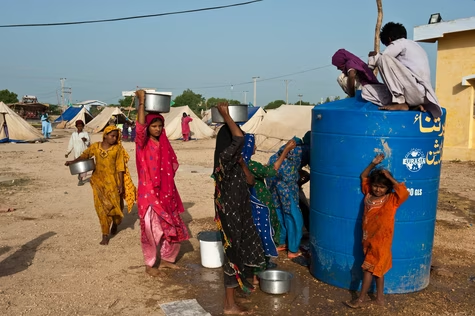
Adaptation requires upfront investment, but it is far more cost-effective than inaction, which allows the climate crisis to escalate, causing irreversible damage and out-of-control social and environmental costs.
Examples of adaptation measures include flood defences, the creation of urban wetlands, drought-resistant crops and climate resilient agriculture, ecosystem restoration and conservation, and investment in early warning systems.
There is a huge funding gap in climate adaptation, and the longer governments sit on their hands, the greater the need and the higher the costs become. Annual estimates for developing countries alone range from $215 to $387 billion.
Once we reach 2°C of warming, the global annual cost to protect everyone exposed to climate hazards will reach $1.2 trillion, equivalent to almost 1% of GDP. Heat and drought are the most pressing challenges, with more than three-quarters of adaptation funding needed to provide adequate protection.
This amount may seem daunting, but estimates calculate that the benefits of adaptation exceed the upfront cost by seven times. Policy makers and world leaders need to start thinking longer term and take steps to prevent the huge economic losses from climate disasters in advance.
Adaptation investments secure assets and provide long-term economic stability. These also have wider secondary benefits such as improved health and social welfare, a more resilient agricultural sector, stable levels of biodiversity, lower levels of migration and conflict, and reduced inequalities.
The 2019 Global Commission on Adaptation Report found that every $1 invested in adaptation can generate up to $7.1 trillion in total benefits globally by avoiding damages and building social and environmental value.
Effective climate adaptation strengthens countries' resilience, protects vulnerable populations, and actually supports economic growth. We must begin to close the investment gap, focus on the countries that need the most support, and invest in the future of our planet.
The Cost of Doing Nothing
Climate inaction is already leading to massive economic losses from extreme weather. The IFRC's 2019 Cost of Doing Nothing report presents an analysis of humanitarian needs if no urgent action is taken. The estimate that annual international humanitarian assistance due to climate-related disasters could double to over 200 million by 2050, costing an extra $20 billion annually.
The Climate Policy Initiative estimates the financial cost of inaction to be $1,266 trillion. The social cost is much higher:
-
In the U.S. alone, the health costs of air pollution and climate change far exceed $800 billion per year.
-
Malnutrition, malaria, diarrhoea, and heat stress caused by rising temperatures are projected to cause an additional 250,000 deaths per year between 2030 and 2050.
-
The World Bank projects losses of up to $225 billion in GDP by 2030 due to the loss of ecosystems and their fallout, such as reduced pollination and declining timber and marine stocks.
-
The number of people suffering from food insecurity will increase from 2 billion to 3.5 billion by 2050.
-
The number of people experiencing high and extreme water stress will increase from 2.6 billion to 5.4 billion by 2040. Water-related conflicts have increased by 270% in the last decade.
-
There will be 1.2 billion climate migrants by 2050 who will endure unimaginable suffering and become reliant on aid. Climate migration contributes to political instability and has massive economic ramifications.
With each additional degree of warming, these impacts are only set to worsen. The two-year Global Stocktake for the Paris Agreement at COP28 confirmed that we are way off track from the targeted 1.5°C target. The window for achieving the Sustainable Development Goals and specific climate goals is rapidly closing.
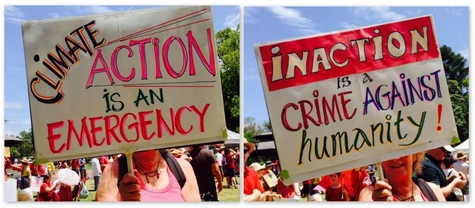
If governments won't act on climate change for people or the planet, at least they should be motivated by the trillions it will cost them if we do nothing. We are already seeing the soaring costs of inaction.
The frequency of extreme events in our backyards should be all the motivation we need for more urgent action, a commitment to phasing out fossil fuels, and to adequately fund the energy transition.
Failing to address climate change is a failure for our planet and for humanity. Why pay trillions in disaster relief, conflict mitigation, aid, and migration management when the solutions are at our feet today?
"The longer our home remains aflame, the harder and more expensive it will be to extinguish the fire and repair the damage." - Climate Policy Initiative.
Author: Rachael Mellor, 10.03.26 licensed under CC BY-SA 4.0
For further reading on the Financial Costs of Climate Change see below ⬇️
More Resources
Curated Directory & Deep-Dive Resources on Financial Costs of Climate Change
- Economic Impact of Climate Change - Wikipedia 80629
- Economics of climate change - Wikipedia 229935
- Economic analysis of climate change - Wikipedia 391039
- Global Warming Impacts (USA) - Union of Concerned Scientists 80645
- William Nordhaus (American economist known for his work in climate change) - Wikipedia 229958
- Google Scholar - William Nordhaus 229973
- Google Scholar - Richard S J Tol 229974
- Google Scholar - Cameron Hepburn 229975
- Climate Finance - 350 442256
- Cameron Hepburn (Director of the Economics of Sustainability Programme) - Wikipedia 229976
- Navigating the Known and Unknown Costs of Climate Change for Canada - Climate Institute 348046
- Video: The economic impacts of unchecked climate change - PBS 348053
- Video: Climate change is a big issue for central banks - Bank of Canada 348056
- Support Sustainable Development and Climate Action - UN 348070
- Elliott Harris: Measure the value of nature – before it’s too late - UN 348072
- Mark Carney: Investing in net-zero climate solutions creates value and rewards - UN 348076
- Globalization´s Peak - IMF 356024
- Video: Twelve rainforest nations are asking rich countries for more money to preserve nature - WEF 367528
- Insurance firms help flooding victims mop up. They also make flooding worse - TBIJ 21.09.26 524993
- UK heatwaves may have cost economy £4.4bn in lost output so far this year, analysis finds - Guardian 12.08.26 521460
- Will Trump’s War With Canada Become Global? - Project Syndicate 22.07.26 520458
- Scientists Warn ‘Garbage’ Models Underestimate Risk of Economic Collapse From Climate Crisis - CD 05.02.26 508652
- Counting the Cost 2025: A year of climate breakdown - Relief Web 27.12.25 503270
- Natural disasters hit global economy for $220bn in 2025: Swiss Re - Al Jazeera 16.12.25 501516
- Tackling Climate Crisis Will Boost Economic Growth, While Inaction Could Cause ‘Permanent Recession,’ Researchers Say - EcoWatch 26.03.25 462845
- The Next Financial Crisis: Insurance - American Prospect 10.01.25 454594
- US Faced 27 Billion-Dollar Disasters in 2024, the Hottest Year on Record - CD 10.01.25 450934
- 2024’s most costly climate disasters killed 2,000 people and caused $229bn in damages, data shows - Guardian 30.12.24 447808
- What Were the Most Expensive Climate Disasters of 2024? - CD 30.12.24 449791
- Can insurance as we know it survive climate change? - Anthropocene 28.12.24 450955
- Paying for the climate crisis: how to stop debt following disasters in low-income countries - Guardian 24.12.24 447739
- Extreme Weather Fueled by Climate Crisis Cost Insurers $600 Billion - CD 10.12.24 446369
- Publication: Within out power: Cut Emissions Today To Insure Tomorrow - Insure Our Future 05.12.24 446368
- Poorer nations need $1tn a year by 2030 in climate finance, top economists find - Guardian 14.11.24 442386
- Can the economy go up even as carbon emissions go down? - Anthropocene 05.11.24 440475
- Reducing the cost of capital to finance the energy transition in developing countries - Nature 27.09.24 439981
- Disaster Dollar Database - Carnegie 20.08.24 429403
- U.S. Treasury Secretary Yellen: $3 Trillion Needed Annually to Reach 2050 Global Climate Goals - EcoWatch 29.07.24 425940
- Heatwaves begin to drive tourists in Europe to cool climes - Guardian 02.07.24 420946
- Global rich must pay more to tackle climate crisis, says architect of Paris deal - Guardian 04.06.24 417534
- Debt payments by countries most vulnerable to climate crisis soar - Guardian 03.06.24 417535
- How extreme weather will affect the insurance and energy sectors - Conversation 28.05.24 420960
- Economic damage from climate change six times worse than thought – report - Guardian 17.05.24 414354
- Billions are needed for climate adaptation – now some frontline communities are deciding how the money gets spent - Conversation 09.05.24 420913
- Nature destruction will cause bigger economic slump in UK than 2008 crisis, experts warn - Guardian 25.04.24 410482
- NOAA Billion-Dollar Weather Disasters Are Not Evidence of Climate Change - Reason 25.04.24 412504
- Climate Crisis to Cost Global Economy $38 Trillion a Year by 2050 - CD 18.04.24 408511
- 38 trillion dollars in damages each year: World economy already committed to income reduction of 19 % due to climate change - PIK-Potsdam 17.04.24 410378
- Climate crisis: average world incomes to drop by nearly a fifth by 2050 - Guardian 17.04.24 408028
- Private climate finance: 4 things to consider - WEForum 17.04.24 439983
- The economic commitment of climate change - Nature 17.04.24 410377
- How Sask.'s new budget does and doesn't address climate change - CBC 27.03.24 404419
- Climate change risk to price stability: Higher average temperatures increase inflation - Sonnenseite 23.03.24 404536
- Cost Of Climate Change: Why Saving Our Planet Now Is Cheaper - Forbes 20.03.24 404415
- Climate Inaction Could Cost $1,266 Trn, As US Pushes Back On Reporting - Forbes 20.03.24 404417
- Climate change indicators reached record levels in 2023: WMO - WMO 19.03.24 404416
- Scotland will bear the brunt of climate costs - BBC 14.03.24 404418
- Methane Emissions from U.S. Oil and Gas Operations Cost the Nation $10 Billion Per Year - ENN 13.03.24 402752
- Can the Panama Canal save itself? - BBC 06.03.24 401183
- Ticker Shows Climate Inaction Cost US Nearly $3,000 Per Second in 2023 - CD 23.02.24 401161
- UN Climate Chief: World Needs $2.4 Trillion in Climate Finance Annually to Keep Goals Within Reach - EcoWatch 02.02.24 396652
- Impact of 2023’s Costliest Climate Disasters ‘Highly Unequal,’ New Research Shows - Earth.org 28.12.23 391037
- 2023’s costliest climate disasters show poor lose out in ‘global postcode lottery’ - Guardian 27.12.23 396799
- Counting the Cost 2023: A year of climate breakdown December 2023 - Relief Web 27.12.23 391186
- Counting the Cost 2023: A year of climate breakdown December 2023 - Christian Aid 27.12.23 391040
- Poorest nations hit hardest by cost of climate disasters, new calculations show - Church Times 27.12.23 391038
- The price of inaction: what a hotter climate means for monetary policy - European Central Bank 18.12.23 391041
- Most investors aren’t paying attention to climate risks – the financial system needs to change - The Conversation 11.12.23 391044
- Global warming could cost poor countries trillions. They’ve urged the COP28 climate summit to help - AP News 04.12.23 391042
- The effect of climate change on firms' debt financing costs - ScienceDirect 02.12.23 386991
- The Financial Paradox Blocking Efforts to Fight Climate Change - NY Times 02.12.23 386992
- Do countries actually have the money to fight climate change? - El Pais 30.11.23 386997
- World Needs More Policy Ambition, Private Funds, and Innovation to Meet Climate Goals - IMF 29.11.23 386996
- Why the Fed should treat climate change’s $150B economic toll like other national crises it’s helped fight - The Conversation 29.11.23 386995
- Revealed: the huge climate impact of the middle classes - Guardian 20.11.23 384692
- Climate Change's $150 Billion Hit to the U.S. Economy - WSJ 15.11.23 386993
- Climate Change and Monetary Policy: Risks, instruments, & chances - European Parliament 11/23 - PDF 386994
- Rich and Poor Nations Have One More Chance to Come to Terms Over a Climate Change ‘Loss and Damage’ Fund - Inside Climate News 28.10.23 382081
- Publication: The Unseen Banking Crisis Concealed Behind the Climate Crisis - Better Markets 23.08.23 368010
- Report Warns 'Today's Climate Crisis Is Tomorrow's Banking Crisis' - CD 18.08.23 368011
- World Bank Climate Finance Plan Little Help, Unfair - Global Issues 16.08.23 366357
- There’s no such thing as a disaster-resistant place anymore - Vox 13.07.23 358889
- 140+ Experts to Rich Nations: Redirect Trillions in Public Money to Curb Climate, Inequality Crises - CD 19.06.23 355917
- The hard right and climate catastrophe are intimately linked. This is how - Guardian 15.06.23 356150
- The Climate Crisis Will Be the Mother of All Financial Crises - CD 12.06.23 353492
- The Health Costs Of Climate Hazards Are Piling Up - NRDC 23.05.23 347234
- Assessing the Benefits and Costs of Nature-Based Solutions for Climate Resilience: A Guideline for Project Developers - World Bank 22.05.23 348058
- Study Warns El Niño Could Cost Global Economy $84 Trillion by 2100 - CD 19.05.23 347894
- Further Delaying Climate Policies Will Hurt Economic Growth - IMF 10.05.23 347230
- Smart Money Podcast: The Cost of Climate Change: The Big Picture - NerdWallet 04.05.23 347233
- India's cost of adapting to climate change needs seen at $1 trillion by 2030, report says - Reuters 03.05.23 347232
- ‘Adapting to climate change to cost India ₹85.6 lakh crore by 2030’ - The Hindu 03.05.23 347243
- Video: Can Asian economies afford the cost of climate-change? - DW 29.04.23 348065
- Climate Change and Financial Risk - Reserve Bank of Australia 06.04.23 347440
- Economic implications of the climate provisions of the Inflation Reduction Act - Brookings 29.03.23 347444
- Debt-for-adaptation swaps: A financial tool to help climate vulnerable nations - Brookings 21.03.23 347441
- Climate finance must center frontline, underrepresented and underserved communities - Greenbiz 20.03.23 340230
- Video: Treasury Secretary Yellen warns that losses tied to climate change could ‘cascade through the financial system’ - CNBC 07.03.23 348057
- Climate change could cost Germany €900 billion - DW 06.03.23 347231
- Climate change to cost Germany up to 900 billion euros by 2050 - study - Reuters 06.03.23 347245