
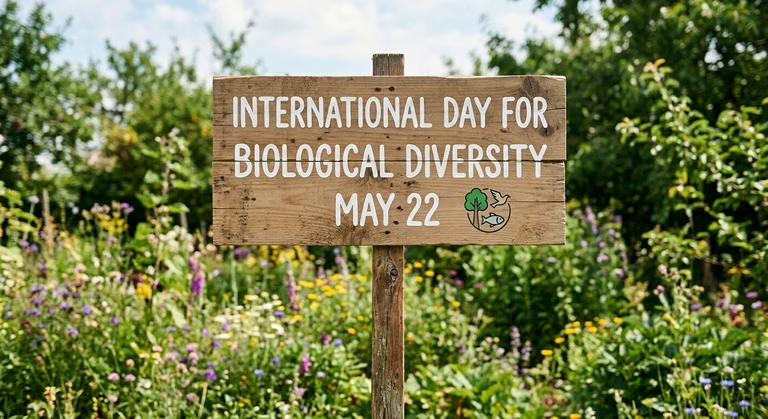
International Day for Biological Diversity - May 22
Discover resources, background, and actions for the International Day for Biological Diversity on May 22. Join global efforts to protect nature and wildlife.

INTERNATIONAL DAY FOR BIOLOGICAL DIVERSITY, May 22 - Acting Locally For Global Impact
International Day for Biological Diversity urges us to reevaluate our relationship with our planet's ecosystems. It promotes the respect, protection, and restoration of our biological wealth.
We depend on healthy, vibrant ecosystems for our water, food, medicines, clothes, fuel, shelter, and energy, and, indeed, our very survival. Despite this, human activities such as deforestation, industrial agriculture, pollution, and overexploitation continue to push nature to its limits.
Explore essential insights, initiatives, and global resources dedicated to nature conservation, biodiversity, and building a sustainable future where human activity exists in harmony with Earth’s diverse species.
Jump straight to our resources on ➡️ International Day for Biological Diversity
Created in 1993 by the UN General Assembly, this annual observance day was originally in December. In 2000, the date moved to May 22 to commemorate the adoption of the Convention on Biological Diversity text in 1992.
"It's surely our responsibility to do everything within our power to create a planet that provides a home not just for us, but for all life on Earth." - David Attenborough.
*****
A Sixth Mass Extinction
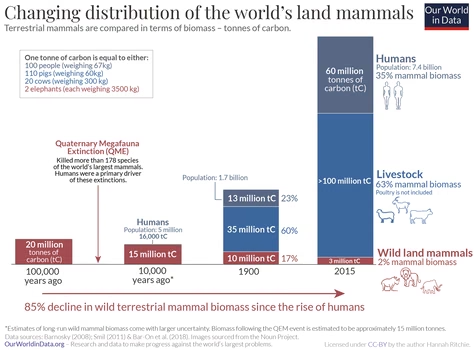
With roughly 1 million animal and plant species threatened with extinction, the Earth is in the midst of an ongoing biodiversity crisis driven entirely by human activity.
- Species are disappearing at 100 to 1,000 times the normal natural background rate.
- Humans and livestock now account for 96% of all mammal biomass. Domesticated poultry accounts for 70% of all birds.
- Freshwater species have suffered the most severe collapse, with monitored populations down 85% globally.
- The steepest regional drops are in Latin America and the Caribbean, followed by Africa, Asia, and the Pacific.
- Human activities have altered over 70% of ice-free land and affected 63% of the oceans.
“If we pollute the air, water and soil that keep us alive and well, and destroy the biodiversity that allows natural systems to function, no amount of money will save us.” - David Suzuki.
Causes Of Biodiversity Loss
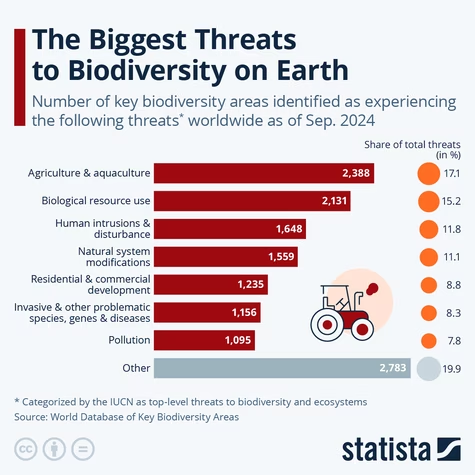
The sixth mass extinction is also known as the Holocene extinction. It began around 11,700 years ago, after the last major ice age ended, and has been magnified by destructive, unsustainable human activities.
- Habitat Destruction - Intensive agriculture, rapid and unmanaged urbanisation, and infrastructure expansion are destroying natural ecosystems. Agriculture alone accounts for roughly 40% of land conversion and 90% of deforestation globally.
- Climate Change - Greenhouse gas emissions, driven largely by the fossil fuel industry, have reached record levels. These gases trap heat in the Earth’s atmosphere, causing rising temperatures, droughts, melting ice, rising sea levels, and extreme weather events. The rate of climate change is faster than the pace at which species can adapt.
- Overexploitation - Hunting, poaching, logging, and industrial fishing remove wild animals and plants faster than they can reproduce, decimating populations and reducing their chances of survival.
- Pollution - The plastics crisis, industrial waste, heavy pesticide and fertiliser use, and heavy metals contaminate land, freshwater systems, and ocean food chains, creating dangerous, uninhabitable environments for plants and animals. Noise and light pollution also disrupt navigation, communication, and reproductive cycles.
- Invasive Species & Infectious Diseases - Invasive species increase competition for resources and introduce unnatural predators. In the case of vegetation, they alter soil chemistry, change fire risks, and disrupt local food chains. Introduced pathogens and parasites can wipe out entire populations that lack natural immunity.
Can We Come Back From The Brink?
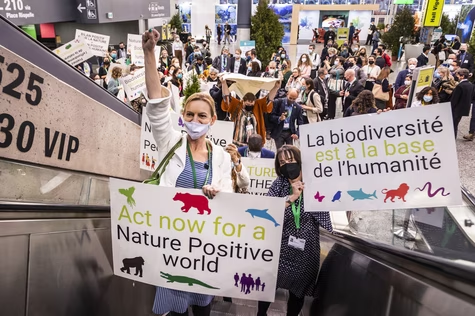
The 17th meeting of the Conference of the Parties (COP17) to the United Nations Convention on Biological Diversity (CBD) is currently underway in Yerevan.
This major international summit focuses on global measures to protect, restore, and sustainably manage nature. World leaders will review collective progress on implementing the 2023–2030 Kunming-Montreal Global Biodiversity Framework (KMGBF), adopted at COP15, and assess whether countries are on track to halt and reverse biodiversity loss by 2030.
The four long-term goals are:
- Protect and Restore - Focus on ecosystem integrity and connectivity, and halt human-induced extinctions of known threatened species.
- Prosper with Nature - Ensure that biodiversity is sustainably used and managed and nature’s contributions to people, including ecosystem functions and services, are valued, maintained and enhanced.
- Share Benefits Fairly - Ensure equitable sharing of benefits from genetic resources and traditional knowledge, especially with Indigenous Peoples and local communities.
- Invest and Collaborate - Close the $700 billion per year biodiversity finance gap and align financial flows.
With the world off track to meet most of its 2030 targets under the KMGBF, COP17 is a global reckoning for nature conservation.
If we fully commit to cutting carbon emissions under the Paris Agreement and the 30x30 land and water protection target, scientists agree that we can still reverse the biodiversity crisis.
We can not do this without urgent, simultaneous action, sufficient funding, removing harmful subsidies, replacing outdated and harmful policies, reducing inequalities, taking an inclusive approach, and tackling climate change, pollution, and biodiversity loss as connected crises.
Grassroots action from businesses, communities, and individuals also plays a powerful role in shifting corporate behaviour through consumer choices and demanding accountability from political leaders.
Awareness days like International Day for Biological Diversity remind us that if we don't course-correct now, we'll keep losing biodiversity at an alarming rate. As things stand, it will take decades to reverse; we cannot afford to wait a minute longer.
“We're halfway to 2030, and the evidence is clear: we are far off track to reach the 30×30 targets. The systems that sustain life on Earth are under threat, and decisions made at COP17 must deliver a clear course correction to protect our planet's ecosystems.” - An Lambrechts, head of the Greenpeace delegation at COP17.
Author: Rachael Mellor, 27.10.26, licensed under CC BY-SA 4.0
More Resources
Curated Directory & Deep-Dive Resources on International Day for Biological Diversity - May 22
- International Day for Biological Diversity - United Nations 525558
- Convention on Biological Diversity 525723
- Geneva Environment Network 525724
- International Day of Biodiversity - GEO 525557
- National Geographic 525725
- FAO 525733
- UNESCO 525727
- International Day for Biological Diversity - Wikipedia 525556
- Message from the Director of UNESCO World Heritage Centre, Mr Lazare Eloundou Assomo, for International Day for Biological Diversity 2026 - UNESCO 22.05.26 525728
- World Biodiversity Day 2026: Local Action for Global Impact - Sustainability 22.05.26 525731
- Biodiversity Day 2026, acting locally for global impact - Renewable Matter 22.05.26 525732
- Opening Remarks by Mr. James George at the 2026 International Day for Biological Diversity - UNDP 22.05.26 525734
- The Secretary-General Message for the International Day for Biological Diversity “Acting locally for global impact” - United Nations 20.05.26 525729
- What is the International Day for Biological Diversity – and why is it important? - WEF 20.05.26 525730
- International Day for Biological Diversity: Harmony between nature and traditional medicine - WHO 19.05.25 525726
- Video: International Day for Biological Diversity - UN TV 5/24 525555