

COP15 Biodiversity Summit
COP15 toolbox featuring NGOs, activism, key players, accusations of lobbying and greenwashing, 30 x 30 agreement, biodiversity fund, and disappointment of the global South

➡️ COP15 - UN Biodiversity Summit, Kunming/Montreal
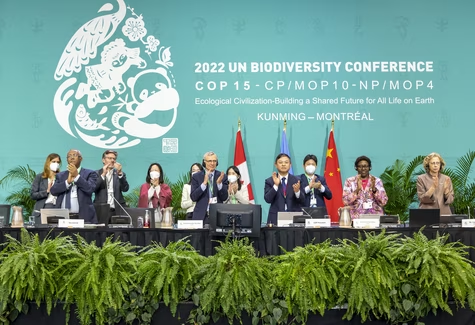
December 7-19, 2022 saw world leaders come together for COP15 in Montreal to address rapidly declining biodiversity and loss of nature, now termed the biodiversity crisis.
Find an extensive platform on ➡️ COP15 including essential resources, must read articles, and video news.
Was COP15 a Success?
Giving us reason for hope, this global summit produced a number of encouraging outcomes. In a historic win for nature, 196 of the world's nations have agreed to protect our planets biodiversity. 30% of all land and water by 2030 – or 30 by 30. Some are comparing the deal with the landmark Paris Agreement. Others noted this as a step in the right direction, but with much more work to be done.
Further cause for celebration was the pledge to commit a minimum of $200 billion annually to biodiversity related funding. Much needed investment to ensure the protection and restoration of our fragile ecosystems.
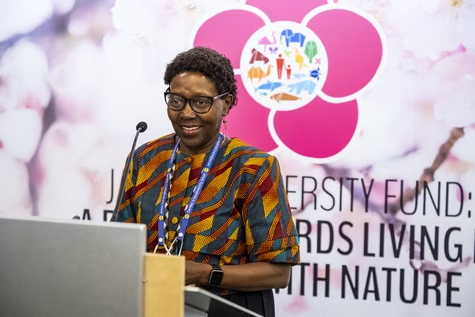
Developing countries fought hard to secure a biodiversity fund of $30 billion a year which will be will be contributed by developed countries - those most responsible for environmental damage.
A review of subsides will also take place which aims to remove $500 billion of funding from industries deemed harmful to nature such as Big Oil. One further takeaway was the commitment to reduce the use of harmful pesticides.
Many were surprised by the spirited involvement from China, who were due to host originally in Kunming, but were replaced due to Covid-19 restrictions. They played an important part in championing for nature and helped to bridge the differences between developed and developing nations.
The event wasn’t all smooth sailing. In a disagreement over financing, delegates from 70 countries walked out of the negotiations - predominantly from Africa, South America, and Asia - they argued that developed countries wanted to set ambitious targets, but not offer sufficient funding to back them. It took two whole weeks of negotiations for all nations to agree.
While some NGOs have hailed COP15 a huge success, others such as Greenpeace have said that the agreement leaves huge gaps for greenwashing, labelled it as weak, and too little too late: This deal may take the foot off the gas, but if we do not press the break, we will be sure to reap the consequences of inaction.
The Kunming-Montreal Global Biodiversity Framework (GBF)
The GBF is an outcome of the 2022 United Nations Biodiversity Conference. It contains four global goals ("Kunming-Montreal Global Goals for 2050") and 23 targets ("Kunming-Montreal 2030 Global Targets"). Here are the original 4 goals and 23 targets of the GBF. Below is a summary from Wikipedia.
"The four goals are:
- The integrity, resilience, and connectivity of ecosystems is maintained, enhanced, or restored, substantially increasing the area of natural ecosystems by 2050, and that human-induced extinction of threatened species is halted, and that by 2050, extinction rate and risk of all species are reduced tenfold, and the abundance of native wild species is increased to healthy and resilient levels; and that the genetic diversity within populations of wild and domesticated species, is maintained, safeguarding their adaptive potential.
- Biodiversity is sustainably used and managed and nature's contributions to people, including ecosystem functions and services, are valued, maintained and enhanced, with those currently in decline being restored, supporting the achievement of sustainable development, for the benefit of present and future generations by 2050.
- The monetary and non-monetary benefits from the utilization of genetic resources, and digital sequence information on genetic resources, and of traditional knowledge associated with genetic resources, as applicable, are shared fairly and equitably, including, as appropriate with indigenous peoples and local communities, and substantially increased by 2050, while ensuring traditional knowledge associated with genetic resources is appropriately protected, thereby contributing to the conservation and sustainable use of biodiversity, in accordance with internationally agreed access and benefit-sharing instruments
- Adequate means of implementation, including financial resources, capacity-building, technical and scientific cooperation, and access to and transfer of technology to fully implement the Kunming-Montreal global biodiversity framework are secured and equitably accessible to all Parties, especially developing countries, in particular the least developed countries and small island developing States, as well as countries with economies in transition, progressively closing the biodiversity finance gap of $700 billion per year, and aligning financial flows with the Kunming-Montreal Global Biodiversity Framework and the 2050 Vision for Biodiversity.
The 23 targets are categorized into three areas as:
- Reducing threats to biodiversity.
- Meeting people's needs through sustainable use and benefit-sharing.
- Tools and solutions for implementation and mainstreaming.
"Target 3" is especially referred to as the "30 by 30" target.[17] It succeeds the Strategic Plan for Biodiversity 2011-2020 (including the Aichi Biodiversity Targets).[18] It aims for governments to designate 30% of Earth's terrestrial and aquatic area as protected areas by 2030.[15] As part of the target, countries must stop subsidizing activities that destroy wilderness, such as mining and industrial fishing.[19] To effectively protect endemic biodiversity, the expansion or development of protected areas should be guided by key species-distribution patterns.[20] This target also recognizes Indigenous land as conservation pathways, but has been criticized for not incorporating Indigenous and community conserved areas into its measures for success.[21]
In parallel to the development of these goals and targets, the concept of nature-positive emerged as a global societal goal for nature that mirrors the mission and vision of the GBF.[22] Nature-positive refers to the goal to halt and reverse nature loss by 2030, and to achieve nature recovery by 2050,[23] while the Global Biodiversity Framework also aims to halt and reverse the loss of biodiversity to begin the road to nature recovery.[24] Since the implementation of the GBF, nature-positive has played a role in mainstreaming nature throughout businesses and governance systems to achieve the targets of the framework.[22]
These targets have been criticized for vagueness, due to a lack measurable indicators for progress or accountability.[25][26] Challenges with the GBF are expected to arise due with unequal implementation due to a lack of specificity. David Obura, Chair of the IPBES, warned the framework may result in "business-as-usual" if countries choose to ignore underlying drivers of biodiversity loss in favour of meeting specific, achievable targets.[27]"
Better World Info's Afterthoughts on COP15
The encouraging outcomes of this summit finally recognise the importance of preserving our natural world. If the funding is secured, used effectively, and all nations commit to their pledges, we believe this could be the breakthrough that nature has been waiting for.
On the other hand, COP15 received a noticeable lack of media attention, political leadership, and involvement from celebrity activists who are normally outspoken, and raise the profile of such events. This nature COP seemed to play second fiddle to the UN climate change summit COP27 in Sharm El Sheikh.
We cannot solve the climate crisis, without also solving our nature crisis. The two go hand in hand. We must work together to ensure that both issues are addressed with equal importance and urgency.
As the executive director of the UNEP Inger Andersen said, ‘Now is our chance to shore up and strengthen the web of life, so it can carry the full weight of generations to come.’
Author: Rachael Mellor, 22.12.22 licensed under CC BY-ND 4.0 (Updated 06.11.24)
For further reading on the COP15 see below ⬇️
More Resources