
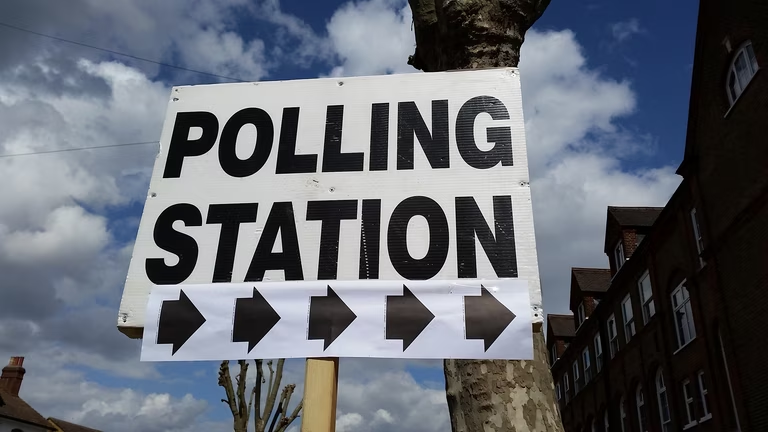
UK Local Elections 2026
On May 7, the UK will elect over 5,000 local councillors in elections that could reshape British politics, challenge the Labour government and give more power to smaller parties.
➡️ UK LOCAL ELECTIONS 2026 - The Great Reset of British Politics Or Another False Hope For Voters?
On May 7, people in England, Scotland, and Wales will elect over 5,000 local councillors in elections that could reshape British politics. The elections are set to pose a significant challenge to the Labour government in light of Keir Starmer's record-low approval rating.
Big cities like London, Manchester, Birmingham, and Newcastle are up for election, as are important counties including Essex, Norfolk, and Suffolk.
The voting age in Scotland and Wales is 16, whereas in England it will remain 18 until lowered to 16 in time for the next general election.
Big changes in Wales mean that the number of Senedd (Welsh Parliament) seats up for grabs is increasing from 60 to 96, and the number of constituencies is decreasing from 40 to 16. People in Wales will now only cast one vote rather than two as in previous elections
Scotland is set to elect 129 members to the Scottish Parliament. The SNP is facing its most competitive race in decades as Reform UK and the Greens challenge its lead. The results of the Scottish and Welsh elections will determine who becomes their First Ministers.
A win for their respective nationalist parties would create significant constitutional disputes for the Labour Party and give them greater weight in decisions on issues such as spending, taxation, and welfare. It could even signal the first steps towards a fractured UK, with less centralised power, and even calls for independence referendums.
Please share this useful resource via ➡️ Twitter, Bluesky, Facebook, Instagram, and LinkedIn !
Jump straight to our resources on the ➡️ 2026 UK Local Elections
Explore our comprehensive guides on -
- ➡️ UK Political Parties
- Key UK Politicians
- PM Keir Starmer
- Key Political Issues
- Previous Local Elections
*****

What Could The Local Elections Mean For Prime Minister Keir Starmer?
As of April 2026, half of all Britons believe that Starmer should step down as PM, a sentiment which has remained unchanged since last autumn. In a polarised and struggling UK, the one thing everyone can agree on is that Starmer is unpopular.
The public perceives that under his governance, Labour has failed to deliver on its promises of change. He seems to take a mild stance on, well, everything, and appears to run things with a general lack of purpose.
He has dropped his pledge to spend £28 billion a year on green energy, abandoned his campaign to fully nationalise water and energy companies, and u-turned on his plan to scrap university tuition fees.
The public mood in the UK is low. Starmers' landslide win meant that he had a long way to fall.
His term began with a country crippled by the cost-of-living crisis, rising energy bills, inflation, and hiked-up food prices. If anything, largely due to external issues (the U.S.-Israel war on Iran, for example), the situation for the average British citizen has become worse, and the people are looking for someone to blame.
A poor performance for Labour in May could mean that its MPs seek to replace Starmer, especially if the sentiment is felt across the board in Wales and Scotland.
The sharp rise in popularity of Reform UK and the Green Party means that this time round, Labour don’t just have the Tory Party to contend with. Labour is projected to lose between 1,000 and 2,000 council seats.
Current polls show that the Tories are struggling to maintain second place. Estimates suggest they are set to lose between 500 and 1,010 councillors.
Labour and Starmer are on the defensive, particularly in London and the Red Wall, which have been Labour strongholds in Northern England and the Midlands for decades.
The risk Starmer faces is that voters will use this election as a referendum on his leadership, punishing local Labour councillors for his failings and the national state of discontent.
Key Issues In The Local Elections
- FINANCIAL CRISIS - Since 2018, over 13 councils have declared bankruptcy. Councils manage services such as social care, bin collections, and road repairs. With one third of councils at risk of financial ruin in the next five years, these local services are crumbling. Leisure centres, libraries, public services, and social care are all suffering.
- NHS - Healthcare in the UK is a top priority for voters as GP appointments have become increasingly difficult to obtain, and long A&E wait times persist. Other issues include significant staffing gaps, a massive backlog of routine operations, systematic underfunding, and ongoing disputes over pay among resident doctors.
- INFRASTRUCTURE - Local services are visibly deteriorating. Together, road maintenance, parking, and congestion are listed as a top three local concern by one-third of voters. The UK has an estimated 1 million potholes, with one appearing every 19 seconds. This costs drivers an average of £645 million a year.
- AFFORDABLE HOUSING - The UK is deep in the midst of a national housing crisis and record-breaking council spending on temporary accommodation. Local councils hold the primary power over planning decisions, social housing maintenance, and developer negotiations, and so although national policies exist, citizens are relying on their local councils to step up. In 2025, the median cost of a home in England was 7.6 times average earnings, putting home purchase out of reach for the majority of workers. In 2020, reports suggested that the UK had a housing shortage of more than 1 million homes.
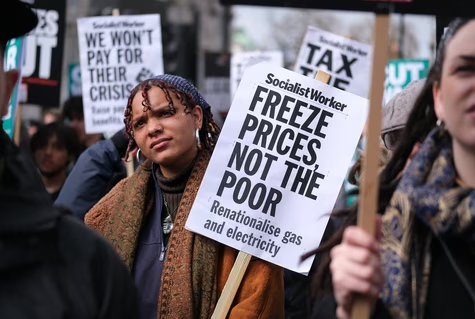
- COST OF LIVING - This remains the single most important national issue for voters. Food, energy, and housing costs remain stubbornly high. As of late 2025, 69% of low-income UK households reported going without essentials due to the cost-of-living crisis. A quarter of low-income households could not afford to keep their homes warm over winter. Over 1 in 3 children live in households with incomes below the level necessary to avoid material deprivation.
- FOREIGN POLICY - Another major national issue on voters' minds is the UK's stance on war. Major discontent is widespread over the war in Iran, the war in Gaza, and the Russian invasion of Ukraine. Citizens feel that UK involvement in these conflicts ignores domestic economic woes and risks escalation. In April 2026, disapproval of the US-led military strikes against Iran rose to 65%. In general, a significant majority (63%–65%) prefer that the UK government use diplomacy to de-escalate conflicts rather than military action.
The Potential For Greater Nationalist Control
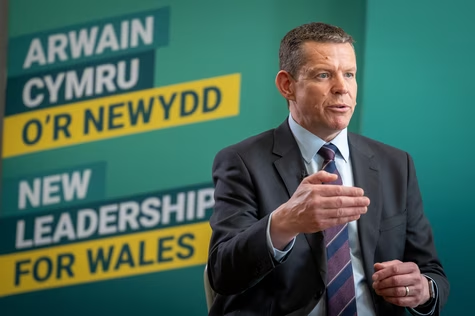
Polls for Wales and Scotland have predicted that nationalist parties will take control in both countries for the first time, joining Sinn Féin in Northern Ireland. Experts have stated that if the SNP and Plaid Cymru secure majorities, then it could create a pathway for the eventual breakup of the United Kingdom.
Although neither has confirmed any immediate plans for a referendum, both countries have promoted the benefits of independence in the past, with Scotland in 2014 narrowly voting to stay in the UK by 55%.
If successful, Wales, in particular, will need to prove to the people that it can run the country well before any campaigning begins. Sinn Féin in Northern Ireland has also expressed a desire to leave the UK.
If nationalist parties continue to win elections, calls for independence will surely grow louder.
Could This Spell The End Of Two-Party Dominance?
This local election stands out as, for the first time since the 1920s, the results could signal the end of the Labour-Conservative dominant two-party system. These elections are a chance for Reform UK, the Green Party, and the Liberal Democrats to prove that there are other worthy contenders and that a vote for a smaller party is no longer wasted.
Traditionally, the Liberal Democrats have been the UK’s third party, and they normally perform well in the local elections as voters turn to an option outside the standard two. This time, however, the competition is fierce as the Greens and Reform are predicted to do well. Your Party will be supporting independent socialist candidates as well as putting forward a few of their own official candidates.
Due to deep dissatisfaction with the two main parties and immigration and economic concerns, Reform UK have become the most popular party in certain areas. They are polling particularly strongly in the North and in Wales.
With fresh-faced leader Zack Polanski at the helm, the Green Party has adopted a stronger and more determined approach to campaigning. In London and other urban areas, they have seen a huge upsurge in support from voters looking for a left-wing alternative that has fair social and economic policies and will actually deliver on its climate promises.
Five parties are now polling above 10% nationally, which may result in more councils moving to "no overall control" where no single party has more than half of the seats on the council. Depending on how these are run and what coalitions form, this can either stall progress or bring councillors together to put politics aside.
*****
Low levels of trust in politicians and a general sense of discontent make political apathy high in the UK. Deep feelings of ‘nothing will change’ ring even louder in local elections where voter turnout hovers around 33-35%.
One of the main barriers is a lack of understanding about what local councils actually do and how this affects their daily lives.
With Better World Info, you can learn which areas are holding local elections, stay informed about political parties and what they stand for, and have your say on the issues that matter most to you.
Author: Rachael Mellor 28.04.26 licensed under CC BY-SA 4.0
For further reading on the 2026 UK Local Elections see below ⬇️
More Resources
Curated Directory & Deep-Dive Resources on UK Local Elections 2026
- GUARDIAN: May 2026 elections 515577
- Guardian - Local elections 2026 515584
- SKY NEWS - Vote 2026 Results 515593
- Sky News - Politics Hub 515592
- 2026 United Kingdom local elections - Wikipedia 514369
- 2026 London local elections - Wikipedia 514370
- 2026 Scottish Parliament election - also on 7 May 515064
- 2026 Senedd election (Welsh parliament) - Wikipedia 515065
- Election analysis - Challenges and opportunities - CNDUK 04.06.26 517791
- What devolution and local election results could mean for integration in England - LSE 20.05.26 516602
- More than 60 Labour MPs call for review of UK voting system - BBC 19.05.26 516601
- Plaid Cymru has forged a brand of inclusive nationalism. That’s why it beat Reform in Wales - Guardian 17.05.26 516227
- The battle to lead Labour—and Britain—hangs on a by-election - Economist 17.05.26 516226
- 1 in 3 Reform UK voters has a positive view of Tommy Robinson - Politico 16.05.26 516228
- More than just a critical blow to Keir Starmer and Labour, local votes signal a dis‑United Kingdom - Conversation 15.05.26 516225
- After a complete collapse, where does Welsh Labour go from here? - Conversation 13.05.26 516115
- Easy as ABC: voters in England tend to pick names nearer top of ballot, data suggests - Guardian 13.05.26 515930
- Starmer rules out leaving Downing Street despite Labour rebellion - Le Monde 13.05.26 515932
- A shock to the system - Voxeurop 12.05.26 515931
- Far-Right Anti-Immigrant Party Surges in U.K. Elections; Calls Grow for Labour PM Starmer to Resign - DN! 11.05.26 516102
- UK’s Keir Starmer battles for political survival after election defeat - Al Jazeera 11.05.26 515717
- Local elections reveal the deep fracturing of UK politics and put the writing on the wall for Keir Starmer - The Conversation 10.05.26 515718
- Labour lose control of Lambeth council for first time in 20 years - Canary 09.05.26 515848
- Labour lose Bradford to no overall control - Canary 09.05.26 515847
- Labour loses Barnsley for first time in 50 years - Canary 09.05.26 515845
- Britain’s Electorate Is ‘Splintering.’ Can Its System Stand the Strain? - NY Times 09.05.26 515719
- Comment on Welsh, Scottish and local election results - Greenpeace 08.05.26 515951
- This election signals a crisis for the British state - Open Democracy 08.05.26 515862
- Exeter Greens take overall control away from Labour - Canary 08.05.26 515853
- English local elections 2026: a story of a new kind of politics - Conversation 08.05.26 515752
- Experts react to the Reform surge and Labour losses - Conversation 08.05.26 515751
- Video: Could Labour and Conservative party dominance in UK politics be ending? - Al Jazeera 08.05.26 515749
- ‘Leader of the pack’: Reform UK makes election gains, humiliating Labour - Al Jazeera 08.05.26 515745
- ‘Two Party Politics... Is Dead’ in UK Says Green Party Leader After Labour Thrashed - CD 08.05.26 515699
- These election results don’t mean tacking left or right, but delivering for the whole country - Guardian 08.05.26 515720
- UK elections 2026: 5 takeaways from Labour’s drubbing - Politico 08.05.26 515721
- ‘Terrifying Moment in Our Democracy’: Virginia Supreme Court Rejects Voter-Approved Redistricting - CD 08.05.26 515698
- Sterling, gilts rise as Starmer vows to stay despite election drubbing - Reuters 08.05.26 515662
- Starmer vows to fight on after Labour punished in polls across Britain - Reuters 08.05.26 515661
- LIVE: Politics latest: Reform surge as Labour suffer disastrous local election losses - Sky News 08.05.26 515574
- 2026 elections mapped: how Labour lost ground in different directions - Guardian 08.05.26 515939
- LIVE: Elections 2026 live: Labour suffers historic defeat in Wales as Reform surges in English council elections and Greens make gains - Guardian 08.05.26 515575
- VIDEO: House of Commons projection: Reform largest party, short of majority - Ed Conway, Guardian 08.05.26 515573
- 2026 elections mapped: how Labour lost ground in different directions - Guardian 08.5.26 515578
- 2026 election results: latest from local, Scottish and Welsh votes - Guardian 08.05.26 515576
- Video: Populist surge: What next for Labour as Reform wins big in elections? - The Latest, Guardian 08.05.26 515579
- Nigel Farage hails ‘historic shift in politics’ after Reform UK election gains - Guardian 08.05.26 515580
- Labour loses control of Birmingham city council after 14 years of leadership - Guardian 08.05.26 515581
- Plaid Cymru wins Welsh Senedd elections, ending 100 years of Labour control - Guardian 08.05.26 515582
- Zack Polanski calls two-party politics dead after mayoral and council wins - Guardian 08.05.26 515583
- The former Red Wall falls to Reform - New Statesman 08.05.26 515539
- The Electoral Commission - My next election 514797
- Who Can I Vote For? - Find out about candidates in your area 514799
- Poll Check - Council Projector 514800
- Policy Exchange analyses the impact of the local and mayoral election - Policy Exchange 514819
- How unpopular is Britain’s Labour government? - Economist (Overall voting intention) 515081
- Scotland sticks wi’ SNP: making sense of Holyrood’s election results - Canary 09.05.26 515849
- UK’s Labour set for heavy losses in elections as Reform makes early gains - Al Jazeera 08.05.26 515514
- After more than a century, Labour has lost Wales - Conversation 08.05.26 515753
- UK elections – early results and takeaways; will Starmer have to resign? - Al Jazeera 08.05.26 515513
- Greens win one of few seats where Your Party also stood - Canary 08.05.26 515854
- Video: “Don’t Cry!” Labour Candidates Told Ahead of Election Devastation - Novara Media 07.05.26 515653
- Local elections 2026: Which councils could progressives win? - LFF 07.05.26 515554
- Local elections don’t matter. Councils are utterly, ruinously powerless - New Statesman 07.05.26 515547
- Labour and the Greens need to work together - New Statesman 07.05.26 515543
- Live results map: Wales, Scotland and local elections - New Statesman 07.05.26 515538
- Election results timeline: when do key battlegrounds in England, Scotland and Wales report? - Guardian 07.05.26 515437
- Starmer’s failure to demonstrate strong values ‘driving away progressive voters’ - Guardian 07.05.26 515436
- VIDEO: Is Britain’s two-party system finally breaking down? - Richard J Murphy 07.05.26 515344
- Election day in the UK: what to look out for – and when we’ll know the results - Conversation 06.05.26 516106
- The battle for Lambeth, Labour’s London stronghold - New Statesman 06.05.26 515548
- Event: What will the 2026 devolved elections mean for Scotland, Wales and the UK? - Institute for Government 06.05.26 5:30 - 6:30pm 514813
- Keir Starmer makes late pitch to voters turning to Greens and Reform - Guardian 06.05.26 515361
- Who is Zack Polanski, UK Greens leader and rising political star? - Al Jazeera 06.05.26 515362
- How close is the United Kingdom to breaking up? - DW 06.05.26 515313
- Video: Labour Weaponises Antisemitism Ahead of Local Elections - Novara Media 05.05.26 515654
- Video: Labour Collapse, Bin Strikes & ‘Sectarian Politics’: Inside the Battle for Birmingham - Novara Media 05.05.26 515652
- Chris Mason: Elections this week a smorgasbord of competitiveness - BBC 04.05.26 515079
- ‘Voting Green will stop Reform’: party eyes kingmaker role in Wales - Guardian 04.05.26 515077
- Labour’s Deflection Machine Is in Full Swing Ahead of a Local Election Catastrophe - Novara Media 04.05.26 515648
- Inside “Hexit”, Reform’s plan to break up London - New Statesman 03.05.26 515541
- Economics Guru on How British Politics Is About to Collapse - Novara Media 03.05.26 515651
- British local elections set to be crucial moment for Starmer - FT 03.05.26 515078
- The Greens and Reform will ensure this week’s elections are the messiest yet - Observer 03.05.26 515080
- Voters should be wary of promises made by Nigel Farage’s Reform UK - Open Democracy 02.05.26 515863
- Local elections 2026: What would a good night look like for the Lib Dems? - LFF 01.05.26 515557
- Labour predicted to lose nearly 2,000 council seats in local elections next week - LFF 01.05.26 515558
- Labour is facing wipeout in its final stronghold. Why? It’s housing, housing, housing - Guardian 30.04.26 515109
- Could Lib Dems become the biggest party in English local government? - Guardian 30.04.26 515107
- Local elections mapped: Where Labour is facing a ‘calamity’ and the key seats to watch - Independent 27.04.26 514821
- England’s previous local elections show what’s wrong with our voting system - Electoral Reform 27.04.26 514824
- UK local elections 2026: what are the prospects in London? - Economics Observatory 27.04.26 514798
- London’s coming for Labour, again - New Statesman 27.04.26 514803
- Revealed: how local election bar charts are misleading voters and using unreliable data - Full Fact 27.04.26 514809
- What does devolution mean and how does it work across the UK? - BBC 27.04.26 514812
- The era of two-party dominance is gone: How May’s local elections are shaping up to spread power across the political spectrum - Public Affairs Networking 24.04.26 514815
- How can we reach Reform voters in a fractured Britain? - LFF 24.04.26 515562
- Mapped: the elections that could deliver ‘unprecedented’ losses for Labour - Guardian 23.04.26 515108
- Video: Green Party strategist reveals plan to win big in local elections - MEE 20.04.26 514820
- Elections 2026: The Five Battlegrounds - Comment is Freed 16.04.26 514817