

LIBERAL Democrats
Standing in the centre to centre-left of the political spectrum, the Lib Dems fight for a fairer deal for citizens and communities. Grassroots advocacy for liberal and social democratic policies.

➡️ LIBERAL DEMOCRATS - Demanding Change & A Fair Deal for Citizens & Communities
Commonly referred to as the Lib Dems, this UK British political party were founded in 1988. They are currently under the leadership of Sir Ed Davey and take a centrist to centre-left stance, drawing on liberal and social democratic ideologies.
As of the 2024 general election, the Lib Dems have 72 members of Parliament in the House of Commons, making them the third largest political party. They have around 90,000 official members.
Unlike its main opponents, the Labour Party and the Conservative Party, the Lib Dems hold a Conference twice a year, at which policy is formulated. All members, either in person or online, have the right to vote on policies and leadership elections.
Their much slower pace and grassroots approach, focusing on areas of existing support, mean they often fall out of the national headlines. For the upcoming local elections in May, they are almost entirely absent from the national debate.
Jump straight to our resources on the ➡️ Liberal Democrats
Explore our comprehensive guides on -
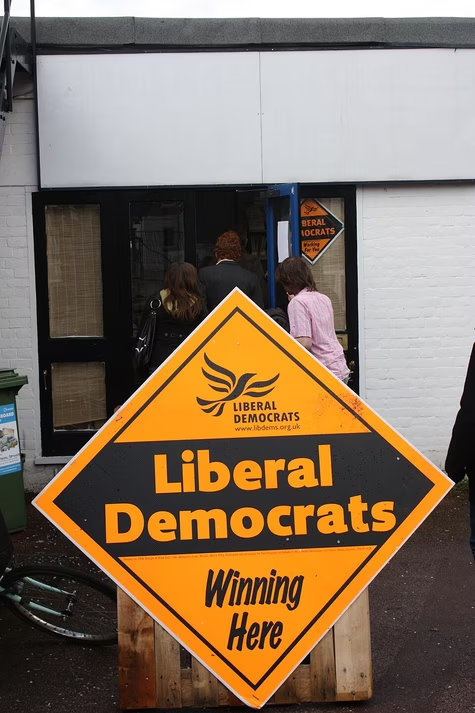
Core Principles Of The Lib Dems
The Lib Dems list their seven core values as liberty, equality, democracy, community, human rights, internationalism, and environmentalism.
Their goal is to build and safeguard a fair, free, and open society that includes these seven values. They advocate for a decentralisation of power and a set of strong social protections.
They support redistribution, investment and progressive taxation. The party has consistently supported LGBT rights and drug reform. They place addressing climate change and restoring nature high on their agenda. The Lib Dems are particularly concerned about the irresponsibility of private water companies and the impact of sewage spills into the environment.
Regarding war, the party supported the war in Afghanistan but opposed the 2003 invasion of Iraq. They take a pro-United Nations stance and vow to never support a military occupation deemed illegal under international law.
They support a ceasefire in Gaza and support Ukraine against Russian aggression. They have expressed clear opposition to UK participation in the U.S.-Israel war on Iran.
The Lib Dems take a pro-NATO stance and propose to raise defence spending to 2.5% of GDP as soon as possible. They strongly advocate for a legally binding "War Powers Bill" that would ensure MPs vote on military action before engaging in conflicts and prevent any bypassing of Parliament.
Historically, the Lib Dems have been divided on the issue of nuclear weapons. Under Davey's leadership, they support maintaining a minimum, credible, and independent nuclear deterrent. They wish to end reliance on US-leased Trident missiles. Overall, they advocate for long-term, multilateral global disarmament and the eventual elimination of nuclear weapons.
The Lib Dem principle of internationalism makes them pro-European and supporters of international cooperation, human rights, and the rule of law. They advocate for closer ties with the EU and policies of reintegration.
In the 2016 Brexit campaign, the Lib Dems supported the Remain vote and actively campaigned for the UK to stay in Europe. They see rejoining the EU as a long-term goal, with the first step being rejoining the single market.
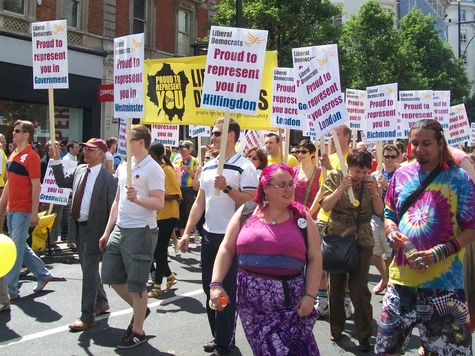
Why Have The Lib Dems Struggled To Gain Popularity?
Historically, the Lib Dems have struggled to sustain high-level popularity due to a combination of trust issues with voters, past association with austerity, their inability to differentiate themselves from the big two, the UK’s First Past the Post voting system, tactical voting, and the increasing competition from other smaller parties.
The Lib Dem-Conservative coalition from 2007–2015 meant that they lost a lot of support from voters, particularly younger ones. It caused their poll ratings to crash to around 8% by late 2010. They broke their pledges on tuition fees and were seen to enable Conservative policies.
Due to the nature of the UK’s voting system, many voters see voting for a smaller party as a wasted vote. This system penalises smaller parties and ensures that they can’t form a government of their own. In the past, the Lib Dems have relied on tactical voting, where voters in particular constituencies will use their vote to remove a party that they don’t like.
Since Sir Ed Davey was voted into leadership in 2020, the party has been experiencing somewhat of a revival. They managed to carve a path forward by appealing to voters who had always thought of themselves as Conservatives but who opposed the current direction of the Conservative Party.
Slowly, the Lib Dems made small gains in traditionally Conservative areas, especially in local elections, where in 2023 and 2024, they won control of more councils and overturned a number of Conservative majorities. In the 2024 local elections, they added more council seats than any other party in the last 5 years, largely in the South and South West of England.
In this election, they campaigned for reforming carers allowance, free personal care in England, lowering the voting age to 16, and proportional representation.
The growth in popularity of the Green Party and Reform UK has served to weaken the growth of the Lib Dems. These parties sit on total opposite sides of the political spectrum and are building support because of their strong and clear messages.
The combined rise of both parties means a tighter fight to build a broad coalition for the Lib Dems. Especially as voters are desperately seeking change. For the first time, British voters have more viable options.
Chances In The 2026 Local Elections
While much of the media attention is currently focused on the divisive Reform UK, a struggling Labour Party, and a rising Green Party, the Lib Dems are quietly positioning themselves as local champions. They may not be as loud on social media or capturing the attention of the national headlines, but they are focused on important community issues like GP appointments and road maintenance in the background.
The polls are predicting a record-low performance for Labour, which will mean big gains for the smaller parties. Estimates by Professor of Political Sociology Stephen Fisher predict that Reform will gain 2,260 councillors, the Greens will gain 450, and the Liberal Democrats 200.
In a clear indicator of the UK’s dissatisfaction with the two main parties, the Tories are predicted to lose 1,010 councillors.
This time around, the Lib Dems will focus on making gains in the North, an area which has traditionally lacked support.
Critics have used the tortoise-and-hare analogy to describe the Lib Dems' approach to countering the rise of the populist party Reform UK. The quiet campaigning favoured by the Lib Dems may mean that they miss out on the political opportunity of a lifetime.
With the UK more divided than ever and the vast majority seeking alternatives, now is the time for the Lib Dems to sharpen their message and help shape the debate on major, contentious issues.
It remains to be seen whether moderate gradual change will triumph over radical upheaval.
Stay tuned for updates.
Author: Rachael Mellor 27.04.26 licensed under CC BY-SA 4.0
For more information on the Liberal Democrats see below ⬇️
More Resources
Curated Directory & Deep-Dive Resources on LIBERAL Democrats
- LIBERAL DEMOCRATS 124750
- Manifesto 2024 514683
- Liberal Democrats - What We Stand For 124760
- Lib Dem Network - ACT 124761
- YouTube - Liberal Democrats 514688
- Instagram 514689
- Facebook 124762
- Twitter 124769
- Liberal Democrats - Autumn Conference 124770
- Immigration & Asylum - Liberal Democrats 124771
- Liberal Democrat Voice 514687
- Ed Davey - Wikipedia 514715
- NICK CLEGG - Liberal Democrats 124775
- Nick Clegg - Wikipedia 124776
- Vince Cable - Wikipedia 124777
- Wikipedia 124754
- Politics 514692
- Independent 514696
- Guardian News 124755
- BBC News 514690
- The Telegraph 514693
- SOCIAL LIBERAL FORUM - the opposition within & the future 124756
- Jo Swinson - Twitter Discussion @UKDemockery 191344
- Our health system is cutting healthy life expectancy. Why isn’t everyone furious? - Lib Dem Voice 27.04.26 514700
- Lib Dems pledge £5k rewards for illegal waste tip-offs - BBC 27.04.26 514684
- Video: Quickfire questions with Jane Dodds - BBC 26.04.26 514685
- Video: Ed Davey sits down with Rob Powell - Sky News 25.04.26 514717
- Can the Lib Dem tortoise outrun the populist hare? - Sky 25.04.26 514686
- There are 72 Lib Dem MPs but what do they actually do? - Times 25.04.26 514697
- Disruptor or centrist dad? Ed Davey talks to Sky's Rob Powell ahead of May elections - Sky News 25.04.26 514695
- “Ed Davey’s just too beige”: Inside the Lib Dems’ election campaign - New Statesman 24.04.26 514716
- Video: 'Labour MPs need to reflect really hard' on the Mandelson scandal says Ed Davey - Sky News 23.04.26 514776
- Video: Lib Dem’s CALL OUT Trump’s war as DIRECT CAUSE of cost of living chaos - MEN 22.04.26 514787
- Video: Sir Ed Davey urges the PM to resign over Mandelson drama - Metro 20.04.26 514774
- Lib Dems vow action on NHS and cost of living in manifesto - BBC 17.04.26 514777
- Lib Dems eyeing full control of borough council - BBC 09.04.26 514702
- Video: Liberal Democrats get things done | 2026 Local Election Film - Lib Dems 09.04.26 514703
- ‘We’d all be in the destruction zone!’ Can anything stop today’s nuclear free-for-all? - Guardian 08.04.26 514781
- Iran conflict shows Trump is 'not a reliable ally' for UK, says Liberal Democrat leader - AA 08.04.26 514785
- Can the Lib Dems fight off a Green challenge? - New Statesman 07.04.26 513467
- The Green Threat - Lib Dem Voice 18.03.26 514704
- UK must build own nuclear missiles, say Lib Dems - BBC 15.03.26 514780
- Why haven’t the Lib Dems ditched Ed Davey yet? - Spectator 17.03.26 514772
- Call off King's US visit over Iran, urge Lib Dems - BBC 09.03.26 514786
- Exclusive Interview — Sir Ed Davey warns UK must learn from Iraq War as Iran conflict escalates - Muslim News 03/26 514784
- Video: Davey: Lib Dems 'have been lead party opposing Donald Trump' - Daily Motion 03/26 514788
- The Liberal Democrats don’t understand growth - Prosperity 13.02.26 514711
- Lib Dems plan to replace Treasury with growth department - BBC 11.02.26 514710
- Lib Dem leader Ed Davey: 'I ain't going to surrender to Elon Musk' - Big Issue 02.02.26 514718
- Lib Dems set out plan to end 12-hour A&E waits - BBC 13.01.26 514779
- Liberal Democrats launch their May election campaign - LGA, 2026 514701
- Lib Dems call for inquiry into hostile foreign state interference to include US - Guardian 19.12.25 514789
- Imagine what a Lib Dem-Green coalition government would be like. The horror! - Telegraph 14.11.25 514705
- What are the LibDems doing wrong? - yPolitics 12.10.25 514792
- Liberal Democrat membership has halved in 5 years - BBC 09.10.25 514791
- Video: Lib Dems appeal to disenchanted Tories voters - Metro 08.10.25 514699
- Five things we learned at Lib Dem conference - LFF 24.09.25 490479
- Video: Labour is losing votes to the Lib Dems - New Statesman 24.09.25 514795
- 'Genocide': How the Liberal Democrats became a pro-Palestine party - MEE 23.09.25 514782
- Video: Who is Ed Davey and why is he vowing to stop Farage, Trump and Musk? - BBC 23.09.25 514775
- Sir Ed Davey: Nigel Farage would 'threaten British democracy' - ITV 23.09.25 514708
- UK Lib Dems ditch flagship net-zero policy - Politico 22.09.25 514712
- Ed Davey loves clowning around, but is it time the Lib Dems got serious? - BBC 20.09.25 514773
- UK Liberal Democrats leader says Israel committing 'genocide' in Gaza - AA 17.09.25 514783
- Ignored by the Media: Why the Lib Dems and Greens Can’t Get a Look-In - Bearly Politics 27.08.25 514794
- Video: Are We Underestimating the Lib Dems? - TLDR News 28.07.25 486234
- Risk, Strategy and Reform UK - Lib Dem Voice 01.05.25 514707
- UK must stand up to 'bully' Trump, says Ed Davey - BBC 23.03.25 514790
- Reform is a bigger threat to Labour and the Liberal Democrats - LSE 20.03.25 514706
- Liberal Democrats plans for restoring nature: a detailed plan for recovery if implemented - Wildlife Trusts 11.06.24 514714
- Lib Dems launch “manifesto to save NHS” with pledges on GP access and cancer - BMJ 11.06.24 514778
- 5 key takeaways from Lib Dem manifesto launch - LFF 10.06.24 418669
- Video: Watch back: Ed Davey launches Lib Dem manifesto in north London - London Standard 10.06.24 514698
- Lib Dems outline vision for net-zero by 2045 in new manifesto - Edie 10.06.24 514713
- Video: What are the Liberal Democrats promising? | Five key manifesto takeaways - Independent 10.06.24 514694
- Here are 3 Lib Dem candidates to look out for in the general election - LFF 07.06.24 417940
- What is the point of the Lib Dems? - Economist 02.06.24 514691
- Video: Why Aren't the Lib Dems Breaking Through? - Good Morning Britain 03.05.24 514796
- The Lib Dems have lost their way – even some members admit it - Guardian 01.05.24 514793
- 5 things we learnt at Lib Dem conference - LFF 26.09.23 374402
- F16: A Better Alternative to the Small Boats Legislation - Lib Dems, 2023 514709
- The orange tide advances as Lib Dems threaten Tories on two very vulnerable fronts - Guardian 19.12.21 267869
- Five highlights of Ed Davey’s Lib Dem conference speech - Left Foot Forward 27.09.20 217641
- What are the key campaign issues in the Liberal Democrat leadership race? - Left Foot Forward 25.08.20 214849
- Hugh Grant: 'I want to do my bit to prevent a national catastrophe' - Guardian 02.12.19 192134
- Lib Dems accused of using misleading data on election material - Guardian 05.11.19 198761
- Former Tory MP Antoinette Sandbach joins the Lib Dems - Guardian 31.10.19 195338
- What now for the Liberal Democrats? It has to be the long game - The Conversation 18.09.17 124781
- Vince Cable’s to-do list: a daunting time ahead for the Lib Dem leader - The Conversation 21.07.17 124782