World Future Council
Excellent guide to the German non-profit working on future oriented solutions to humanities greatest challenges. The Future Policy Award & World Future Forum.
➡️ THE WORLD FUTURE COUNCIL (WFC) – For a Sustainable Planet & Peaceful Communities
The World Future Council is a German non-profit foundation which was established in 2007 by Jakob von Uexküll. Uexküll, almost 3 decades earlier, also founded the inspiring Right Livelihood Award, commonly referred to as the alternative Nobel Prize. He was a member of the European Parliament (1987-89), and also served on the Political Affairs Committee and the UNESCO Commission on Human Duties and Responsibilities.
Driven by his commitment to the environment, justice, and peace, the World Future Council was established to safeguard the rights of future generations by promoting sustainable and equitable solutions worldwide. It brings together a diverse group of global experts who focus on policy advocacy to address critical issues such as climate change, renewable energy, and social justice.
The council consists of 50 outstanding members of civil society, science, politics and business who are all innovators and visionaries in their fields. They meet annually at the World Future Forum to discuss global challenges and the solutions to them, which are then pivotal in shaping policies around the world.
As of 2025, Sri Lankan-born Neshan Gunasekera has held the position of CEO. With a background in international law, human rights, international relations, education, and environmentalism, he has been with the World Future Council since the very beginning.
"A better world is possible, but it requires us to think differently and act courageously" - Jakob von Uexküll
*****
Jump straight to our resources on the ➡️ World Future Council
Explore our comprehensive guides on -
-
Rights of Children & Youth
-
The Climate Crisis
Four Focus Areas
RIGHTS OF CHILDREN & YOUTH
Children's rights ensure that young people are given every opportunity to live healthy, happy lives and reach their full potential. The WFC helps identify and implement the best policies for children and pushes decision-makers to take practical, timely action.
The WFC prioritises;
-
Child protection and health
ENERGY & JUST DEVELOPMENT
The WFC works hard to promote dialogue on renewable energy and a just social transition. They believe that the goals set out in the Paris Climate Agreement and the 2030 Agenda are not ambitious enough and strive to expand these international agreements into practical national measures.
The WFC priorities;
-
Strengthening actors of the energy transition
-
A shift towards 100% renewable energy
-
Climate protection to counter global warming
-
Science-based policy making for renewable energy
ECOSYSTEMS & LIVELIHOODS
By protecting ecosystems and livelihoods, we can work towards eradicating hunger and malnutrition and foster a more sustainable use of natural resources. The WFC advocates for an overhaul of our global food systems, a strengthening of agroecology, and the protection of our marine ecosystems.
The WFC priorities;
-
Scaling up agroecology
-
Marine conservation
-
The NonHazCity Building Awards

PEACE & DISARMAMENT
The WFC aims to shift our increasingly militarised societies away from war, posturing, weapons proliferation, and nuclear threats to one of common security. They promote the reduction of military budgets, disarmament, the abolition of nuclear weapons, and using the money instead for climate protection, healthcare, and sustainable development.
The WFC priorities;
-
Nuclear disarmament
-
International security
What Has Their Work Achieved So Far?
Over the years, the WFC has achieved great success in advancing its vision: "to pass on a healthy planet with intact societies to our children and grandchildren." We outline some of their achievements below:
-
They have organised over 100 parliamentary workshops and webinars on effective solutions.
-
Sent 165 parliaments around the world a copy of their parliamentary handbook.
-
Educated 110 delegates and decision makers about the importance of child protection.
-
More than 300 cities, regions, islands, and countries have implemented a 100% renewable energy strategy called for by the WFC.
-
A new policy initiative in Bosnia-Herzegovina led to the destruction of 145,000 weapons.
World Future Policy Award (WFPA)
The WFPA is the world's leading prize for policy solutions. It is often referred to as the "Oscar for best policies," as it annually celebrates and showcases the most visionary and effective laws that help advance the WFC vision.
The awards are supported by 12 UN agencies, including the UNEP, UNDP, and UNICEF. They have supported 65 pioneering laws and policies from 40 countries, giving them the international recognition they deserve. Each year, 193 governments are invited to put forward their best policies.
The 2025 theme, "Living in Harmony with Nature and Future Generations", was dedicated to laws which protect our natural ecosystems and how people can live alongside them in balance.
There were 8 winners:
-
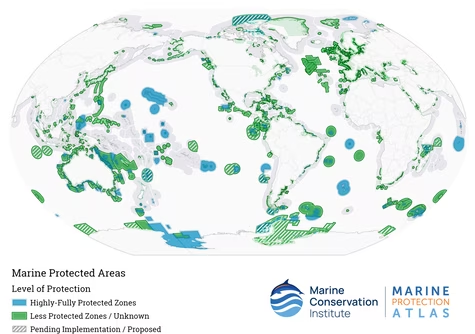
Vision Award – The BBNJ Agreement (The High Seas Treaty), which officially came into force on January 17, 2026, is a landmark win for our planet's oceans. It is a legally binding framework that will protect marine life, enable the establishment of Marine Protected Areas (MPAs), regulate the fishing industry, and support developing countries in building sustainable relationships with the ocean.
-
Global Impact Award – The Te Awa Tupua Act in New Zealand provides legal protection for the Whanganui River, a place with a deep ancestral relationship with the Whanganui Iwi Māori tribe. The Act affirms the river as a living, indivisible entity. For the first time, Indigenous peoples and the Crown have come together to protect the natural environment for the benefit of present and future generations. This Act exemplifies the rights of nature and Indigenous people.
The other 6 awardees were:
-
The Environmental Ombuds Office of Tyrol, Austria
-
The Biodiversity Act of Bhutan
-
Law 287 on the rights of nature and related state obligations in Panama
-
The Biodiversity Act of South Africa
-
Law 19/2022 granting the Mar Menor, Spain and its basin the status of a legal person.
-
The National Environment Act, Uganda
*****
With a special focus on youth and preserving our planet for future generations, the WFC is a brilliant example of how policy and legal protections can be used for good. They provide the frameworks for nations to implement their own strategies and work towards a more sustainable and peaceful planet.
"Change is possible when people listen and engage in dialogue. That's why it's so important to keep talking about solutions. I am convinced that the World Future Council is going down the right path to achieve lasting change for a better future."- Jane Goodall
Author: Rachael Mellor, 26.02.26 licensed under CC BY-SA 4.0
For further reading on the World Future Council see below ⬇️
More Resources