
International Day for the Elimination of Racial Discrimination - March 21
This day takes a stand against racism. It is our opportunity to unite for equality, reflect on progress, and embrace diversity.
➡️ INTERNATIONAL DAY FOR THE ELIMINATION OF RACIAL DISCRIMINATION - March 21
This United Nations observation day is an important global reminder of the persistent struggle against racism and a rallying call for collective action. March 21 commemorates the horrific Sharpeville Massacre in 1960, South Africa, where peaceful anti-apartheid demonstrators were met with open fire by police.
Last year, 2025, marked the 60th anniversary of the International Convention on the Elimination of All Forms of Racial Discrimination (ICERD). It was adopted on December 21, 1965 and was a groundbreaking step in international efforts to eradicate racism. This treaty laid the foundations for future progress in human rights. It has now been ratified by 179 countries. Notably, Myanmar, North Korea, and South Sudan are not signatories.
Despite almost universal ratification, many regions still suffer from deeply ingrained racial injustices and stigmas which cause systematic disadvantages, have serious physical, social, and emotional consequences, and put countless lives at risk. This day calls upon individuals, communities, and nations to reflect on the progress made and the challenges that remain.
"No one is born hating another person because of the colour of his skin, or his background or his religion. People learn to hate, and if they can learn to hate, they can be taught to love, for love comes more naturally to the human heart than its opposite." - Nelson Mandela
Jump straight to our resources on ➡️ International Day for the Elimination of Racial Discrimination
Explore our comprehensive guides on -
-
Black Lives Matter Protests
-
Organisations Against Racism
The State of Racial Discrimination Around the World
-
According to the World Justice Project since 2015, discrimination has increased in three-fourths of countries.
-
UNESCO's 2025 Global Outlook on Racism and Discrimination reveals that race accounts for 38% of reported discrimination cases globally, 18% of cases involve physical attacks.
-
Racism intersects with other forms of discrimination. Those with multiple risk factors, such as women, young people, and low-income earners, are even more likely to experience discrimination.
-
Social media and online platforms have contributed to the resurgence of hate speech and xenophobic narratives. The scapegoats of refugees and migrants have compounded the issue.
-
Today's systematic racism stems from European colonialism, slavery, and apartheid.
-
Racial discrimination includes Black populations aswell as other racialised communities such as the Roma in Europe, Dalits and Muslims in Asia, indigenous peoples in the Americas and Oceania, Palestinians, and refugees from all backgrounds.
-
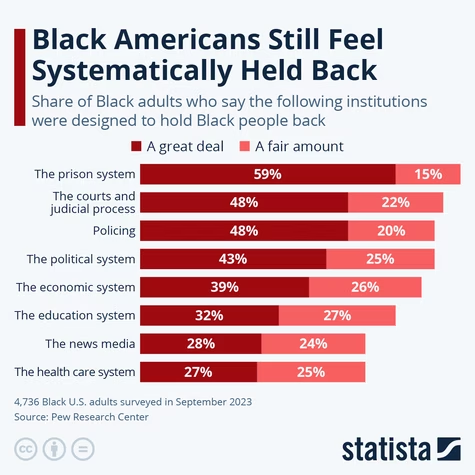
Globally, racial and discriminatory practices plague police and justice systems. In the U.S., Black people are 2.8 times more likely to be killed by police than white people. Black people are six times more likely to experience police misconduct, including physical violence.
-
Black Americans are incarcerated at nearly five times the rate of white Americans. Their sentences are also harsher, receiving, on average, 30% longer for similar crimes. Black people represent 48% of those serving life sentences.
-
Countries with some of the highest levels of racism include Iran, Myanmar, Israel, Belarus, and El Salvador.
-
In the UK, a study from 2019–2021 revealed that Black women were 3.7 times more likely to die during or up to a year after pregnancy than White women.
-
In the U.S., Black children are almost four times more likely to receive suspensions from school than white children.
-
In an analysis of 22 low- and middle-income countries, children from marginalised ethnic and religious groups lag far behind their peers in reading skills.
-
Racism in the housing market means that people of colour and those from ethnic minority backgrounds face systemic disadvantages in accessing and securing safe, quality, affordable housing.
-
In the U.S., the wage gap between Black workers and white workers has been increasing since 2000. Even when factors such as education, age, and experience are the same, they still earn significantly less.
-
A 2023 study across six Western nations found that 66% of employees from marginalised racial and ethnic groups experienced racism at work.
-
Facial recognition systems exhibit significantly higher error rates when identifying people of colour, leading to disproportionate surveillance, harassment, and wrongful arrests.
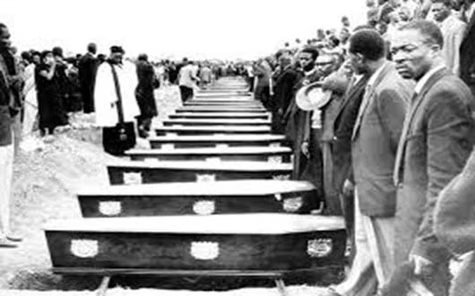
The Sharpeville Massacre, 1960, South Africa
The International Day for the Elimination of Racial Discrimination was established on the day of the Sharpeville Massacre to honour the victims of this dark day in South African history. The apartheid era did not officially end until 1994. It was a racist legal system that took away the freedoms and rights of all non-white South Africans.
White South Africans at the time made up only 15% of the population, but they held a tight grip on power, money, politics, and the rules of society. Using racist laws and violence, white supremacist discrimination repressed Black communities, intensifying and legalising the vast inequalities that already existed in South Africa.
Pass laws required Black South Africans to carry identification at all times. It was used to restrict where they could work, live, and travel. It was one of the most restrictive laws which confined Black people to specific settlement areas, which were considered undesirable by white people. Housing, education, healthcare, and public services were dangerously underfunded and left black communities living in deplorable conditions with little prospects. This system was used to arrest millions of Black South Africans.
On March 21, 1960, the Pan African Congress (PAC) organised a peaceful protest in Sharpeville, a designated Black township. In this act of nonviolent civil disobedience, the protestors marched to the local police station without their passes and asked to be arrested. They chanted songs about freedom and demanded an end to the Pass laws.
Police and armoured vehicles gathered around the protesters whilst military jets flew overhead. Then, without warning, they opened fire on the unarmed demonstrators, killing sixty‐nine of them and injuring 180. In total, the police were reported to have fired 700 bullets.
The event sparked international outrage. Just a few days later, approximately 30,000 protesters marched to Cape Town to protest the complete brutality shown by the police. One month later, the UN General Assembly officially declared apartheid as a violation of the UN Charter.
The International Day for the Elimination of Racial Discrimination was established six years later. Apartheid did not end until 29 years after this awareness was created, and today South Africa remains one of the most racially segregated and unequal societies. Apartheid has left a deep-rooted scar in the lives of Black South Africans, and discrimination is a persistent barrier that is proving hard to break down.
Civil Rights & Social Justice Activists
MALCOLM X - Pivotal African American leader and human rights activist who helped to shift the discourse on race throughout the 1950s and 60s. He helped redefine Black identity by promoting Black pride and celebrating heritage. He encouraged African Americans to reject all forms of racism. Malcolm X also played a key role in bringing the civil rights struggle to the international stage.
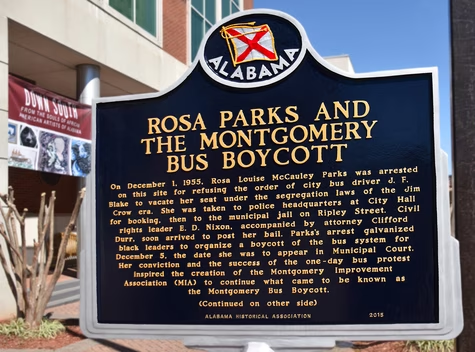
ROSA PARKS - Widely referred to as the mother of the civil rights movement. Rosa became famous for her act of defiance in 1955, when she refused to give up her seat on a bus to a white passenger. This spearheaded the Montgomery Bus Boycott, a year-long boycott of the city's bus system. The Supreme Court later ruled segregated buses unconstitutional.
JOHN LEWIS - Lewis was a U.S. Congressman who earned the name "conscience of the Congress" for his steadfast commitment to social justice, voting rights, and racial equality. He was the youngest speaker at the historic 1963 March on Washington, the leader of the Bloody Sunday march in 1965, and served for 17 terms as a U.S. Representative in Georgia.
NELSON MANDELA - A global symbol of peace and reconciliation. Mandela dedicated his life to pursuing a multi-racial South Africa and putting an end to white domination. His work led to a 27-year prison sentence and, ultimately, his election as South Africa's first Black president. In 1994, he was awarded the Nobel Peace Prize alongside F.W. de Klerk for their unwavering contribution to peace, equality, and human rights.
MARTIN LUTHER KING JR – MLK Jr dreamt of an America where people were judged by their character and not by the colour of their skin - where equal opportunities, freedom, and justice could be enjoyed by everyone. In the fight for this dream, he became one of the most influential leaders in ending racial segregation in the U.S.A. Embracing the tactics of peaceful, nonviolent resistance, his tireless advocacy for racial equality led to the creation of the 1964 Civil Rights Act and the 1965 Voting Rights Act.
*****
Racial discrimination tragically still bleeds into every sector of society. The legacy of systematic racism lives on for generations in healthcare, education, housing, employment, policing, and just about every other aspect of our daily lives. Human rights are to be enjoyed universally; these barriers constitute a direct violation of those rights.
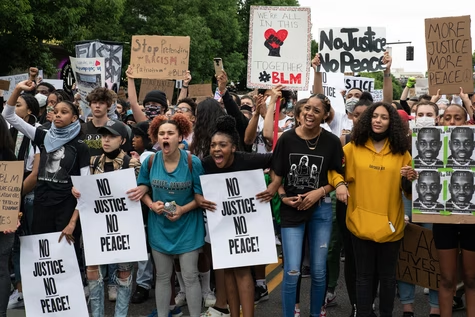
In recent years, the Black Lives Matter movement has propelled the issue of racism into the spotlight, and rightly so. Initially founded in 2013 in response to the acquittal of Trayvon Martin's murderer, the movement was reignited following the murder of George Floyd, an unarmed Black man, by a Minneapolis police officer. It triggered the largest protests in U.S. history.
The fight for racial justice and against structural oppression involves targeting the root causes, including patriarchy, colonialism, and slavery, as well as economic inequality. Days like March 21st raise awareness of ongoing issues and push for long-term, effective change.
By fostering dialogue, promoting understanding, and advocating for equality, we can work towards a world where diversity is celebrated and discrimination is relegated to the past.
"In a racist society, it is not enough to be non-racist, we must be anti-racist." - American political activist, Angela Y. Davis
Author: Rachael Mellor, 12.02.26 licensed under CC BY-SA 4.0
For further reading on the International Day for the Elimination of Racial Discrimination see below ⬇️
More Resources
Curated Directory & Deep-Dive Resources on International Day for the Elimination of Racial Discrimination - March 21
- International Day for the Elimination of Racial Discrimination - March 21 - United Nations 507423
- United Nations - OHCHR 508371
- Peace One Day - Anti-Racism Programmes 507422
- Wikipedia 507424
- Sharpeville massacre - Wikipedia 508374
- Sharpeville Massacre, 21 March 1960 - South African History Online 508375
- UN calls for solidarity and political will to stamp out racial discrimination - UN News 23.03.26 511883
- From Sharpeville to Durban: The unfinished fight against racial discrimination - OHCHR 19.03.26 511314
- Ahead of UN day to end discrimination, Hamilton anti-racism group says 'collective response' is needed - CBC News 18.03.26 511316
- Unifor Statement on the International Day for the Elimination of Racial Discrimination - Unifor 18.03.26 511315
- HC’s message on the International Day for the Elimination of Racial Discrimination - OHCHR 21.03.25 508372
- The International Day for the Elimination of Racial Discrimination: Unions in action to combat the far right - ITUC 19.03.25 508370
- Lest we forget 21 March: Sharpeville Massacre and UN anti-racism day - Mandela Scottish Memorial 21.03.24 508379
- Sharpeville: new research on 1960 South African massacre shows the number of dead and injured was massively undercounted - Conversation 28.11.23 508377
- International Day for the Elimination of Racial Discrimination 2022 - South African Government 21.03.22 508378
- Video: The Sharpeville Massacre - standing up against racism - UN Human Rights 19.03.21 508376
- International Day for the Elimination of Racial Discrimination - House of Lords 21.03.19 508373