
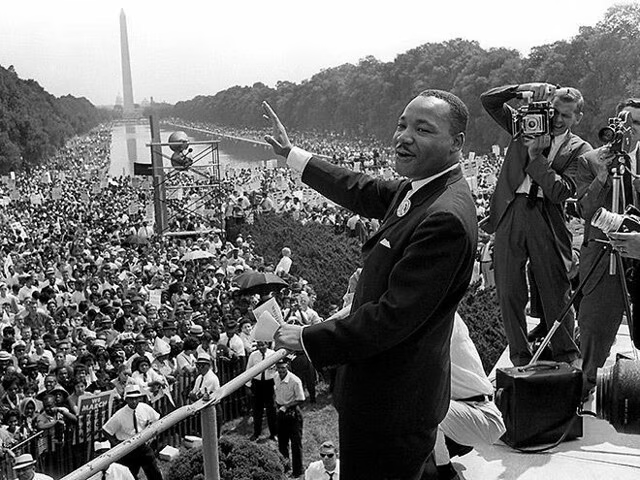
Martin Luther King (USA)
Explore the life and legacy of Dr. Martin Luther King Jr. Learn about his nonviolent civil rights movement, famous speeches, 1964 Nobel Peace Prize, and lasting impact.
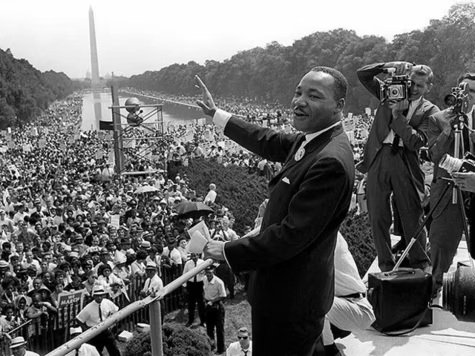
MARTIN LUTHER KING JR. (1929 - 1986) - Leader Of The American Civil Rights Movement
Discover the fascinating world of the civil rights movement and the inspiring leader MLK Jr. Our guide offers you in-depth information on nonviolent activism, the ongoing fight for racial equality, and his historical work dismantling institutional segregation.
Connect with hundreds of valuable resources, initiatives, and organisations on how courage, compassion, and persistent activism can drive meaningful social progress.
Jump straight to our resources on ➡️ Martin Luther King Jr.
*****
General Information
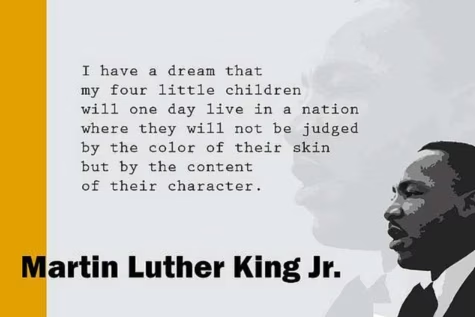
Martin Luther King Jr (MLK) grew up in a time of extreme racial segregation. He dreamt of an America where people were judged by their character and not by the colour of their skin - where equal opportunities, freedom, and justice could be enjoyed by everyone.
In the fight for this dream, MLK went on to become one of the most influential leaders in ending racial segregation in the U.S.A. Embracing the tactics of peaceful, nonviolent resistance, his tireless advocacy for racial equality led to the creation of the 1964 Civil Rights Act and the 1965 Voting Rights Act.
As the youngest person to receive the Nobel Peace Prize at the time, he believed that true justice could be achieved by addressing poverty and economic inequality and by appealing to the nation's moral conscience.
MLK was assassinated at the age of 39, but his legacy of nonviolent activism and inspirational speeches lives on.
"Nothing in all the world is more dangerous than sincere ignorance and conscientious stupidity" - MLK Jr.
Explore our comprensive guides on Martin Luther King Jr. Day, his inspiring speeches and sermons, his assassination in 1968, and the modern day Black Lives Matter Movement.
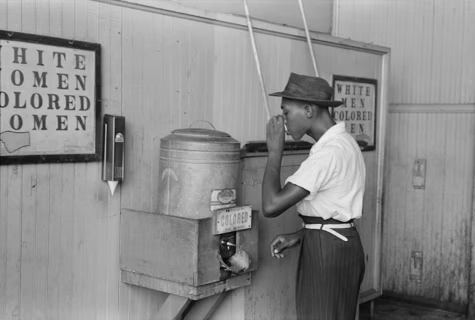
Racial Segregation In The U.S.A
Racial segregation in the U.S. began in the colonial era and was then institutionalised after the end of slavery in 1865. It meant that even after the cruelty and barbarity of slavery was over, life for Black Americans was still heavily regulated, restricted, and deeply embedded with discrimination in all aspects of everyday life.
Racial segregation existed all over the U.S., but was enshrined in law in the majority of southern states. The Jim Crow laws created a system of apartheid, which legally separated services for Black and white Americans, including schools, hospitals, public transport, bathrooms, and all other public spaces. The services provided for Black Americans were vastly inferior, reducing opportunities and enforcing a system of oppression.
These laws were enforced under state power and with violence. African Americans were all but stripped of their right to vote through a system of taxes, tests, and intimidation. Interracial marriage was forbidden. They were forced to live in disadvantaged neighbourhoods, with dangerous and overcrowded housing, and were legally excluded from the rental or purchase of property.
Black Americans were also confined to low-paid, low-skilled jobs, without the right to unionise. Discrimination in the South was overt and severely damaging to the extent that the legacy of these practices can still be witnessed today.
The Civil Rights Act of 1964 and the Voting Rights Act of 1965 legally dismantled these laws but the situation on the ground remained hostile and attitudes towards Black Americans certainly did not change overnight.
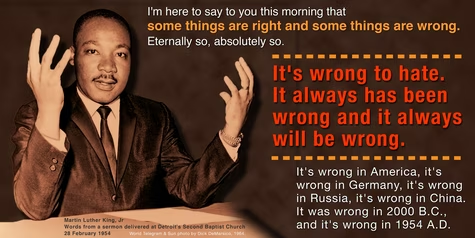
The Discovery Of Nonviolence & Gandhi
Martin Luther King Jr. was raised in Atlanta, Georgia. His father was the pastor of the Ebenezer Baptist Church and a successful minister. He worked hard to shield his children from the reality of racism and racist practices at the time. He fought against racial prejudice and believed that racism and segregation were misaligned with the will of God.
Influenced by his father, MLK Jr. sought from an early age to fight for the rights of Black Americans. He believed that studying to become a doctor or a lawyer was the best way to do so and completed his doctorate at age 25. During his time in education, several influential figures taught him about the principles of nonviolent resistance, and he was drawn to the teachings of Gandhi and his use of love and nonviolence as tools for social reform.
On the back of this, MLK Jr set out six principles of nonviolence to instil a sense of shared compassion that would, in turn, lead to the end of racism, poverty, inequality, and violence.
-
Nonviolence is a way of life for courageous people.
-
Nonviolence seeks friendships, tolerance, and understanding.
-
Nonviolence seeks to defeat injustice.
-
Nonviolence supports the concept of suffering for a just cause to educate and transform.
-
Nonviolence adopts love and not hate.
-
Nonviolence trusts that the world sides with justice.
MLK's Biggest Achievements
-
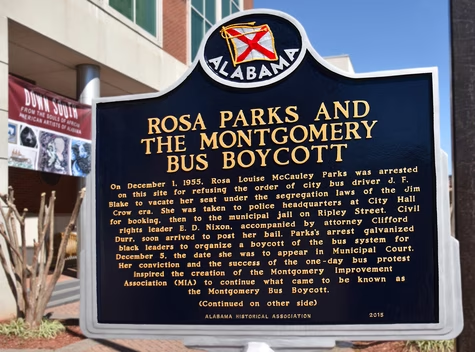
THE MONTGOMERY BUS BOYCOTT (1955-56) - This 381-day protest began with Rosa Parks, who refused to give up her seat to standing white passengers at the direction of the bus driver. She was arrested, and alongside other civil rights leaders, MLK orchestrated a boycott of the Montgomery bus service, resulting in substantial financial losses and legal defeats. On November 13, 1956, the Supreme Court ruled the state of Alabama's bus segregation laws were unconstitutional.
-
FOUNDING MEMBER OF THE SOUTHERN CHRISTIAN LEADERSHIP CONFERENCE (1957) - The organisation coordinated nonviolent civil rights protests across the South. Under the leadership of MLK, they combined Christian principles with the wisdom of Gandhi, using Black churches as bases to organise support for marches, boycotts, protests, and other forms of nonviolent resistance.
-
THE GREENSBORO SIT-IN MOVEMENT (1960) - This student-led campaign began in North Carolina. Tired of discriminatory rules, young Black Americans began sitting at racially segregated lunch counters, silently refusing to move and exercising their right to remain seated. They were subjected to verbal and physical abuse, to which they did not react. The idea caught on in other cities, and at an SCLC conference, King met with several of the sit-in leaders. He encouraged others to follow suit, and eventually, segregation at lunch counters in 27 cities was abolished. King led a large group of students into a department store where they were denied service. On refusing to leave along with 36 others, King was arrested. He was released but shortly after was ludicrously jailed for a traffic conviction in which presidential candidate John F. Kennedy pressured for his release.
-
THE MARCH ON WASHINGTON (1963) - With help from labour unionist A. Philip Randolph and political activist Bayard Rustin organised one of the largest peaceful demonstrations in American history. On August 28, 1963, 250,000 people attended the March on Washington for Jobs and Freedom. This is where King delivered his inspirational and unforgettable 'I Have a Dream' speech. The demonstration helped to sway public opinion on the second-class treatment of African Americans. Shortly after, in 1964, the Civil Rights Act was passed, which banned discrimination and segregation of public services.
-
THE SELMA-TO-MONTGOMERY MARCHES (1965) - With a renewed focus on voting rights, the SCLC, SNCC, King, and other organisers began a march from Selma to the state's capital, Montgomery. Although initially peaceful, the march was quickly met with violence from the police, who used tear gas and batons to deter demonstrators. In what became known as Bloody Sunday, widespread media coverage displayed images of the injured and bloodied activists to a horrified audience. A second attempt was made on March 9, 1965, with 2,500 demonstrators. This time, when they encountered the police, they knelt in prayer and promptly turned back. The third attempt gained the support of President Lyndon B. Johnson, who this time ordered troops and the National Guard to protect the protestors. On March 25, an estimated 25,000 protesters gathered in the state capitol where King delivered another moving speech. Five months later, the Voting Rights Act was passed.
Martin Luther King Jr. Day
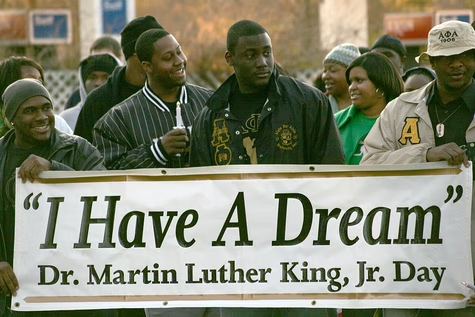
Martin Luther King Jr. Day is celebrated each year on the third Monday in January. The legislation to first introduce this day was introduced just 4 days after his assassination on April 4, 1968. It took 15 years of pressure from civil rights activists for it to be approved. It wasn't until the year 2000, another 17 years later, that it was recognised as a federal holiday in all 50 states.
The day honours the tireless dedication of King to the civil rights movement, the achievements he made, and the work still to be done. It encourages Americans to volunteer and improve their communities in his honour.
MLK Day is marked with speeches, parades, marches and commemorative events. It encourages us to spread love and compassion, support Black businesses, donate to social justice causes, and become involved with civil rights groups.
Assassination Controversy
Almost 6 decades later, there are still unanswered questions and controversy surrounding the assassination of MLK Jr. He was killed by a sniper while standing on a balcony at the Lorraine Motel in Memphis, Tennessee. He was aged 39 at the time of his death. The news of his murder sent shockwaves throughout the country, where riots and demonstrations erupted in more than 100 cities across the U.S.
It also sparked massive outbreaks of racial violence, leading to the deaths of 40 people across the country. Escaped fugitive James Earl Ray confessed to the crime and was sentenced to 99 years in prison. For 28 years, he maintained he was not guilty, and in his last few weeks, he even spoke to Dexter King, the son of MLK Jr., to further claim his innocence.
Members of King's family and many of his civil rights companions suspect that there was a larger government conspiracy to get rid of King to dismantle, disrupt, and end the civil rights movement.
The ongoing claims by Ray of his innocence prompted King's family to pursue a new trial, but it was unsuccessful, and many theories still lie unproven.
MLK's Legacy
The legacy of Martin Luther King Jr. lives on through his children, who have continued his activism in civil rights, nonviolence, and equality. The Martin Luther King, Jr. Research & Education Institute supports a range of educational activities featuring King's work and the movements he inspired. It also houses the King Papers Project, an endeavour to publish the entire papers of Martin Luther King, Jr., including his sermons, speeches, correspondence, and other writings.
In 1968, MLK Jr.'s wife established The King Centre, which is now led by their son, Bernice King. It is a living memorial that keeps the King's legacy alive and strives to finish his work through research, education, training, advocacy, and activism.
The now global Black Lives Matter (BLM) movement is proof of the long way we still have to go before racial inequality and discrimination are eradicated. Huge protests started in Minneapolis in 2020 after the brutal murder of unarmed George Floyd by state police. By the summer of 2020, it was estimated that 15-26 million people had participated in the demonstrations in the United States alone. Led by BLM, these protests became the largest ever in U.S. history. The protests drew massive attention to the issue of racial inequality in the U.S. and around the world. Below we list some shocking statistics.
-
The Black pay gap is roughly $2.7 trillion, leading to much higher rates of poverty within non-white communities.
-
Just 44% of Black families own their own homes compared to 73.7% of white families. Homes located in Black-majority neighbourhoods are worth 23% less in comparison to similar properties in white neighbourhoods.
-
Black Americans represent 14% of the country's population, yet food insecurity rates for the Black population are 19.7%.
-
Black drivers are 20% more likely to get stopped than white drivers relative to their residential population. Black drivers are then 1.5-2 times more likely to be searched.
-
Racial bias in facial recognition means that Black and Asian faces are up to 100 times more likely to be misidentified.
-
Between the period 2012-16, Black men were served sentences 19.1% longer for the same federal crime than white men. Black people make up 38% of the population in jails and prisons.
-
In 2020, despite only representing 14% of the population. Approximately 42% of people on death row were Black.
"Human progress is neither automatic nor inevitable... Every step toward the goal of justice requires sacrifice, suffering, and struggle; the tireless exertions and passionate concern of dedicated individuals." - Martin Luther King Jr.
Author: Rachael Mellor, 23.12.25, latest update 29.08.26, licensed under CC BY-SA 4.0
More Resources
Curated Directory & Deep-Dive Resources on Martin Luther King (USA)
- News 15
- The Man 29
- Organisations 19
- Speeches & Sermons 35
- MLK Jr. Day - January 95
- Articles on MLK 73
- Filmography 4