Human Rights
Explore a curated directory of famous human rights defenders, civil rights leaders, and modern activists—from Martin Luther King Jr. to Nobel Peace Prize laureates.
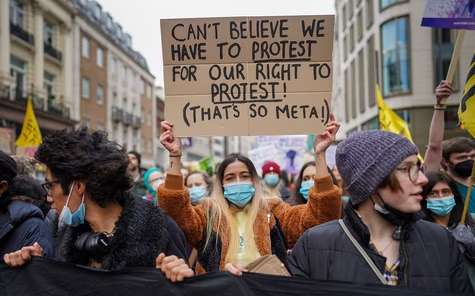
HUMAN RIGHTS DEFENDERS & ACTIVISTS - Fighting For Human Rights At All Costs
Discover the inspiring world of human rights defenders and become informed about your own rights. Our guide offers you in-depth information on global advocacy, human rights laws and mechanisms, social justice initiatives, and our universal rights.
Connect with hundreds of valuable resources, initiatives, and exemplary activists - from brave lawyers and journalists to global NGOs - putting their lives on the line to stand up for those who have been silenced, violated, abused, marginalised, and imprisoned.
Jump straight to our resources on ➡️ Human Rights Defenders
*****
General Information
Every single person on the planet is legally entitled to our human rights, regardless of gender, place of birth, age, race, religion, sexual orientation, or any other factor which may alienate an individual or group and result in discrimination.
Many of us take our human rights for granted, but even today, millions of people are still fighting for them. Human rights go hand in hand with equality.
"To deny people their human rights is to challenge their very humanity" - Nelson Mandela.
The Universal Declaration of Human Rights was adopted by the United Nations in 1948. All 193 UN member states agreed to the principles of the declaration. For the first time, it set out our fundamental rights and made them universally protected.
The declaration consists of 30 separate articles covering everything from freedom and security to the right to justice and protection of the law, asylum, democracy, and education.
Despite protective laws in place, human rights defenders, activists and NGOs are still very much needed to protect people without a voice. They play a vital role in fighting violations, often through legal systems and the courts.
- Every hour, a child dies in an armed conflict.
- Every 10 hours, a human rights defender, journalist, or trade unionist is killed or disappeared.
- One in five people globally have experienced discrimination in the past year.
- CIVICUS reports that civic freedoms are seriously repressed or attacked in over 110 countries.
Major international rights organisations report that the global human rights situation is deteriorating as we witness a global decline in civil liberties, political rights, and the rule of law.
Protecting civic space, freedoms, justice, and funding for vital humanitarian organisations is more important than ever.
Not only are our rights being rolled back, but violence against human rights defenders has reached record levels, with at least 5,995 killed since 2015. Latin America is the most dangerous region to be a rights defender.
The most targeted sectors for attacks, harassment, arbitrary arrests, and killings are in the defence of land, environment, peasant and indigenous peoples' rights.
Explore our comprehensive guides on women’s rights, children’s rights, refugees and migrants, press freedom, and internet freedom.
Better World Info’s Top Human Rights Defenders
-
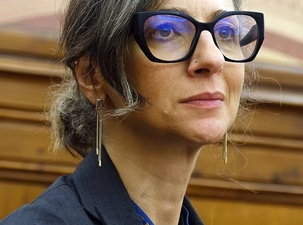
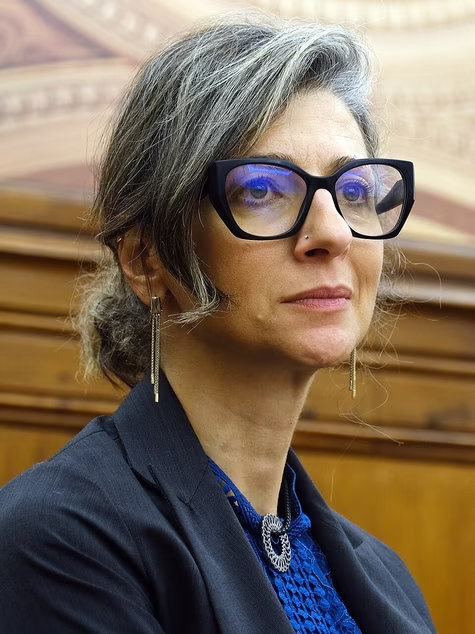
Francesca Albanese (Italy) -
Albanese is a distinguished figure in international law and human rights. In 2022, she was appointed UN Special Rapporteur on the occupied Palestinian territories. She is the first woman to take on the position.
In her first report, she recommended that UN member states develop “a plan to end the Israeli settler-colonial occupation and apartheid regime”. After the Israeli invasion of the Gaza Strip on October 27th, 2023, Albanese called for an immediate ceasefire and warned that Palestinians in Gaza were at risk of ethnic cleansing.
She has continually pushed for nations to implement an embargo on arms sales to Israel, put an end to all trade agreements, enforce accountability for war crimes, and complete Israeli withdrawal from the occupied territories. She urged the International Criminal Court to pursue war crimes prosecutions against the U.S. and Israeli officials.
In response, Trump’s administration imposed sanctions and added her to the "Specially Designated Nationals" list, imposing a transactional ban, freezing any U.S. assets, intense screening, travel sanctions, and revoking her visa.
In 2025, Francesca received the Lay Down Your Arms Peace Prize who has “forcefully and unwaveringly worked against Israel’s full-scale war on the occupied Palestinian territories, in particular Israel’s ongoing genocide against the Palestinian people.”
Albanese is one of the most prominent and uncompromising critical voices of Israel’s actions in Gaza and the system of occupation in general. Despite intense international pressure, her approach remains firmly grounded in international law. She serves as an inspiring testament to integrity and the common good.
-
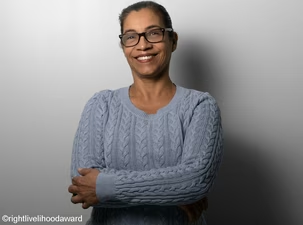
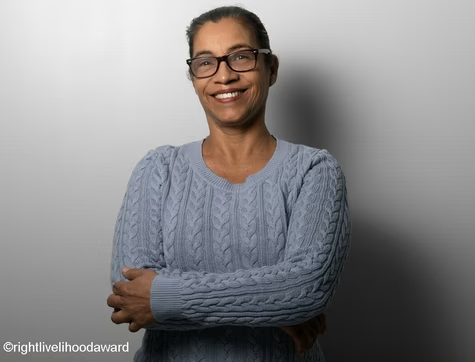
Lottie Cunningham Wren (Nicaragua) -
Wren is a lawyer from the Miskito indigenous group in Nicaragua who used the law to defend the ancestral lands and human rights of indigenous and Afro-descendant peoples in her Central American country.
She was awarded the Right Livelihood Award in 2020 for “her ceaseless dedication to the protection of indigenous lands and communities from exploitation and plunder.”
Her work has helped secure territorial rights in Nicaragua and also went on to become the blueprint for Indigenous land protection around the world, helping those vulnerable to illegal corporate resource exploitation and armed settler violence.
Wren has been remarkably successful at engaging and mobilising communities to defend their rights, giving them the tools they need to get organised. She even went so far as to prove that protecting Indigenous land is essential to safeguarding local ecosystems.
In 2003, she founded the Centre for Justice and Human Rights of the Atlantic Coast of Nicaragua. This dedicated NGO works to protect Indigenous and Afro-descendant land and human rights in the remote Autonomous Regions of Nicaragua.
-
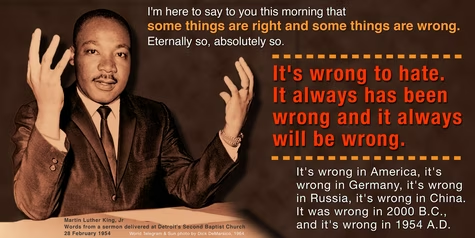
Martin Luther King Jr (USA) -
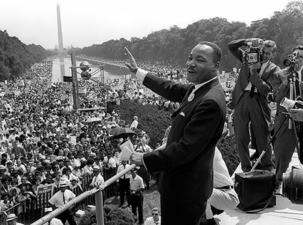
Martin Luther King Jr (MLK) grew up in a time of extreme racial segregation. He dreamt of an America where people were judged by their character and not by the colour of their skin - where everyone could enjoy equal opportunities, freedom, and justice.
In the fight for this dream, MLK became one of the most influential leaders in ending racial segregation in the U.S.A. Embracing peaceful, nonviolent resistance, his tireless advocacy for racial equality helped lead to the 1964 Civil Rights Act and the 1965 Voting Rights Act.
As the youngest person to receive the Nobel Peace Prize at the time, he believed that true justice could be achieved by addressing poverty and economic inequality and by appealing to the nation's moral conscience.
MLK was assassinated at the age of 39, but his legacy of nonviolent activism and inspirational speeches lives on.
"Nothing in all the world is more dangerous than sincere ignorance and conscientious stupidity" - MLK Jr.
Martin Luther King Jr.'s legacy lives on through his children, who have continued his activism for civil rights, nonviolence, and equality. The Martin Luther King, Jr. Research & Education Institute supports a range of educational activities featuring King's work and the movements he inspired.
-
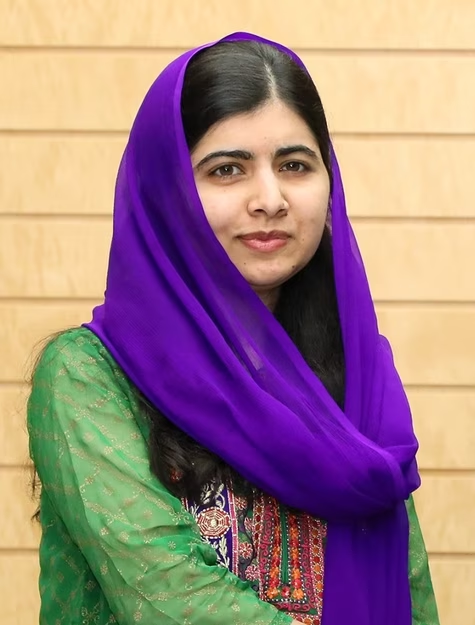
Malala Yousafzai (Pakistan) -
Malala is an internationally celebrated female education activist and the youngest ever Nobel Prize laureate. She co-received the Peace Prize in 2014 at the age of just 17 "for their struggle against the suppression of children and young people and for the right of all children to education”.
After her anonymous journal entries detailing the harrowing reality of Taliban occupation for young girls grew in popularity, Malala started to receive the wrong kind of attention. In 2012, after tracking her movements for months, a Taliban soldier shot Malala in the head whilst she was on the school bus - a clear message for critics of the regime.
The horrors of the event gained global attention as she was airlifted to the UK for emergency surgeries. Malala not only survived, but she went on to become one of the most outspoken activists for girls' education in history.
She was awarded the Sitara-e-Shujaat, Pakistan's second-highest civilian bravery award, the Mother Teresa Award, the Ambassador of Conscience Award from Amnesty International, the International Children's Peace Prize, and over 50 other awards for her bravery and commitment to human rights and social justice.
TIME magazine named her one of “The 100 Most Influential People in the World.”
On her 16th birthday, she was invited to give a speech at the United Nations, where she called for the equal right to education for girls all over the world. She became the youngest-ever United Nations Messenger of Peace and a global symbol of the call for worldwide access to education.
Malala has released two best-selling memoirs, opened a school in the Bekaa Valley, Lebanon, for Syrian refugees, and donated $50,000 to UNRWA to rebuild schools in the Gaza Strip. During the Kashmiri conflict, she fought to get children back into education, urged an immediate ceasefire and humanitarian aid to be sent to Afghan civilians, condemned the Taliban’s erasure of girls and women from society, is a vocal critic of U.S President Trump, particularly his harsh policies on immigration, and has condemned the persecution of the Rohingya in Myanmar.
Alongside her father, she set up the Malala Fund in 2013. It is a non-profit organisation that invests in local education networks and advocates for policy changes around the world.
"I raise my voice not so I can shout, but so that those without a voice can be heard. We cannot succeed when half of us are held back." - Malala Yousafzai.
-
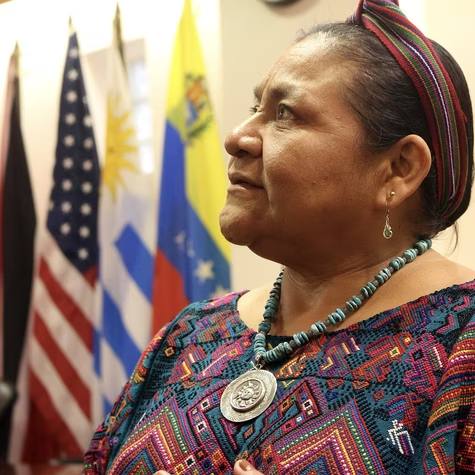
Rigoberta Menchú Tum (Guatemala) -
Rigoberta is a global symbol of peace and reconciliation across social divisions on the American continent. Growing up in poverty, her family were subjected to brutal repression and persecution. Rigoberta is K'iche', a Guatemalan indigenous group that makes up 9-11% of the population.
She has dedicated her life to fighting for the rights of indigenous peoples in her home country and across the region.
The brutal 36-year civil war ending in 1996 left indigenous communities ravaged by severe rights violations and attempted genocide by the Guatemalan army. It resulted in more than 200,000 deaths, 80% of which were of Maya descent.
Women became targets of physical and sexual violence, villages were destroyed, populations were massacred, 1.5 million Guatemalans were displaced, crops were razed, and water supplies were poisoned.
Rigoberta played a pivotal role in publicising the rights of Guatemala's Indigenous peoples and holding Guatemala's military and political leaders to account in Spanish courts. This led to the extradition of seven former governmental officials and even a charge of genocide.
Although she never won the presidency, her party, Winaq, became the country's first Indigenous party.
She was awarded the Nobel Prize in 1992 "for her struggle for social justice and ethno-cultural reconciliation based on respect for the rights of indigenous peoples." She used her prize money to establish the Rigoberta Menchú Tum Foundation that advocates for Indigenous communities, supports refugees, and fights for justice for survivors of genocide.
In 1996, UNESCO named her a Goodwill Ambassador, and she received the Prince of Asturias Award in 1998.
While in exile, she published her memoir, which went on to become a global bestseller. It graphically exposed the brutal atrocities committed by the military against the Maya people.
In 2006, alongside other female peace laureates, she co-founded the Nobel Women's Initiative to advocate for women's rights worldwide.
-
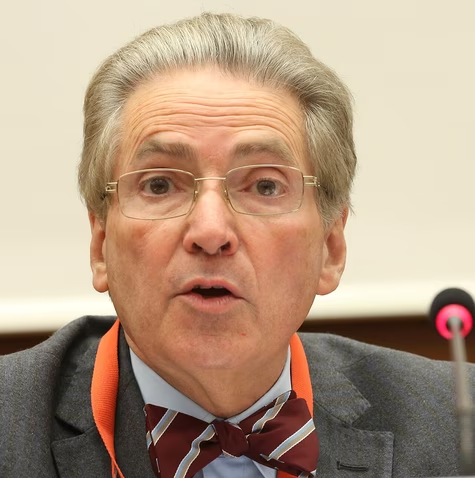
Alfred de Zayas (USA, Switzerland) -
De Zayas is best known for his position as the first UN Independent Expert on the Promotion of a Democratic and Equitable International Order from 2012 to 2018. His long career has earned him immense respect as an international lawyer, historian, human rights activist, professor, and celebrated author.
He has also served as Secretary of the UN Human Rights Committee and Chief of the Petitions Department at the Office of the UN High Commissioner for Human Rights.
His work has always focused on promoting a fairer world by advocating for human rights and the rule of law, and ensuring accountability for violations. He has a particular interest in the judicial protection of minorities, indigenous populations, and the right to freedom of expression.
He has written and lectured on the Armenian genocide, the Holocaust, Guantanamo Bay, ethnic cleansing in the former Yugoslavia, the Second World War, the Turkish invasion of Cyprus, the dispute over Kashmir and their right to self-determination, the Nagorno-Karabagh conflict, and minority populations in Western Sahara, Sri Lanka, Equatorial Guinea, and Nigeria.
De Zayas is an outspoken critic of Western foreign policy, unilateral economic sanctions, particularly those imposed by the U.S., UK, and the EU, the weaponisation of human rights, military interventions, indefinite detention, the dominance of corporate power, and trade agreements.
Human Rights For A Better World
These inspiring individuals, and the thousands of other champions of human rights, prove that one person's actions can make a huge difference.
Human rights defenders safeguard our fundamental freedoms and hold powerful entities accountable by exposing abuses, advocating for justice, and protecting vulnerable populations.
Their efforts drive systemic change and the push for equal rights, often at immense personal risk, making them essential to upholding democracy and human dignity worldwide.
Author: Rachael Mellor, 07.09.26, latest update 28.09.26, licensed under CC BY-SA 4.0
More Resources
Curated Directory & Deep-Dive Resources on Human Rights
- Martin Luther King (USA) 270
- Petra Kelly (Germany)
- Aaron Swartz (USA) 34
- Vittorio Arrigoni (Italy) 52
- Kailash Satyarthi (India) 18
- Bianca Jagger (UK / Nicaragua) 120
- Nurcan Baysal (Turkey) 8
- Rachel Corrie (USA) 104
- Shirin Ebadi (Iran) 46
- Helen Bamber (UK) 9
- Julia Häusermann (UK) 13
- Mary Robinson (Ireland) 55
- Hina Jilani (Pakistan) 11
- Aung San Suu Kyi ? (Burma)
- Soros Foundation (USA) 16
- John Perry Barlow (USA) 19
- Norman Finkelstein (USA) 15
- Bono / U2 (Ireland) 14
- Kenneth Roth (USA) 8
- Bayard Rustin (USA) 8
- Rosa Parks (USA) 24
- Freedom Riders (USA 1961) 7
- Malalai Joya (Afghanistan) 41
- Natan Blanc (Israel) 11
- Ahed Tamimi (Palestine) 30
- Andrei Sakharov & Elena Bonner (Soviet Union) 9
- Aleksandr Solzhenitsyn (Russia) 19
- Rigoberta Menchu Tum (Guatemala) 33
- Martin Almada (Paraguay) 25
- Malala Yousafzai (Pakistan) 47
- Thich Quang Do (Vietnam) 8
- Baltasar Garzon (Spain) 13
- Wei Jingsheng (China) 9
- Wang Dan (China)
- Amira Hass (Israel) 12
- Richard Falk (USA) 94
- Michael Ratner (USA) 12
- Princess Diana (UK) 26
- Hafsat Abiola-Costello (Nigeria) 10
- Graça Machel (Mozambique & South Africa) 22
- Irena Sendler (Germany, Poland) 12
- Archbishop Oscar Arnulfo Romero (El Salvador)
- Rosalina Tuyuc Velásquez (Guatemala) 5
- Ernesto Cardenal (Nicaragua) 9
- Sergio Vieira de Mello (Spain) 6
- Emily Hobhouse (UK) 4
- Waris Dirie (Somalia) 12
- Yuri Orlov (Russia) 7
- Nikolai Girenko (Russia) 5
- Jo Wilding (England) 10
- Peter Tatchell (UK) 16
- Ngawang Sangdrol (Tibet) (opens an external link) 1
- Ama Adhe (Tibet) 3
- Palden Gyatso (Tibet) (opens an external link)
- Thich Huyen Quang (Vietnam) 6
- Dita Sari (Indonesia) 8
- Tisahamy and the Veddah Tribe (Sri Lanka) 3
- Virginia Durr (USA) 6
- Woody Guthrie (USA)
- Paul Robeson (USA) 13
- Harriet Tubman (USA) 9
- Richard Gere (USA)
- Benjamin B. Ferencz (USA) 15
- Kathryn Bolkovac (USA) 9
- Audrey Hepburn (Belgium, USA) 3
- Prof. Protess & his journalist students (USA) 6
- Osman Murat Ülke (Turkey) 6
- Akin Birdal (Turkey) 5
- Bruno Kreisky (Austria) 5
- Jemima Khan (UK) 23
- Rupert Neudeck (Germany) 8
- The White Rose
- Oskar Schindler (Germany) 6
- Victor Klemperer (Germany) 4
- Hans Litten (Germany) 6
- Eduardo Umana Mendoza (Colombia) 3
- Vaclav Havel (Czech Republic)
- Stephen Biko (South Africa) 11
- Mamphela Ramphele (South Africa) 8
- Matoub Lounes (Algeria) 6
- Leonard Peltier (Lakota People, USA)
- Muhammad Ali (USA) 1
- John Amaechi (UK) 7
- George Washington Carver (USA) 2
- Famous Black Americans (USA) 7
- Harriet Beecher-Stowe (USA) 14
- Frederick Douglass (USA) 11
- Joe Gelders (USA)
- Jim Thorpe (USA) 13
- George Orwell (UK)
- Mary Wollstonecraft (UK) 9
- Jan Karski (Poland) 14
- Karl May (Germany)
- Maria Montessori (Italy) 18
- Ruby Bridges (USA) 22
- Olympe de Gouges (France) 5
- Father Shay Cullen (Ireland) 12
- Emmanuel Ray (UK) 27
- Theodore Roosevelt Mason (USA) 4
- Prince Harry (UK) 45
- Prince William (UK) 21
- Bob Moses (USA) 5
- Emma Watson (UK) 3
- Amal Clooney (Lebanon, UK) 4
- Alfred de Zayas (USA, Switzerland) 49
- Francesca Albanese (Italy) 62
- Volker Türk (Austria) 37
- Bernice King (USA) 7
- Jesse Jackson (USA) 11
- Other Exemplary People on Human Rights 72