
World Oceans Day - June 8
Discover World Oceans Day resources for June 8. Learn about marine conservation, climate change, and how we can achieve the 30x30 protection goal.
➡️ WORLD OCEANS DAY, June 8 - Catalysing Action for Our Oceans
This United Nations international day aims to raise awareness about the crucial role that oceans play in our lives and the importance of preserving and protecting them. The official UN theme for 2026 is 'Reimagine: Beyond the world we know, a new relationship with our ocean.'
The World Ocean Day organisation, which is managed by The Ocean Project is the grassroots network that founded and coordinates the annual global celebration in 2002. It was formally adopted by the UN in 2008 to globally mandate and formally recognise the observance
The World Ocean Day organisations theme in 2026 focuses on ‘Strong Marine Protected Areas (MPAs) for Our Blue Planet’
It aligns with the 30x30 goal set out in the Kunming-Montreal Global Biodiversity Framework at the UN Biodiversity Conference in 2022 (the goal of protecting at least 30% of lands, waters, and oceans by 2030) and the recent ratification of the High Seas Treaty.
Please share this important resource via ➡️ Twitter, Bluesky, Facebook, Instagram, and LinkedIn !
Jump straight to our resources on ➡️ World Oceans Day
Explore our comprehensive guides on -
- Our Guide to Water & Oceans
- Ocean Protection
- The High Seas Treaty
- Marine Protected Areas
- The Fishing Industry
- Rising Sea Levels & Glacial Melt
- Ocean Acidification
- Oil Spill Disasters
- The Oceans Plastic Crisis
- Coral Reefs
- The Shipping Industry
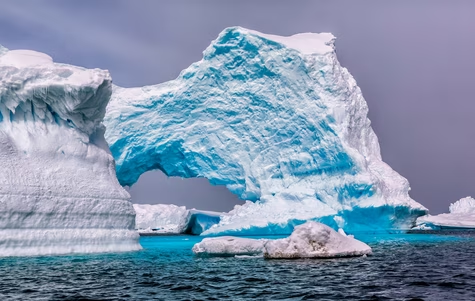
With 90% of fish stocks now depleted globally, 50% of the world's coral reefs destroyed, and a 30% increase in acidity compared to pre-industrial times, there has never been a more pressing time to protect our oceans.
The balance between depletion and restoration is dangerously close to tipping irreversibly in the wrong direction. A healthy ocean and a healthy planet cannot exist without each other; we must push for stronger international policies and action at all levels to safeguard both.
*****
Major Threats to the World's Oceans
Oceans are currently facing a polycrisis as pollution, overfishing, and climate change wreak havoc on this precious ecosystem.
- Sea levels are rising by 3.7 mm per year. By 2050, current predictions place sea level rise at 30 cm, leading to large-scale coastal flooding and erosion.
- The ocean’s warmest recorded year ever was in 2023.
- Ocean acidity has increased by 30% since the start of the Industrial Revolution, driven by rising atmospheric carbon dioxide levels.
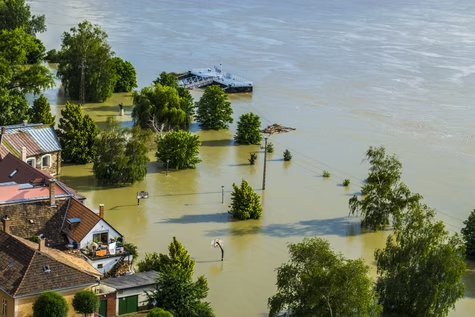
- Increased ocean temperatures have resulted in the loss of half of the world's coral reefs. They are at risk of being completely wiped out by 2050.
- 12 million tonnes of plastic waste enter our oceans every year.
- The Arctic and Antarctic have recorded their lowest ever sea-ice coverage in the last 40 years.
Marine Protected Areas (MPAs) & The High Seas Treaty
MPAs are designed to protect threatened habitats and boost dwindling biodiversity in our struggling oceans. They are a powerful tool for legally regulating harmful human activities such as bottom trawling, overfishing, resource exploitation, and seabed mining.
As of 2025, there are over 15,000 MPAs worldwide, covering roughly 8% of the world's oceans. For these sites to be truly effective, they must be adequately monitored and managed. Of all the MPAs, only 2.9-3.6% are categorised as "fully or highly protected".
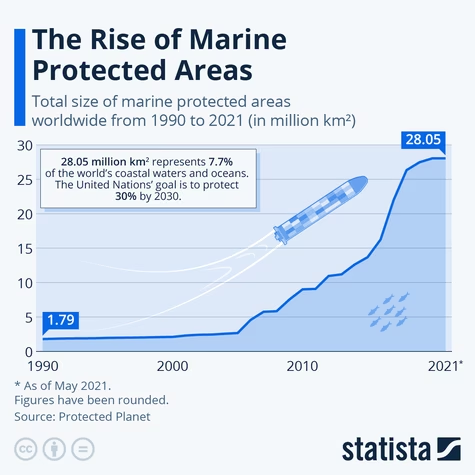
Historically weak legislation, inadequate regulations, and poor enforcement have hampered their effectiveness. However, as of January 17, 2026, we now have the first legally binding framework to protect the wild west of international waters - the High Seas Treaty.
Officially called the Biodiversity Beyond National Jurisdiction Agreement (BBNJ), the high seas are international waters beyond any nation's jurisdiction, making them rife with unchecked fishing, pollution, and other environmentally destructive activities.
Previously, just 1% of these waters were adequately protected. This landmark win for our planet's oceans will protect marine life, enable the establishment of MPAs, regulate the fishing industry, and support developing countries in building sustainable relationships with the ocean.
Following the 2022 COP15 Biodiversity Conference, 196 governments pledged to protect 30% of their seas by 2030. This new treaty is an important step towards achieving the 23 targets set out in the framework and avoiding irreversible damage to marine biodiversity and the blue economy.
Healthy Oceans For A Better World
World Oceans Day provides an opportunity to propose solutions to the critical issues mentioned above. It also highlights successful conservation efforts and policy implementation, providing others with guidelines.
Oceans are fundamental to all life on our planet. They help stabilise our climate, provide a key source of nutrition for billions of people, support the livelihoods of 3 billion people, and are home to some of the most magnificent animals and habitats on the planet.
We must create not only a healthy blue planet, but also a more just, equitable and sustainable one.
"The ocean’s power of regeneration is remarkable - if we just offer it the chance," - Sir David Attenborough.
Author: Rachael Mellor, 06.06.24 (Updated 08.06.26) licensed under CC BY-SA 4.0
For further reading on World Oceans Day see below ⬇️
More Resources
Curated Directory & Deep-Dive Resources on World Oceans Day - June 8
- World Oceans Day - official 350083
- World Oceans Day - 8 June 172558
- United Nations WORLD OCEANS DAY 289865
- World Ocean Day - Action theme 2026 516936
- UNESCO - World Oceans Day 289867
- Video: Announcing UN World Oceans Day 2022 289895
- World Oceans Day - Wikipedia 289671
- Marine Stewardship Council - World Ocean Day 289887
- World Oceans Day - BBC Bitesize 516935
- National Geographic Kids 516937
- YouTube Search - World Oceans Day 289840
- You Tube Search - World Ocean Day 2026 290849
- UN OCEAN CONFERENCE - Lisbon, Portugal | 6-7/22 289838
- United Nations Decade of Ocean Science for Sustainable Development 289847
- 2022 UN Ocean Conference - UN Decade of Ocean Science for Sustainable Development 289846
- Commonwealth Blue Charter 289892
- #Reimagine 517850
- #WorldOceansDay 289674
- #WorldOceanDay 289863
- #WorldOceansDay2026 289864
- #WOD2026 517849
- #SaveOurOcean 289839
- #SaveOurOceans 289843
- #TidesAreChanging 350209
- #Revitalization 289673
- #CollectiveAction 289672
- Scientists sound alarm on World Oceans Day as Trump axes deep-sea monitoring - RFI 08.06.26 517845
- WWF Q&A: World Oceans Day, Marine Protection & Financial Aid - Sustainability Mag. 08.06.26 517844
- World Oceans Day Reimagines Our Relationship With the Water Around Us - Columbia Climate School 08.06.26 517848
- “REIMAGINE: Beyond the world we know, a new relationship with our ocean” - Geneva Environment Network 08.06.26 517846
- Giving guitarfish a chance: one man’s mission to persuade fishers to farm giant snails instead - Guardian 08.06.26 517847
- World Oceans Day 2026: Turning Risk into Resilience and Resilience into Opportunity - Observer Research Foundation 20.05.26 517313
- 13th Annual Photo Competition for UN World Oceans Day - DPG 06.03.26 516938
- Tweet: The ocean covers 71% of the earth's surface but receives less than 1% of global climate finance.Pollution, overfishing & climate change threaten the health of the ocea… 472704
- Tweet: Prochlorococcus, a marine bacterium that is only 0.5–0.7 micrometers wide, produces more oxygen than all tropical rainforests combined. Every tiny organism plays a key… 472705
- World Oceans Day: Scientists find new clues about frontiers of ocean life - Mongabay 06.06.25 472708
- Tweet: Governments, scientists, advocates & other influential voices are coming together next week for the world’s main forum on ocean action. - @UN 06.06.25 472706
- The Secretary-General Message for World Oceans Day - UN 05.06.25 472707
- Unravelling the tales of sharks and dugongs on World Oceans Day - UN News 07.06.24 418754
- 6 things you can do for the ocean today - Greenpeace 07.06.24 418616
- ‘Awaken New Depths’ and Celebrate UN World Oceans Day 2024 - EcoWatch 07.06.24 417918
- Meet the Winners of the 11th Annual UN World Oceans Day Photo Competition - EcoWatch 07.06.24 417917
- Discovery+ announces special lineup for World Oceans Day 2023 - Media Brief 06.06.23 350219
- Plastic Ocean Project screening short film ‘356′ for World Oceans Day - WECT 06.06.23 350216
- SEA LIFE TRUST and CCEP launch nationwide beach cleans on World Oceans Day - Politics Home 06.06.23 350214
- 5 Ways to Celebrate World Oceans Day - Oceana 01.06.24 417271
- Inspiring conservation on World Oceans Day - Mirage 01.06.23 350220
- Video: Dr. Jane Goodall's Message for World Oceans Day 2022 289841
- World Oceans Day 2022: The fight against climate change & pollution - France 24 English 08.06.22 290851
- When the tide turns: A sobering thought for World Oceans Day - UCA 07.06.23 350212
- World Oceans Day for Kids | World Oceans Day 2022 - Twinkl Teaching Resource 07.06.22 290850
- World Oceans Day to be 1st-ever hybrid celebration of annual event - AA 6/22 289893
- World Ocean Day 2022: What is it and what is this year’s theme? - Independent 289881
- World Oceans Day – Why protecting the oceans means protecting people - Greenpeace 6/22 289888
- World Oceans Day 2022: How climate change and warming waters are affecting the health of the oceans - abc 6/22 289873
- Greenpeace Africa and fishing communities across West Africa demand action on the fishmeal and fish oil industry - Greenpeace 6/22 289889
- World Oceans Day 2022: The sustainable swaps to make, from shampoo bars to reusable coffee cups - Independent 6/22 289875
- Celebrating a Decade of ARTivism for Oceans on World Oceans Day - PangeaSeed Foundation 6/22 289879
- World Oceans Day 2022: Inspirational Quotes to Fire You Up to Protect Oceans - News18 289876
- World Oceans Day 2022: 5 Things You Can Do to Protect the Ocean - ScandAsia 6/22 289878
- World Ocean Day: A look at 8 critically endangered marine species - Al Jazeera 6/22 289884
- World Oceans Day – Mapping the Commonwealth one coral reef at a time 6/22 289891
- How you can act on ocean pollution this World Oceans Day - Big Issue 6/22 289885
- World Oceans day 2022: Greek Island cleans up Marine debris - WION 6/22 289877
- Oceans of Learning: Jump in for World Oceans Day 2022! - RTE 6/22 289874
- UN World Oceans Day Photo Competition - OFA 6/22 289880
- Royal Museums Greenwich - World Oceans Day 2022 289894
- Hong Kong & Macau to Celebrate World Oceans Day with BAP-Certified Seafood - Global Sea Food 25.05.22 290869
- Hong Kong & Macau to Celebrate World Oceans Day with BAP-Certified Seafood 5/22 289890
- End war on nature and ensure ocean health, UN chief says in message for World Oceans Day - UN News 6/21 289886
- World Oceans Day: Marine reserves to be created in England - BBC 6/21 289882
- World Oceans Day: what are you doing to protect your ocean? - Guardian 6/20 289897
- Celebrate World Oceans Day from home with the UN this Monday - EcoWatch 6/20 208927
- 'I raised hell': how people worldwide answered the call of World Oceans Day - Guardian 6/20 289898
- World Oceans Day: how are you celebrating? - Guardian 6/15 289896
- Our Tweet on the topic 6/22 289842
- Our Facebook post 6/22 289844
- Our Instagram post 6/22 289868