
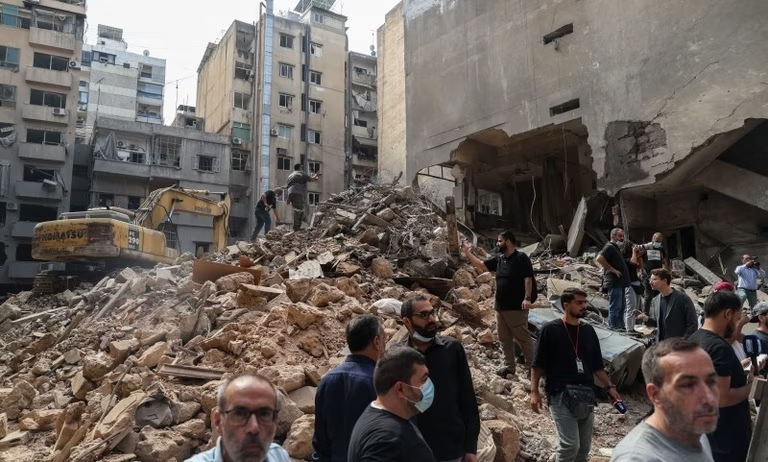
Israeli Invasion of Lebanon
Get the latest updates on Israel's invasion of Lebanon. Coverage includes IDF ground operations, Hezbollah clashes, peace talks, and regional impacts.
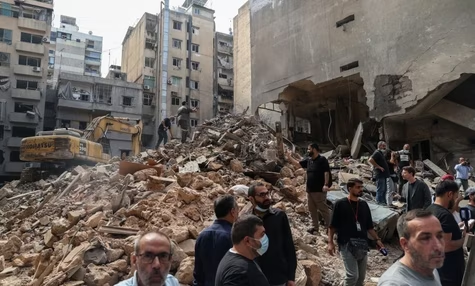
ISRAELI INVASION OF LEBANON (September 2024 - Ongoing)
Uncover the complex realities of the Israeli war on Lebanon and learn how this ongoing conflict continues to destroy the lives of civilians.
Explore in-depth analysis of the deepening humanitarian crisis, including the widespread destruction of infrastructure and the displacement of over a million civilians. We analyse the repeated failure of diplomatic ceasefire agreements, alongside the dangerous role of Hezbollah.
Connect with vital news sources, expert insights, and human rights documentation—exploring serious allegations of war crimes and critical perspectives aimed at fostering accountability, humanitarian relief, and a pathway toward genuine stability and a sustainable peace.
Jump straight to our resources on the ➡️ Israeli Invasion of Lebanon
*****
General Information
Israel is currently engaged in a major ground invasion of Southern Lebanon, which escalated sharply in March 2026. This followed the collapse of a previously negotiated ceasefire, the U.S. - Israel attacks on Iran, and their assassination of the Iranian Supreme Leader, Ayatollah Ali Khamenei.
The initial attacks struck more than 1,000 targets in Lebanon, which Israel claimed were Hezbollah strongholds. Hezbollah, a paramilitary group and a political party that wields tremendous power in Lebanon, launched retaliatory strikes, prompting Israel to begin its ground invasion.
Since March 2, Israeli forces have launched more than 1,840 attacks on Lebanon.
Israel claims their goal is to permanently demilitarise South Lebanon, create a buffer zone to protect Israeli border communities, and allow tens of thousands of displaced Israeli residents to return home.
This new escalation of the war on Gaza has expanded the war further into the Middle East. It has led to the deaths of more than 4,000 predominantly Lebanese civilians, injured more than 12,000, and displaced more than a million.
The British Red Cross reports that 4.3 million people are now in need of humanitarian assistance in the country. This is particularly shocking when you consider the total population is 5 million.
Many Lebanese fear that Israel's ultimate goal is prolonged occupation and a redrawing of the border.
The current situation as of August 2026 -
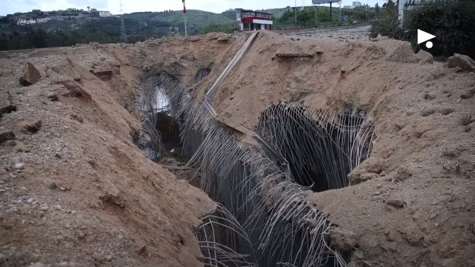
Israel continues to occupy southern Lebanon despite a U.S. brokered ceasefire deal. They recently destroyed a tunnel system in the Beaufort area that they claim to be a key part of Hezbollah’s infrastructure.
Although full-scale combat has ceased, Lebanon is caught in a tentative, highly volatile ceasefire and struggling under a profound humanitarian and economic crisis.
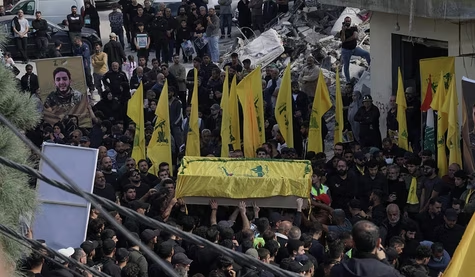
Who Are Hezbollah?
Hezbollah is both a Shiite Muslim political party and militant group. They operate from Lebanon and are backed heavily by Iran. They violently oppose both Israeli and Western powers operating in the Middle East.
They are the dominant military force in Lebanon and wield significant power over the country.
Hezbollah became involved in the Gaza War by launching a cross-border rocket campaign in solidarity with Hamas right at the start of events in 2023.
Since then, they have suffered severe blows to their leadership and infrastructure as the Israeli military began its retaliatory campaigns in late 2024.
Hezbollah entered the Iran War in March 2026, in retaliation for the killing of Iranian Supreme Leader Ayatollah Ali Khamenei. They have a mutual alliance with Iran and have supported their war efforts against the U.S. and Israel.
In response, the IDF unleashed brutal air strikes across southern Lebanon, the Bekaa Valley, and Beirut. They followed this with an expansion of their ground operations.
Hezbollah dragged Lebanon into yet another war. Their decision to become involved in the Iran war was met with swift backlash from many Lebanese. Public support for Hezbollah is waning as many blame the group for extensive damage, heavy casualties, the economic crisis, and serious hardships across the nation.
- Fewer than one-third of Lebanese citizens express confidence in the party.
- More than half explicitly say they do not trust it.
- 79% favour a national army monopoly on arms, meaning that only the official Lebanese Armed Forces should maintain weapons in the country.
- 58% explicitly favour disarming Hezbollah.
- Support within the Shia community remains high, with approximately 87.5% backing the group. Support from non-Shia communities remains below 10%.
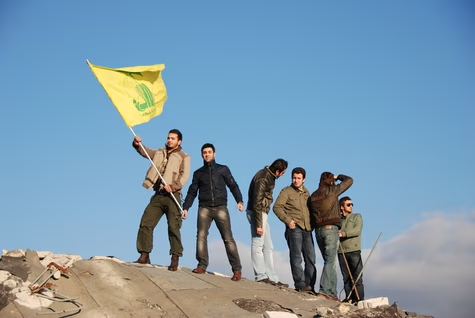
History Of Lebanon - Israel Conflicts
The 2026 escalation is sadly the latest in a long list of cross-border conflicts spanning almost 5 decades:
- The South Lebanon Conflict (1978) - Also known as the ‘First Israeli invasion of Lebanon’, codenamed Operation Litani by Israel. The IDF defeated the Palestine Liberation Organisation (PLO), forcing them to withdraw from southern Lebanon and thus preventing them from launching attacks on Israel from the Lebanese land border. The United Nations called on Israel to immediately withdraw its troops from Lebanon and established the United Nations Interim Force in Lebanon (UNIFIL).
- The Second Israeli Invasion of Lebanon (1982) - The invasion followed a series of attacks and retaliatory attacks between the PLO, who were back operating in southern Lebanon and the IDF. A full-scale invasion reached Beirut and led to an 18-year occupation of a "Security Zone" in the south. During this time, Hezbollah was established and waged a guerrilla war against the Israeli occupation until their withdrawal from Lebanon in 2000.
- The Third Israeli Invasion of Lebanon (2006) - A 34-day conflict against Hezbollah. Hezbollah were fighting for the release of Lebanese citizens held in Israeli prisons. On 11 August 2006, the United Nations Security Council approved Resolution 1701 to end the hostilities. It called for disarmament of Hezbollah, Israeli withdrawal from Lebanon, the deployment of the Lebanese Armed Forces, and an enlarged UNIFIL. Both sides claimed victory.
Humanitarian Impact
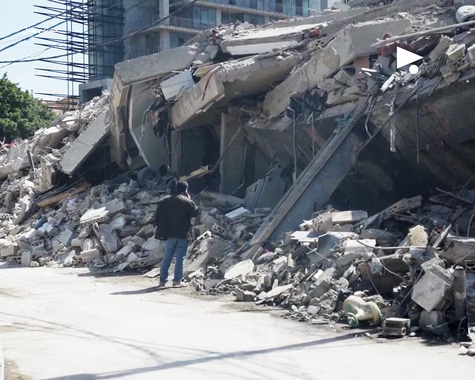
- Israeli attacks have killed more than 4,300 people in Lebanon, the vast majority of them civilians.
- An estimated 1.2 million people, including 350,000 children, have been displaced. Israeli evacuation orders now cover more than 568 square miles, equating to 14% of the country's territory.
- The IDF has levelled entire border villages to prevent Hezbollah from re-establishing attack launch sites.
- Over 37,000 housing units have been heavily damaged or completely flattened.
- Dozens of hospitals have been either forced to close or suspend operations due to direct damage or lack of resources. An estimated 200 medical facilities have faced targeted attacks.
- Israeli air strikes have killed at least 130 Lebanese first responders, including paramedics and ambulance drivers.
- Agricultural lands in the south and the Beqaa Valley in the north have been completely razed, preventing food production and destroying livelihoods.
- Poverty rates in heavily impacted southern states are projected to reach over 87-94%.
- Key bridges in southern Lebanon have been targeted to cut off and isolate communities, making it extremely difficult for them to access basic supplies and medical attention.
War Crimes
There is extensive evidence of war crimes which have been committed by both sides during the Israeli military invasion.
Examples include the levelling of border towns, the deliberate destruction of civilian infrastructure, targeting dense civilian zones, targeted attacks on medical personnel and services, use of white phosphorus in residential areas, and direct targeting of journalists.
These acts of war are clear violations of the UN Charter.
War crimes are being documented by the National Committee for International Humanitarian Law and the UN Office of the High Commissioner for Human Rights. There are also reports based on evidence provided by Lebanese citizens which are to be submitted to the UN Human Rights Council in Geneva.
Renewed interest in the pursuit of justice and accountability followed the new U.S. ceasefire proposal, which stated that both sides were prevented from taking political or legal action against one another while negotiations are underway.
Another point of interest is Lebanon's non-membership in the International Criminal Court. They are not a party to the Rome Statute and therefore are not under the jurisdiction of the ICC. This places serious roadblocks on the path to accountability.
Internal political divisions and fears of exposing Hezbollah to the laws of the ICC have previously prevented them from pursuing membership. Calls for them to join are growing louder from both civilians and political groups.
In April 2024, they almost granted the court jurisdiction, but later revoked the decision.
Attempts At Peace & Ceasefire In Lebanon
On 14 April 2026, talks between Israeli and Lebanese officials took place in Washington, D.C. This marked the first direct negotiations between the two nations since 1993.
The Washington Peace Proposals were hosted by U.S. Secretary of State Marco Rubio and are U.S. brokered initiatives aimed at ending the conflict. The result was a 14-point trilateral framework agreement focused on the IDF's withdrawal from Southern Lebanon. Units of the Lebanese Armed Forces would replace them and would oversee the disarmament of Hezbollah.
On 26 June 2026, Lebanon and Israel signed the framework. It has been designated as a first step and not a final peace treaty. The framework does not include a full IDF withdrawal. Hezbollah rejected the agreement.
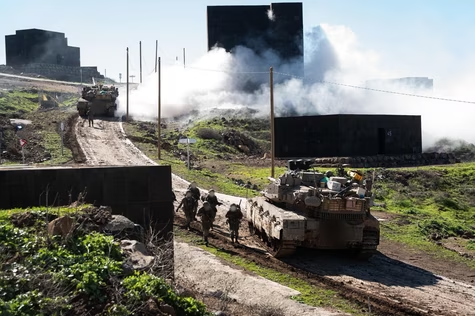
Israel has refused to agree to a ceasefire. Their primary goal is the complete disarmament of Hezbollah and a long-term ‘security zone’ along the border.
Lebanon meanwhile has prioritised an immediate ceasefire. They have proposed a full withdrawal of Israeli troops to within their own borders.
The current proposal is based on a three-zone plan where Southern Lebanon is divided into zones to facilitate a phased Israeli withdrawal.
Hezbollah, which rejects all Western influence in the Middle East have warned that attempts to disarm them could spark a civil war.
Follow-up talks have struggled to align the framework to any binding timeline for a ceasefire.
Lebanon is still enduring daily strikes, demolition operations, reconnaissance overflights, and limited humanitarian assistance.
Netanyahu is insistent that the IDF will not withdraw from southern Lebanon (where it occupies roughly one-fifth of the country) until it has fully dismantled Hezbollah's infrastructure.
*****
Achieving lasting peace in Lebanon demands an immediate end to military action from all sides and comprehensive disarmament across all non-state armed groups. We must respect Lebanon’s right to sovereignty and security.
True stability must be built on accountability, deep governmental reforms, and justice for war crimes and international law violations.
Robust humanitarian aid to restore healthcare and basic infrastructure, fund economic recovery, and enable a safe, dignified return for uprooted families is essential.
“Stop the fighting. Stop the bombing. There is no military solution. Only diplomacy, dialogue and the full implementation of the UN Charter and Security Council Resolutions” - UN Secretary-General António Guterres
Author: Rachael Mellor, 04.08.26, licensed under CC BY-SA 4.0
More Resources
Curated Directory & Deep-Dive Resources on Israeli Invasion of Lebanon
- 2026 Lebanon War - Wikipedia 512976
- 2024 Israeli invasion of Lebanon - Wikipedia 434032
- Israeli–Lebanese conflict - Wikipedia 433647
- #Lebanon 433637
- #LebanonUnderAttack 433638
- Israeli shelling continues as Lebanon’s PM demands withdrawal in UN speech - Al Jazeera 25.09.26 523456
- Lebanese army failing to curb Hezbollah activity in south, Israeli officials tell US - JPOST 28.08.26 522878
- Video: Amnesty International Calls for War Crime Investigation into Assassination of Journalist Amal Khalil 25.08.26 523403
- Canada boosts Lebanon aid to $50m and condemns Israeli ‘unlawful invasion’ - Al Jazeera 19.08.26 522020
- Israeli strikes in south Lebanon a ‘violation of international law’: PM - Al Jazeera 13.08.26 522036
- Rights groups call Israel’s killing of journalist Amal Khalil a ‘war crime’ - Al Jazeera 06.08.26 521563
- IDF destroys Iran-backed Hezbollah tunnel systems, says more remain in southern Lebanon - JPOST 04.08.26 521235
- IDF destroys Hezbollah stronghold where Nasrallah declared Israel ‘weaker than a spider’s web’ - ynet 15.07.26 520016
- Why Lebanon can have a framework agreement and Syria cannot - JNS 12.07.26 519921
- Israel Is Deliberately Targeting Lebanon’s Journalists - Jacobin 09.07.26 519667
- Amnesty Calls for War Crimes Probe After Israel ‘Obliterated Entire Families’ in Lebanon - CD 09.07.26 519680
- Headteacher among four killed in deadliest Israeli attack on Lebanon since latest ceasefire - BBC 06.07.26 519615
- Netanyahu says some Lebanese Christian villages 'asked to be annexed' by Israel - Le Monde 05.07.26 519616
- What is South Lebanon's Ali al-Taher ridge and why does Israel want it? - New Arab 05.07.26 519618
- Lebanon’s Aoun calls on US to keep ‘always standing beside’ his country - Al Jazeera 04.07.26 519617
- Lebanese army sidelining Shiite troops who won’t confront Hezbollah, Israeli envoy claims - ynet 02.07.26 520591
- 100,000s unable to return amid continued military activity despite agreements - Relief Web 02.07.26 519760
- Lebanon’s Surrender Agreement: Hezbollah Expert Amal Saad on Beirut’s “Framework” With Israel - Dropsite 02.07.26 519509
- The Framework Agreement Between Lebanon and Israel: A Positive First Step on a Long Road to Change - INSS 02.07.26 520595
- Powerful blast heard across northern Israel as IDF destroys Hezbollah’s ‘drone fortress’ in Lebanon - y net 29.06.26 519305
- In Lebanon, framework agreement signed with Israel spurs protest, criticism - Al Jazeera 28.06.26 519794
- Trilateral Framework Between the United States of America, the State of Israel, and the Republic of Lebanon - US Department of State 26.06.26 519256
- Senior Israeli Political Source: 'The Goal Is to End the Conflict and Reach a Peace Agreement' - y net 26.06.26 519257
- Despite Trump-Iran Deal, Netanyahu Says Israel Will Not Leave Lebanon ‘As Long as I Am Prime Minister’ - CD 24.06.26 519384
- Report: Israel, Lebanon discuss US-backed plan to transfer southern territory to Lebanese army - y net 24.06.26 519267
- Israel demands Lebanon take ‘concrete action’ against Hezbollah before any withdrawal, official says - y net 24.06.26 519268
- Video: Remembering Mona Khalil, Beloved Lebanese Sea Turtle Conservationist Killed in Israeli Airstrike - DN! 23.06.26 519142
- Tentative But Defiant, Lebanese Families Return to Southern Lebanon Amid Continued Occupation - Dropsite 22.06.26 519209
- Israel Holds to Lebanon Truce, With Troops Kept on Defense - NY Times 22.06.26 519153
- Netanyahu: Israel will 'keep the security zone in Lebanon as long as is necessary to protect our people' - y net 22.06.26 519151
- Why Lebanon may make or break the Iran-US deal - Al Jazeera 21.06.26 518879
- Iran says it is closing strait of Hormuz over Israeli strikes in Lebanon - Guardian 21.06.26 518881
- Israeli soldiers in Lebanon are free to take action if under threat, Israel's Katz says - Reuters 21.06.26 518880
- Tweet: Hezbollah broke the ceasefire, not Israel. Terrorists lie. Hezbollah is a terrorist organization. Hezbollah lies. - @yechielleiter 20.06.26 519395
- Lebanon Emerges as Weak Link in U.S.-Iran Deal to End War - NY Times 19.06.26 519394
- IDF Troops Say They Are 'Policing' Displaced Civilians Returning en Masse to Homes in Southern Lebanon - Haaretz 18.06.26 518747
- Israel demarcates expanded Lebanon occupation zone, challenging US-Iran pact - Reuters 18.06.26 518746
- Israel seized more land from neighbors since 2023 than it has in decades - AP 18.06.26 518745
- Trump tells Netanyahu to be ‘more responsible with respect to Lebanon’ - AlJazeera 16.06.26 519220
- Netanyahu says Israel won’t leave occupied land in Lebanon - Al Jazeera 15.06.26 518319
- Civil Records for Hundreds of Thousands of Lebanese Could Be Wiped Out By Israel’s Total War - Intercept 14.06.26 518802
- ‘Normalizing fire at Israel’: Jerusalem bristles as Trump pushes restraint on Hezbollah, Iran - ynet 14.06.26 518440
- 'A Nakba of 2026': An IDF reservist recounts his time in Lebanon - RS 11.06.26 520586
- Israel kills 14 in southern Lebanon after trading fire with Iran - Al Jazeera 09.06.26 517882
- Israel kills 17 in Lebanon as Trump says US-Iran in ‘final throes’ of deal - Al Jazeera 09.06.26 519255
- Israelis push Netanyahu to resist U.S. pressure and keep fighting in Lebanon - Washington Post 08.06.26 518080
- Video: Iran Warns Israel over Attacks on Lebanon After Iran, Israel Exchange Strikes: Trita Parsi - DN! 08.06.26 517885
- Lebanese president accuses Iran of using his country as a bargaining chip in peace talks with the US - CNN 06.06.26 517895
- Video: Israel's air force strikes southern Lebanon despite agreement on ceasefire - DW 05.06.26 517883
- Israel strikes southern Lebanon after ordering evacuations of nine villages - Guardian 05.06.26 517884
- Joint Statement of the United States of America, Republic of Lebanon, and State of Israel on the Latest High-Level Trilateral Meeting - US Department of State 03.06.26 517802
- Trump Pushes to End Lebanon Conflict in Hope of Unlocking a Deal With Iran - WSJ 01.06.26 517546
- Israel can't bomb its way out of the Hezbollah problem - ynet 31.05.26 517551
- Tyre is Now the Epicenter of Israel’s Assault on Lebanon - Dropsite 28.05.26 517289
- No End in Sight: Israel Expands War on Lebanon, Orders Evacuation of 14% of Country - DN! 28.05.26 517432
- Lebanese Cities Face ‘Direct Threat of Israeli Occupation’ as IDF Orders 200,000 People to Evacuate - CD 27.05.26 517182
- Israel Is on a Killing Spree of Paramedics and Rescue Workers in Lebanon - Dropsite 22.05.26 517034
- Looting and destruction are Israeli army’s ‘primary mission’ in Lebanon, soldiers say - Middle East Eye 21.05.26 516594
- Israeli strikes on Lebanon kill at least 19 as clashes with Hezbollah continue despite ceasefire - Guardian 20.05.26 516595
- Lebanese president vows to 'do the impossible' to end war with Israel as strikes continue despite ceasefire - Euronews 18.05.26 516596
- Israel strikes southern Lebanon hours after ceasefire extension - France24 16.05.26 516593
- War worsens Lebanon’s economic crisis with job losses, price gouging and slow business - AP 15.05.26 516592
- Satellite Imagery Shows Ongoing Demolitions Across Southern Lebanon - Bellingcat 14.05.26 516779
- What is on the table during Lebanon-Israel direct negotiations? - Al Jazeera 14.05.26 516182
- Lebanon says two paramedics among 13 killed in Israeli strikes - BBC 12.05.26 515869
- Israeli killings in Lebanon rise: Is even the pretence of a ceasefire over? - Al Jazeera 11.05.26 515783
- If Trump wants out of war he needs to stand up to Israel on Lebanon - Responsible Statecraft 11.05.26 515782
- Israeli attacks on Lebanon continue as US says will facilitate 'intensive talks' - New Arab 09.05.26 515781
- Senators press US military on Israel’s displacement campaign in Lebanon - Al Jazeera 07.05.26 515518
- ‘Ceasefire in Name Only’: Israel Bombs Beirut With Approval From Trump Administration - CD 07.05.26 515391
- Video: Israel’s Destruction of Southern Lebanon Turns Villages into “Moonscapes”: Reporter Lylla Younes - DN! 06.05.26 515620
- Historic Lebanon-Israel talks: A no-win situation? - DW 06.05.26 515311
- Israel strikes south Lebanon beyond designated 'security zone' - France24 03.05.26 515089
- Thirteen killed in Israeli strikes on southern Lebanon, health ministry says - BBC 02.05.26 515090
- Civilians or Hezbollah: Who did Israel hit on Lebanon’s ‘Black Wednesday’? - Al Jazeera 30.04.26 515092
- A history of neglect: How Lebanon's state failed the south - New Arab 30.04.26 515091
- Israel in Lebanon: Is the 'security buffer zone' legal? - DW 29.04.26 514724
- Israeli strikes kill eight in southern Lebanon, including three rescue workers - Euronews 29.04.26 514670
- In Lebanon, Israel imposes 'peace' through domination, with Mat Nashed - New Int 29.04.26 515655
- Hezbollah drone strikes target Israeli soldiers in southern Lebanon - Guardian 28.04.26 514668
- ‘We were left alone’: Along Israel's ‘Yellow Line’, Lebanese feel abandoned by the state - Middle East Eye 28.04.26 514669
- Lebanon cannot be bombed into sovereignty - Al Jazeera 27.04.26 515097
- 'We must never forget why the peace agreement signed between Israel and Lebanon in 1983 collapsed less than a year later' - Le Monde 26.04.26 514461
- Lebanon is a house divided as its leaders negotiate and Hezbollah fights on - Middle East Eye 25.04.26 514462
- Six killed in Israeli strikes on south Lebanon - New Arab 25.04.26 514463
- Video: Lebanese Journalist Amal Khalil Killed in Israeli Strike, Medics Blocked from Saving Her Under Rubble - DN! 24.04.26 514381
- Israeli attacks on Lebanon may violate international law, UN warns - Al Jazeera 24.04.26 514577
- Lebanese PM Condemns Israel’s Killing of Journalist Amal Khalil as ‘Clear-Cut War Crime’ - CD 23.04.26 514309
- Lebanon Needs a New Negotiating Strategy with Israel - Carnegie Endowment 22.04.26 515405
- Israel-Lebanon ceasefire violated 220 times in less than three days - Canary 22.04.26 514363
- How Israel is destroying Lebanon’s water infrastructure - Al Jazeera 22.04.26 514156
- To stay or to go? No good options for Lebanon’s displaced - Al Jazeera 20.04.26 514118
- Bint Jbeil: A key battleground in Israel's war on south Lebanon - New Arab 20.04.26 513829
- Does Israel’s ‘Yellow Line’ violate the Lebanon ceasefire? - Al Jazeera 19.04.26 513827
- Bittersweet emotions as Lebanese return south to scenes of destruction - Guardian 19.04.26 513828