
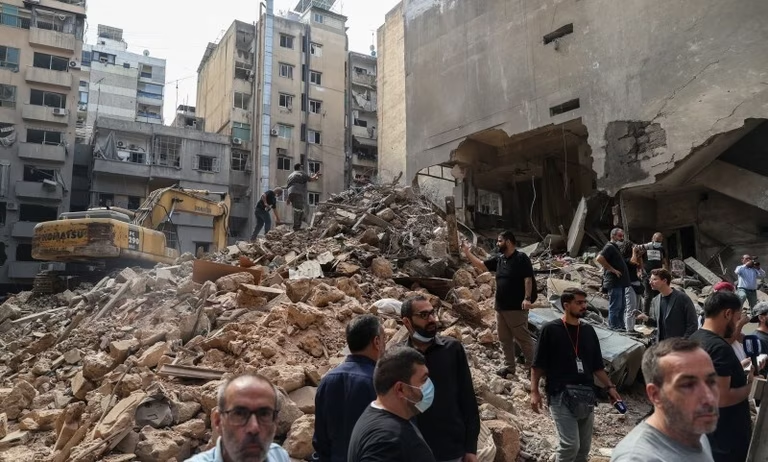
Israeli Invasion of Lebanon
Get the latest updates on Israel's invasion of Lebanon. Coverage includes IDF ground operations, Hezbollah clashes, peace talks, and regional impacts.
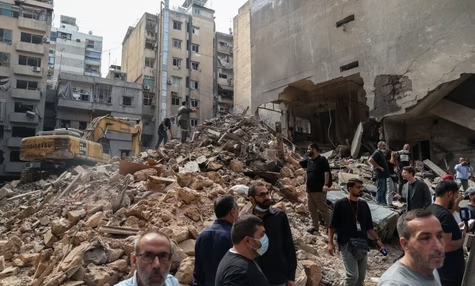
ISRAELI INVASION OF LEBANON (September 2024 - Ongoing)
Uncover the complex realities of the Israeli war on Lebanon and learn how this ongoing conflict continues to destroy the lives of civilians.
Explore in-depth analysis of the deepening humanitarian crisis, including the widespread destruction of infrastructure and the displacement of over a million civilians. We analyse the repeated failure of diplomatic ceasefire agreements, alongside the dangerous role of Hezbollah.
Connect with vital news sources, expert insights, and human rights documentation—exploring serious allegations of war crimes and critical perspectives aimed at fostering accountability, humanitarian relief, and a pathway toward genuine stability and a sustainable peace.
Jump straight to our resources on the ➡️ Israeli Invasion of Lebanon
*****
General Information
Israel is currently engaged in a major ground invasion of Southern Lebanon, which escalated sharply in March 2026. This followed the collapse of a previously negotiated ceasefire, the U.S. - Israel attacks on Iran, and their assassination of the Iranian Supreme Leader, Ayatollah Ali Khamenei.
The initial attacks struck more than 1,000 targets in Lebanon, which Israel claimed were Hezbollah strongholds. Hezbollah, a paramilitary group and a political party that wields tremendous power in Lebanon, launched retaliatory strikes, prompting Israel to begin its ground invasion.
Since March 2, Israeli forces have launched more than 1,840 attacks on Lebanon.
Israel claims their goal is to permanently demilitarise South Lebanon, create a buffer zone to protect Israeli border communities, and allow tens of thousands of displaced Israeli residents to return home.
This new escalation of the war on Gaza has expanded the war further into the Middle East. It has led to the deaths of more than 4,000 predominantly Lebanese civilians, injured more than 12,000, and displaced more than a million.
The British Red Cross reports that 4.3 million people are now in need of humanitarian assistance in the country. This is particularly shocking when you consider the total population is 5 million.
Many Lebanese fear that Israel's ultimate goal is prolonged occupation and a redrawing of the border.
The current situation as of August 2026 -
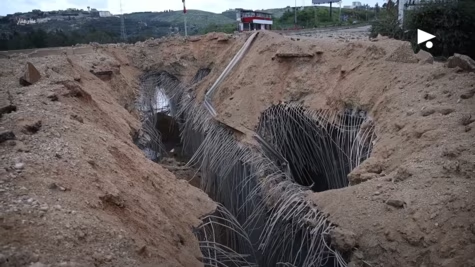
Israel continues to occupy southern Lebanon despite a U.S. brokered ceasefire deal. They recently destroyed a tunnel system in the Beaufort area that they claim to be a key part of Hezbollah’s infrastructure.
Although full-scale combat has ceased, Lebanon is caught in a tentative, highly volatile ceasefire and struggling under a profound humanitarian and economic crisis.
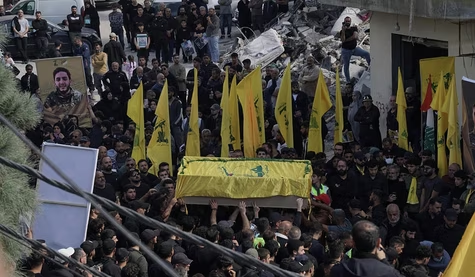
Who Are Hezbollah?
Hezbollah is both a Shiite Muslim political party and militant group. They operate from Lebanon and are backed heavily by Iran. They violently oppose both Israeli and Western powers operating in the Middle East.
They are the dominant military force in Lebanon and wield significant power over the country.
Hezbollah became involved in the Gaza War by launching a cross-border rocket campaign in solidarity with Hamas right at the start of events in 2023.
Since then, they have suffered severe blows to their leadership and infrastructure as the Israeli military began its retaliatory campaigns in late 2024.
Hezbollah entered the Iran War in March 2026, in retaliation for the killing of Iranian Supreme Leader Ayatollah Ali Khamenei. They have a mutual alliance with Iran and have supported their war efforts against the U.S. and Israel.
In response, the IDF unleashed brutal air strikes across southern Lebanon, the Bekaa Valley, and Beirut. They followed this with an expansion of their ground operations.
Hezbollah dragged Lebanon into yet another war. Their decision to become involved in the Iran war was met with swift backlash from many Lebanese. Public support for Hezbollah is waning as many blame the group for extensive damage, heavy casualties, the economic crisis, and serious hardships across the nation.
- Fewer than one-third of Lebanese citizens express confidence in the party.
- More than half explicitly say they do not trust it.
- 79% favour a national army monopoly on arms, meaning that only the official Lebanese Armed Forces should maintain weapons in the country.
- 58% explicitly favour disarming Hezbollah.
- Support within the Shia community remains high, with approximately 87.5% backing the group. Support from non-Shia communities remains below 10%.
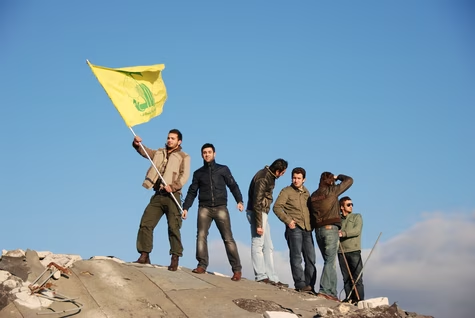
History Of Lebanon - Israel Conflicts
The 2026 escalation is sadly the latest in a long list of cross-border conflicts spanning almost 5 decades:
- The South Lebanon Conflict (1978) - Also known as the ‘First Israeli invasion of Lebanon’, codenamed Operation Litani by Israel. The IDF defeated the Palestine Liberation Organisation (PLO), forcing them to withdraw from southern Lebanon and thus preventing them from launching attacks on Israel from the Lebanese land border. The United Nations called on Israel to immediately withdraw its troops from Lebanon and established the United Nations Interim Force in Lebanon (UNIFIL).
- The Second Israeli Invasion of Lebanon (1982) - The invasion followed a series of attacks and retaliatory attacks between the PLO, who were back operating in southern Lebanon and the IDF. A full-scale invasion reached Beirut and led to an 18-year occupation of a "Security Zone" in the south. During this time, Hezbollah was established and waged a guerrilla war against the Israeli occupation until their withdrawal from Lebanon in 2000.
- The Third Israeli Invasion of Lebanon (2006) - A 34-day conflict against Hezbollah. Hezbollah were fighting for the release of Lebanese citizens held in Israeli prisons. On 11 August 2006, the United Nations Security Council approved Resolution 1701 to end the hostilities. It called for disarmament of Hezbollah, Israeli withdrawal from Lebanon, the deployment of the Lebanese Armed Forces, and an enlarged UNIFIL. Both sides claimed victory.
Humanitarian Impact
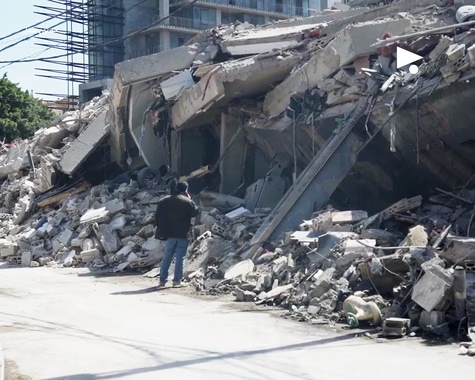
- Israeli attacks have killed more than 4,300 people in Lebanon, the vast majority of them civilians.
- An estimated 1.2 million people, including 350,000 children, have been displaced. Israeli evacuation orders now cover more than 568 square miles, equating to 14% of the country's territory.
- The IDF has levelled entire border villages to prevent Hezbollah from re-establishing attack launch sites.
- Over 37,000 housing units have been heavily damaged or completely flattened.
- Dozens of hospitals have been either forced to close or suspend operations due to direct damage or lack of resources. An estimated 200 medical facilities have faced targeted attacks.
- Israeli air strikes have killed at least 130 Lebanese first responders, including paramedics and ambulance drivers.
- Agricultural lands in the south and the Beqaa Valley in the north have been completely razed, preventing food production and destroying livelihoods.
- Poverty rates in heavily impacted southern states are projected to reach over 87-94%.
- Key bridges in southern Lebanon have been targeted to cut off and isolate communities, making it extremely difficult for them to access basic supplies and medical attention.
War Crimes
There is extensive evidence of war crimes which have been committed by both sides during the Israeli military invasion.
Examples include the levelling of border towns, the deliberate destruction of civilian infrastructure, targeting dense civilian zones, targeted attacks on medical personnel and services, use of white phosphorus in residential areas, and direct targeting of journalists.
These acts of war are clear violations of the UN Charter.
War crimes are being documented by the National Committee for International Humanitarian Law and the UN Office of the High Commissioner for Human Rights. There are also reports based on evidence provided by Lebanese citizens which are to be submitted to the UN Human Rights Council in Geneva.
Renewed interest in the pursuit of justice and accountability followed the new U.S. ceasefire proposal, which stated that both sides were prevented from taking political or legal action against one another while negotiations are underway.
Another point of interest is Lebanon's non-membership in the International Criminal Court. They are not a party to the Rome Statute and therefore are not under the jurisdiction of the ICC. This places serious roadblocks on the path to accountability.
Internal political divisions and fears of exposing Hezbollah to the laws of the ICC have previously prevented them from pursuing membership. Calls for them to join are growing louder from both civilians and political groups.
In April 2024, they almost granted the court jurisdiction, but later revoked the decision.
Attempts At Peace & Ceasefire In Lebanon
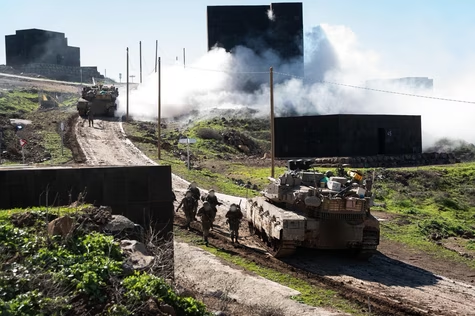
On 14 April 2026, talks between Israeli and Lebanese officials took place in Washington, D.C. This marked the first direct negotiations between the two nations since 1993.
The Washington Peace Proposals were hosted by U.S. Secretary of State Marco Rubio and are U.S. brokered initiatives aimed at ending the conflict. The result was a 14-point trilateral framework agreement focused on the IDF's withdrawal from Southern Lebanon. Units of the Lebanese Armed Forces would replace them and would oversee the disarmament of Hezbollah.
On 26 June 2026, Lebanon and Israel signed the framework. It has been designated as a first step and not a final peace treaty. The framework does not include a full IDF withdrawal. Hezbollah rejected the agreement.
Israel has refused to agree to a ceasefire. Their primary goal is the complete disarmament of Hezbollah and a long-term ‘security zone’ along the border.
Lebanon meanwhile has prioritised an immediate ceasefire. They have proposed a full withdrawal of Israeli troops to within their own borders.
The current proposal is based on a three-zone plan where Southern Lebanon is divided into zones to facilitate a phased Israeli withdrawal.
Hezbollah, which rejects all Western influence in the Middle East have warned that attempts to disarm them could spark a civil war.
Follow-up talks have struggled to align the framework to any binding timeline for a ceasefire.
Lebanon is still enduring daily strikes, demolition operations, reconnaissance overflights, and limited humanitarian assistance.
Netanyahu is insistent that the IDF will not withdraw from southern Lebanon (where it occupies roughly one-fifth of the country) until it has fully dismantled Hezbollah's infrastructure.
*****
Achieving lasting peace in Lebanon demands an immediate end to military action from all sides and comprehensive disarmament across all non-state armed groups. We must respect Lebanon’s right to sovereignty and security.
True stability must be built on accountability, deep governmental reforms, and justice for war crimes and international law violations.
Robust humanitarian aid to restore healthcare and basic infrastructure, fund economic recovery, and enable a safe, dignified return for uprooted families is essential.
“Stop the fighting. Stop the bombing. There is no military solution. Only diplomacy, dialogue and the full implementation of the UN Charter and Security Council Resolutions” - UN Secretary-General António Guterres
Author: Rachael Mellor, 04.08.26, licensed under CC BY-SA 4.0
More Resources
Curated Directory & Deep-Dive Resources on Israeli Invasion of Lebanon
- Israel Continues ‘Gaza Tactics’ in Lebanon, Leveling Villages and Homes in Violation of Ceasefire - CD 18.04.26 514514
- Celebrations in Lebanon as 10-day ceasefire with Israel begins - Al Jazeera 17.04.26 513770
- Video: People in Lebanon hope for 'real' ceasefire - DW 17.04.26 513733
- ‘This Is Not Self-Defense’: UN Experts Condemn Israel’s Criminal Assault on Lebanon - CD 16.04.26 513777
- Displaced Lebanese wary as ceasefire between Israel and Hezbollah begins - Al Jazeera 16.04.26 513765
- Lebanon Ceasefire Marks Historic Strategic Defeat... for the US and Israel - CD 16.04.26 514305
- Trump's Lebanon ceasefire takes Israel by surprise - BBC 16.04.26 513588
- Lebanon–Israel talks must be given a chance - Chatham House 15.04.26 513402
- Israel’s War & Demands “Could Throw Lebanon Back into a Civil War”: Ex-Israeli Negotiator Daniel Levy - DN! 15.04.26 514283
- “Scorched-Earth Campaign”: Israel Uses “Gaza Playbook” to Turn Southern Lebanon into Rubble - DN! 15.04.26 514220
- What's behind Israel's attacks along Lebanon's Litani River? - DW 15.04.26 513404
- Ella Baron on Israel and Lebanon’s peace talks – cartoon - Guardian 14.04.26 513685
- Israel-Lebanon Talks Loom as Fighting Persists - CFR 14.04.26 513403
- Who is Yechiel Leiter, Israel’s US envoy leading talks with Lebanon? - Al Jazeera 13.04.26 513522
- Hezbollah leader urges Lebanon’s government to pull out of Israel talks - Al Jazeera 13.04.26 513514
- Israel’s Netanyahu, in south Lebanon, says threat of invasion removed - SCMP 13.04.26 513132
- Israel, Lebanon hold direct talks in US - DW 13.04.26 513321
- ‘Everything is gone’: Israel destroys entire villages in Lebanon - Guardian 12.04.26 513134
- Video: Lebanon protests talks with Israel - France24 12.04.26 513133
- Israel's War Against Lebanon, Explained - TIME 11.04.26 513092
- ‘Endless war’: inside an Israeli kibbutz near Lebanon’s volatile border - Guardian 11.04.26 513093
- Negotiating – and continuing the war at the same time? - Tagesschau 10.04.26 513932
- Will Israel and Lebanon start ceasefire talks? - Al Jazeera 10.04.26 513347
- Will Israel and Lebanon start ceasefire talks? - Al Jazeera 10.04.26 513094
- “10 Minutes of Terror”: Lebanon Death Toll Tops 300 from Israel’s “Black Wednesday” Attack - DN! 10.04.26 513158
- UNICEF Says Children ‘Being Pulled From Under Rubble’ in Lebanon After Israeli Bombardment - CD 10.04.26 513440
- Video: What is Israel's endgame with Hezbollah and Lebanon? - DW 10.04.26 513095
- ‘Nightmare for Civilians’: Israel Inflicts 1,400+ Casualties on Lebanon War’s Deadliest Day - CD 09.04.26 513507
- Netanyahu says there is no ceasefire in Lebanon as Israel launches fresh strikes - Guardian 09.04.26 513456
- Hospitals in Beirut struggle to deal with casualties after Israeli attacks - Al Jazeera 09.04.26 515038
- Why is Israel continuing to attack Lebanon, despite the ceasefire? Expert Q&A - Conversation 09.04.26 513353
- Israel is cutting off Southern Lebanon as we speak - Canary 09.04.26 513455
- In Bombing Lebanon, Netanyahu Asserts That War and Peace Are His Decision Alone - CD 09.04.26 513240
- 10 Minutes, 100 Airstrikes: Israel Rejects Ceasefire for Lebanon, Kills 250+ in Massive Attack - DN! 09.04.26 512902
- The deadliest 10 minutes in decades: Lebanese reel from Israeli strikes that killed hundreds - Guardian 09.04.26 512911
- Did Israel attack Lebanon to spoil Iran war ceasefire? - Guardian 09.04.26 512901
- 10 Minutes, 100 Airstrikes: Israel Rejects Ceasefire for Lebanon, Kills 250+ in Massive Attack - DN! 09.04.26 513163
- EU’s Kallas urges ‘heavy-handed’ Israel to end strikes in Lebanon - Politico 09.04.26 512903
- With aggressive new attacks on Lebanon, Israel signals it will not be bound by Donald Trump’s ceasefire - CBC 08.04.26 512820
- Despite Ceasefire With Iran, Israel Pummels Lebanon With ‘Apocalyptic’ Strikes - CD 08.04.26 514017
- ‘People are afraid’: Lebanese reeling after Israel’s devastating attacks - Al Jazeera 08.04.26 515042
- Hundreds feared dead in Lebanon strikes - UN News 08.04.26 514490
- Massive Israeli Assault on Lebanon Threatens U.S.-Iran Ceasefire - Dropsite 08.04.26 512966
- ‘They want to create a rift’: Israeli attacks deepen Lebanon fissures - Al Jazeera 07.04.26 514563
- How Israel’s invasion of southern Lebanon created a humanitarian crisis - Al Jazeera 07.04.26 514488
- Israel’s War on Lebanon Is a Consequence of “No Accountability” for Gaza: Human Rights Watch - DN! 06.04.26 512965
- Doctors warn that Israel is targeting Lebanon’s health care system, as it did Gaza’s - AP News 06.04.26 512871
- Lebanese Doctors Warn Israel Is Inflicting Gaza-Style Devastation on Their Healthcare System - CD 06.04.26 512854
- Israel Is Conducting a Campaign to Ethnically Cleanse Southern Lebanon of Shia Residents - Dropsite 02.04.26 512236
- Israel’s Message to a Broad Swath of Lebanon: Shiites Must Go - NYT 01.04.26 512758
- ‘What This Describes Is Ethnic Cleansing’: Israeli Plan for Southern Lebanon Sparks Horror - CD 01.04.26 512257
- Israel Announces Plan to Occupy Southern Lebanon - CFR 01.04.26 512326
- A Mission for Lebanon’s Army - Carnegie Endowment 31.03.26 514919
- Report from Beirut: “Hearts Are Very, Very Heavy” After Israeli Strikes Target Journalists, Medics - DN! 30.03.26 512746
- Israel’s unending attacks in Lebanon push country’s population to the brink - Al Jazeera 28.03.26 512092
- Lebanon faces ‘humanitarian catastrophe’ under Israeli assault: UN - Al Jazeera 27.03.26 512105
- Lebanon's humanitarian crisis worsens as fighting continues - DW 24.03.26 511749
- More than 1 million people in Lebanon have been displaced. These are their stories - Intercept 22.03.26 511988
- Israel’s displacement of civilians in Lebanon is a possible war crime - Al Jazeera 23.03.26 511851
- Report from Beirut: 1,000+ Dead, 1M+ Displaced, Many Fear Long-Term Occupation of Southern Lebanon - DN! 20.03.26 511654
- Israeli military launches ‘ground operations’ in southern Lebanon - Al Jazeera 16.03.26 512384
- Israeli and Lebanese Representatives Expected to Hold Direct Talks in Coming Days - Haaretz 14.03.26 510779
- UN chief Guterres says ‘no military solution, only diplomacy’ for Lebanon - Al Jazeera 14.03.26 510778
- Report from Beirut: Israel Expands Bombing Campaign & Mass Displacement in Lebanon - DN! 13.03.26 510756
- Israel unlawfully used white phosphorus in Lebanon: HRW - Al Jazeera 09.03.26 514489
- Another Land Grab? Israel Intensifies Bombardment of Lebanon & Orders Mass Displacement in the South - DN! 06.03.26 510311
- Israel intensifies war on Lebanon after Hezbollah attack - Al Jazeera 02.03.26 509890
- ‘Health crime’: Aoun slams Israel over spraying chemicals in south Lebanon - Al Jazeera 04.02.26 508521
- A year after Hezbollah-Israel ceasefire, over 64,000 Lebanese displaced - Al Jazeera 02.02.26 508065
- Israeli Drone Strike Kills One, Wounds Three in Southern Lebanon - AntiWar 01.02.26 507290
- Israel is intensifying attacks on Lebanon, is it planning another war? - Al Jazeera 11.12.25 501126
- Israel, Lebanon send civilian envoys to truce committee for expanded talks - Reuters 03.12.25 500110
- Israel launches airstrikes on southern Lebanon, says it's targeting Hezbollah - Japan Times 07.11.25 496896
- An Automated Occupation in South Lebanon - Carnegie Endowment 04.11.25 496900
- Lebanon says it foiled Israeli network plotting bomb attacks - AL Jazeera 10.10.25 492661
- Video: Marching to Armageddon - George Galloway 19.06.24 436116
- ‘Drop Israel’: How military escalation with Iran divides Trump’s base - Al Jazeera 14.06.25 494576
- Lebanese PM condemns wave of Israeli attacks on southern Lebanon - Al Jazeera 22.05.25 470409
- Video: How stable is Lebanon’s peace – after Israel attack on Beirut? - Al Jazeera 29.03.25 463136
- Lebanon Situation Report No.6 - January 2025: Violations have continued with airstrikes, gunfire, and the destruction of infrastructure across the Bekaa, South, and El Nabati… 461462
- Since 7 October 2023, Lebanon experienced a prolonged conflict that resulted in significant human casualties and extensive material damage. As of 6 February 2025, the MoH rep… 461041
- Another ceasefire is under threat from Trump – the precarious deal between Lebanon and Israel - Guardian 21.02.25 458409
- The Lebanese Villages Recently Destroyed by Israel - Dropsite 21.02.25 458300
- Israel refuses to fully withdraw from Lebanon: Here’s what to know - Al Jazeera 18.02.25 457902
- Israeli official says forces will remain in 5 locations in Lebanon after Tuesday’s pullout deadline - AP News 17.02.25 457360
- How many people has Israel killed in Lebanon since the ceasefire? - Al Jazeera 28.01.25 454325
- Post-ceasefire, people in Lebanon still struggle to access health care - Médecins Sans Frontières 21.01.25 452014
- Tweet: The USA is building a new megastructure HQ in Lebanon over 43 acres as an "Embassy" - @CraigMurrayOrg 18.01.25 458340
- Security Council Speakers Urge Israel to Withdraw from Lebanon, Golan Buffer Zone, Allow Peacekeepers to Operate without Obstruction - UN Security Council 17.01.25 451249
- Gaza ceasefire and release of hostages welcomed: Justice is the only way for a lasting peace - FIDH : International Federation for Human Rights 16.01.25 451287
- Lebanon: Signs of hope amid immense challenges, says Türk - UN Office of the High Commissioner for Human Rights 16.01.25 451333
- Remarks by Humanitarian Coordinator, Imran Riza extension of the Lebanon Flash Appeal - United Nations Lebanon 07.01.25 449198
- DEMAC receives grant to strengthen diaspora humanitarian response in Lebanon - Diaspora Emergency Action & Coordination 07.01.25 449160
- Lebanon: Salesians continue to care for those displaced by war even after ceasefire, Aim to create safe spaces, education for children - Salesian Missions 06.01.25 449370
- Flash Appeal: Lebanon, Covering the period January-March 2025 (January 2025) - UN Office for the Coordination of Humanitarian Affairs 06.01.25 449348
- IOM Lebanon Emergency Response Update No.6: The ceasefire on 27 November has prompted 860,740 internally displaced persons (IDPs) to start returning to their communities as o… 449327
- Lebanon: Flash Update No.53 - Escalation of hostilities in Lebanon, as of 02 January 2025 - UN Office for the Coordination of Humanitarian Affairs 06.01.25 449347
- Gender Alert: On the Frontlines: Women-Led Organizations Central to Lebanon’s Crisis Response - UN Women 03.01.25 449382
- Attacks on Health Care in Lebanon: Insecurity Insight identified 507 incidents of violence against or obstruction of health care in Lebanon between 08 October 2023 and 03 De… 447978
- Lebanon: Displacement Tracking Matrix, Mobility Tracking data indicates that 860,740 internally displaced persons (IDPs) have begun returning to their communities - Internat… 448003