
Gaza Peace Plan
Track developments on Trump's 20-point Gaza peace deal. Updates on the ceasefire, Hamas disarmament, ongoing conflict, and Board of Peace funding.
TRUMP'S GAZA PEACE PLAN - Officially Labelled A Failure By Oxfam & Save The Children
Explore the complex history of Gaza peace efforts and understand how repeated attempts at diplomacy continue to collide with persistent ceasefire violations. Our comprehensive guide offers in-depth analysis of negotiated truces, breaking down why peace plans repeatedly stall and why the situation remains deeply deadlocked.
Connect with hundreds of valuable resources, initiatives, and organisations working toward genuine peacebuilding, human rights advocacy, and a sustainable resolution for the region.
Jump straight to our resources on ➡️ Attempts At Peace In Gaza
*****
General Information
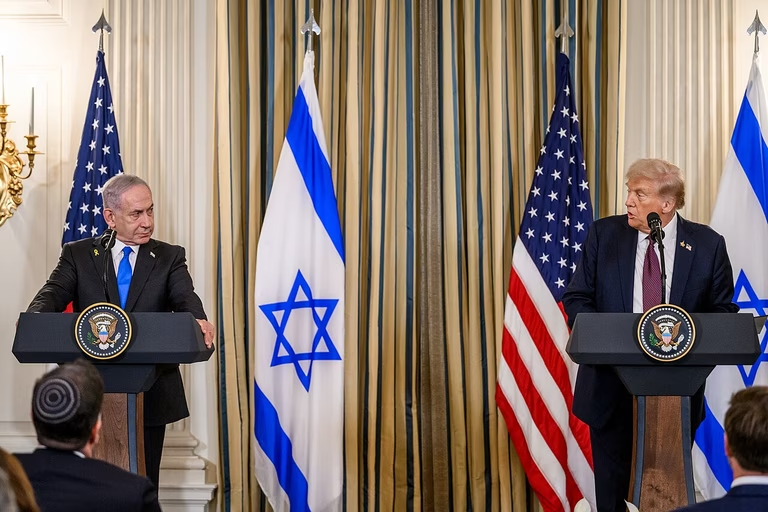
U.S. President Donald Trump announced the twenty-point Gaza peace deal on September 29 during a press conference with Israeli Prime Minister Benjamin Netanyahu. This new truce came after days of negotiations in Egypt and Paris, which were assisted by many Arab and Muslim countries.
As part of the first phase, a new immediate ceasefire and release of all hostages were agreed to. Phase one was formally approved by Israel on October 9, which led to the release of all living hostages being held by Hamas. Israel, in turn, began the release of hundreds of Palestinian prisoners.
This is the third time Israel and Hamas have attempted to uphold a ceasefire, first in November 2023 and again in January 2025.
As of May 2026, although the plan remains formally in place, Israel has violated the ceasefire agreement at least 2,400 times since its inception. In a mockery of the ‘peace plan’ and human rights, a reported 738 Palestinians have been killed during this time of ‘ceasefire’.
What Was In The Agreement?
As part of the ceasefire, “all military operations, including aerial and artillery bombardment, will be suspended, and battle lines will remain frozen.”
The IDF will partially withdraw their troops, leaving it in control of 53% of the Gaza enclave. Two further withdrawals are planned, which will allow Israel to maintain a security perimeter around Gaza but not within.
Full uninterrupted aid will be sent to Gaza, as well as assistance to rebuild vital civilian infrastructure for water, electricity, sewage, medical facilities, and bakeries. The Rafah crossing with Egypt will be reopened. Two hundred U.S troops will be sent to Israel to monitor the ceasefire and help with aid delivery.
The plan does not permit Hamas to have a role in the future governing of Palestine, nor does it guarantee the establishment of a Palestinian State. Much of the success of this ceasefire deal hinges on how postwar governance in Gaza will look.
It is positive that the U.S., France, Arab, and Muslim countries all have a vested interest now which was clearly demonstrated by the Sharm El-Sheikh meeting on October 13.
UN Security Council Resolution 2803
The UN resolution of 17 November 2025 endorses the Gaza peace plan and welcomes the formation of a Board of Peace to support the reconstruction of the Gaza Strip. It authorises the deployment of an International Stabilisation Force and allows for the establishment of a Palestinian executive committee to manage day-to-day governance in the Gaza Strip.
The Board Of Peace
Established by U.S. President Donald Trump to oversee the ceasefire, governance, and reconstruction of Gaza, has come under great scrutiny. The board excludes the involvement of Palestinian leadership, grants unprecedented centralised power to members, and undermines the work of the UN.
Regarding Gaza, fears are circulating that the lack of Palestinian representatives will dismantle existing frameworks and create a path for foreign-imposed leadership. Their work is grossly underfunded, has resulted in very little real action on the ground, and does not respect the Palestinian right to sovereignty.
Permanently Stalled?
With both sides insisting the other side violated the terms of the agreement, the peace plan remains in a deadlock.
Israel and the Board of Peace have insisted on the disarmament and demilitarisation of Hamas as a non-negotiable. Yet Hamas refuses to commit to this without the complete withdrawal of Israeli armed forces.
With repeated deadly attacks by Israel since the October truce, it is not surprising that Hamas are unwilling to stick to their end of the deal.
Distracted by the invasion of Iran, the U.S. has reduced its monitoring presence on the ground. The U.S.-led Civil-Military Coordination Centre in Israel set out with a mission to monitor the ceasefire and improve the flow of aid. It has failed.
Israel now occupies and controls between 50-64% of the Gaza Strip.
The people of Gaza are suffering from rampant disease, widespread famine, aid restrictions, a dire displacement crisis, severe fuel shortages, and a lack of basic sanitation or even clean drinking water.
Of major concern is rising tensions and unrest between Israeli and Palestinian communities, particularly in the West Bank, where local hardline factions oppose the terms of the ceasefire deal. In 2025, 240 Palestinians were killed in attacks by both Israeli settlers and the IDF.
As of May 2026, there has been no significant progress in the disarmament of Hamas or the Israeli military's withdrawal from Gaza.
Author: Rachael Mellor, 14.10.25, latest update 28.07.26, licensed under CC BY-SA 4.0
More Resources
Curated Directory & Deep-Dive Resources on Gaza Peace Plan
- “Emperor” Trump’s So-Called Board of Peace Erases Palestinians from Gaza Governance - DN! 23.01.26 506661
- ‘Imperial’ agenda: What’s Trump’s Gaza development plan, unveiled in Davos? - Al Jazeera 23.01.26 506426
- Kushner presents 'master plan' for rebuilding postwar Gaza - DW 23.01.26 506659
- Every Nation in the World Should Reject Trump’s Absurd and Dangerous ‘Board of Peace’ - CD 22.01.26 506398
- Wanted for War Crimes, Netanyahu Skips Signing of ‘Board of Peace’ Charter at Davos - CD 22.01.26 506350
- “An Abomination”: Yanis Varoufakis on Trump’s “Board of Peace” & Threat to Democratic World Order - DN! 22.01.26 506397
- ‘New Gaza’ Plan by Far-Right Zionist Jared Kushner Decried as ‘Ethnic Extermination’ - CD 22.01.26 506324
- Trump’s ‘board of peace’: Who has joined, who hasn’t – and why - Al Jazeera 21.01.26 506158
- Wanted War Criminal and ‘Genocide Architect’ Netanyahu Joins Trump Board of Peace - CD 21.01.26 506369
- Trump’s $1 Billion-a-Seat Diplomacy Club Takes Aim at the U.N. - WSJ 20.01.26 505939
- Trump’s board of peace is an imperial court completely unlike what was proposed - Guardian 20.01.26 506147
- What to Know About Trump’s ‘Board of Peace’ for Gaza - NYT 19.01.26 506152
- Trump asks Putin to join Gaza ‘board of peace’ even as Ukraine war rages - Al Jazeera 19.01.26 505804
- Kremlin says Putin has been invited to join Trump’s Gaza ‘board of peace’ - Guardian 19.01.26 505508
- Don’t Be Fooled: The Trump ‘Peace Plan’ Is Just Genocide Under a Different Name - CD 18.01.26 505525
- The Trump Regime's “Peace Board” Is Another Brick in His Personal Occidental Empire - TFF 18.01.26 505777
- Trump asks Turkiye’s Erdogan, Egypt’s el-Sisi to join Gaza ‘board of peace’ - Al Jazeera 17.01.26 505408
- Blair and Rubio among names on senior executive of Gaza 'Board of Peace' - BBC 17.01.26 505407
- Gaza plan phase two: US to discuss Hamas disarmament, Israeli withdrawal - Al Jazeera 15.01.26 505491
- US envoy announces launch of ‘phase two’ of plan to end Gaza war - Al Jazeera 14.01.26 504873
- U.K.'s Starmer Reportedly Accepts Seat on Trump-led Gaza Board of Peace - Haaretz 13.01.26 505941
- Trump expected to announce Gaza Board of Peace next week: U.S. officials - Axios 07.01.26 503887
- Trump Meets with Netanyahu for Sixth Time - Arab Center Washington DC 05.01.26 503888
- Trump Isn't Fostering a Cease-fire Deal – He's Washing His Hands of Gaza - Haaretz 03.01.26 503325
- The Year Of Force - Observer Research Foundation 03.01.26 503323
- Gaza aid lifelines under strain as winter worsens - UN 02.01.26 503324
- Israel looking to reopen Rafah crossing after US pressure: Israeli media - Al Jazeera 01.01.26 502926
- Gaza's ceasefire stalled, rebuilding plans uncertain - DW 31.12.25 502927
- What Stands Between Trump’s Peace Plan and the ‘New Gaza’ It Promises - Bloomberg 31.12.25 502925
- Trump puts differences with Netanyahu aside, sends warnings to Hamas and Iran - Le Monde 30.12.25 502928
- Hamas will have ‘hell to pay’ if it fails to disarm, Trump warns after Netanyahu meeting - Guardian 29.12.25 502717
- Trump could unveil Gaza ‘peace council’, ‘government’ soon: Israeli media - Al Jazeera 26.12.25 502463
- Israeli truce violations making Gaza peace efforts ‘incredibly difficult’ - Al Jazeera 20.12.25 511955
- IDF Chief Says Ceasefire Line Is a ‘New Border,’ Suggesting Goal to Annex More Than Half of Gaza - CD 08.12.25 501001
- ‘Bloodshed was supposed to stop’: no sign of normal life as Gaza’s killing and misery grind on - Guardian 06.12.25 502866
- U.S.-Backed Ceasefire Is Cover for Ethnic Cleansing in Gaza & West Bank: Sari Bashi - DN! 03.12.25 500881
- Trump’s Gaza Peace Plan Stumbles Over Hamas Disarmament - WSJ 18.12.25 501790
- Donald Trump’s peace plan is faltering in the chaos of Gaza - Economist 17.12.25 501791
- Hamas says Israeli violations ‘threaten viability’ of Gaza ceasefire deal - Al Jazeera 15.12.25 501456
- Europe ready to lead ‘multinational force’ in Ukraine as part of US peace plan - Guardian 15.12.25 501484
- Hamas Resistance Movement Opposes Foreign Governance of Palestinian Territories - teleSUR 15.12.25 501280
- Ukraine ready to drop NATO membership ambition amid peace talks - Al Jazeera 14.12.25 501471
- Hamas has its own disarmament vision as Gaza truce enters critical phase - Al Jazeera 11.12.25 501075
- Trump says he plans to name Gaza Board of Peace early next year - Al-Monitor 10.12.25 501073
- Blair loses place in Trump's Gaza plan as PA insists any new body must be tied to it - New Arab 09.12.25 501072
- Hamas urges more international pressure on Israel amid ceasefire violations - Al Jazeera 09.12.25 501116
- In Places Trump Has Touted Bringing Peace, Conflict Still Rages - Time 09.12.25 501074
- ‘Yellow line’ that divides Gaza under Trump plan is ‘new border’ for Israel, says military chief - Guardian 08.12.25 500649
- Peace deal mediators voice concern about potential expulsion of Palestinians from Gaza - Middle East Eye 05.12.25 500577
- By Endorsing the U.S. Gaza Plan, the UN Security Council Elevates “Rule by Law” Over Rule of Law - Carnegie Endowment for International Peace 05.12.25 500578
- Human Rights Group Warns US Gaza Plan Will Impose ‘Unlawful Collective Imprisonment’ of Palestinians as New Details Emerge - CD 04.12.25 504920
- What should happen next under the Gaza peace plan? - Al-Monitor 04.12.25 500579
- West Bank Violence Threatens Trump’s Gaza Peace Plan - FP 04.12.25 500576
- Trump plans to announce Gaza government, Board of Peace by Christmas, officials say - Axios 04.12.25 500580
- U.S.-Backed Ceasefire Is Cover for Ethnic Cleansing in Gaza & West Bank: Sari Bashi - DN! 03.12.25 500164
- The BMJ appeal 2025-26: “There is no ceasefire”—Gazan doctors brace for winter as Israeli attacks and aid restrictions continue - BMJ 02.12.25 504904
- Israel’s genocide in Gaza has not stopped, despite the ceasefire: Analysts - Al Jazeera 02.12.25 499897
- What happens in Gaza’s ‘Bermuda Triangle’ - Al Jazeera 29.11.25 502063
- Ceasefire in Gaza has not brought promised levels of aid as winter conditions threaten even more lives - Relief Web 25.11.25 500123
- Dissecting the UN’s “Comprehensive Plan” for Gaza and the inevitable dead-end - Middle East Monitor 24.11.25 498956
- Israel has violated Gaza truce nearly 500 times in 44 days, killed hundreds - Al Jazeera 23.11.25 499004
- Trump Pulls From Gaza Playbook to Push for Peace in Ukraine - WSJ 22.11.25 498955
- How the US-Israeli ‘peace plan’ will partition Gaza - Al Jazeera 22.11.25 498957
- The 'everlasting peace' in Gaza promised by Trump is off to a troubled start - Le Monde 21.11.25 498593
- What is Security Council Resolution 2803, and what does it mean for the Trump Gaza plan? - Chatham House 21.11.25 498591
- Anti-Hamas armed groups seek future role under Gaza peace plan - BBC 21.11.25 498588
- Feminists must resist the US-Israeli colonial plan for Gaza - RCW 20.11.25 498991
- The Gaza Plan Just Hit a Crucial Juncture. Egypt Is Critical for Its Success. - Carnegie Endowment for International Peace 20.11.25 498589
- Mixed reactions to UN Security Council approval of Gaza plan - Al Jazeera 18.11.25 498590
- Trump’s Gaza “peace” plan: A cruel joke in a conflict and peace illiterate world - TFF 18.11.25 498816
- UN plan just ‘first step’ toward peace in Gaza, says Palestinian foreign minister - Guardian 18.11.25 498592
- UN security council votes to endorse Donald Trump’s Gaza plan - Guardian 17.11.25 (must read) 498237
- UN to vote on Gaza stabilisation force plan that references Palestinian state - Guardian 17.11.25 498238
- What to Look for as the Gaza Peace Plan Comes to the UN Security Council - International Crisis Group 14.11.25 498065
- How the Flaws of Trump’s Gaza Deal Prevent an Enduring Peace - Carnegie Endowment for International Peace 14.11.25 498066
- US military planning for divided Gaza with ‘green zone’ secured by international and Israeli troops - Guardian 14.11.25 498064
- The path to peace in Gaza comes to a crossroads at the U.N. - Washington Post 14.11.25 498063
- Trump wants to recreate the British mandate in Palestine - Al Jazeera 13.11.25 499786
- Trump’s Ploy at the UN Is American Imperialism Masquerading as a Peace Process - CD 13.11.25 498337
- Revised U.S. Gaza Proposal Cites Path to Palestinian Statehood for First Time as Trump Rallies International Support for Peace Plan - Haaretz 13.11.25 498067
- Internal US documents reveal officials ‘deeply concerned’ over Trump’s Gaza plan: Report - Cradle 12.11.25 497646
- Mahmoud Abbas defends role of Palestinian Authority in Gaza peace plan - Le Monde 12.11.25 497648
- Video: Are Trump’s Gaza Peace Plan Challenges Serious? - Al Arabiya 12.11.25 497647
- One Month Into Ceasefire, Israel Continues ‘Silent Genocide’ in Gaza - CD 11.11.25 497599
- Trump has promised peace for Gaza. Private documents paint a grim picture. - Politico 11.11.25 497650
- Macron and Abbas announce panel to draft new Palestine constitution after Paris talks - Euronews 11.11.25 498329
- The Trump Administration Has a New Plan for Gaza - Atlantic 10.11.25 497649
- US takes over Gaza aid oversight from Israel under Trump 'peace plan' - New Arab 08.11.25 496969
- U.S. Wants Security Council to Adopt Trump Plan for Gaza - NY Times 07.11.25 496967
- The Gaza peace plan needs revolving door diplomacy by Gulf and European ‘Trump whisperers’ - Chatham House 07.11.25 496970
- The important change needed in UNSC’s Gaza resolution: Control over the money - Atlantic Council 07.11.25 496968
- Gaza peace plan: First step in a journey of a thousand miles - Politico 06.11.25 496644
- GISR will host a public lecture by renowned economist, Prof Jeffrey Sachs, on "Gaza Peace Deal and the Future of the Arab World" - Jeffrey Sachs 05.11.25 497464
- The U.S. Draft Security Council Resolution on Gaza: Initial Concerns - Just Security 05.11.25 496646
- US to share draft UN resolution on Gaza with most of Security Council - Reuters 05.11.25 496645
- Trump administration advancing UN resolution for Gaza security force, source says - CNN 04.11.25 496445
- Are we closer to a Gaza international peace force after Istanbul meeting? - Al Jazeera 03.11.25 496444
- The U.N. Must Help Consolidate Gaza Peace - FP 03.11.25 496446
- Lasting peace and recovery in Gaza depends on local participation, not just ceasefires - Conversation 02.11.25 496447
- Optimism for Gaza Is Based on Shaky Assumptions - War on the Rocks 31.10.25 495871