
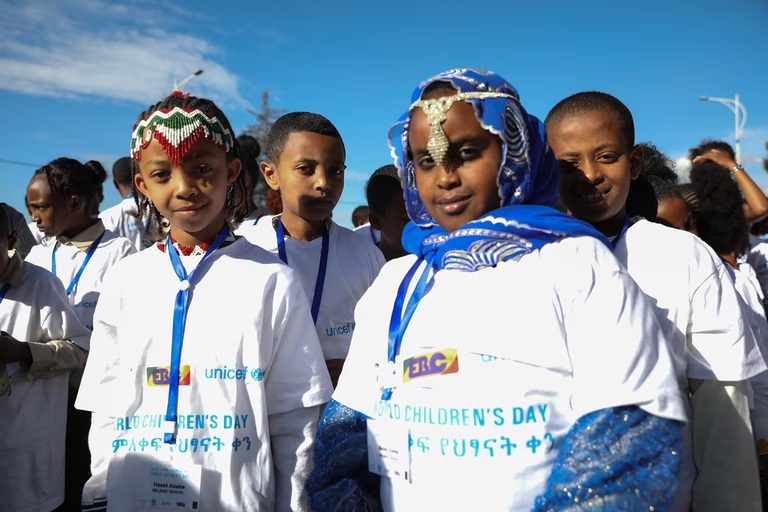
Children's Day - November 20
Explore World Children's Day on Nov 20. Discover UNICEF guides, the UN Convention on Child Rights, and global actions empowering youth.
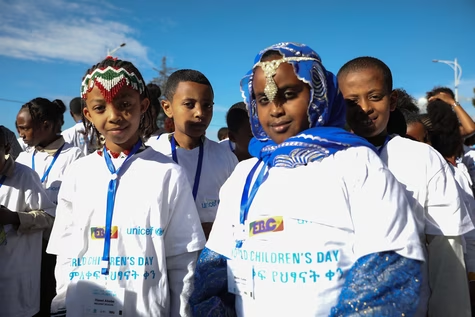
WORLD CHILDREN'S DAY, November 20 – Recommitting To The Rights Of Children Everywhere
Discover the importance of World Children’s Day and learn how it supports children's rights worldwide. Our guide offers you in-depth information on children's welfare, protection, and their fundamental human rights.
Connect with hundreds of valuable resources, initiatives, and organisations – for genuine youth empowerment, improved child welfare, and a sustainable future for every child.
Jump straight to our resources on ➡️ World Children's Day
*****
General Information
First established in 1954 as Universal Children's Day by the United Nations, this global day of action is now hosted by UNICEF every year to promote togetherness, awareness, and improve children's welfare around the world.
World Children's Day commemorates the signing of the Declaration of the Rights of the Child by the UN General Assembly on November 20, 1959 and the Convention on the Rights of the Child on the same date in 1989.
This day is our opportunity to promote the ideals of the UN Charter, to advocate for, promote and celebrate children's rights, and build a better world for children.
Explore our comprehensive guides on children in developing countries, Sustainable Development Goals, education, youth activism, young leaders, the youth voice, and resources for girls and boys.
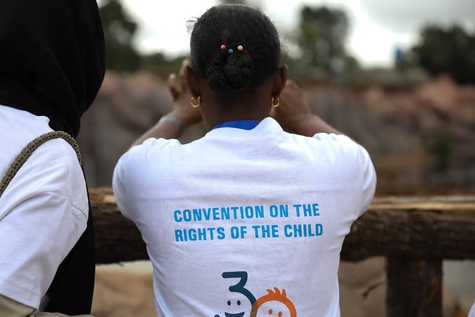
Children's Rights = Human Rights
Child rights are human rights. Yet despite this, in many places around the world, these rights are repeatedly and systematically disregarded, denied and attacked.
The Convention on the Rights of the Child is the most widely ratified human rights treaty in history. It outlines 54 articles covering all aspects of a child's life and then sets out their civil, political, economic, social, and cultural rights for all people under 18.
These rights are vitally important in upholding the dignity of children and highlight the importance of ensuring their well-being and development. All children, regardless of their age, race, gender, religion, wealth, birthplace, or any other factor, have the right to live free of fear and want.
Signed and ratified by 196 countries, the treaty is monitored by the UN Committee on the Rights of the Child. (The U.S. is the only UN member not to have ratified the treaty). These countries are required by law to ensure the following rights are available to all children.
-
Life, survival & development
-
Medical care & nutritious food
-
Freedom of information - from newspapers, social media, the radio or TV, etc.
-
Support from their government if needed
-
Rest & play
-
Free from work that is dangerous
-
Be raised by their parents if it is safe to do so
-
Freedom of thought
-
Protection from violence, abuse or neglect
-
An education
-
Freedom to express their opinions
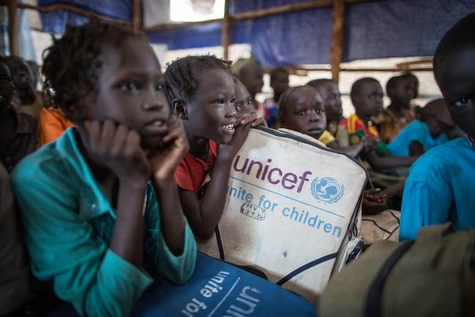
Children's Rights In Crisis
Poverty is a key driver of neglect, abuse and missed opportunities for children. An estimated 356 million children are living in extreme poverty. These children are at high risk of having their rights violated, often by the parents who will do anything just to survive.
Global crises such as Covid-19, the climate crisis, economic instability, war, and environmental disasters disproportionately affect children. The facts are staggering -
-
Two in three children under five live in severe food poverty.
-
One hundred sixty million children are victims of child labour and slavery. Three out of four work for their own families.
-
Globally, 64 million primary school-aged children are out of school.
-
One in five girls worldwide is married before the age of 18.
-
More than 8,000 women die as a result of India's dowry system every year.
-
Over 230 million girls and women worldwide have undergone female genital mutilation. The practice serves no benefits, only harm, and serious long-term health implications.
-
An estimated 150 million girls and 73 million boys experience sexual assault annually.
-
Between 2005 and 2022, more than 105,000 children were recruited by armies, although the actual number of cases is believed to be much higher.
-
One in five children is currently living in areas affected by armed conflict.
-
At the end of 2024, the total number of children displaced by conflict and violence rose to 48.8 million.
-
Estimates suggest that there are up to 150 million street children worldwide.
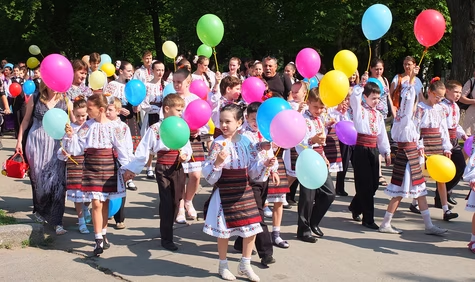
Youth Empowerment
With today's young people facing numerous challenges, youth empowerment has never been more critical. Children are worried about the world they are inheriting, and rightly so. Regarding the climate crisis, 70% of people aged 16-25 label themselves as very concerned.
Participation in youth activism has never been higher, and role models such as Greta Thunberg and the Fridays for Future climate campaign have inspired young people to engage with the issues that affect them the most. This increase in youth engagement has compelled politicians and world leaders to listen, shift their focus to sustainability, and enhance the political participation of young people.
Poverty, discrimination, conflict, and marginalisation leave millions of the most disadvantaged children at risk. These children are the most vulnerable to the physical, physiological and health impacts of our planet's current polycrises.
The time to act is now. We need more research, monitoring, funding, solutions, and interventions to expand resources, involve young people, and implement practices that will improve the situation for the millions of children whose rights have been denied.
Days like World Children's Day are our chance to harness the power of children and collective action, and help to change the world for everyone. It is our legal obligation.
As the next generation, young people hold the key to shaping our future. We must ensure they are heard, supported, and given every opportunity to reach their full potential.
Author: Rachael Mellor, 17.11.25, latest update 07.09.26, licensed under CC BY-SA 4.0
More Resources
Curated Directory & Deep-Dive Resources on Children's Day - November 20
- It's World Children's Day - UNICEF 288544
- World Children’s Day across Europe and Central Asia - UNICEF 316153
- World Children's Day 20 November - United Nations 288543
- Convention on the Rights of the Child - UN 316162
- World Children's Day Resources - UN 316152
- Universal Children’s Day and the Education 2030 agenda - UNESCO 288542
- Save The Children - Universal Children's Day 316146
- Universal Children's Day - Twinkl 316154
- #ChildrensDay 170298
- #ChildrensDay - fb 170299
- #ForEveryChild 440902
- #WorldChildrensDay 440899
- Declaration of the Rights of the Child - Wikipedia 316144
- Children's Day - Wikipedia - June 1 + November 20 243186
- Children's Day (India) - Wikipedia 316145
- What is World Children's Day? And 5 ways you can get involved - UNICEF 316157
- Here Are Some Children's Day Celebration Ideas, Activities and Games To Surprise Your Child - Parent Circle 316150
- Tweet: Young Gazans described their lives during war, in testimonies to mark World Children's Day - @Reuters 21.11.25 498582
- On World Children's Day UNICEF calls for prioritizing investments in children - UNICEF 20.11.25 498580
- World Children’s Day: Statement of the Special Envoy on the situation of children of Ukraine - Council of Europe 20.11.25 498579
- Secretary-General's message on World Children's Day - UN 20.11.25 498578
- Celebrating all kids’ Right to Play on World Children’s Day 2025 - Kids News 16.11.25 498794
- The fight against child poverty: UNICEF's World Children's Day - Borgen Project 12.12.24 446911
- Secretary-General's message on World Children's Day - UN 20.11.24 441379
- Empowering Youth for Global Peace: Celebrating World Children’s Day - International Peace Bureau 20.11.24 441378
- Tweet: On World Children’s Day, #ICC Prosecutor @KarimKhanQC reflects on the importance of a child-centred approach in the work of the Office of the Prosecutor. - @IntlCrimCo… 441377
- World Children's Day, Red Cross calls for blood donations, and life expectancy in Luxembourg is 83 - RTL 20.11.24 441380
- Tweet: Message from Ann Skelton, Chair of the UN Committee on the Rights of the Child #UNCRC on World Children’s Day 2024 - @UNChildRights1 20.11.24 441375
- World Children’s Day: Joint Statement by the High Representative and European Commission - EEAS 20.11.24 441376
- Listen to the Future: Celebrating and Amplifying Children's Voices on World Children’s Day - WVI 19.11.24 441381
- Tweet: "I wish I could wake up and go to school in a clean environment, where I do not hear the sound of bombs or see destruction," says 11-year-old Rafif from Gaza, State of… 440901
- Tweet: Conflicts and wars in Sudan, Ukraine, Myanmar, Yemen, DR congo, Gaza, Lebanon and worldwide are robbing children of their lives and their futures. - @PVAenglish 17.11… 440898
- Tweet: This #WorldChildrensDay, we asked children to write you a letter. Across countries, across languages, children are calling out for peace, for safe and healthy environm… 440896
- The Secretary-General Message on World Children’s Day - UN 15.11.24 440900
- Dear adults - UNICEF 11.11.24 440897
- World Children's Day: Joint Statement by the European Commission and the High Representative - European Commission 18.11.22 316147
- Video: World Children's Day - Jolina and Rosena - UNICEF India 18.11.22 316161
- On World Children’s Day, let’s recognize that children’s rights include mental health - Conversation 17.11.22 316148
- Best messages, quotes, and wishes to share on Children's Day - Economic Times 14.11.22 316151
- 23 Children’s Day Celebration Ideas and Activities - First Cry Parenting 04.11.22 316149
- Video: UNICEF celebrates World Children’s Day - UNICEF, 2021 316160
- World Children's Day in a year like no other - End Violence Against Children 20.11.20 316156
- Video: Children take over the United Nations - UN, 2019 316158
- From kids’ takeovers to iconic landmarks going blue - UNICEF, 2018 316155
- Video: Get ready for World Children's Day - UNICEF, 2017 316159
- Google News 170296
- YouTube 170297