
AI for Social Good
Discover how artificial intelligence is transforming humanitarian aid, healthcare, and climate justice. Explore real-world AI tools and case studies for NGOs.
ARTIFICIAL INTELLIGENCE FOR SOCIAL GOOD
Discover the powerful potential of artificial intelligence and learn how we can actively guide its development for the public good. Our guide offers you in-depth information on navigating crucial hurdles - like breaking Big Tech monopolies and establishing strong regulations - so we can responsibly harness AI to combat global issues such as climate change, pandemics, and advance global equity.
Connect with hundreds of valuable resources, initiatives, and organisations – for genuine technological accountability and postive social change.
Jump straight to our resources on ➡️ Artificial Intelligence For Social Good
*****
General Information
As technology rapidly evolves and outpaces regulations and key safeguards, the dangers and ethical implications of AI should certainly not be underestimated. Likewise, neither should its potential for enabling real-life positive change.
The movement to harness AI for Social Good is already transforming how NGOs, charities, and even global institutions work towards tackling humanity's most pressing challenges.
The use of AI has sped up processes, increased efficiency, cut costs, helped to identified patterns, and helped to sort through mountains of data. AI models, however, can miss context and can also display biases. Worryingly, they can project confidence with very little information.
The benefits of AI are best seen when used in collaboration with human intelligence. People bring diverse logical decision-making, opinions based on evidence, and the unreplicable human imagination. They also bring essential perspectives with empathy and accountability.
AI For Good Global Summit
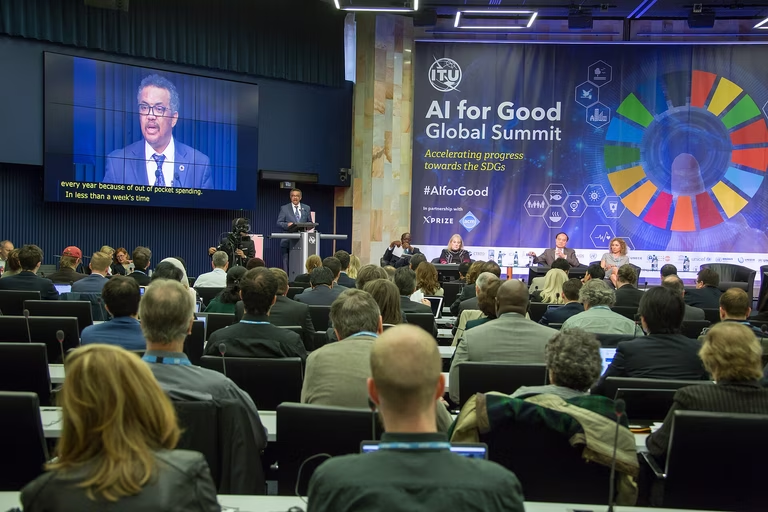
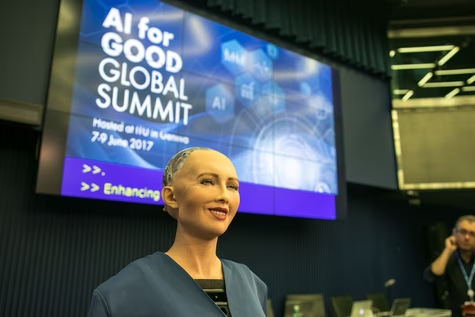
AI for Good is the United Nations' leading platform for promoting AI standards, skills, policy, and partnerships to solve global challenges. It was established in 2017 by the International Telecommunication Union (ITU), the UN’s agency for digital technologies.
Every year they hold a summit in Geneva alongside more than 50 other UN agencies to connect AI experts with global leaders to expand and realise AI solutions that help accelerate the UN Sustainable Development Goals (SDGs).
Their mission is to “Unlock AI’s potential to serve humanity through building skills and standards, and advancing partnerships to solve global challenges.”
The 2026 summit was held on July 7-10 and focused on establishing new frameworks for agentic AI trust, initiatives for expanding capacity in developing nations, and new investment pledges to help close the global digital divide.

How AI Can Be Used to Build A Better World
NGOs and non-profits are already utilising AI to improve their efficiency, optimise field work, draft grant proposals, analyse data, summarise reports, create predictive models, and analyse satellite imagery.
The benefits can readily be seen in the following sectors:
Humanitarian Aid & Disaster Response
During crises, timing is everything. AI helps NGOs respond faster and smarter using predictive logistics. The World Food Programme (WFP) uses AI to optimise delivery routes for humanitarian aid in remote regions.
The International Rescue Committee (IRC) activates AI-powered chatbots to deliver real-time support and life-saving information to families in active conflict zones.
Healthcare & Disease Prevention
AI is improving access to medical expertise in underserved regions. It helps with early diagnostics, allowing healthcare workers to take short smartphone videos of newborns and use computer vision to estimate weight and detect early signs of malnutrition.
It has also proved critical in epidemic tracking, as organisations can use machine learning models to analyse climate and population data to predict and mitigate disease outbreaks before they spread.
Environmental Conservation & Climate Change
Protecting biodiversity and monitoring the planet's health requires processing massive amounts of data. To monitor deforestation, AI platforms can scan satellite imagery in real time to detect illegal logging activities. It can also be used to prevent wildlife poaching as predictive algorithms analyse historical poaching data to help wildlife rangers deploy patrols more effectively in national parks.
Real-World Examples
rAInbow - Developed by Aapulu Labs, this conversational AI acts as a digital companion and resource for survivors of domestic violence.
Eureka - A smart personal assistant that helps refugees to navigate complex legal and integration bureaucracies in new host countries.
Annie MOORE - A software that can recommend matches between foster homes and refugees. It has contributed to an impressive increase in employment outcomes for refugees resettled, with figures ranging from 22% to 38%.
Plantix - An AI-powered app that diagnoses crop diseases, pests, and nutrient deficiencies. With a photo of an affected plant, farmers receive instant identification of the issue along with customised organic or chemical treatment plans, local weather forecasts, and fertiliser calculations.
Forensic Architecture - This research agency uses spatial and architectural analysis, combined with AI and machine learning, to investigate human rights violations and state violence.
The Bernie Sanders Initiative
In June 2026, progressive Senator Bernie Sanders introduced the American AI Sovereign Wealth Fund Act. This proposed to give the public a 50% ownership stake in the largest AI companies in the U.S. He has cited the risks AI poses to jobs, privacy, and democracy as major concerns.
The legislation requires a one-time 50% tax on the stock of the biggest AI companies. This stock would be deposited into the sovereign wealth fund estimated to be worth $7 trillion if created. This would “make sure that AI benefits humanity, not just the richest people on the planet.”
It would create an Independent Commission for Democratic AI to manage the fund in the public's best interest. It would also require large companies that operate AI and non-AI businesses to break up so that they can't try to evade public ownership.
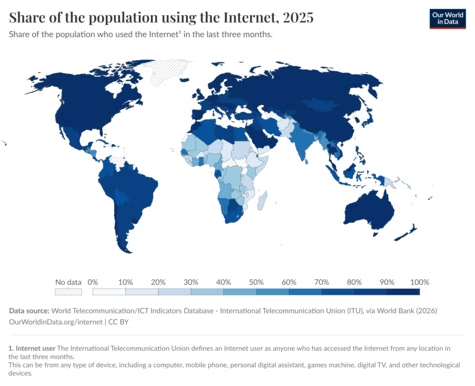
Challenges In The Use Of AI For Good
The potential to harness AI in the social sector and make a real difference in the world is immense. Whilst AI is still in its early stages and regulation and safeguards are still lax, there are a number of challenges which must first be overcome:
- The Digital Divide: Over one-third of the global population remains offline. For AI to truly be a force for good, we must ensure that technological advances do not further widen the gap between connected and unconnected communities.
- Algorithmic Bias: AI models are trained on data from wealthy nations. When applied to developing regions, the results are not transferable and must not be generalised. Localised datasets must be built in order to provide effective solutions.
- Sustainability & Funding: Unlike the tech giants of Silicon Valley, whose interests lie in profiteering and space travel, NGOs working to help people lack sufficient capital needed to build, host, and maintain complex AI infrastructure.
- Ethics & Privacy: Vulnerable communities most in need must be protected. Strict data governance and regulation are required to prevent surveillance or data leaks.
- The Energy & Water Burden: Extreme energy and water consumption caused by data centres needed to power AI creates a paradox. AI systems already consume hundreds of billions of litres annually. By 2030, global data centre water use could reach 9.3 trillion litres. By the same year, they will require 3-4% of total global electricity production to function.
*****
The ethical challenges and dangers of AI are undeniable and are certainly not under sufficient regulation as yet. However, we cannot ignore its potential for creating positive change in the world.
The examples above prove that when harnessed responsibly and guided by ethical principles, AI is a powerful tool for solving pressing global issues.
To fully realise its potential for good, we must implement strict governance, bias mitigation, and transparent systems that protect human rights and ensure trustworthy outcomes.
“The future of AI and the fate of humanity must not be decided behind closed doors in Silicon Valley by billionaires seeking to maximise their power and profit. It must be decided by workers, parents, teachers, artists, scientists, communities and the American people.”
Author: Rachael Mellor, 18.07.26, latest update 28.07.26, licensed under CC BY-SA 4.0
More Resources
Curated Directory & Deep-Dive Resources on AI for Social Good
- AI For Social Good (AI4SG) 520622
- Podcast: AI for Social Good 520641
- Google AI: Societal Impact 520642
- Harnessing artificial intelligence for social good - UNICEF 520647
- 7-10 July 2026 AI for Good Global Summit - Geneva, Switzerland 520672
- Sanders Introduces Legislation to Create $7 Trillion AI Sovereign Wealth Fund - Bernie Sanders 18.06.26 520704
- In Somalia, AI is helping deliver food to hungry families - UN News 03.08.26 522054
- Contesting Big Tech’s AI Greenwashing - Verfassungsblog 05.06.26 520679
- Why AI alone cannot fix social problems - Rest Of World 21.04.26 520667
- Why AI and data centre growth risks stalling without a social licence to operate - WEF 30.03.26 520671
- Economic Growth, Social Good: 88 Nations Endorse AI Impact Summit Declaration In New Delhi - News18 21.02.26 520673
- Claims that AI can help fix climate dismissed as greenwashing - Guardian 17.02.26 520680
- AI for Social Good: A Guide for Getting Started - Medium 30.07.25 520649
- 3 ways regulation can prevent deepfake greenwashing - WEF 18.07.25 520681
- Research article: AI for social good Open Access - Royal Society 11.06.25 520635
- Is AI Good for Society? - HDSR 31.05.25 520682
- Leading on AI for Social Good - Poverty Action Lab, 2025 520628
- AI for Social Good - SSIR, 2025 520655
- AI for Social Good: Beyond Profit, Toward Purpose - Doug Villella 07.11.24 520648
- AI for social good: Improving lives and protecting the planet - McKinsey 10.05.24 520623
- AI for Social Good: Using Artificial Intelligence to Save the World - Rahul Dodhia 03/24 520657
- AI for social good and the corporate capture of global development - T&F 16.02.24 520656
- Report: AI for social good: Improving lives and protecting the planet - McKinsey, 2024 520662
- ‘AI for Social Good’: Whose Good and Who’s Good? Introduction to the Special Issue on Artificial Intelligence for Social Good - Springer 13.08.21 520666
- How to Design AI for Social Good: Seven Essential Factors - Pub Med 06/20 520640
- AI for social good: unlocking the opportunity for positive impact - Nature 18.05.20 520629
- AI for social good: unlocking the opportunity for positive impact - University of Oxford 18.05.20 520630
- Harnessing AI for social good: How local governments can support social value delivery in the age of artificial intelligence - IED 520636