
The Dangers of AI
What are the biggest dangers of AI? Discover expert insights on privacy threats, job impacts, and safety risks in our essential guide to AI safety.
THE DANGERS OF AI - From Algorithmic Bias To Existential Threat
Explore the complex world of artificial intelligence and learn how we must overcome serious challenges to harness it for good. Our AI guide offers you in-depth information on Big Tech's concentration of power, issues with algorithmic bias, and your digital rights.
Channelling AI for the public good requires urgent regulation, robust governance, bias mitigation, complete transparency, and a human rights-centred approach.
Connect with valuable resources, initiatives, and organisations with a focus on tackling the dangers of AI.
Jump straight to our resources on the ➡️ Dangers Of AI
*****
General Information
The Digital Revolution and the rapid rise of Big Tech companies and AI over the last 2 decades have led to vast market dominance, massive concentrations of money, and an unexpected and dangerous role in politics.
The world's five largest tech giants are all American companies – Alphabet (Google), Amazon, Apple, Meta (Facebook), and Microsoft. They all have their headquarters in the San Francisco Bay Area of Northern California, also known as Silicon Valley.
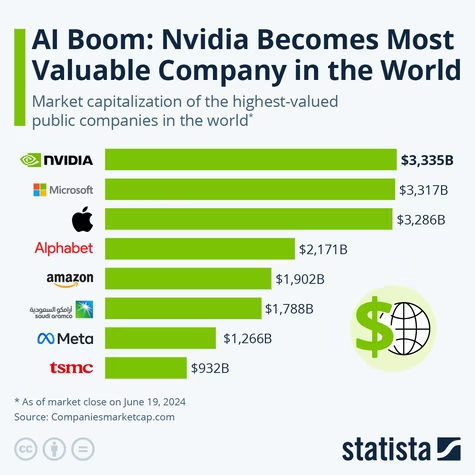
These companies exert massive control over the internet through operating systems, search engines, social media, e-commerce, and streaming services. This unprecedented influence allows them to set their own rules for competition, data privacy, information access, marketing, and audience engagement.
Major Risk Areas Of Artificial Intelligence
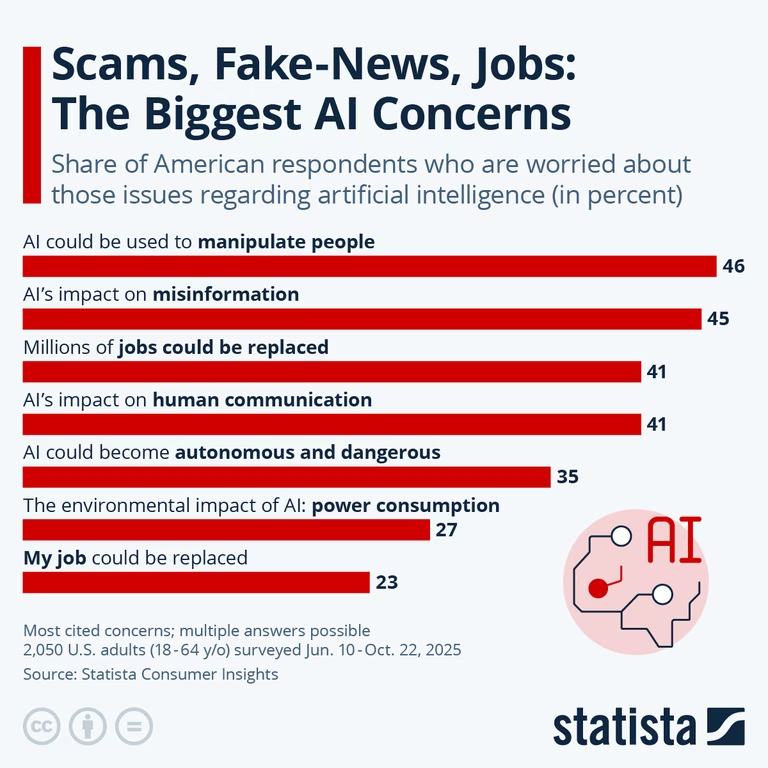
- The Spread of Misinformation - AI technologies can spread misinformation and disinformation, which strongly influence people’s decisions and actions. This is especially dangerous in politics. One of the most famous examples was in 2024 when AI was used to clone the voice of President Joe Biden. The audio discouraged Democrat voters from going to the polls. Deepfakes can quite convincingly misrepresent someone doing or saying something. They can distort the truth, damage reputations, and extort individuals.
- Algorithmic Bias - Learning from human data and history, AI has developed unintended biases that mirror both the good and bad of human nature. This unintended consequence has led to harmful discrimination based on gender in applicant tracking systems, with marginalised and underserved communities in healthcare diagnostics, and with race in facial recognition policing tools.

- ➡️ Privacy - Generative AI applications such as virtual assistants and chatbots use large language models. They get their information by scanning and mining information from websites. This data is usually obtained without consent and risks containing personal information.
- ➡️ Existential Risks - Geoffrey Hinton, regarded as one of the godfathers of AI, along with other AI scientists and industry experts, have consistantly warned that the rapid evolution of AI could soon surpass human intelligence. They have stressed the importance of implementing mitigation measures, likening the risk to nuclear war and pandemics.
- Monopoly & Antitrust Concerns - The critical infrastructure required to run AI, such as cloud computing, chips, and data models, is all controlled by a small group of Big Tech companies. This concentration of power and money stifles competition, locks out startups, and, most concerningly, lets them control market behaviour.
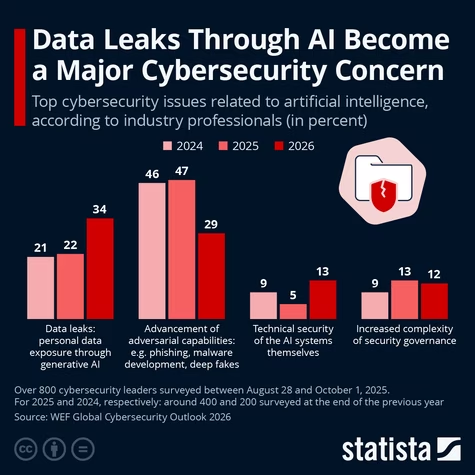
- Cyber Security - Estimates calculate that only 10-22% of organisations have adequate security in place to protect them from advanced cyber attacks. AI tools can clone voices, generate fake identities, and create phishing emails. The IBM 2026 Cost of a Data Breach Report found that one in four malicious breaches now involve AI. Organisations hit by these attacks reported average losses of $6 million.

- Intellectual Property Rights - AI scrapes the internet and collects it for future use. It can generate images that mimic an artist’s style, music that replicates a singer’s voice, and written works such as poems or essays that imitate an author’s style. In these instances, questions arise about who owns the copyright to AI-generated content and whether it should be made clear that AI was used.
- International Interference - As just a small number of states control AI hardware, smaller nations become dependent on foreign technology, leaving them vulnerable to outside influence. Foreign states and malicious actors can manipulate, infiltrate, and weaponise AI infrastructure, data, and learning models. The use of deepfakes, AI disinformation, and attacks on software and national grids poses a threat to national security and can easily destabilise elections.
- Lack of Accountability - When AI goes wrong, who is responsible? In cases of fatal crashes and collisions involving self-driving cars and wrongful arrests based on facial recognition systems, who is to blame? How can victims seek justice if there is no accountability?
- Labour Exploitation - Big Tech companies outsource essential tasks for training AI models, such as data labelling and content moderation, to low-wage workers in the Global South. These workers report being under constant surveillance, psychological distress from reviewing graphic content, and being subject to extreme underpayment, sometimes as low as $2 an hour.
- ➡️ Job Losses - AI has caused widespread disruption to the job market. As automation becomes the norm, around 40% of workers globally worry about losing their jobs to AI. There will be a great need to reskill workers as roles such as machine learning specialists and robotics engineers become more important. Jobs in fields such as customer service, data entry, and clerical roles are predicted to decline.

- ➡️ Use of AI in Warfare - AI-powered autonomous weapons are a new and dangerous era of warfare. They bring with them profound risks, reduce life-and-death decisions to algorithms, and have a high chance of misidentifying targets. They also significantly increase the risk of fatalities and scale up the speed and volume of strikes. Human lives are reduced to target lists and calculations, which remove the reality of the unimaginable suffering and immorality of war. With the ability to destroy countless lives at the push of a button, military operators are given emotional distance. Human accountability is eroded, and oversight becomes incredibly difficult.
- ➡️ Extreme Energy & Water Consumption - Operating AI systems is incredibly energy-intensive, and so the industry carries a significant carbon footprint. One study estimates that training just one language processing model emits over 600,000 pounds of carbon dioxide - nearly 5 times the average emissions of a car over its lifetime. Data centres which are used to run AI applications generate considerable heat and use large volumes of water for cooling. Estimates suggest data centres consumed roughly 4.5 trillion litres globally in 2025; this is expected to more than double by 2030. Between 43% and 54% of data centres operate in areas experiencing high water stress, drought, or heat risk.
Can We Use AI For Social Good?
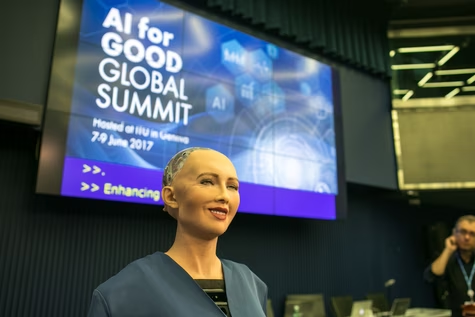
As technology rapidly evolves and outpaces regulations and key safeguards, we should not underestimate the dangers and ethical implications of AI. Likewise, we should not underestimate its potential to enable real-life positive change.
The benefits of AI are best seen when used in collaboration with human intelligence. People bring diverse logical decision-making, opinions based on evidence, and the unreplicable human imagination. They also bring essential perspectives, empathy, and accountability.
The use of AI has sped up processes, increased efficiency, cut costs, helped to identify patterns, and helped to sort through mountains of data.
The movement to harness AI for Social Good is already transforming how NGOs, charities, and even global institutions work towards tackling humanity's most pressing challenges.
NGOs and non-profits are already using AI to improve efficiency, optimise fieldwork, draft grant proposals, analyse data, summarise reports, build predictive models, and analyse satellite imagery.
The benefits are already being used in humanitarian aid distribution and disaster response, healthcare and disease prevention, and environmental conservation and climate change mitigation efforts.
The ethical challenges and dangers of AI are undeniable and are certainly not yet sufficiently regulated. However, we cannot ignore its potential for creating positive change in the world. When harnessed responsibly and guided by ethical principles, AI is a powerful tool for solving pressing global issues.
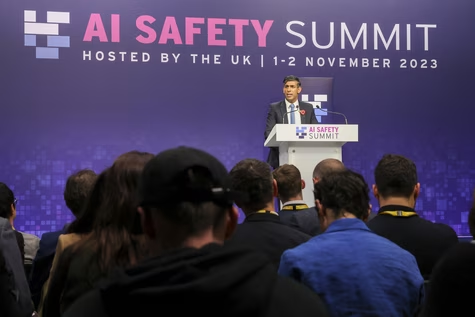
International AI Summits
The first global summit on artificial intelligence was the AI Safety Summit held on November 1–2, 2023, at Bletchley Park in Buckinghamshire, England.
Before the inaugural summit, the Centre for AI Safety released a landmark Statement on AI Risk that warned that "mitigating the risk of extinction from AI should be a global priority alongside other societal-scale risks such as pandemics and nuclear war."
This statement was signed by Turing Award winners Geoffrey Hinton and Yoshua Bengio, Sam Altman, CEO of OpenAI, Demis Hassabis, former CEO of DeepMind, and Dario Amodei, co-founder of Anthropic.
At the 2023 summit, global governments formally acknowledged the safety risks of AI, the outcome of which was the Bletchley Declaration. Signed by 28 countries including the U.S., the UK, China, India, and the European Union, this landmark agreement focuses on identifying and jointly managing the risks of frontier AI.
The declaration acknowledges the immense potential of advanced AI systems alongside the serious and potentially catastrophic risks of misuse. It has created a framework for international cooperation, allowing countries to share research and best-practice policies transparently.
Although the agreement was historic in getting global superpowers to agree on the existential risks, it has so far failed to establish legally binding global regulations.
This summit was succeeded by summits in South Korea in 2024 and France in 2025. The most recent summit was the India AI Impact Summit, held in New Delhi in February 2026. This event marked a notable shift away from AI safety toward affordable infrastructure, inclusive expansion, and corporate growth.
Human rights groups such as Amnesty International criticised the summit for putting the dangers of unchecked AI development on the back seat. Civil society groups and labour unions also commented that their interests were overshadowed by huge tech companies.
Of note, the U.S.A., the global leader in AI, explicitly rejected the idea of formal global AI governance.
Mitigating The Risks Of AI
Mitigating the risks of AI must become a global priority. Global cooperation is essential to implement international safety controls, governance, and ongoing risk evaluation.
Currently, AI deployment is rapidly outpacing our ability to regulate it. Responsible development and use of AI have been pushed aside as greedy tech companies focus primarily on market dominance.
To fully realise AI's potential for good, we must implement strict governance, mitigate bias, and build transparent systems that protect human rights and ensure trustworthy outcomes.
Mitigation solutions include:
- Investing in cyber preparedness and security to protect organisations from cyber attacks.
- Implementing AI fairness tools which mitigate bias across the entire AI lifecycle.
- Incorporate human oversight with ethics committees and review boards.
- Inform consumers about data collection practices, how data is stored, and how it is used. Provide an option to opt out.
- Power data centres with renewable energy.
- Ensure that accountability is at the core of AI governance strategies.
- Comply with copyright laws when training AI models.
- Educate users and employees on identifying misinformation.
Addressing the systemic risks of AI cannot be done by one nation alone; it requires multilateralism, transparent governance, and strict accountability from Big Tech companies to ensure powerful systems remain safe and aligned with societal values.
Safeguarding our future requires a human-centred approach. We simply must steer technological progress toward collective human well-being over relentless corporate expansion.
Author: Rachael Mellor, 17.08.26, latest update 30.09.26, licensed under CC BY-SA 4.0
Work in progress. Suggestions and input welcome.
More Resources