
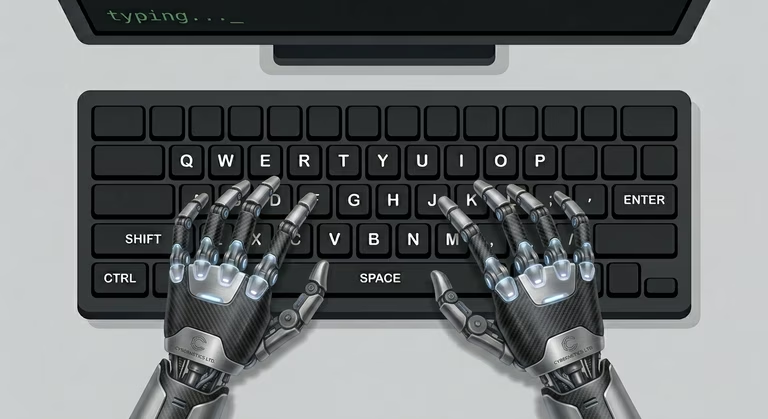
The Death of the Internet - AI Risks
Discover how generative AI and bot traffic threaten organic web content. Explore the Dead Internet Theory and how Better World Info promotes a human-centered web.
THE DEAD INTERNET THEORY - Humans Are Now Officially The Minority Online
Discover how artificial intelligence is reshaping today’s internet and learn how we can actively protect authentic online spaces. Our digital guide offers you in-depth information on the "dead internet" phenomenon, algorithmic saturation, and how we must preserve human knowledge and perspectives.
Connect with valuable resources, initiatives, and organisations focused on preventing the erosion of trust, protecting human activity online, and choosing human connection over algorithmic feeds.
Jump straight to our resources on the ➡️ Dead Internet Theory
*****
General Information
The internet as we knew it is undergoing a profound transformation. What started years ago as a conspiracy theory predicting a robot takeover of the internet has become a serious concern among AI safety experts, cybersecurity organisations, industry insiders, publishers, journalists, and knowledge platforms such as Better World Info.
Even everyday users are experiencing AI fatigue. In a study by Talker Research, almost half of respondents agreed that AI feels so omnipresent that they "can never escape it."
As of May 2026, AI bot traffic officially overtook human traffic on the internet. This milestone was reached 18 months ahead of industry projections.
The main fears are that human connection, verifiable facts, originality, and authenticity will become drowned out by the swath of AI-generated noise. Since the public rollout of AI systems, the internet has become more unlikeable, more stressful, and an active source of anxiety.
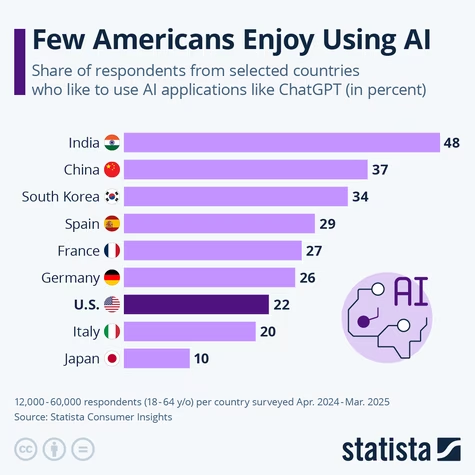
A study by the Pew Research Centre revealed, paradoxically, that those who use AI the most also like it the least. While chatbot use in the U.S.A. has reached 50%, only 16% of adults believe it will improve society.
Other major concerns, particularly among younger populations, include the immense energy and water consumption of sprawling data centres, the impact on critical reasoning, and the risk of disruption to the job market.
What Exactly Is The Dead Internet Theory?
In the late 2010s, the dead internet theory was dismissed as nothing more than paranoid fantasy. Over time, the concept gained credibility. Whether a human-driven internet is dead remains up for debate, but one thing is clear: the digital public sphere is becoming increasingly automated.
As of August 2026, more than half of internet traffic, content, and interactions are generated by automated systems. The rapid development of generative AI and automated bots has made it incredibly cheap, fast, and lucrative to flood the web with artificially generated content.
Non-human traffic mostly comes from chatbot referrals such as ChatGPT and Gemini, AI crawlers that scan thousands of pages to feed their data models, and AI agents that autonomously carry out easy automated tasks.
AI crawlers make up most AI traffic. Meanwhile, traffic from AI agents grew nearly 8,000% in 2025 in comparison to the previous year. Over 95% of new AI-driven traffic targets just three core sectors: Online retail, media streaming, and travel and hospitality.
“I’ve been a Dead Internet Theory truther for years. What used to sound like a conspiracy is now just…the feed. At this point, it’s not *if* most of what we see online will be AI-generated. It’s that it already is.” - Alexis Ohanian, co-founder of Reddit.

Key Issues With An AI-Dominated Internet
- AI Slop Content - The internet has become flooded with low-effort, low-quality, and mass-produced content designed to chase clicks, views, and ad revenue. It provides very little genuine value. Social media feeds, video streaming platforms, and product review pages in particular have become choked with misleading, triggering, fake, and downright bizarre content. (I refer you to shrimp Jesus)
- Synthetic Engagement Loops - Designed to get users hooked and ingrain their product into our daily habits. These are deliberately designed mechanics that push artificial triggers to prompt a user action and get our attention, usually alongside a fake sense of urgency. More activity means more profitability.
- The Rise of AI-Enabled Cybercrime - The IBM 2026 Cost of a Data Breach Report found that one in four malicious breaches now involve AI. Shockingly, malicious bots account for approximately 40% of global web traffic. Estimates calculate that only 10-22% of organisations have adequate security in place to protect them from advanced cyberattacks. AI tools can clone voices, generate fake identities, and create phishing emails at great speed and volume. Organisations hit by these attacks reported average losses of $6 million.
- The Search Engine Crisis - More than half of all online searches now end without a single click to an external website. As AI gives direct answers on the search page without even being asked, web traffic to news sites, blogs, and businesses has dropped to between 20 and 80%. Finding authentic, lived human experiences and trustworthy answers via search engines is becoming increasingly difficult. Many websites (content farms) now exist purely to harvest search engine optimisation (SEO) traffic using AI-generated text, which dominates search results.
-
Accelerating The Erosion Of Trust - Fake videos, reviews, and news articles can be made by anyone in seconds; public trust has shifted from trust to suspicion. This phenomenon is particularly dangerous for democracy, as fake political statements, images, and voice recordings spread disinformation across the internet at breakneck speed, boosted by engagement-driven algorithms. One of the most famous examples was in 2024 when AI was used to clone the voice of President Joe Biden. The audio discouraged Democrat voters from going to the polls.

- The Ouroboros Effect - This unintended consequence of recursive training happens as AI models increasingly train on synthetic data generated by other AI models rather than authentic human input. The name Ouroboros comes from the ancient symbol of a snake eating its own tail. Over time, this feedback loop will degrade the quality of information as small errors and biases multiply. Future models then treat these hallucinations as fact. Feedback loops also tend to produce repetitive, generic outputs and carry a high risk of collapse.
*****
AI-Embedded Search Engines - Poisoning the Well of Knowledge
Internet browsing is becoming increasingly obsolete as AI-generated answers are embedded in search engines. Large language models summarise entire web searches into one short, easy-to-digest answer.
Instead of guiding users to authentic sources, independent journalism, or other verified, human-curated content, it creates a dangerous trap of convenience, with the utmost confidence.
It is impossible to summarise important complex global events such as the war in Gaza or the Climate Crisis in just a few oversimplified sentences. They offer no critical analysis, thought-provoking insight, or expert input to help us fully understand the topic and form our own informed opinions.
These summaries leave users dangerously uninformed and misinformed. They also raise issues around copyright, hallucinations, transparency, and fake sources.
Independent human content creators are losing traffic on a vast scale, traffic that they need to sustain their work. This leaves the internet a place devoid of fresh, original, and diverse perspectives.

Can We Protect The Human Internet?
As the internet evolves, we too must shift how we interact with technology. One important step is to develop a way for platforms and individuals to distinguish human from bot activity.
Users can actively seek out verified, community-driven, and transparent spaces which are reserved for genuine human connection. These gated communities help to preserve the human aspect of the web and place a renewed emphasis on original thought, creativity, and imagination.
We can help combat the homogenisation of knowledge by actively supporting independent, socially driven media outlets - those that prioritise original reporting, research over automated answers, and human connection over algorithm-driven feeds.
Can We Fight Back Against the AI Tsunami?
Beyond the small changes we can make at the individual level, preventing the death of the internet requires a proactive, coordinated stance from Big Tech companies, AI regulators, and governments worldwide.
A human-centric web starts with strict platform accountability. Mandatory watermarking for artificially generated media, algorithmic transparency, and aggressive bot-filtering are good first steps. Strict transparency laws are essential to enforce these changes and to hold tech companies accountable.
Issues such as the amplification of disinformation and data privacy breaches must not be tolerated.
In a world where the internet has become increasingly isolated, polarised, unreliable, harder to navigate and shadier, we must protect independent digital spaces.
“The internet may not be dead. But our capacity to govern it democratically remains dangerously underdeveloped.” - Mimi Mihăilescu on The Rise of Synthetic Politics.
*****

The Role of Better World Info: Truth vs Synthetic Noise
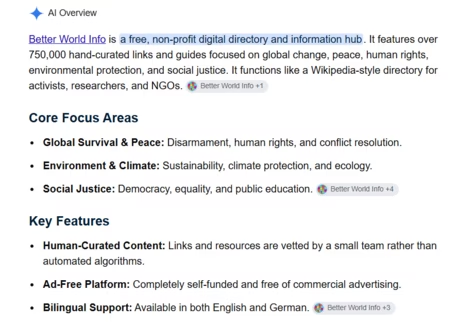
Platforms like ours at Better World Info play a vital role in combating the rapid decline of a human-centric internet. We are steadfast in our dedication to human-curated knowledge, critical thinking, and informed decision-making.
As algorithms increasingly prioritise automated, low-effort engagement and synthetic media, independent and transparent digital directories provide a vital service. We are free, and unlike Big Tech, we don't steal your personal data to resell it to the highest bidder.
By manually vetting resources, championing social justice, peace, and human rights, and highlighting genuine grassroots initiatives, Better World Info helps to preserve a human-centred web - proving that the internet can still be a space for authentic connection, reliable education, and meaningful global change.
Authors: Dr Norbert Stute 13.08.26, edited by Rachael Mellor, 18.08.26, licensed under CC BY-SA 4.0
More Resources
Curated Directory & Deep-Dive Resources on The Death of the Internet - AI Risks
- Dead Internet theory - Wikipedia 521541
- Internet Bot / Web Robot - Wikipedia 521542
- Bad Bot Report 2026 - Thales 521545
- Fact check: How do I spot AI-generated images? - DW 18.08.26 521675
- European publishers are getting hit harder by AI bot scraping, report finds - Digiday 14.8.26 521544
- Short: Google’s AI Is Killing the Internet - Bloomberg 12.08.26 521540
- Bad bots make up 40% of internet traffic - HelpNetSecurity 30.04.26 521547
- Fraud and Abuse Report 2025: Charting a Course Through AI’s Murky Waters - Akamai 11/25 521546
- Bot Traffic Report 2016 (the good old times) 521543
- Our GERMAN Links on the Topic 521548