Digital Independence Day - DI Day
Reclaim your digital sovereignty on DI Day. Learn how to switch from Big Tech to open-source, and privacy-focused alternatives with our guide.
DIGITAL INDEPENDENCE DAY (DI.DAY) – Ending European Reliance On U.S. Big Tech
Discover the path to digital sovereignty and learn how you can actively break free from Big Tech dominance. Our Digital Independence Day guide offers you in-depth information on online privacy, internet governance, taking a digital detox, and step-by-step strategies to make the switch to ethical tech alternatives.
Connect with hundreds of valuable resources, initiatives, and organisations – for digital rights, open-source software, and a self-determined digital future.
Jump straight to our resources on ➡️ DI.DAY
*****
General Information
Digital Independence Day is a movement that helps people reclaim their digital sovereignty. It is about taking back control over digital technology.
The initiative was launched at the 39th Chaos Communication Congress, headed by German author Marc-Uwe Kling and the organisations Save Social and the Chaos Computer Club. The monthly event takes place on the first Sunday of each month. It encourages people to ditch Big Tech services (Google, Meta, Amazon, Microsoft, etc.) and switch to European alternatives that have a greater respect for privacy.
It was first launched on January 4, 2026, and so far, 189 organisations have joined the initiative, organising over 400 meet-ups. The monthly nature of the campaign allows people to make gradual changes to their digital lives without feeling overwhelmed.
The official website provides simple guides to help people migrate their data and set up new tools. Various organisations have helped to establish "Switching Parties", which provide hands-on technical help.
Dependence On U.S. Tech
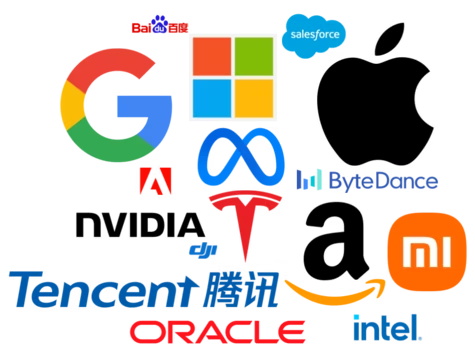
Amazon, Microsoft, and Google combined control roughly 70% of Europe's cloud computing market, that is, servers, storage, databases, and software. U.S. rivals have slowly outcompeted European service providers over the past decade. EU services currently only account for 15%.
The two largest European companies in the market are German-owned SAP and Deutsche Telekom, which each hold 2%. Heavy European reliance on U.S. tech giants has become a geopolitical vulnerability.
With the increasingly volatile Donald Trump at the helm, there has been a shift in how Europeans view this heavily one-sided relationship with U.S. tech. Experts have scrutinised this over dependence and warned leaders that it could take years to fix.
The Trump administration is guilty of using its technological dominance as a geopolitical power tool, and, as such, Europe is increasingly in favour of developing digital autonomy.
A major concern is that U.S. law enforcement has the right to request user data from American companies. The CLOUD Act (Clarifying Lawful Overseas Use of Data Act), passed in 2018, allows this to happen regardless of whether the data is stored within or outside the U.S. It shifts jurisdiction over data control away from where the data is located.
Tensions between the EU and the U.S. became particularly strained after Trump's recent attempt to annex Greenland. Due to its strategic location in the Arctic between the U.S. and Europe, Greenland has experienced increasing militarisation since the early 2000s. In his efforts to seize it, Trump initially refused to rule out military action.
We are already seeing examples of digital coercion by the U.S. In early 2025, during negotiations with Ukraine over critical minerals, they threatened to cut off Kyiv's access to Starlink services if a deal could not be reached.
A few months later, Microsoft were accused of disconnecting the email account of the International Criminal Court's chief prosecutor, Karim Khan. This happened after a panel of judges issued arrest warrants for Israeli Prime Minister Benjamin Netanyahu.
Declaring that the ICC posed "an unusual and extraordinary threat", Trump imposed strict sanctions on the ICC. Many of the courts prosecutors and judges have suffered severe restrictions on their work and personal lives.
In 2020, controversial U.S.-based Palantir Technologies signed a £330 million contract to become the primary software provider for the British National Health Service (NHS). The move went ahead despite opposition from doctors, campaigners, and unions.
Palantir have a highly controversial background with surveillance and data security. Concerns centre on the risks of misuse of patient data, dependence on U.S. services, and increasing privatisation.
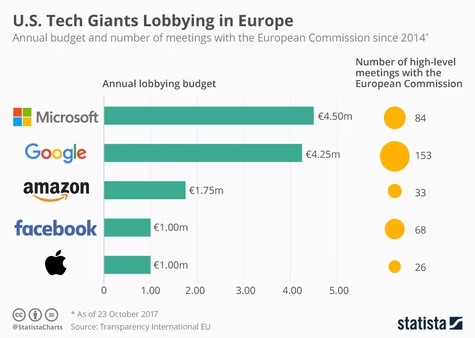
To defend their dominance, secure their huge profits, and prevent strict regulations, the tech industry now spends a record €151 million on lobbying the EU.
Meta takes the top spot, spending a whopping €10 million annually, followed by Microsoft, Apple, and Amazon, which each spend roughly €7 million. There are now 437 lobbyists who have continuous access to the European Parliament.
Their access to EU policymakers is unprecedented. In the first half of 2025, Big Tech held an average of three lobbying meetings a day.
Digital regulation in the EU is under immense pressure from the U.S. government. U.S. tech covers everything from the information people consume to the digital infrastructure on which we depend.
In her first term as President of the European Commission, Ursula von der Leyen passed landmark regulations designed to curb the power of Big Tech, rein in platforms, increase content moderation, and set global standards for artificial intelligence.
The Digital Markets Act, the Digital Services Act, the Artificial Intelligence Act, and the Data Governance Act & Data Act were designed to protect users and promote a fairer digital market. Lobbying has put these landmark regulations under great pressure.
Polling after the Greenland crisis shows that the vast majority of Western Europeans want less U.S. influence and more control and decision-making from within Europe.
Europe has the capacity and talent to take greater control of the digital market and data privacy, as well as reduce the risks of military aggression. Europe's digital sovereignty is achievable, albeit a lengthy process.
Austria's military has already switched to open-source services that are hosted in Europe. Some German regional governments have followed suit. In 2024, Denmark ended the use of Google laptops in schools in the interest of data protection.
The new Dutch government have prioritised digital sovereignty. In the public sector, France has moved 5.7 million workers from Zoom to Visio, which runs on French infrastructure.
The European Commission is currently building a system using Matrix, an open-source European technology that enables decentralised messaging, to reduce its dependency on U.S. tech.

How To Ditch Big Tech Services
The monthly DI.DAY movement suggests a phased approach to transitioning away from Big Tech. It is a good idea to start by replacing search engines and browsers, as this is one of the easiest and quickest steps.
A second stage would be to begin migrating email accounts, calendars, and cloud storage to more secure providers. Finally, they suggest switching to more privacy-focused social media, messaging apps, maps, video hosting services, and digital entertainment such as music and streaming.
The DI.DAY organisers provide tips on de-Googling your phone and laptop, staying in control of your data, adopting open source software, and using decentralised communication tools. They make the process of moving away from Big Tech simple.
Below we list some alternatives to try out:
Google Search Engine -
-
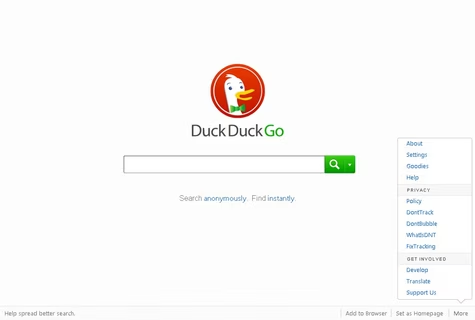
DuckDuckGo do not track your search history, IP address, or user data.
-
Ecosia uses ad revenue to fund reforestation projects. It is privacy-focused, carbon-negative, and runs on 100% renewable energy.
-
Startpage acts as a middleman, which fetches Google results but strips away all identifying data.
-
Mojeek is one of the few search engines with its own independent web index, offering a truly different perspective.
-
SearXNG is one for the tech-savvy. It offers a "metasearch" engine that aggregates results from many sources.
Chrome Internet Browser -
-
Firefox is a privacy-focused, open-source web browser designed to block trackers and third-party cookies by default.
Whatsapp Messaging -
-
Signal is a highly secure, non-profit messaging app with end-to-end encryption, open-source code, and minimal data collection.
Windows/MAC Operating Systems -
-
Linux Mint is a free, open-source operating system renowned for its stability and high security.
X/Facebook/Instagram Social Media -
-
Mastodon is a decentralised, open-source, and ad-free social network that offers feeds free from algorithms, enhanced privacy control, and community-focused moderation.
-
Pixelfed is a decentralised, open-source photo-sharing platform that labels itself an ethical alternative to Instagram. It is free from tracking, advertising, and algorithms.
*****
Digital Independence Day has brought the concept of digital sovereignty to the mainstream. Within Europe, greater control over the digital sphere enables greater independence, strengthened cybersecurity, improved data protection, and reduces the hold that Big Tech currently has over the global tech industry.
Implemented correctly, it will boost competitiveness, foster local AI development, secure cloud infrastructure, and ensure that European values and laws are integrated into the European digital landscape.
It is widely agreed that tech giants already have far too much power. This influence is bleeding into politics and weakening our democracies.
Europe must push back against big tech lobbying and stand by its hard-won digital laws. Days like DI.DAY not only raise awareness of the risks of overdependence but also helps us to make the switch. We can all play our part.
"Without radical measures to reduce dependency on digital monopolies, the digital future of Germany and Europe is lost." - Dr Harald Wehnes, Professor of Computer Science at the University of Würzburg
Author: Rachael Mellor, 27.03.26, latest update 22.07.26, licensed under CC BY-SA 4.0
More Resources
Curated Directory & Deep-Dive Resources on Digital Independence Day - DI Day
- DI Day (de) 511438
- Our GERMAN Links on DI Day 511437
- Digital Independence 511563
- People VS Big Tech 511693
- Europe is distancing itself from America. That leads in one direction - Washington Post 19.03.26 511592
- Video: Europes quiet Breakup with U.S. Big Tech - Brit in Germany 15.03.26 511591
- Video: Digital Independence Day & QualityLand (Marc-Uwe Kling) - Soenke Scharnhorsts Podcasts 12.03.26 511576
- I tried leaving ‘Big Tech’ forever - Medium 03.03.26 511692
- Leave big tech behind! How to replace Amazon, Google, X, Meta, Apple – and more - Guardian 26.02.26 511681
- Video: European Governments Move Away From U.S. Tech Platforms - Your Morning 18.02.26 511587
- Europeans are dangerously reliant on US tech. Now is a good time to build our own - Guardian 17.02.26 511590
- These four charts show how reliant Europe is on U.S. digital infrastructure - CNBC 13.02.26 511583
- DI.DAY is a Movement to Encourage People to Ditch Big Tech - It's Foss 10.02.26 511564
- EU capitals say deleting US tech is not realistic - Politico 09.02.26 511586
- Video: France Ditches US Tech: Will Europe Follow? - TLDR News EU 07.02.26 511582
- DI.DAY (Digital Independence Day) Starts a Movement to Encourages People to Ditch Big Tech Services - Tech Edu Byte 06.02.26 511575
- Bye Bye Big Tech: Extra tips - Bits of Freedom 06.02.26 511690
- Digital sovereignty (3/3): Are European citizens trapped into using US Big Tech? - France24 04.02.26 511570
- #DIDit: EDRi members spark movement for alternatives to Big Tech - EDRI 04.02.26 511577
- The world is trying to log off U.S. tech - Rest of the World 02.02.26 511687
- Digital Independence Day: Why Digital Independence Is Important - Cryptomator 01.02.26 511561
- Digital Independence Days 2026, February - Sascha Mahlke 02/26 511567
- How the EU became a digital colony — and how it might break free - The Parliament 26.01.26 511580
- Video: Europe aims to end tech reliance on US networks - @interestingengineeringie 25.01.26 511588
- Report Says the E.U. Is Gearing Up to Weaponize Europe’s Tech Industry Against the U.S. - Gizmodo 24.01.26 511603
- Europe’s digital reliance on US Big Tech: Does the EU have a plan? - France24 24.01.26 511686
- Europe Prepares for a Nightmare Scenario: The U.S. Blocking Access to Tech - WSJ 23.01.26 511600
- Europe’s Bazooka Could Hit US Tech - CEPA 23.01.26 511584
- Europe wants to end its dangerous reliance on US internet technology - Conversation 21.01.26 511680
- EU vs US Tech War Escalates as Apple, Google and Meta Face Fresh Retaliation - European Business Magazine 08.01.26 511599
- Digital Freedom Through Digital Independence Day - Schopflin Stiftung 02.01.26 511572
- German hackers call for ‘digital independence days’ to reduce US tech grip - Reddit 01/26 511573
- German hackers push digital independence drive - Dig Watch 31.12.25 511565
- German hackers call for ‘digital independence days’ to reduce US tech grip - Euractiv 29.12.25 511562
- German hacker group urges monthly Digital Independence Day - The Star 29.12.25 511566
- Digital Independence Day - Moritz Glantz 27.12.25 511569
- Europe gets serious about cutting digital umbilical cord with Uncle Sam's big tech - The Register 22.12.25 511589
- Get over your X: A European plan to escape American technology - ECFR 10.12.25 511578
- Is there an alternative to Big Tech’s control of the social media space? - LSE 10.12.25 511684
- Europe Is Bending the Knee to the US on Tech Policy - Wired 24.11.25 511596
- Why EU Organizations Need Alternatives - Wire 03.11.25 511685
- Attention is all you need – why Europe should decouple from US technology - LSE European Politics 14.10.25 511581
- Europe tightens grip on strategic space data as dependence on U.S tech comes under scrutiny - The European 07.10.25 511594
- U.S.-EU Tech Tensions: Escalation or Diffusion? - CSIS 10.09.25 511593
- Why are Big Tech companies a threat to human rights? - Amnesty 29.08.25 511694
- Should Europe wean itself off US tech? - BBC 18.08.25 511595
- Europe’s Growing Fear: How Trump Might Use U.S. Tech Dominance Against It - NY Times 20.06.25 511598
- Why the World Needs European Alternatives to Big Tech - Get Connie 20.05.25 511682
- Europe in Big Tech’s Grip: Still Hooked on US Digital Power? - Pulse 13.05.25 511597
- Big tech alternatives - Runbox 10.05.25 511691
- The Transatlantic Tech Clash: Will Europe “De-Risk” from the United States? - CSIS 02.05.25 511601
- Europe strives for payments sovereignty as US players tighten grip - Payment Year Books 29.04.25 511678
- Europe is as Dependent on US Tech as it is on US Defence - Geopolitical Risk Advisory 22.04.25 511602
- European Union gets serious as bloc seeks independence from U.S. tech such as Uber, Apple and Mastercard - Fortune 16.04.25 511679
- Establishing Your Digital Independence Day - Digital Independent 03.04.25 511574
- EU-US rift triggers call for made-in-Europe tech - Politico 10.03.25 511579
- Trump takes aim at ‘overseas extortion’ of American tech companies: the EU-US rift deepens - EUISS 27.02.25 511604
- Beyond Big Tech: A manifesto for a new digital economy - People vs Big Tech 30.09.24 511683
- Big Tech, the Platform Economy and the European Digital Markets - Intereconomics, 2023 511689
- Europe’s digital independence day - CEPS 19.02.20 511568
- Europe's Digital Independence Day - Forbes 19.02.20 511571
- It's not enough to break up Big Tech. We need to imagine a better alternative - Guardian 11.05.19 511688