
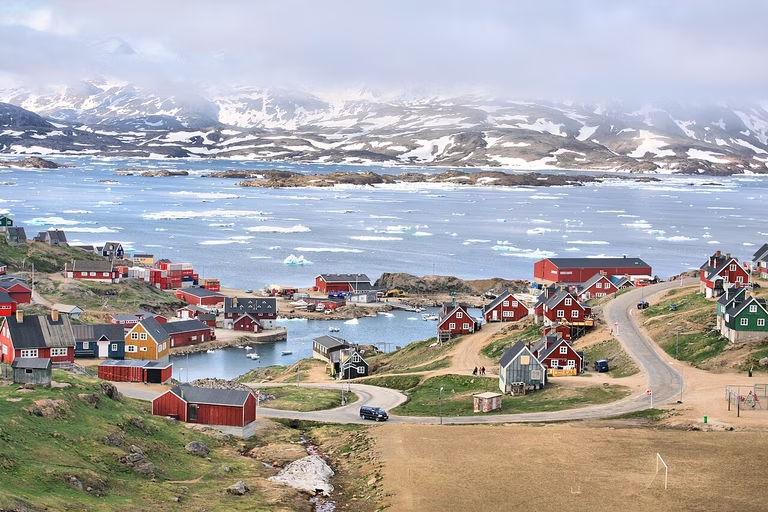
Greenland
Explore how Greenland faces growing threats from U.S. strategic interest, Arctic militarisation, and natural resource exploitation. Read insights and analysis.
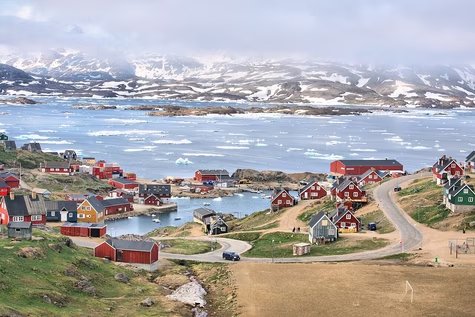
GREENLAND UNDER THREAT – Trump Eyes Annexation & Resource Exploitation
Discover the beautiful yet threatened island of Greenland and learn how they are standing up to unwanted foreign interference. Our guide offers you in-depth information on the Arctic region, political autonomy and environmental preservation.
Connect with hundreds of valuable resources, initiatives, and organisations – for greater sovereignty, information on foreign expansion, and indigenous rights.
Jump straight to our resources on ➡️ Greenland
*****
General Information
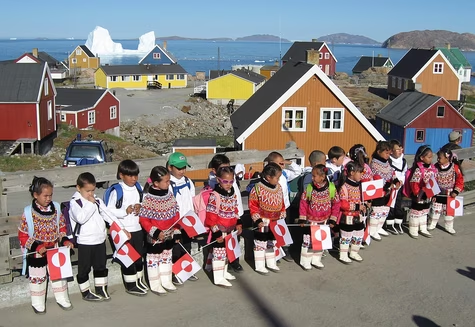
Greenland is the world's largest island and home to 56,000 predominantly Inuit people. Not a country in its own right, Greenland is considered an autonomous territory within the Kingdom of Denmark.
Almost 80% of Greenland's landmass is covered by a vast ice sheet that extends over roughly 1.7 million square kilometres. The nature of the island and its geographical positioning make it especially vulnerable to the effects of climate change, particularly warming temperatures.
Approximately 28,000 sq kilometres of Greenland's ice sheet and glaciers have melted over the last three decades.
The U.S. has coveted the island since the 19th century, but interest has grown significantly since the end of World War II. Trump has recently reignited these proposals, and he seems intent on getting it at all costs. Threats to invade or annex Greenland, if actioned upon, would be in direct violation of international law. The Greenlandic government has consistently declared that Greenland is 'not for sale'.
"We don't want to be Americans, we don't want to be Danes, we want to be Greenlanders." - Statement by Greenlandic leaders
Explore our comprehensive guides on U.S. national missile defense, Arctic oil drilling, rare earth elements, and U.S. imperialism and foreign policy.
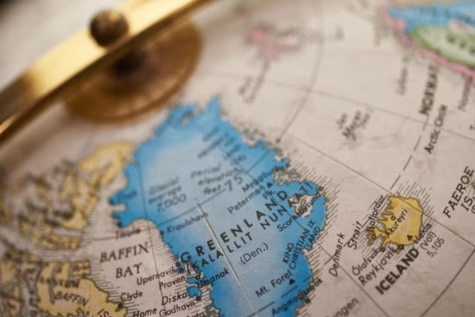
Governance Of Greenland
Greenland is a self-governing nation with its own parliament that handles domestic matters, including education, taxation, and justice.
Geographically, Greenland lies on the North American continent, but since the 9th century, it has been politically and culturally associated with Europe. Historically, Greenland was a Norwegian colony, but when the Denmark-Norway union split in 1814, it was transferred to Denmark.
As both countries are part of the wider Arctic region, Norway remains closely interconnected with issues related to the Arctic. Although Greenland has control over its internal policies, Denmark handles international affairs, including defence, foreign relations, and its currency.
Two-thirds of Greenland's budget revenue comes from Denmark. The rest is primarily generated by the island's vast fishing industry.
The current Prime Minister of Greenland, Jens-Frederik Nielsen, has made his stance on Trump's threats to take over ownership of Greenland very clear -
"Greenland does not want to be owned by the United States. Greenland does not want to be governed by the United States. Greenland does not want to be part of the United States."
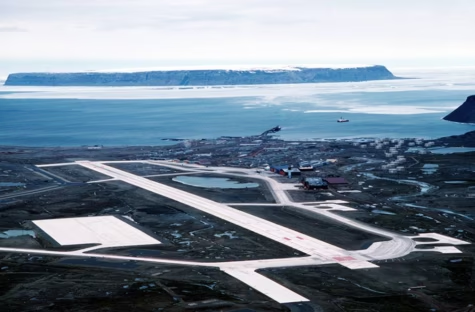
Militarisation Of Greenland
Due to its strategic location in the Arctic between the U.S. and Europe, Greenland has experienced increasing militarisation since the early 2000s. Renewed investment in Russia's Arctic military and the reopening of Russian bases have prompted upgrades by the U.S. and Denmark and increased geopolitical competition between the big global powers.
Adding to tensions, the U.S., Russia, and China have also been eyeing new trade opportunities in the Arctic. Melting ice caused by climate change has opened new shipping routes in the northern sea, increasing Greenland's strategic value internationally.
The primary U.S. air base in Greenland is Pituffik Space Base, previously Thule Air Base. The base is positioned on the Northwest coast and was established in 1951 under the Greenland Defence Agreement. The base operates under a NATO framework as long as both Denmark and the U.S. remain members.
In a recent round of modernisation, the base installed Ballistic Missile Early Warning Systems to counter increased military activity from Russia and China in the region.
Since 2019, U.S. President Donald Trump has been loudly claiming that the territory is key to U.S. national security. He has threatened to take ownership by any means necessary, including the use of force.
Trump argues that the Arctic lacks sufficient defence, surveillance, and warning capabilities. In an attempt to prove his point, he described their current defence as 'two dog sleds'. Then, with no evidence, he stated that Greenland is "covered with Russian and Chinese ships all over the place".
Existing agreements between the U.S and Denmark allow the U.S. to bring unlimited troops to the island. Trump has, however, called the current arrangement a 'lease agreement', stating that U.S ownership is the only way.
Trump's goals to annex Greenland, if acted upon, could threaten the existence of NATO as it currently stands. U.S. military action against a Nato ally would effectively end the alliance and its security framework.
So far, Greenland's leaders and Denmark's Prime Minister, Mette Frederiksen, have rejected Trump's demands. Denmark has recently announced a £1.2 billion boost in defence spending to purchase inspection ships, long-range drones, extra staffing, and airport expansion to handle F-35 fighter jets. The plan apparently is not in response to this recent escalation but rather has been under discussion for many years.
Opinion polls show that 85% of Greenlanders are firmly against any form of American takeover.
Exploitation For Minerals & Oil
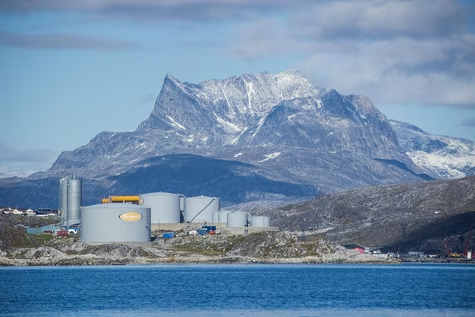
Greenland is estimated to sit on top of more than 30 billion barrels of oil. However, due to extreme temperatures and its harsh environment, 3 decades of exploration have failed to result in any commercially viable operations.
In 2021, Greenland officially banned any new oil and gas exploration. Just a few active licenses remain in Jameson Land, which will remain legal for roughly another decade. Prioritising sustainability, environmental protection, and its fishing industry, the government is staunchly opposed to expanding fossil fuel production. Infact, 70% of Greenland's electricity now comes from renewable sources, primarily hydropower.
Greenland is also rich in rare earth minerals. The island is home to 25 of the 30 raw materials listed by the EU as critical. They rank 8th in the world for reserves, with an estimated 1.5 million tons of untapped deposits. To date, no rare earth mining has taken place on the island.
These minerals are now vital to the production of modern technologies, including smartphones, electric vehicles, military hardware, and everything in between. The market is dominated by Chinese mining and production. China currently mines 60% of the world's rare earth minerals and manages a staggering 90% of their processing.
As the U.S. and Europe attempt to break this mineral stronghold, competition for new opportunities is fierce. Despite the known challenges of mining in Greenland, contractors are already on the ground scoping out a potential new frontier.
The ongoing trade war between China and the U.S., where tariffs reached highs of 145%, has exacerbated economic rivalry. It has not gone unnoticed that Trump's motives in Greenland may not be solely driven by security concerns.
Never before has there been a greater need to protect Greenland from outside interference. Militarisation and exploitation of the territory pose grave threats to this pristine landscape and the indigenous people who call it their home.
Hopes For Sovereignty
If Trump gets his way, then Greenland would become the largest ever land acquisition in U.S. history. Not only would it be devastating for the Greenlandic people, but it would also set a dangerous precedent for future power grabs by the U.S. and other political heavyweights.
This Greenland escalation is hot on the heels of the recent abduction of Venezuelan President Nicolás Maduro. Disguised under a thin veil of narcoterrorism, this oil grab from a South American country in crisis was a blatant disregard for international law. We cannot let Greenland become the next victim of Trump's authoritarian regime.
Foreign ministers from Greenland and Denmark will today (14.01.26) take part in a critical meeting with U.S. Vice President JD Vance.
"The future of Greenland must be decided by Greenlanders" - Jens-Frederik Nielsen
We must restore respect for the borders of not only Greenland but every nation. Sovereign rights must be upheld.
Greenland belongs to its people. We must not allow for the militarisation of the Arctic or the plunder of its rich natural resources.
Author: Rachael Mellor, 14.01.26, latest update 01.09.26, licensed under CC BY-SA 4.0
More Resources
Curated Directory & Deep-Dive Resources on Greenland
- Guardian - Greenland 503860
- Al Jazeera - Denmark 503861
- Greenland - Wikipedia 503788
- Greenland - Grokipedia 503791
- Proposed United States acquisition of Greenland - Wikipedia 503790
- American hybrid warfare against Greenland during the second Trump administration - Wikipedia 503789
- Already Causing Trouble in Greenland: The U.S Space Force - WBW 508862
- Video: Greenland Deal: Trump Drops Threat to Annex Denmark Territory in Favor of Greater U.S. Military Role - DN! 29.09.26 523628
- Trump’s Greenland Deal Puts His Annexation Plans on Ice - Jacobin 28.09.26 524412
- US-Denmark-Greenland Agreement: The Winner Takes It All - Forever - TFF 25.09.26 523526
- US-Denmark-Greenland agreement to be signed today: 13 more realistic hypotheses - TFF 22.09.26 523311
- Algal Blooms: A ‘Dark’ Threat to Greenland’s Cooling Capabilities - ENN 04.08.26 522170
- Trump at NATO Summit: Greenland ‘Should Be Controlled by the United States, Not by Denmark’ - CD 07.07.26 519689
- In Greenland: PFAS Results Raise More Questions Than Answers - WBW 05.07.26 519846
- Video: Is Greenland the Most Socialist Country in the World? - TAP 12.06.26 518653
- Murals, myths and belonging: how art is reshaping South Greenland - Conversation 28.05.26 517234
- ‘Go Home’: Greenlanders Protest New US Consulate as Trump Envoy Makes Clear Takeover Threat Remains - CD 22.05.26 517200
- German Chancellor Merz and Canadian Prime Minister Carney attend massive NATO exercise for war with Russia in Arctic - WSWS 16.03.26 510999
- Trump Pledges Hospital Boat for Greenland—Which, Unlike US, Has ‘Free and Equal Access to Health for All’ - CD 22.02.26 509417
- Greenland rejects Trump’s offer to send US hospital ship to Arctic island - Al Jazeera 22.02.26 509333
- In Copenhagen, Danes and Greenlanders told us why Trump’s threats matter - Open Democracy 20.02.26 509682
- A New Perspective and Blueprint: A Demilitarised Arctic for the Common Good — and Why It Is Rational - TFF 18.02.26 509880
- Trump news at a glance: Danish PM believes US president still wants to own Greenland - Guardian 15.02.26 508917
- In Munich, Lawmakers Concede Scars Remain After Trump’s Greenland Threat - NY Times 15.02.26 508915
- Top Republican lawmakers spar over Greenland - Politico 14.02.26 508916
- Greenland Is Not for Sale: An Indigenous Activist Speaks Out Against the US - Truthout 13.02.26 509138
- Trump’s Lust for Greenland’s Rare Earth Minerals Faces Harsh Arctic Realities - Mother Jones 11.02.26 509192
- EU-US tensions over Greenland and tech are far from over, says Emmanuel Macron - FT 10.02.26 508542
- What the Arctic in a time of crisis means for humanitarians - New Humanitarian 10.02.26 508543
- ‘Now we’re in a power struggle’: Europe’s resentment grows over Trump’s newest provocations - Politico 10.02.26 508540
- Does America Really Want to Pick a Fight With Greenland? - Atlantic 09.02.26 508539
- Video: France and Canada open consulates in Greenland after US threats - France24 08.02.26 508402
- Trump’s Greenland Threats Spill Into Another Danish Territory - NY Times 07.02.26 508541
- Canada, France to open consulates in Greenland amid ongoing US threats - Al Jazeera 06.02.26 508636
- Canada and France open Greenland consulates in show of Denmark support - Guardian 06.02.26 508405
- Canada and France open Greenland consulates after Trump demands - BBC 06.02.26 508403
- France and Canada open consulates in Nuuk in show of support for Greenland - France24 06.02.26 508406
- France and Canada open consulates in Greenland amid Trump threats - CNN 06.02.26 508404
- What Trump’s plans for the Arctic mean for the global climate crisis - Guardian 05.02.26 508648
- Greenland, nuclear weapons, and global security - Peace and Health Blog 05.02.26 510158
- Arctic Fever: new exhibit finds 19th-century parallels to Trump’s Greenland obsession - Guardian 05.02.26 508025
- Europeans don't admit Greenland concessions, JD Vance says - BBC 05.02.26 508023
- Greenland shatters temperature record, redrawing economy from fishing to minerals - Reuters 04.02.26 508529
- How Europe could lose the war over Greenland - Politico 04.02.26 508022
- NATO sets Arctic mission plans in motion - DW 04.02.26 508024
- A Century Ago, the U.S. Accepted Danish Control of Greenland. Here’s How. - NY Times 04.02.26 508021
- Trump’s Greenland threats open old wounds for Inuit across Arctic - Guardian 02.02.26 507419
- Greenland finds ‘hope’ despite US testing ‘red lines’ in talks - Hill 01.02.26 507297
- MAGA’s right-wing allies in Europe are repulsed by Trump’s push for Greenland - CNN 30.01.26 507373
- Experts Warn of ‘Disastrous’ Climate Impacts If Trump Seizes Control of Greenland - CD 29.01.26 508103
- Greenlanders Watching Turmoil in the United States Say No Thanks - NY Times 29.01.26 507127
- Cables show Trump’s moves on Greenland rattled other nations - Politico 29.01.26 507129
- 'No one owns the land': Greenland's Inuit see themselves as guardians, not owners - TRT World 29.01.26 507128
- Denmark FM 'more optimistic' after meeting with US over Greenland - TRT World 29.01.26 507126
- Copyrighted art, mobile phones, Greenland: welcome to our age of shameless theft - Guardian 28.01.26 506943
- Why is Greenland so rich in natural resources? - Guardian 28.01.26 506950
- Trump, Greenland, Europe and NATO's future - TFF 27.01.26 507729
- ‘Enemy of Europe’? How Trump’s push for Greenland spooked far-right allies - Guardian 27.01.26 507375
- Video: Trump forcing NATO to increase Arctic presence - DW 26.01.26 506629
- In Greenland, US-NATO deal met with relief, mistrust - DW 25.01.26 506546
- Trump’s Greenland brinkmanship leaves leading Republicans rattled - Guardian 25.01.26 506547
- Trump's Greenland ambitions strain MAGA ties with Europe's far-right - ABC 25.01.26 507374
- US and Denmark discuss Greenland 'military access' in more conventional talks - Le Monde 24.01.26 506549
- Trump’s Greenland threats placed US allies and military in an impossible position - LSE 23.01.26 506548
- Video: Infinitely Greenland | Billion Dollar Peace Board | Chairman For Life | Peace Buddies - The Late Show with Stephen Colbert 23.01.26 510277
- 6 things to know about Trump’s obsession with Greenland - Politico 23.01.26 506550
- What a US military base lost under Greenland’s ice sheet reveals about the island’s real strategic importance - Conversation 22.01.26 508297
- Relations with US have taken ‘big blow’, says EU foreign policy chief - Guardian 22.01.26 506329
- Filling Greenland with U.S. Bases Would Not Be a Win for Peace - WBW 22.01.26 508868
- Trump’s Greenland framework sounds a lot like an already existing 1951 deal - CNN 22.01.26 507379
- NATO’s Mark Rutte emerges as Trump whisperer-in-chief after dramatic about-face at Davos - CNN 22.01.26 507378
- Get out of Greenland mode and stand up for yourself, Zelenskyy tells Europe - Guardian 22.01.26 506334
- Trump’s posturing over Greenland has changed the transatlantic alliance forever, European officials say - CNN 22.01.26 506287
- Starmer says ‘British pragmatism’ helped resolve Greenland crisis as he welcomes Trump U-turn – UK politics live - Guardian 22.01.26 506196
- How Trump backed down over Greenland - New Statesman 21.01.26 508599
- Trump walks back Greenland tariffs threat, citing vague ‘deal’ over territory - Guardian 21.01.26 506300
- Greenland: Trump signals deal, rolls back tariff threats - DW 22.01.26 506190
- What Starmer should do if Trump annexes Greenland - Prospect 21.01.26 506695
- Starmer toughens rhetoric on Trump and decries pressure over Greenland - Guardian 21.01.26 506234
- Greenland: Trump clashes with allies - BBC 21.01.26 506290
- Greenland’s strategic position in seven maps: Why Trump wants the island - Al Jazeera 21.01.26 506295
- While threatening Greenland, Trump also threatens Iceland - Intercept 21.01.26 508565
- Video: Can Congress Stop Trump From Taking Greenland? Sen. Bernie Sanders Says Yes - The Late Show with Stephen Colbert 21.01.26 510276
- Trump just backed off on using military force to take Greenland. What does it mean? - CNN 21.01.26 506296
- Trump drops tariff threat, says he won’t take Greenland by force - Al Jazeera 21.01.26 506298
- By suddenly declaring a deal on Greenland, Trump demolished his case for owning it - CBC 21.01.26 506307
- Trump is crossing red lines. Why doesn’t Europe push him back? - CNN 21.01.26 506289
- Russia watches US-European tensions over Greenland with glee, gloating and wariness - ABC 21.01.26 506291
- Greenlanders looking for Canadian support amid U.S. threats, Governor General says - CBC 21.01.26 506294
- Inside Trump's Head-Spinning Greenland U-Turn - WSJ 21.01.26 506187
- Trump rules out force on Greenland — but keeps Europe guessing - Politico 21.01.26 506189
- By taking a win on Greenland, Trump set US and allied security in the Arctic on a better path - Atlantic Council 21.01.26 506188
- Video: Donald Trump backtracks on using force over Greenland and drops new tariffs on allies - BBC 21.01.26 506297
- Video: Trump backpedals on threats against Greenland, but allies say damage has been done - PBS 21.01.26 506299
- Video: Trump Has ‘No Strategy’ On Greenland | Anne Applebaum - Times News 20.01.26 510274
- Europe's far-right parties, often praised by Trump administration, push back on Greenland - CBC 20.01.26 507377
- Europe has five options for responding to Trump’s Greenland threats. None of them look good - The Conversation 20.01.26 506304
- Operation Arctic Endurance: Donald Trump Wants to Invade Greenland. Will it Lead to the Disintegration of NATO? - Michael Chossudovsky 20.01.26 507727
- Why Trump’s split with Europe over Greenland is a double-edged sword for Russia - CNN 20.01.26 506285
- 5 key points on Trump’s Greenland push - CNN 20.01.26 506301