
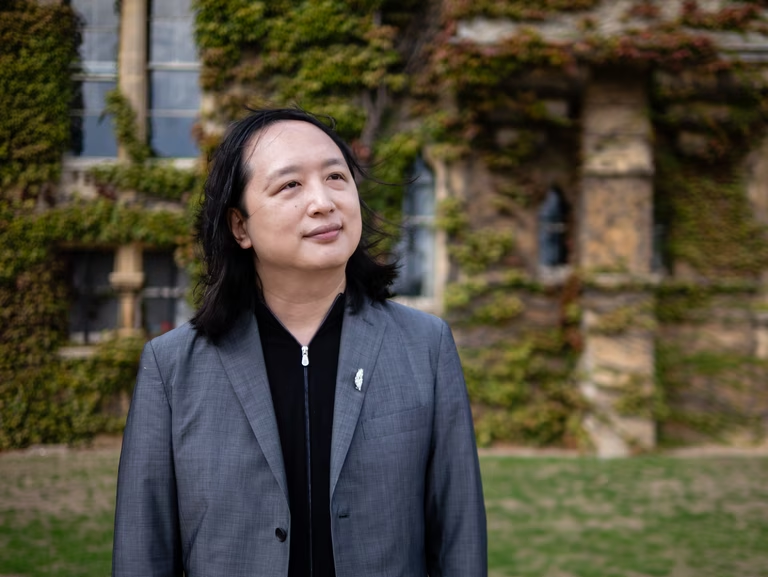
Audrey Tang - Taiwan
Explore Audrey Tang’s pioneering work in civic tech, open governance, and digital democracy in Taiwan. Discover key resources and Right Livelihood insights.
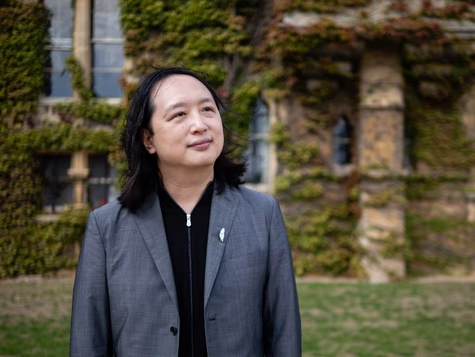
AUDREY TANG, Taiwan - Right Livelihood Award 2025
Discover emerging digital tools for civic technology and learn how they can strength our democracies. Our guide to the work of Audrey Tang offers you in-depth information on digital rights, internet freedom, and open governance.
Connect with valuable resources, initiatives, and organisations – for increased transparency, improved citizen participation, and hopes of a more inclusive future.
Jump straight to our resources on ➡️ Audrey Tang
*****
General Information
Audrey Tang is a Taiwanese civic hacker and software programmer who has earned a reputation as one of the biggest names in computing. She has used her skills and influence to bring civic tech into the mainstream and promote internet freedom and civic participation in Taiwan and beyond.
She became Taiwan's first digital minister in 2016. Then, she went on to take the position of Cyber Ambassador in 2024, a high-level diplomat role specialising in digital policy, cybersecurity, and technology governance.
Tang is the world's first openly non-binary cabinet minister.
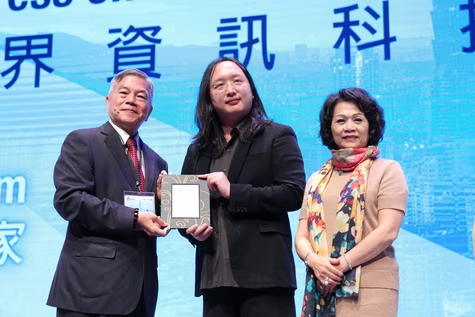
In 2025, she was awarded the Right Livelihood Award "for advancing the social use of digital technology to empower citizens, renew democracy and heal divides." - RLA
Two years earlier, she was named in Time Magazine's "100 Most Influential People in AI" list for her profound impact in leveraging technology for the public good.
Explore our comprehensive guides to Big Tech as a threat to democracy, the political situation in Taiwan and their dispute with China, as well as our guides to democracy and social media.
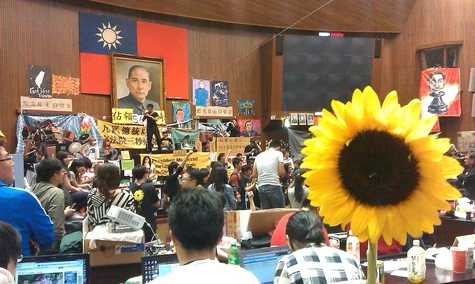
Digital Tools As A Force For Good – The Impact of Audrey Tang
Since the 2014 Sunflower Movement, Tang has become instrumental in shaping the government's approach to technology. At the time, she was working as a consultant and digital adviser to Apple to develop their chatbot, Siri.
Alongside other activists, Tang protested against a trade deal between Taiwan and China, which was conducted in a shroud of secrecy. The Cross-Strait Service Trade Agreement (CSSTA) was thought to increase economic reliance on China and further threaten Taiwan's sovereignty.
For 24 days, they occupied the parliament of Taiwan. Tang's contribution amplified their impact by using digital tools to stream, translate, and broadcast activist demands. She turned the protest into a digital, transparent event and helped bridge the gap between protesters and the government.
Tang was a key contributor to the online platform vTaiwan. Software that brings together the voices of citizens, experts, and government officials to facilitate consensus-building on complex policy issues. The platform was used to help settle debates on the rideshare app Uber, which has become synonymous with labour issues and the gig economy.
The platform was used to promote online discussion and allowed citizens to participate in the decision-making process. The opinions collected were ultimately used to shape new regulations.
In her role as digital minister, Tang advised governmental departments on technological matters. She worked hard to promote absolute transparency and to implement technological changes that made all government data and resources accessible to the public.
During the COVID-19 pandemic, her assistance with the development of 'Mask Maps' gave her international recognition. The software used open data to log pharmacy stock levels in real time and made them available to the public.
Tang successfully championed the basic human right of high-speed internet for Taiwanese citizens. She has also worked to combat disinformation using memes to prevent misinformation during crises.
Digital Technology & Democracy
Digital technology is transforming our democratic processes and reshaping how we engage with political processes. Digital tools are being used in campaigning, how we communicate with politicians, how we share our opinions, how we obtain information, how we vote, and how elections are run in general.
These new tools for eDemocracy have opened up new avenues for participation, transparency, and accountability. Social media and government forums facilitate public discourse, make it easier for our voices to be heard, and allow voters to hold leaders accountable.
Tang has proven that technology can help deepen trust and give millions a chance to help shape policies. With the mission to fight polarisation and uphold democratic values, her ideas in digital democracy and civic participation are being rolled out across the world to promote open, inclusive, and transparent governance.
Her 'Taiwan Model' of democracy has already been adopted across various levels of government, civic organisations, and international initiatives, as well as in governments abroad.
Japan, for example, utilised the Mask Map software and has adapted the vTaiwan model and AI-based Polis tool for use in the Digital Democracy 2030 initiative. In the U.S., Tang has advised on initiatives such as Engaged California and the Project Liberty Institute.
At the 2025 Paris AI Summit, Tang co-launched Robust Open Online Safety Tools (ROOST). It is a non-profit initiative to create free, open-source, AI-powered tools for online safety and a decentralised response to online threats in the EU and beyond.
*****
Working alongside governments, civic groups, and the tech industry, Tang has become a pioneer of the open-source movement, made access to broadband a human right, and used civic hacking to mobilise campaigns against disinformation and deepfakes. We commend her for her work strengthening democracy and look forward to following her journey.
"I am a 'conservative anarchist' -conservative in preserving shared spaces and anarchist in rejecting top-down coercion" - Audrey Tang
Better World Info and Audrey Tang share much common ground in their commitment to leveraging technology and information for positive social change. We both advocate for open access to information and transparency to empower and engage a more active citizenry.
Author: Rachael Mellor, 21.10.25, latest update 20.08.26, licensed under CC BY-SA 4.0
More Resources
Curated Directory & Deep-Dive Resources on Audrey Tang - Taiwan
- Audrey Tang - RLA 2025 491136
- Video: 2025 Right Livelihood Laureate Audrey Tang 491137
- Video: An Inside Look: Can Audrey Tang’s Vision for Technology Save Democracy? (must watch) - RLA 499614
- Britannica 491125
- Wikipedia - Audrey Tang 491124
- Ministry of Digital Affairs - MODA 491145
- Ministry of Digital Affairs (Taiwan) - Wikipedia 491138
- Open Government - Wikipedia 491144
- E-Democracy - Wikipedia 491146
- SocialCalc - The Architecture of Open Source Applications (Volume 1) 491139
- Audrey Tang - projectspeaker 491140
- Audrey Tang - SayIt 491141
- meta cpan - AudreyT 491142
- Medium - Audrey Tang 491143
- tw 491199
- fb 491200
- YouTube 491201
- Addictive intelligence, assistive intelligence…Audrey intelligence? How social enterprise can shape the development of AI with Audrey Tang and James Gauci - Pioneers Post 25… 510384
- Video: Cyber Ambassador Audrey Tang - Towards Plurality - Closing Keynote at Mila AI Policy Conference 2026 - Mila - Institut québécois d'IA 10.02.26 510402
- Civic hacker Audrey Tang on digital tools for increasing citizen engagement - RNZ 09.02.26 510395
- Want to solve deepfakes? Ask citizens what to do - FT 02/26 510388
- Video: AI and Democracy with Ambassador Audrey Tang; Plurality in Practice, Transparency - Institute for Ethics in AI Oxford 12.01.26 510401
- Video: Audrey Tang - How digital democracy can heal polarisation and revitalise trust - RLA 10.12.25 505792
- Digital democracy in a polarised era - Stockholm University 05.12.25 510397
- AI can help shore up democracy: Tang - Taipei times 04.12.25 510391
- Audrey Tang: “Europe’s political structure focuses on security rather than speed” - Table Briefings 09.11.25 510392
- ‘We are already the super intelligence we are looking for’: Audrey Tang and others’ big ideas for a better future at SEWF25 - Pioneers Post 06.11.25 510387
- Audrey Tang, hacker and Taiwanese digital minister: ‘AI is a parasite that fosters polarization’ - El Pais 02.11.25 510385
- How Taiwan Is Trying to Defend Its Democracy From Mis - Diplomat 10.09.25 492453
- »It's been a race to the bottom of the brain stem« - Netcompany 15.08.25 492451
- Podcast: AI and Democracy: Ambassador Audrey Tang on Plurality in Practice, Transparency and Collective Intelligence - University of Oxford 05.08.25 492452
- Video: Audrey Tang on Rebuilding Trust in the Digital Age - Zoom In Zoom Out 31.07.25 491193
- Video: Audrey Tang - Plurality and Digital Democracy - Edge City 18.06.25 491196
- Taiwan is standing up to disinformation - D&C 12.06.25 510389
- Tech, the politics of Taiwan, and the future of democracy: meet Taiwan’s cyber ambassador, Audrey Tang - Varsity 25.05.25 510386
- Audrey Tang wants to save democracy with 'pro-social' media - Fast Company 17.06.25 510399
- Video: Audrey Tang: On Becoming a "Good Enough Ancestor" - RadicalxChange 16.05.25 491197
- Video: Audrey Tang: The Power of Collective Intelligence - WKF 11.04.25 491194
- Video: Audrey Tang: Taiwan's First Digital Minister on Innovation and Democracy - Harvard 09.04.25 491188
- Is humour the key to better AI governance? Audrey Tang thinks so - Gov Insider 08.04.25 510398
- Social media for psychologists: Building your brand without compromising integrity - PBS 01.04.25 510400
- Video: A dialogue with Audrey Tang - Cambridge 31.03.25 491195
- Video: How Pro-Social Technology Is Saving Democracy from ‘Big Tech’ with Audrey Tang - YouTube 26.03.25 491191
- Video: Reboot Democracy: A conversation with Audrey Tang, Digital Minister for Taiwan - GovLab 31.01.25 491189
- Video: Is China Still A Threat To Taiwan? | Audrey Tang - YouTube 09.09.24 491192
- Video: Conversation With Audrey Tang - Wilson Center 03.09.24 491190
- The good hacker: can Taiwanese activist turned politician Audrey Tang detoxify the internet? - Guardian 17.08.24 510396
- Video: Adventures In Democracy With Audrey Tang - Condiut 16.07.24 491198
- Taiwan’s Digital Minister Has an Ambitious Plan to Align Tech With Democracy - Time 20.05.24 510394
- Video: Audrey Tang: Taiwan's transgender digital minister - AFP News Agency 6/20 492455
- Video: Digital Social Innovation to Empower Democracy - TEDx Talks 5/19 492454
- An Inside Look: Can Audrey Tang’s Vision for Technology Save Democracy? - RLA 510390
- The SPD’s shadow foreign policy + Interview with Audrey Tang + Asia.Table opinion on Takaichi Sanae - Table Briefings 510393