
Delhi Air Pollution Crisis
Delhi’s air pollution crisis explained. Discover PM2.5 and PM10 impacts, pollution sources, health effects, policy gaps, and global comparisons.
Guide on ➡️ Delhi Air Pollution
Delhi's air pollution problem has transformed from an episodic to an annual concern with the government’s inability to address the worsening air condition, the situation has turned into a seasonal inevitability rather than a preventable public health emergency. According to international health estimates, prolonged exposure to fine particulate matter is now among the leading risk factors for premature mortality in urban India, disproportionately affecting children, the elderly, and low-income populations. Shockingly enough, air pollution has contributed to 16 million deaths in India in the past decade.
Although experimental approaches centered around traffic regulation, dust management, as well as joint energy efforts through inter-state collaboration have proven constructively viable, the on-ground implementation of such initiatives remains inconsistent and politically constrained. As particulate pollution continues to impose an invisible yet severe health burden on millions, the gap between available solutions and institutional action has become the defining fault line of Delhi’s air quality crisis.
This article examines how recurring pollution episodes in Delhi and the National Capital Region reflect deeper institutional gaps, regional coordination failures, and compares global trends in mitigating air pollution.
Key Takeaways
- Chronic Crisis, Not Seasonal: Delhi’s air pollution is a persistent, structural environmental emergency driven by urban, regional, and geographic factors rather than a winter-specific phenomenon.
- Severe PM2.5 Exposure: PM 2.5 (Particulate Matter 2.5) refers to tiny airborne particles measuring 2.5 thousandths of a millimetre that can penetrate deep into the lungs. Average annual PM2.5 levels in Delhi are more than twice the national permissible limit (40 µg/m³) and up to 16 times higher than the WHO guideline (5 µg/m³), with winter spikes often exceeding 250 µg/m³.
- Major Health Impact: Long-term exposure to toxic air in Delhi is estimated to cause over 11,000 deaths annually, primarily due to respiratory and cardiovascular diseases.
- Key Pollution Sources:
- Vehicular emissions contribute 17.8% to PM2.5 levels.
- Domestic use of solid fuels (cow dung, wood, coal) accounts for 13%, especially in winter.
- Brick kilns and small industries contribute 11% of local pollution.
- Construction activities and road dust are major sources of PM10.
- Stubble burning contributes 25–30% of PM2.5 during peak months (Oct–Nov).
*****
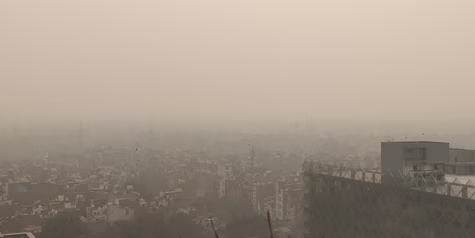
Delhi’s Air Pollution Crisis
Delhi’s air pollution crisis is not a seasonal aberration but a persistent, multifaceted environmental emergency rooted in urban emissions, regional agricultural practices, and geographical constraints. The levels of PM2.5 and PM10 (Particulate Matter 10 are tiny dust particles measuring 10 thousandths of a millimetre that irritate the respiratory system) in the city have regularly crossed the safe limits set internationally. The average annual level of PM2.5 in the city is more than double the nationally permissible limit of 40 μg/m³. It has already crossed sixteen times the permissible limit set by the World Health Organisation of 5 μg/m³. In winter months, Delhi’s particulate matter can spike well beyond 250 μg/m³ on certain days, illustrating severe public health risks that are now routine rather than occasional.
When placed in a global context, it is safe to say that the air quality in Delhi is among the worst in the world. Data obtained from satellite measurements indicate that there is no doubt that Delhi is among the topmost polluted metropolises in the world, with average air quality indices substantially higher than those of cities like Beijing, despite aggressive pollution-fighting measures implemented in China over the past decade. Although the level of PM2.5 in Beijing has been substantially lowered, that in Delhi remains uneven.
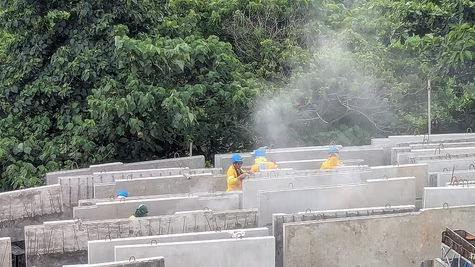
What is PM 2.5 ?
These are very tiny particles floating in the air which have a diameter of 2.5 micrometers, hence the name. PM2.5 is 40-30 times smaller than a human hair and is considered the most harmful air pollutant due to its microscopic size, which allows it to penetrate deep into the lungs and enter the bloodstream. Short-term exposure to PM2.5 can cause coughing, shortness of breath, severe asthma attacks, and a worsening of Chronic Obstructive Pulmonary Disease (COPD). Long-term exposure is associated with serious health outcomes, including lung cancer, heart failure, coronary artery disease, stroke, and dementia. In places like Delhi alone, considered one of the most polluted cities in the world, PM2.5 exposure is estimated to cause approximately 12,000 deaths every year.
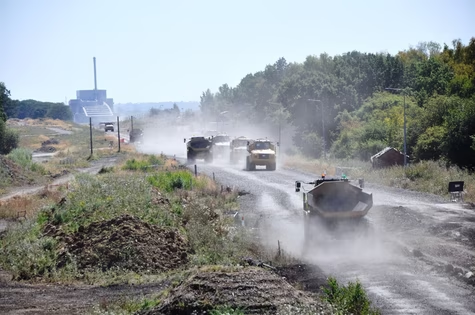
Primary Factors Responsible for Delhi’s Air Pollution
The problem of air pollution in the Delhi region is a result of a set of well-known factors that seem to re-emerge every year. Among the factors are the fine dust from construction and transportation activities, listed as major factors by the then-environment minister of the Delhi government as responsible for the poor quality of the city’s air pollution problems on two separate occasions. Just the emissions from transport activities have a known impact of approximately 17.8% on the PM2.5 emissions of Delhi’s air pollution levels. Compounding this chronic urban load is the perennial problem of stubble burning in neighbouring states, which continues to intensify seasonal smog. When viewed together, these recurring sources reflect a predictable pattern of environmental stress rooted in policy inertia, regional interdependence, and the normalisation of pollution as an annual inevitability rather than a preventable crisis. Domestic use of solid fuel like cow dung, wood, and coal contributes 13% to PM2.5 concentration in the region, spiking in winter due to cold weather demand. Additionally, brick kilns and small industries’ emissions account for about 11% of the net local pollution in Delhi. This takes place with a dispersed presence in the adjacent states of Haryana and Uttar Pradesh.
Delhi's Odd-Even Policy
The odd-even scheme is the Delhi government’s traffic rationing measure under which vehicles bearing number plates (registration numbers) ending in an odd number will be allowed on the road only on odd dates and those with even digits on even dates.
The odd-even scheme used by the Chief Minister of Delhi, Arvind Kejriwal, in Delhi in 2016 was not the first time a similar scheme was implemented. The United States implemented the odd-even scheme in 1979 due to the rise of oil prices across the world due to the conflict in Iraq and Iran. The odd-even scheme was again implemented in 2012, after Hurricane Sandy impacted the United States, resulting in a shortage of gasoline and the hoarding of fuel. Lacking an even number or letter on their license plates was considered an odd-numbered plate.
Countries That Have Implemented the Odd–Even Scheme to Curb Air Pollution
Various countries around the world have experimented with the odd–even rationing method as a way to quickly reduce air pollution, especially when there has been a severe deterioration in air quality.
China
Prior to the 2008 Summer Olympics in Beijing, the government in Beijing instituted the odd/even rationing method for vehicles in order to reduce emissions from motor vehicles during that period. In August 2015, the government of China put the odd/even restriction policy back into place in a stricter form, along with other measures for controlling pollution in the city of Beijing, such as limiting production from factories and not allowing people to drive their private vehicles. During this period, approximately 5 million vehicles in Beijing were allowed to drive only on alternate days for a period of two weeks.
France
In Paris, France, the odd/even rule has been used several times by the city government to limit the number of vehicles that can operate during periods when it suffers from extreme pollution. When the odd/even rule is in effect in Paris, the city often has its public transportation free in order to promote patrons using public transit instead of driving to work.
Mexico
Mexico introduced vehicle restriction measures as early as 1989, issuing a circular that mandated citywide bans on private vehicles one day per week, based on odd–even number plates. The policy, popularly known as Hoy No Circula, was aimed at tackling chronic air pollution in Mexico City.
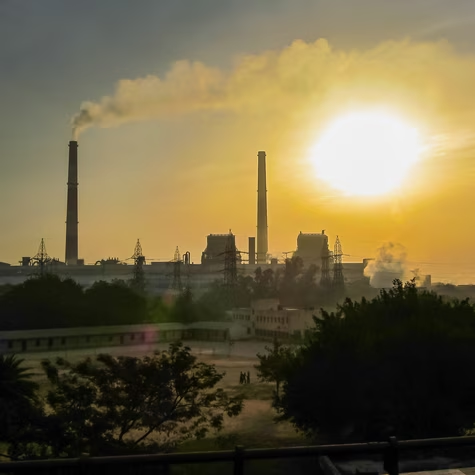
Policy Gap and Institutional Inertia
One significant policy gap has been the non-implementation of the odd-even vehicle rationing scheme under the ruling BJP regime. Previous implementations of the odd-even system had led to an estimated 20% reduction in PM2.5 levels over a 15-day period, demonstrating its short-term effectiveness.
Stubble burning has recently peaked in contributing to air pollution in Delhi and accounted for approximately 25% to 30% of PM2.5 levels in October and November 2025. On November 5 alone, there were 94 reported instances of stubble burning (India.com). Despite this chronic problem, there is currently no effective inter-state mechanism for collaboration; therefore, responses have been limited primarily to political scapegoating rather than coordinated action.
In the already worsening situation, the Municipal Corporation of Delhi has failed in presenting appropriate pollution curbing plans. The unpreparedness of the civic body during the standing committee meetings has become a recurrent institutional pattern, with the deluge of information from the officials regarding allocations made for the cause of pollution control remaining unclear. Additionally, this regular lack of clarity is, furthermore, accentuated by the non-response of the Department of Environmental Management and Services about the technical deficiencies, which has marked a tendency towards an administrative unwillingness within the civic body. Such regular tendencies are, therefore, indicative of a governance deficit, wherein the accountability is deferred, the environment-related problems are normalised into administrative ambiguities, and the administrative inertness is also allowed to develop as a regularity as opposed to an exception.
Conclusion
Some proposed policy initiatives consist of re-establishing permanent, year-round odd/even rationing of motor vehicle travel, along with providing free public transportation to reduce PM2.5 concentration levels (20% possible reduction) based on historical trends. In addition, the need to relocate, retrofit, and/or move away from polluting industrial emission sources is significant to reducing the 11% of pollution created by the use of brick kilns and factories located within the National Capital Region. It also needs to sustainably reduce its dependence on coal and focus on the automation of emergency protocols as pollution levels cross the pre-programmed thresholds. Lastly, a significant focus towards the strict enforcement of municipal dust control standards through routine auditing processes, the permanent implementation of GRAP stages I & II (Graded Response Action Plan), developing state-level inter-state agreements on providing alternatives for stubble burning and working together to develop shared clean energy grids for all states, are imperative.
Recommended Readings :
- PM2.5 causes 12,000 deaths every year in Delhi: Why is it so deadly? (India Today)
- MCD fails to present plan to curb pollution (The New Indian Express)
- Understanding Delhi-NCR’s GRAP Stages: Rules, Regulations, and Restrictions (Grapstatus)
- Punjab reports 94 stubble burning cases on Gurpurab count now 2933 (The Times of India)
- Stubble Burning in Northern India: Factors, Technological Solutions and Management Strategies-A Comprehensive Review (ARCC Journals)
- What New Delhi can learn from China’s war on air pollution (Al Jazeera)
- Cloud Seeding Was Successful In These Countries, And Failed In This Nation (NDTV)
Author: Tanuj Samaddar, 05.01.26, licensed under CC BY-SA 4.0.
More Resources
Curated Directory & Deep-Dive Resources on Delhi Air Pollution Crisis
- What New Delhi can learn from China’s war on air pollution - Al Jazeera 12.12.25 501474
- Air pollution has contributed to 16 million deaths in India in the past decade – new study - Conversation 12.12.24 445535
- Choking season in India - New Int 12.12.24 447106
- Delhi’s annual air pollution has become a human-made calamity - Conversation 04.12.24 444167
- ‘Death in the Air’: Life in Delhi, the world’s most polluted city - Al Jazeera 29.11.24 443880
- Delhi air pollution: Why has India failed to clean up its toxic smog? - Al Jazeera 20.11.24 441669
- New Delhi lifts construction ban as air quality ‘slowly improves’ - Al Jazeera 22.11.21 261872
- Delhi residents engulfed in pollution blame authorities for inaction - Guardian 04.11.19 201708
- As New Delhi’s pollution crisis persists, so does widespread public denial and complacency - PRI 07.02.18 170420
- New Delhi's pollution problem is so bad that some diplomats are packing their bags - WaPo 16.11.17 170421
- Delhi pollution: Choppers can’t battle smog – because of smog - Indian Express 16.11.17 170422
- Delhi smog: Emergency anti-pollution measures lifted - BBC 16.11.17 170423
- Depression to inundate eastern India; No reprieve for smog-stricken Delhi - Accuweather 16.11.17 170424
- As bad air chokes city, Delhi govt sits on Rs 787-crore 'green' fund - Times of India 16.11.17 170425
- Delhi's smog and climate change are separate environmental crises - Business Standard 16.11.16 170426
- Delhi's Toxic Sky - The Atlantic 15.11.17 170427
- Delhi-NCR smog: State pollution boards asked to intensify action against violators - Times of India 15.11.17 170428
- Delhi pollution Live Updates: Arvind Kejriwal meets Haryana CM, says will take possible steps to tackle situation - The Indian Express 15.11.16 170429
- Delhi's anti-smog helicopters grounded because the smog is too thick - Telegraph 15.11.17 170430
- India's Capital New Delhi Hopes for Rain to Wash Away Suffocating Smog - Time 13.11.17 170431
- How to solve Delhi's pollution problem - The Hindu 13.11.17 170432
- Choking on air in New Delhi - NYT 12.11.17 170433
- Toxic smog chokes Indian capital of New Delhi - Chicago Tribune 11.11.17 170434
- Love in a time of masks: A Photographer's Take On Delhi's Toxic Air - NDTV 10.11.17 170435
- The deadly smog over New Delhi is a perfect example of everything that’s wrong with India - Quartz 10.11.17 170436
- Delhi's smog turns dangerous - VICE 08.11.17 170437
- 'Pollyutens' Delhi', 'Chandni Choke': How social media reacted to Delhi's smog - Times of India 08.11.17 170438
- 'I feel helpless': Delhi residents on the smog crisis - Guardian 08.11.17 170439
- Chandni choke, Rajiv choke, Patel choke: Smog-filled New Delhi just can’t breathe - Quartz 08.11.16 170440
- Delhi, Blanketed in Toxic Haze, Has Become A Gas Chamber - NYT 07.11.16 170441