
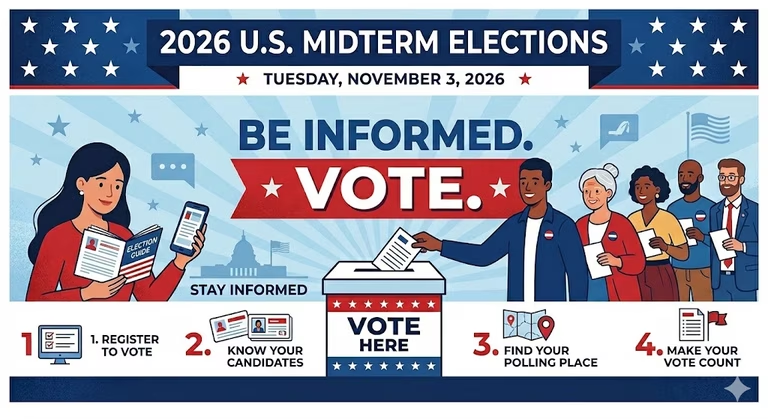
U.S. Midterm Elections 2026
Explore an independent guide to the 2026 U.S. Midterms. Get key House & Senate race updates, candidate profiles, latest polls, and the impact on Congress.
U.S. MIDTERM ELECTIONS 2026 - Who Will Win Control of Congress & Implications for Trump
Discover the high-stakes landscape of the 2026 U.S. midterm elections and learn how you can impact the next two years of Trump's administration. Our voting guide offers you in-depth information on key House and Senate races, voter suppression attempts, and the major political implications for Donald Trump's presidential agenda.
Connect with hundreds of valuable resources, initiatives, and organisations – for genuine election integrity, defended democratic rights, and a balanced political future.
Jump straight to our resources on the ➡️ U.S. Midterm Elections
*****
General Information
Midterm elections happen every four years in November. They take place in the middle of the president's four-year term of office. Voters elect members of the House of Representatives and the Senate, which together are called Congress.
All 435 House seats and 35 Senate seats will be contested. This year, there will be two special Senate elections to fill vacancies. Election day is November 3, 2026.
Currently, Trump's Republican Party controls both the House and the Senate. When the ruling party controls Congress, it can easily advance its own legislative agenda, approve cabinet members, judges, and high-level officials, and determine federal spending.
This guide provides an unbiased overview of key races, candidate profiles, and the most important issues to voters. Knowing where candidates stand on healthcare, climate policy, and economic reform helps voters to make informed decisions.
The outcomes of all the elections will influence the balance of power between the Republican and Democratic parties. Opposition to Trump's policies is surging and will no doubt play an important role in the outcome.
The recent 'No Kings' rallies have grown exponentially, and the March 2026 demonstration drew in 8-9 million participants at more than 3,000 sites. This was the largest single-day protest in U.S. history.
Protesters are rallying against Trump's authoritarianism, his brutal crackdown on immigration, the Iran war, the suppression of the Epstein Files, and the rising cost of living.
The Primary Elections, which select party candidates, will be held from March 3 to September 15, 2026. Those chosen in the November 3rd voting will then take their place in the 120th Congress on January 3, 2027.
Explore our guides on election news and polls, midterm elections in general, Trump opposition, key political issues at home and abroad, and getting the vote out!
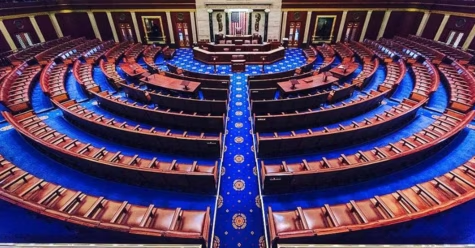
Key House Races
The U.S. House of Representatives is the lower House of the United States Congress. It was designed to represent the people directly. Each state receives at least one representative, with larger states having more.
The presiding officer is the speaker of the House, who is elected by the members.
All 435 voting seats are up for election. The Republicans currently hold a narrow majority of 218 seats compared to the Democrats' 214. Polling currently shows a Democratic lead of roughly 5.1%, suggesting a high potential for the House to flip control.
The Democrats only need to flip three seats to take control of the House, and competitive seats are spread across the country. California, New York, and Arizona all offer multiple opportunities to flip seats.
Highly competitive battlegrounds include Texas, California, Missouri, and Utah.
Redistricting is reshaping the electoral map in several states. Redrawing of congressional or state legislative district boundaries typically happens every decade following the U.S. Census. A recent trend of "mid-decade" redistricting has emerged to gain an advantage ahead of upcoming elections.
Driven by a desire to flip seats or solidify a party's majority, several states have actively redrawn their maps, others are in the process of doing so, and some have been rejected or blocked.
Key Senate Races
The United States Senate is the upper chamber of the U.S. Congress. They have exclusive power to confirm U.S. presidential appointments, to approve or reject treaties, and to convict or exonerate impeachment cases.
Together, the House and the Senate help to regulate and balance the executive and judicial powers of government.
A total of 35 seats are contested. Currently, the Republican Party holds a 53–47 majority. Republicans are defending 22 seats, and Democrats are defending 13.
Experts have labelled the Democrats' prospects of taking control an "uphill battle". Many Democratic seats are in competitive battleground states, and so while Democrats have a high likelihood of retaking the House, the path to a Senate majority remains 50/50.
This election cycle, there will be record numbers of retirements, with 7 Republicans and 4 Democrats announcing they will not seek re-election. This means that these seats are also up for grabs in the Primaries.
Gubernatorial Elections
There will be 39 gubernatorial elections in 2026, with 18 incumbent Governors running for re-election and 21 incumbent Governors who are either term-limited or not seeking re-election.
Currently, there is a near-even split, with 26 Republican and 24 Democratic governors nationwide. Several of the elections will take place in battleground states where control could shift either way.
Top competitive races will take place in Arizona, Michigan, Wisconsin, and Georgia.
State Legislatures are also holding regularly scheduled elections. With thin margins in multiple chambers, even small changes could help the Democrats to gain power at the state level. There are 88 state legislative chambers in 46 states up for grabs.
State legislatures can be crucial, and as such, the Democrats are increasing their focus on local politics ahead of the midterms. State legislatures create laws, approve state budgets, and also provide checks on executive power. As they operate on a more local level, they have direct influence over daily life in areas such as education, healthcare, transportation, and criminal law.
Polls & Trends
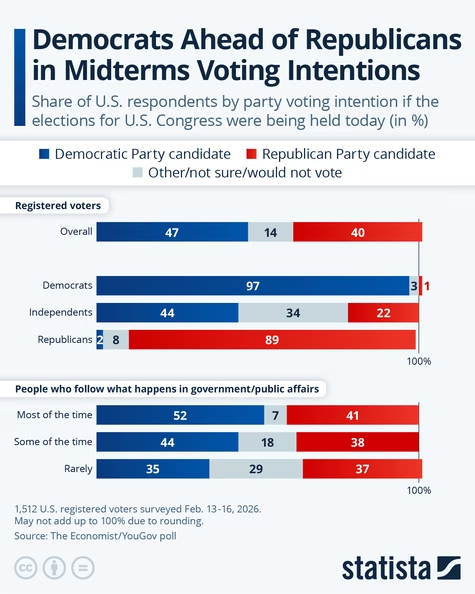
As of April 2026, polling shows a highly competitive environment in all races. Several aggregators indicate a slight Democratic lead in national preference, ranging from +4.6% to +6.0%.
Current trends show that the Democrats hold a consistent lead in the House. However, with the Republicans maintaining structural advantages in the Senate, they are forecast to have a 64.8% chance of retaining control of the upper chamber.
Historically, the party holding the Presidency loses an average of 28 House seats and 4 Senate seats in the midterms. If this trend holds, it favours the Democrats as they seek to flip the narrow GOP House majority.
Polls have also revealed that voters' top concerns are inflation, gas prices, foreign policy, and aggressive ICE operations.
*****
With Better World Info, it is easy to stay informed and engaged. The 2026 midterms are not just about choosing representatives; they're about shaping the future course of the nation.
The first two years of Trump's second presidential term have been chaotic, dangerous, and nationalistic. Marked by trade wars, slashes to federal spending by the DOGE, the controversial role of multi-billionaire Elon Musk, the end of USAID, reduced support for NATO, the reversal of climate policies, the kidnapping of Venezuelan president Maduro, and the war in Iran.
Trump has repeatedly bypassed Congress and asserted executive power to meet his own ends. By doing so, he has abandoned democracy and disrupted international order.
Without Republican backing in the House and Senate, Trump's ability to act with impunity will face additional barriers. A divided government would result in a more effective check on executive actions and higher scrutiny.
This year's midterms are especially important as they will determine the legislative trajectory of Trump's final two years in office. As Trump cannot run again in 2028, it will also play an important role in shaping the future of both parties.
Author: Rachael Mellor, 10.04.26, latest update 21.07.26, licensed under CC BY-SA 4.0
More Resources