
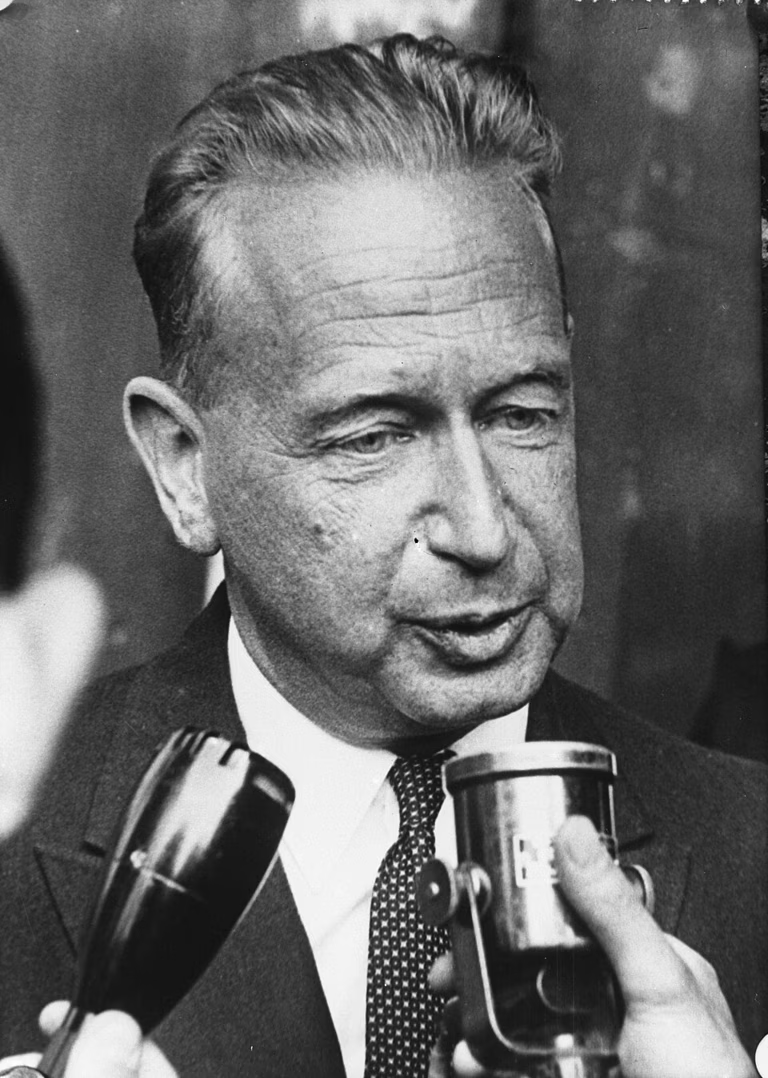
Dag Hammarskjold (Sweden)
Explore the legacy of the youngest UN Secretary-General and his transformative role in peacekeeping, diplomacy, and moral leadership.
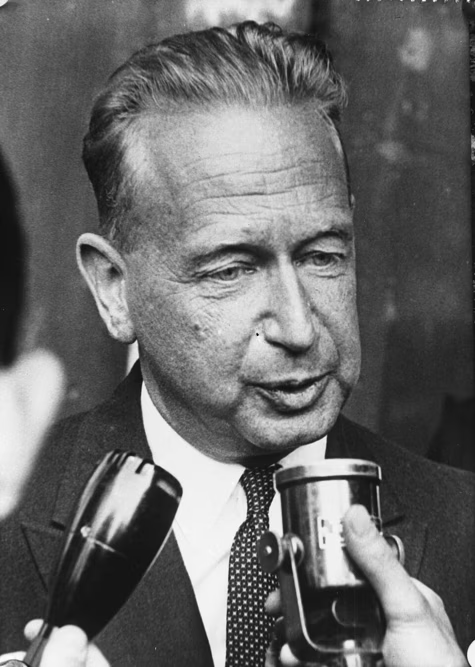
➡️ DAG HAMMARSKJÖLD (1905-1961) - The Youngest Ever Secretary-General of the United Nations
Dag Hammarskjöld was a Swedish economist and diplomat who is celebrated for his great courage and integrity throughout his career. He served as the second Secretary-General of the UN from April 1953 until September 1961, when he met his untimely death in a plane crash in Zambia en route to broker peace in the Democratic Republic of Congo.
He helped establish the first-ever armed UN peacekeeping force, transformed the UN Secretariat, successfully diffused tension in crisis situations through quiet diplomacy, supported the decolonisation of Africa and Asia, and set the precedent for moral and ethical leadership.
Hammarskjöld remains the only person to receive the Nobel Peace Prize posthumously. The award was announced one month after his death, "for developing the UN into an effective and constructive international organisation capable of giving life to the principles and aims expressed in the UN Charter".
"Never look down to test the ground before taking your next step; only he who keeps his eye fixed on the far horizon will find the right road." - Dag Hammarskjöld
*****
Jump straight to our resources on ➡️ Dag Hammarskjöld
Explore our comprehensive guides on -
-
The United Nations
-
Erskine Childers - Irish UN Civil Servant Influenced by the Ideals of Hammarskjöld
-
The Impact of Colonialism
With a background in literature, social philosophy, and political economy, Hammarskjöld worked in various related fields until he was appointed to the foreign office, where he played an important part in shaping Sweden's financial policy. Here, he took on many different roles and was ultimately unanimously appointed Secretary-General of the United Nations for multiple terms.
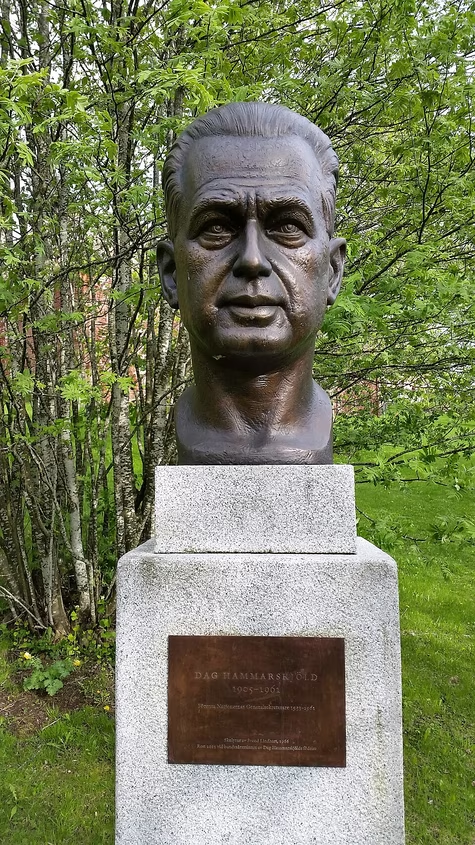
A Transformative Leader of the UN
Hammarskjöld left a legacy as one of the most successful leaders of the UN, as, while it was still in its infancy, he transformed his role into one that was proactive, neutral, and a force in diplomacy. He regarded himself as politically independent and, as such, stood apart from the Cold War major powers. He helped to develop modern peacekeeping as we know it today.
We highlight some of Hammarskjöld's achievements below:
-
Approach to the 1956 Suez Crisis - Alongside Canadian PM Lester Pearson, he established the first major UN peacekeeping force, transforming a theoretical concept into a practical tool for managing conflict. He circumvented the Security Council deadlock by referring the issue to the General Assembly, successfully diffusing tensions between Egypt and its three adversaries: Britain, France, and Israel. He championed the concept of a "Blue Helmet" force to supervise the withdrawal of foreign troops and act as a buffer between Egyptian and Israeli forces.
-
Quiet Diplomacy - Hammarskjöld successfully used discreet, private negotiations to resolve international conflicts on several occasions. Most famously, he secured the release of captured American soldiers in China in 1955. He also used this method to help defuse crises in Lebanon and Jordan.
-
Decolonisation - As a staunch advocate of independence and sovereignty, Hammarskjöld helped with the transition of many newly independent countries in Africa and Asia. He also helped establish the UN's role as a useful aid to economic development.
-
The 1960 Congo Crisis – To prevent a Cold War proxy war, Hammarskjöld launched the ONUC peacekeeping operation to help the DRC maintain territorial integrity after independence. He faced opposition from the Soviet Union, the Congo's Prime Minister at the time, Patrice Lumumba, and Western powers such as Belgium, the UK, and France. Although controversial, his work was an example of his dedication to on-the-ground diplomacy.
-
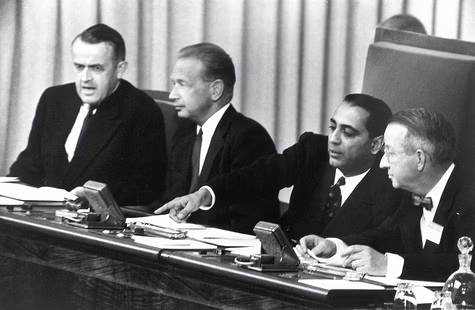
The UN International Conferences on the Peaceful Uses of Atomic Energy - Hammarskjöld played a key role in the first and second conferences which sought to redirect atomic energy from weaponry to peaceful applications and enable the sharing of nuclear technology for civilian purposes.
Conclusion
The 1961 plane crash that killed Secretary-General Dag Hammarskjöld and all of those on board is still shrouded in mystery today. There is strong evidence of foul play, which may or may not be related to his peacekeeping efforts in the DRC. Decades of investigation have resulted in no definitive answers, and no party has ever claimed responsibility.
Hammarskjöld will be remembered for his dedication to justice and his emphasis on prevention and not escalation. If only modern political leaders would follow in his footsteps, the world would be a much safer and more stable place.
His work demonstrates the need for strong leadership in international institutions willing to stand up for peaceful alternatives, the power of diplomacy, and the urgent need for de-escalation.
Author: Rachael Mellor, 02.03.26 licensed under CC BY-SA 4.0
For further reading on Dag Hammarskjöld see below ⬇️
More Resources
Curated Directory & Deep-Dive Resources on Dag Hammarskjold (Sweden)
- Dag Hammarskjöld Foundation 11308
- Dag Hammarskjöld Foundation - About 11309
- Dag Hammarskjöld (1905-1961) - Wikipedia 11310
- Dag Hammarskjöld Library - Uppsala University 11311
- UN Pulse - UN Dag Hammarskjöld Library 11312
- Dag Hammarskjöld - the Peacemaker ! 9/11 (Archive) 11313
- UK and US accused of obstructing inquiry into 1961 death of UN chief - Guardian 02.03.24 400752
- MI6 accused of thwarting effort to solve 1961 death of UN chief - Guardian 12.10.19 201404
- Britain and US urged to release papers on Dag Hammarskjöld’s death - Guardian 12.11.17 11314
- Plane crash that killed UN boss 'may have been caused by aircraft attack' - Guardian 26.09.17 11315
- Dag Hammarskjöld's plane may have been shot down, ambassador warned - Guardian 4/14 11316
- Judges call for reopening of inquiry into 1961 death of UN chief - Guardian 9/13 11317
- Dag Hammarskjöld: evidence suggests UN chief's plane was shot down - Guardian 8/11 11318
- 'I have no doubt Dag Hammarskjöld's plane was brought down' - Guardian 8/11 11319
- Dag Hammarskjöld - Commemorative Events 11320
- Uppsala's Dag Hammarskjöld - YouTube 11321
- Dag Hammarskjöld - Literature 11322
- Nobel Peace Prize 1961 11323
- Guardian 11324
- Google News 11325
- YouTube 11326
- Amazon Books 11327
- Dag Hammarskjold - Biography 11328
- Dag Hammarskjold - Acceptance Speech (1961) 11329
- Dag Hjalmar Agne Carl Hammarskjold 1961 11330
- Dag Hammarskjöld: The UN Years 11331
- Dag Hammarskjöld Library - United Nations 11332
- Dag Hammarskjöld - Uppsala University Library Search 11333
- Dag Hammarskjold - Second United Nations Secretary-General 11334
- Peace and Development – 50 years after Hammarskjöld (London 6/11) 11335
- "Annual Erskine Childers Lecture 2011: “Peace and Development - 50 years after Dag Hammarskjöld” - London 6/11 *.pdf 11337
- Dag Hammarskjold Lecture 2011 11338
- Dag Hammarskjöld Medal - Wikipedia 11339
- My hero: Dag Hammarskjöld by Timothy Mo - Guardian 5/12 11340
- International Peace and Security: Thoughts on the Twentieth Anniversary of Dag Hammarskjöld's Death - Brian Urquhart (1981) 11341