
Military & Climate Crisis - 6%
Global militaries account for over 6% of greenhouse gas emissions. Discover how unreported military operations, weapons, and wars drive the climate crisis.
THE CLIMATE COST OF WAR & MILITARIES – 6% of Global Greenhouse Gas Emissions
Discover the hidden climate impact of military activities and war. Our guide explores unchecked military emissions, fossil-fuels as a driver of conflict, and the environmental destruction left in the wake of violence.
Learn how military greenhouse gas emissions remain wildly underestimated and unregulated and how the climate crisis is now a contributing factor to escalating tensions.
Explore valuable resources, research, and initiatives addressing military emissions, climate accountability, and peace.
Jump straight to our resources on the ➡️ Military & Climate Change
*****
General Information
One of the biggest blind spots of climate change is the impact of emissions from war, the armed forces, weapons production, and the arms trade. The military is one of the largest consumers of fossil fuels, as tanks, aircraft, ships, submarines, and other vehicles ferociously consume fuel on their warpath.
With a lack of transparency, zero accountability and no legal requirement to monitor and report, estimates put the combined contribution to climate change at 6%. The actual percentage is likely much higher. The carbon footprint of the military-industrial complex and its endless wars is immense.
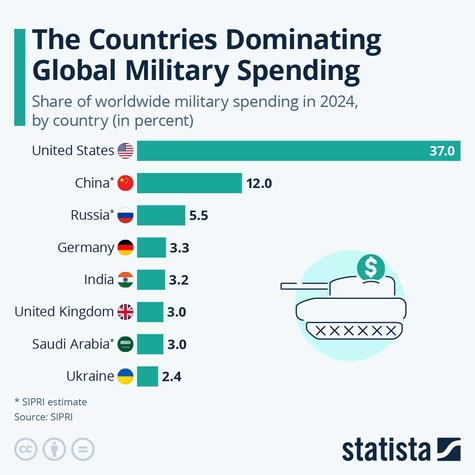
With military spending reaching unprecedented highs of $2718 billion in 2024, the focus of militaries around the world is very much on expansion and upgrades, with emission reductions and environmental considerations a mere afterthought.
Oil is fuelling todays national security. In the ultimate paradox, military actions are not only a cause of the climate crisis, but the climate crisis is now officially a cause of war.
The military is “the institution that’s actually keeping the fossil fuel infrastructure in place through brutality and violence.” - Mike Prysner, co-director of Earth's Greatest Enemy
Explore an indepth look at the unprecedented spending of the U.S. Armed Forces, the growing numbers of climate refugees, Nuclear Weapons madness, and cases of ecocide.
Military Climate Impunity & Irresponsibility
“Ignoring military emissions is not just concerning with regard to climate change. It ignores the growing recognition of climate change being a serious security risk for Europe and beyond” - Florian Krampe, director of climate research SIPRI.
Longstanding environmental exceptionalism has created an emissions gap which is seriously overlooked in climate negotiations such as the recent COP30. Shockingly, if the global military were a country, it would rank in fourth place in terms of emissions.
As there are still no concrete measures to promote military decarbonisation, the whole industry is highly dependent on fossil fuels. In fact, after the U.S. insisted, military operations were excluded from reduction obligations in the 1997 Kyoto Protocol. The 2015 Paris Agreement currently only covers voluntary reporting, of which only a handful of countries oblige, and even then, publications meet only the bare minimum of UN guidelines. Countries with the largest militaries publish nothing at all.
Rampant greenwashing by militaries results in less than 10% of their carbon footprint ever being reported. Not a single nation reports on the impact of its activities during war. We must begin to understand the true scale of emissions and environmental impact before we can start to reduce them.
The U.S. Department of Defence is the world's single largest consumer of petroleum. The U.S. military purchases 270,000 barrels of oil per day. This puts its annual emissions at 55 million metric tons of carbon dioxide, more than those of 150 countries. In a worrying trend, modern upgrading of jets, for example, the F-35 stealth fighters, use considerably more fuel than previous aircraft.
Whilst UN reporting systems allow militaries to downplay their emissions, hide them under other categories, and make exemptions for emissions in international waters and airspace, we will not see a reduction in emissions.
Trillions are spent every year propping up war machines, weapons proliferation programmes, and military technologies, money which has been diverted away from essential climate financing, action, and adaptation for those most vulnerable.
The Military & Climate – Key Statistics
-
The global arms trade value in 2024 reached $111.6 billion. Arms production and their supply chains are significant producers of carbon emissions. The exact amount is unknown due to shady industry practices and weak regulation.
-
The world is currently experiencing the highest number of armed conflicts since 1945, with a 65% increase in conflict-affected areas since 2021.
-
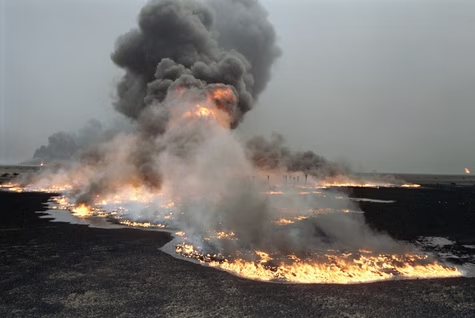
In 1991, as a result of deliberate sabotage by Iraqi forces, more than 700 oil wells were set ablaze, releasing 130-140 million tons of carbon dioxide, equating to 2% of global emissions for that year. The Persian Gulf was flooded with 11 million barrels of crude oil. More than 3 decades later, Kuwait is still suffering the disastrous consequences.
-
Israel's war on Gaza, aside from the devastating humanitarian consequences, generated 32 million tonnes of CO₂ in the first year and a half alone. This is equivalent to the emissions of more than 8 coal-fired power plants in one year.
-
In a deliberate campaign of ecocide, Gaza has witnessed the destruction of 97% of tree crops, 82% of annual crops, and 89% of farmland.
-
To remove and process the rubble which Gaza has been reduced to, it is estimated that machinery will generate the equivalent of 66,000 tonnes of CO₂.
-
Military activity in the three years since Russia's invasion of Ukraine has created the equivalent of 237 million tonnes of CO₂.
-
Countries reporting both conflict and climate-related displacement have tripled since 2009. These countries receive only a quarter of the climate finance they need.
-
Some of the worst-affected countries include Sudan, Yemen, Syria, Haiti, the Democratic Republic of the Congo, and Myanmar.
-
A recent study discovered that for every 1°C increase in temperature, conflict between individuals increases by 2.4% and conflict between groups increases by 11.3%.
Ecocide as a Weapon of War
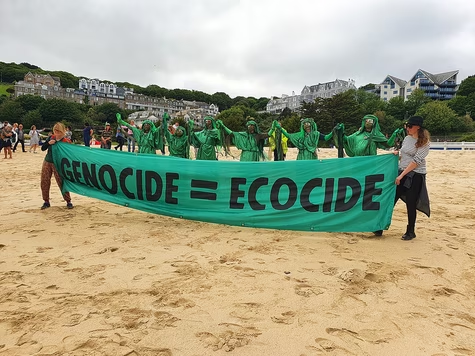
Ecocide refers to the mass destruction of the natural environment by deliberate or negligent human action. There is a massive movement to criminalise ecocide due to its devastating, widespread, and long-term impacts on flora, fauna, the air, water sources, and human populations. Ecocide is already recognised in 11 countries, but legal prohibitions remain limited.
There is a renewed push to include ecocide in the Rome Statute, which currently only includes some forms of environmental damage under war crimes. The movement is led by groups such as Stop Ecocide International, which aims to fill gaps in current frameworks and prevent this form of catastrophe from happening again.
In war, ecocide has been used for decades to cripple the enemy and civilian populations. A population simply cannot survive without a healthy and clean environment. Clean air, safe water, fertile soil, and arable land sustain life. Without these things, the survival and well-being of a population, its ecosystems, and biodiversity are at serious risk.
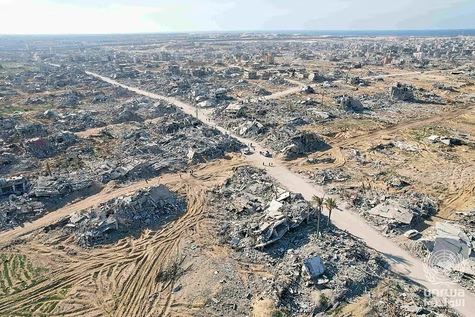
Scorched earth policy is a military strategy to destroy anything of value which might enable armed forces or civilians to fight a war. Relentless Israeli bombardment and military activities have left vast areas of Gaza reduced to rubble and completely unlivable.
This destruction extends far beyond infrastructure. The soil, contaminated with hazardous materials, is incapable of supporting even the smallest-scale farming. Water sources, already scarce, have been further polluted by damaged sewage infrastructure and targeted attacks on water systems. Israel has repeatedly prevented the reconstruction of desalination plants, landfills, and sewage disposal systems. Chronic electricity and fuel shortages prevent Palestinians from protecting their environment and pursuing any kind of sustainable development. A grey, dusty, barren, rubble-filled landscape replaces once-thriving ecosystems.
In 2023, during the early stages of the Russian Invasion of Ukraine, the Nova Kakhovka Dam was destroyed in one of the worst ecological disasters in Europe. The dam provided drinking water for more than one million people, irrigation for thousands of acres of farmland, and was home to countless endangered species. Landmines, industrial runoff, and chemicals contaminated the Dnipro River, leaving ecosystems destroyed.
Military training areas destroy vast areas of agricultural land, wetlands, and forests. They are now estimated to cover between 1-6% of the land's surface. Explosives, chemicals, fires, and abandoned ordnance cause serious long-term environmental damage to ecosystems.
Long after wars are over, heavy metals and pollutants from munitions and rubble render soil and water sources unusable for decades.
Demilitarise For Real Climate Progress
The U.S. military “is the greatest threat to all living things on Earth” - Mike Prysner, co-director of Earth's Greatest Enemy
Instead of persistent global conflicts, endless wars, and an escalating arms race, humanity must commit to international dialogue, disarmament, and a culture of peace.
Governments are starting to acknowledge the oversized role militaries play in global emissions and to recognise the broader environmental impacts of conflict.
The environment has long been a forgotten victim of war, mere collateral damage. But after the July 2025 historic advisory opinion by the ICJ on countries' legal obligations to tackle climate change, this may become a thing of the past. The Vanuatu Initiative, spearheaded by the Pacific Islands Students Fighting Climate Change, did not specifically mention military activities but declared that the human right to a clean, healthy, and sustainable environment is protected by law. It also reaffirmed that governments are legally obligated to curb the use of fossil fuels and to regulate the climate impacts of companies and businesses.
Prior to this, in 2022, the UN's International Law Commission published a draft on the protection of the environment, specifically during armed conflict. They went on to be approved by the UN General Assembly the same year. It lays out a framework for environmental protection before, during, and after armed conflicts and in the case of occupation. Lack of enforcement, state pushback, and the absence of clear obligations have stalled implementation.
The need for greater transparency is a matter of urgency. Research by SGR estimated that military carbon footprints grow by 32 million tonnes of carbon dioxide equivalent for each additional $100bn in military spending. With military budgets rapidly increasing around the world, the underreporting of military emissions will continue to have even greater implications for the climate crisis and our ability to adapt.
Author: Rachael Mellor, 04.12.25, latest update 19.08.26, licensed under CC BY-SA 4.0
More Resources
Curated Directory & Deep-Dive Resources on Military & Climate Crisis - 6%
- Petition: Stop Excluding Military Pollution from Climate Agreements - Action Network 267795
- American Security Project - Climate Change and U.S. Military Bases 267790
- Climate and Security Resources: U.S. Government, Defense 267798
- Video: Earth's Greatest Enemy | Official Trailer - Empire Files 7/23 469773
- Bootprint - Militarism & Environment 507283
- Climate Collateral (2025 update): Why the military’s impact on climate change can no longer be ignored - IPB 499641
- Disarmament for Climate Justice and Health - IPPNW Delegation to COP28 388606
- Environmental impact of war - Wikipedia 267801
- Scorched earth - Wikipedia 267861
- The Military Emissions Gap 393137
- Conflict and Environment Observatory 408253
- View your government’s military emissions data - Military Emissions 487516
- Climate Militarism 487521
- @milemissionsgap 393136
- #CountMilitaryEmissions 267865
- #MilitaryEmissions 267866
- #Climate_Militarisation 390714
- #NoWarNoWarming 267864
- EARTH'S GREATEST ENEMY - New Film by Abby Martin 469718
- The military needs to be included in climate agreements but “greening” the military is not enough - WILPF 261869
- Climate change, drone attacks exacerbate Sudan's humanitarian crisis - DW 14.10.26 525017
- Militaries and conflict: critical gaps in climate action - Conflict and Environment Observatory 13.10.26 525012
- NATO, the climate crisis and the ecosocialist emergency - International Viewpoint 03.10.26 525015
- Count military emissions in climate plans, Quakers say - Quakers in Britain 30.09.26 525013
- Ongoing Wars, Nuclear Threats and the Deepening Climate Crisis - Countercurrents 21.09.26 525016
- Ending Fossil Fuels and Abolishing War: A Crossroads Reached - Transform Defence 13.09.26 525014
- How much does war contribute to the climate crisis? - People’s World 27.08.26 522335
- West Point’s only climate scientist fired after continuing to teach human causes of climate change - Guardian 27.08.26 522332
- Video: The Ecocidal History of the U.S. Military – EARTH'S GREATEST ENEMY Deleted Scene - Empire Files 25.08.26 522438
- Mission impossible? Quantifying military emissions - Bulletin of the Atomic Scientists 24.08.26 (Must read) 523757
- Oil disaster unfolds in protected marine area as Russian shadow fleet tanker leak accelerates off Oman - Greenpeace 05.08.26 522334
- Revealed: major oil firms make $93bn profits amid war and climate crisis - Guardian 04.08.26 522336
- Military Climate Action Swamped by Spending Rises - Rethinking Security 17.07.26 522333
- How the Iran War Worsens the Climate Crisis - TIME 10.07.26 519788
- Moscow’s black skies send a message to the world: oil must remain in the ground - Ukraine War Environmental Consequences Work Group 10.07.26 519790
- War kills. It Also Warms: Holding States Responsible for the Damages to Climate in Armed Conflicts - Opinio Juris 06.07.26 519789
- Solving the Climate Crisis Requires Peace, and Peace a Stable Climate - Transform Europe 21.06.26 517476
- Video: Abby Martin: The US military machine is destroying our planet - Real News 01.06.26 517477
- Europe’s fossil fuel reliance could be weaponized in war, EU chiefs warn - Politico 28.05.26 517475
- The pollution that outlives war - Al Jazeera 23.05.26 517474
- Climate crisis: toxic ‘rain’ and surge in carbon emissions show environmental impact of Iran war - Ibanet 05.05.26 516496
- Wars destroy lives and the climate. Why aren’t we counting military emissions? - Conversation 04.05.26 516494
- The Double Dividend: Eight Reasons Why the World Cannot Afford to Keep Choosing Bombs Over a Liveable Planet - WILPF 28.04.26 516497
- Lebanon accuses Israel of committing ‘ecocide’ in country since 2023 - Guardian 28.04.26 516495
- The Iran War Is Impacting the Environment in Unseen Ways - WIRED 27.04.26 516493
- The First-Ever Conference to End Fossil Fuels Has to Address Militarism, Too - Truthout 24.04.26 514405
- Your Carbon Footprint Is Counted. The Military’s Is Missing. - Wired 22.04.26 514404
- Why it’s important to talk about military spending on Earth Day - IPB 22.04.26 514403
- Hegseth calls climate change ‘crap.’ The military is still bracing for it. - Politico 20.04.26 514406
- Fossil fuel transition talks must address militaries - Conflict and Environment Observatory 20.04.26 514402
- Climate crisis: war in Middle East highlights urgency of fossil fuel phase-out - International Bar Association 14.04.26 513302
- Climate Change: The Silent Casualty of War - Observer Research Foundation Middle East 14.04.26 513304
- Arms race a major contributor to climate chaos - Counter Currents 14.04.26 514209
- The Iran war has heightened the nuclear and climate threat. Australia must help the world step back from the brink - Guardian 13.04.26 513303
- Unspoken cost of U.S. military is a stunning volume of pollution - LA Times 05.04.26 513301
- War’s Environmental Fallout: U.N. Expert Decries Targeting of Oil Sites & Desalination Plants - DN! 01.04.26 512751
- Climate 'change': the facts - War on Want 28.03.26 512051
- Environmental consequences of the war in Ukraine: Dec 2025 – February 2026 review - Ukraine War Environmental Consequences Work Group 26.03.26 512048
- What does the Iran war mean for clean energy transition? - Guardian 26.03.26 512050
- Iran War Drives Massive Surge in Planet-Heating Emissions Amid Calls to Accelerate Transition to Renewables - Earth.org 24.03.26 512049
- War Is Hell for People and the Earth - CD 23.03.26 512246
- 5m tonnes of CO2 emitted in just 14 days of US war on Iran, analysis finds - Guardian 21.03.26 511560
- As Another Oil-Fueled War Erupts, Study Reveals Planet Heating at Unprecedented Rate - CD 06.03.26 510676
- The environmental and climate cost of war - Physics World 02.01.26 503317
- Environmental Consequences of the War in Ukraine—October-November 2025 - UNEC Working Group 16.12.25 503315
- How US Militarism Supercharges the Climate Crisis - Inkstick 10.12.25 503313
- Trade Wars Destroy the Planet - Project Syndicate 10.12.25 503316
- War causes climate change, Fossil fuels cause war - 198methods 09.12.25 503314
- Has the ICC just advanced accountability for wartime environmental damage? - Conflict and Environment Observatory 08.12.25 501356
- Global race to secure critical minerals for weapons threatens climate, warns report - Guardian 04.12.25 502808
- COP30 cannot meet the 1.5C goal while military emissions stay uncounted - Al Jazeera 20.11.25 501353
- Ukraine to Claim $44bn in Climate Damages From Russia. Why War Is So Bad For Emissions - Time 20.11.25 501355
- Most militaries report less than 10 percent of their carbon footprint - SGR 18.11.25 498825
- War is one of the world’s ‘top polluters’. Is it time EU militaries disclosed their emissions? - Euronews 17.11.25 501354
- The environment as casualty of war - Ecologist 24.09.25 490574
- Rising Nato military spending to cause huge spike in emissions, report warns - Guardian 15.09.25 487519
- Introducing War on Climate, a new series that explores how conflict interacts with environmental issues around the globe - Conversation 11.09.25 490656
- Bringing Demilitarization into Climate Justice: Reflections on 2025 Climate Reparations Camp - National Priorities Project 09.09.25 514193
- Catholic Leaders Warn: Climate Crisis Risks Driving More War and Conflict - Caritas 09.09.25 487520
- Three reasons why the climate crisis must reshape how we think about war - Conversation 03.09.25 490657
- The climate effects of nuclear war (must read) - Taylor&Francis 16.07.25 492255
- The $1 Trillion Pentagon Budget Will Make Its Emissions Higher Than the Entire Country of Ethiopia - Climate Community Institute 10.07.25 479960
- How the US became the biggest military emitter and stopped everyone finding out - Guardian 30.05.25 473006
- How increasing global military expenditure threatens SDG 13 on Climate action - CEOBS 5/25 487517
- What does the global arms race mean for climate action? - Transnational Institute 29.04.25 487518
- Israel’s Destruction of Gaza Has Created an Environmental Nightmare - Mother Jones 15.02.25 457388
- The Price of Ecocide: How Russian Aggression Destroys Ukraine’s Nature - Ukraine Crisis 26.11.24 442512
- Protect the climate for whom?’: Palestinians highlight Gaza at Cop29 - Guardian 23.11.24 442514
- Fueling the Flames: How the West's Military Emissions Undermine Climate Action - CD 22.11.24 442516
- Israel says it's "making the desert bloom" by planting forests. For Palestinians, it's ecocide - Salon 20.11.24 442517
- Russian invasion toll on environment $71 billion, Ukraine says - France24 19.11.24 442520
- There will be no climate justice without the liberation of Palestine - TNI 19.11.24 442515
- Video: We can’t fight the climate crisis without fighting militarism - Al Jazeera 18.11.24 442519
- Countering Ecocide Key Point In Zelensky’s Peace Formula For Ukraine - Stop Ecocide International 15.11.24 442513
- CCPI x Military Emissions Gap – How Military Emissions Impact Global Warming - CCPI 14.11.24 442518
- Tweet: One component of the environmental devastation of #Gaza is the damage to its WASH infrastructure from the use of explosive weapons, wastewater contamination presents a… 438954
- Who killed Ukraine's Seym River? Investigation into accusations of ecocide - Le Monde 05.11.24 438952
- Israeli airstrikes are causing a dangerous 'smog soup' in Beirut - The New Arab 01.11.24 438955
- Ukraine’s new Ecocide war crime theory - Counter Offensive 31.10.24 438950
- Time for some ‘tough choices’ on military spending #Budget24 - Stop The War Coalition 29.10.24 438949