
WIND Power
Discover onshore and offshore wind energy. Explore leading wind projects, global market leaders, key tech advancements, and the clean energy transition.
WIND POWER - Onshore & Offshore Turbines Harnessing The Power Of The Wind
Learn about the rapid growth of wind energy and how you can actively support the clean energy transition. Our wind power guide offers you in-depth information on onshore and offshore wind farms, technological innovations, and plunging production costs.
Connect with hundreds of valuable resources, initiatives, and organisations – for accelerated renewable deployment, clean electricity generation, and a sustainable, fossil-free future.
Jump straight to our guide on ➡️ Wind Energy
*****
General Information
Wind power is a renewable, sustainable, and clean energy source which uses the wind's kinetic energy to drive turbines and generate electricity. It is now one of the fastest-growing energy sectors globally and contributes significantly to reducing greenhouse gas emissions, combating climate change, and accelerating the energy transition.
Over 138 countries utilise wind energy. More than 80 of these have an installed capacity exceeding 100 MW.
Wind power now accounts for roughly 11% of global electricity demand.
Basic wind power technology was developed as early as the 11th century, when it was used to pump water and grind grain. Modern wind power for electricity generation began in the 1970s, following the 1973 oil crisis, when interest in alternative energy sources and investment increased.
Key Facts & Statistics
- The cost of producing wind power has dropped by 90% since the 1980s.
- It takes just 3-6 months for wind turbines to generate the energy needed to cover their manufacturing, installation, operation, maintenance, and decommissioning costs! (EWEA).
- Global wind power capacity exceeded the 1-terawatt (TW) milestone in 2023, with year-on-year increases of 13%. A total capacity of 2,000 GW is predicted by 2030.
- China is the world leader in wind energy. They produce more than a third of global wind power generation. The Gansu Wind Farm is the biggest in the world, featuring 7,000 wind turbines with a total capacity of 20 GW.
- By 2030, the wind energy sector will employ 4 million people.
- The average installed capacity of turbines in 2025 was 5.5 megawatts for onshore installations and 10-15 MW for offshore. This onshore amount is enough to meet the electricity demand of around 3,500 households.
- Offshore wind has the potential to generate 18 times the current global electricity demand.
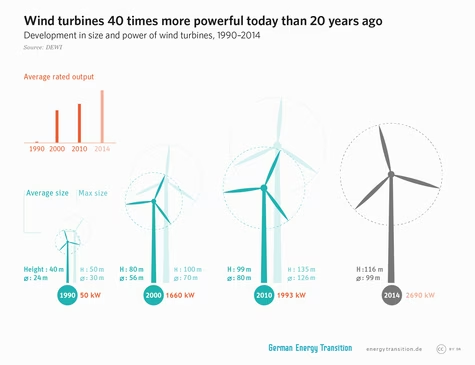
- Onshore turbines now stand as tall as 135m.
Weighing Up The Pros & Cons Of Wind Power
ADVANTAGES
The wind is almost everywhere, day and night! The potential for the continued expansion of this clean, inexhaustible energy source is vast, especially as manufacturing costs continue to fall.
Wind power is an excellent solution, even in remote areas without grid connection. It is not limited by geographical factors or the need for expensive infrastructure.
The energy efficiency of wind power systems has increased significantly over the last few decades. Average performance levels range between 40-50%. Solar power only manages a maximum of 25%.
The land required to produce high levels of wind energy is also minimal, especially for offshore wind farms. Land-based wind farms occupy minimal space, allowing multiple land uses such as animal grazing and crop cultivation.
The environmental impact of both onshore and offshore wind power is minimal. It has the lowest overall impact of all energy sources. They also, surprisingly, make very little noise, similar to the sound a refrigerator makes from 30 metres away.
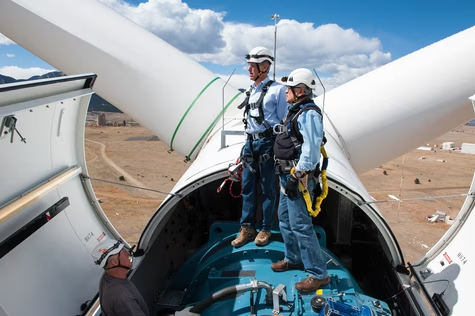
Maintenance of turbines is low, and they can run for years without intervention. Once they reach the end of their life, the turbine materials can be repurposed.
Denmark is leading the way in creative recycling, turning blades into bicycle shelters and utility poles. The land on which they are situated can be easily reused or restored to its original state.
DISADVANTAGES
The main disadvantages of wind turbines are their reliability and their impact on wildlife.
Weather dependency affects turbine energy output, limiting their capacity to 40%. This means the grid must be supplemented with storage technologies or alternative energy sources to cover periods when the wind isn't blowing.
Due to their tall vertical nature, the risk of rotor blade collision with birds and bats is increased. Direct mortality is only part of the problem. Due to habitat change and fragmentation, a study from Finland found that 63% of bird species, 72% of bats, and 67% of mammals are displaced from areas where wind turbines are installed.
For this reason, biodiversity assessments should be conducted thoroughly before site development begins. Land that has already been compromised, such as agricultural land, is ideal, as we can produce food and energy from the same land without causing further disruption.
Although designed in an aesthetically neutral way, many people view wind farms as visually intrusive, especially when they are in areas of natural beauty, such as the countryside or on hills, which they often are.
Compared to other forms of energy production, especially from fossil fuels, wind power has minimal disadvantages. It plays an important role in the push towards the energy transition.
With careful planning and measures to minimise environmental and human impact, wind turbines are an excellent solution to low-carbon energy production.
Offshore Wind Farms
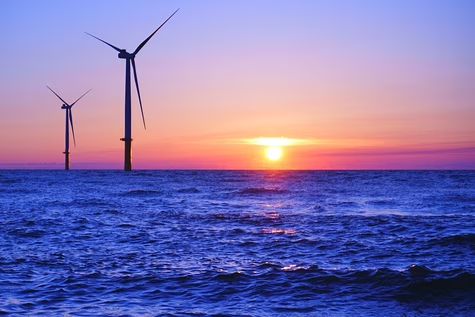
The biggest offshore wind farm in the world is Hornsea 2, located in the North Sea off the east coast of the UK. It covers an area of 462 square km and is enough to power 1.4 million UK homes.
Greater wind speeds, consistency, and the absence of restrictions make offshore wind power much more efficient. They also have a reduced visual impact and less effect on local ecosystems.
The drawbacks of offshore wind power are mainly cost-related. They are costly to construct and maintain, up to 20% more than their land counterparts. They also tend to sustain more damage due to high winds and strong waves.
Offshore wind farms can currently be built only in water no deeper than 60 meters, which severely limits their viability in deep water. Floating wind turbines are a potential solution, but are still in the early stages of development.
Wind Power For A Better World
Wind power is already playing a significant role in the green energy transition. Current trends project this to continue. In 2025, the global wind industry installed a record 165 GW of new capacity - a 40% increase from the previous year.
Wind turbines of the future are set to be larger, quieter, and more powerful, increasing their energy capacity and market value. Technological advancements will help further reduce the cost of their production and installation by 17-35% by 2035.
Airborne wind energy (AWE), which uses automatic tethered flying devices to convert wind energy into electricity, is a promising new technology that could transform the wind power industry. Still in its infancy, renewable advocates eagerly await the development of a commercially viable AWE product.
To meet the climate goals set out in the Paris Agreement and the Sustainable Development Goals and to ensure energy security, countries must continue to invest in the renewable energy industry.
Supported by ambitious government clean energy targets, China is leading the way, adding substantial new capacity each year. The EU is also accelerating its deployment of wind energy.
Under Trump in the U.S., federal incentives like the Inflation Reduction Act (IRA), which promoted wind energy investments, have been dismantled. He has sought to aggressively halt the offshore wind industry by issuing bans and paying billions in taxpayer funds to major energy companies to abandon their wind farm leases.
His One Big Beautiful Bill Act effectively repealed much of the IRA’s climate incentives by rescinding climate funding and rapidly phasing out wind, solar, and electric vehicle tax credits.
Multilateral cooperation between governments and the private sector is critical to addressing challenges in infrastructure and investment in the wind power sector. Despite pushback from the U.S., the Conference on Transitioning Away is a beacon of hope on how we can coordinate an international effort to phase out fossil fuels.
"When the winds of change blow, some people build walls and others build windmills" – Ancient Chinese proverb.
Author: Rachael Mellor, 07.02.25, latest update 20.08.26, licensed under CC BY-SA 4.0
More Resources