BRICS Association (Brazil, Russia, India, China, South Africa)
Explore the BRICS Association, a major global economic bloc countering US hegemony, comprising Brazil, Russia, India, China, South Africa, and more.
➡️ BRICS+ - Intergovernmental Organisation of Major Emerging Economies
Originally comprising of Brazil, Russia, India, and China, BRICS is now a major intergovernmental organisation and economic bloc.
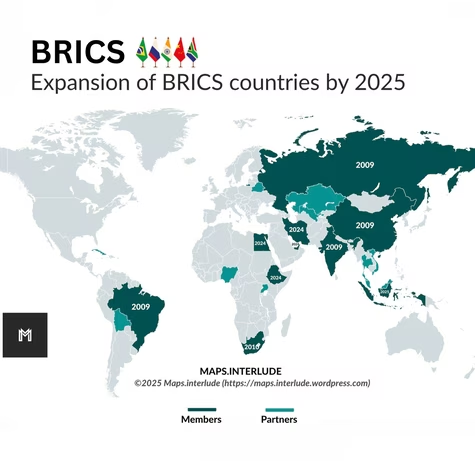
After the expansion of new member states, South Africa in 2010 and Egypt, Ethiopia, UAE, Iran, and Indonesia in 2024 and 2025, it now has significant global weight. It is a much-needed counter to U.S. hegemony. The coalition was soon after renamed BRICS+.
The BRICS Association has its own multilateral bank, the New Development Bank, designed to fund infrastructure and development projects while giving member nations a louder voice in global finance. It functions as a strategic counterbalance to the G7-dominated global financial architecture.
Jump straight to our resources on ➡️ BRICS+
Explore our comprehensive guides on -
-
Narendra Modi – Current Chairman & PM of India
-
Lula da Silva – Chairman in 2025 & President of Brazil
History & Founding of BRICS+
The conceptual origins of BRICS were first articulated by the Russian Foreign Minister Yevgeny Primakov in 1998 and were rooted in many informal dialogues and forums, including RIC (Russia, India and China) and IBSA (India, Brazil, and South Africa).
The BRIC Heads of State (now referred to as BRICS) held their first summit meeting on June 16-18, 2009, in Ekaterinburg, Russian Federation, to adopt the acronym BRIC, and to form an informal diplomatic club in which their governments could meet annually at formal summits and coordinate multilateral policies.
The founding members in 2006 were India, Russia, China and Brazil. South Africa joined the organization in September 2010, which was then renamed BRICS, and attended the third summit in 2011 as a full member.
Egypt, Ethiopia, the UAE, and Iran attended their first Summit as member states in 2024 in Russia; Indonesia followed in early 2025, thereby changing the bloc's name from BRICS to BRICS+.
BRICS rotates its presidency annually among member nations.
Its activities are traditionally centred around three key pillars:
2. Economy and Finance
3. People-to-people (P2P) exchanges, which also encompass civil society interactions.
The bloc accounts for approximately 45% of the world’s population, generates more than 35% of global GDP, and produces 30% of the world's oil.
The BRICS+ New Unit Currency
The idea of a reserve currency for the BRICS nations emerged during the 2009 summit in Russia. Recent global financial challenges and aggressive U.S. foreign policies have propelled the push for de-dollarisation and a new BRICS currency.
The BRICS nations seek to reduce their global reliance on the US dollar and assert economic sovereignty by recalibrating their financial architecture to better serve their own interests.
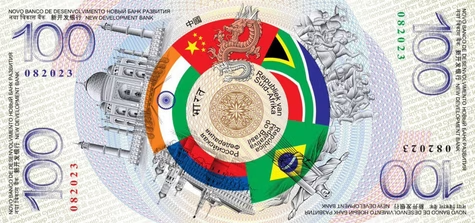
According to experts, this proposed currency will feature national flags and multilingual texts. The BRICS R5 initiative comprises the five original currencies - the Ruble, Real, Rupee, Renminbi and Rand.
Designed by the International Reserve and Investment Asset System, the UNIT will use a stable reserve basket comprised mainly of BRICS+ currencies (80%) and gold (20%).
Critics believe the idea of a BRICS currency is flawed because the member countries' economies are largely different. There is concern that members might instead lean more towards the Chinese Yuan, given its larger influence.
The majority of BRICS nations support an interoperable digital payment system, that will allow users to easily make, receive, and manage transactions across different banks and platforms. In contrast, Russia has advocated for a single unified currency.
Brazilian President Luiz Inacio Silva recently dismissed any claims of internal discussion about the creation of a unified BRICS currency. He proposed that India and Brazil trade in their own currencies, rather than rely on the US dollar. Seconding this, India has emphasised the expanded use of local currencies for trade and linking payment systems.
The Global Impact of BRICS+ - A New World Order?
DIVESTMENT & RISING GLOBAL INTEREST RATES -
The BRICS nations are increasingly reducing their reliance on U.S. Treasury holdings. This divestment is fuelled by the need to diversify their reserves into hard assets like gold, and to financially aid the expansion of local currency trade agreements.
Between October 2024 and October 2025, China, India, and Brazil collectively divested approximately $183.2 billion in U.S. Treasury securities.
While the U.S. Federal Reserve may consider initiating a rate-cutting cycle to improve the growth prospects of the U.S. economy, the structural decline in demand from foreign central banks may support long-term rates. Projections for mid-2026 suggest that the 10-year U.S. Treasury yields may remain between 3.75% and 4.5% based on the rate of divestment from BRICS economies.
OIL, GAS & COMMODITIES -
The energy sector is at the helm of the de-dollarisation movement. As trade settlements shift towards more local currencies and the newly proposed UNIT, oil and gas companies have the additional challenge of multiple pricing regimes.
In this light, the role of gold as an active trade asset would gain prominence, serving as a stable alternative for storing the value of export revenues during periods of dollar volatility.
FINANCIAL SOVEREIGNTY -
With investors questioning sovereign creditworthiness, there has been a costly real restructuring of global financial portfolios. Attractive dividends in emerging markets like India, China, and Southeast Asia are catalysing this shift.
Reliability is improved as national/central banks' responses to inflation through swifter policy normalisation are much faster than those of their G7 counterparts.
TECH & FINTECH OPPORTUNITIES -
Technological advancements have allowed the shift towards a multipolar financial system. Blockchain technology, AI, and digital payment systems enable BRICS+ countries to improve their economies and move away from US/UK-dominated banking systems.
THE GREEN ENERGY TRANSITION -
Fintech innovation is aiding environmental sustainability and green energy transition in the BRICS+ nations. Furthermore, tokenisation of green assets enables retail investors to own fractions of renewable energy projects, democratizing access to green investments.
Blockchain technology is being used to mobilise financial resources to fund green energy projects, reflecting a push to digitise this sector. Investors are now eyeing economically reliant and potentially profitable markets such as India, China, and Malaysia for ESG-compliant investments.
PROJECT MBRIDGE & CENTRAL BANK DIGITAL CURRENCY INTEROPERABILITY-
Project mBridge aims to connect the central bank digital currencies (CBDCs) of countries such as China, Thailand, Hong Kong and the UAE to reduce reliance on the SWIFT network and enable efficient trans-border monetary settlements. The potential for a BRICS bridge to integrate these CBDCs could revolutionise global liquidity pools.
A 'New Form' of BRICS Under Modi
The 2025 BRICS+ summit in India reiterated its commitment to transforming the bloc by prioritising people-centredness and humanity first. Indian Prime Minister Narendra Modi gave BRICS the new acronym "Building Resilience and Innovation for Cooperation and Sustainability."
India aims to prioritise the agendas of the Global South during its presidency, including the post-pandemic economic recovery and global cooperation to combat common threats.
Furthermore, India's vision of 'AI for All' will begin to take shape. Its focus is the use of AI in everyday grassroots governance and administration. Artificial intelligence has already transformed various sectors of the economy of the BRICS nations.
AI Framework in BRICS+ - Equitable Development & Digital Sovereignty
The BRICS AI Governance Declaration in 2025 aims to establish equitable global AI governance that ensures meaningful participation by developing countries in AI policy-making and promotes the responsible use of AI.
The bloc advocates for a UN-centred, multilateral approach that opposes Big Tech monopolies, promotes open-source solutions, and emphasises national control over data and digital infrastructure.
Below we list some examples of AI already in use across BRICS+ nations:
-
Russia - The 'Third Opinion' is used by radiologists to assist with early disease detection, improving overall hospital efficiency and reducing patient wait times.
-
South Africa - The FutureProofSA project uses AI to create personalised learning systems that adapt over time. They have made significant investments in the Digital Skills Development Programme, which trains professionals to work with algorithms.
-
India - The Diksha portal provides learning materials in multiple languages, tailored to local context and needs, with input from educators. India has also developed the Responsible AI for Youth initiative, which teaches young people how to approach AI responsibly and ethically.
-
China - The AI Vocational Training Program helps to retrain workforces regarding digitisation. It also helps prepare young adults to enter the workforce.
-
Brazil - The Wind and Solar Energy Forecasting System helps Brazil to maximise clean energy production, and MapBiomas has developed a tool that uses neural networks to assess biomes and prevent deforestation.
*****
The BRICS+ bloc is at a pivotal turning point, taking it from humble beginnings as an ad hoc diplomatic grouping of four developing nations to a complex, multi-purpose system that comprises almost half the world's population and a third of global economic output.
For several decades, the rules of international trade, finance, and development were set in Washington, Brussels, and Tokyo. The BRICS+ bloc's architecture, from unconditional lending of the NDB to the mBridge initiative's bypassing of SWIFT, signifies not only an economic diversification strategy but a conscious exercise of institutional creativity - the writing of a new rulebook.
A single dramatic rupture will not shape the financial and geopolitical architecture of the 21st century; rather, it will be a gradual accumulation of alternatives that will bring the Global South onto a much more level playing field.
Recommended Reading:
-
The history of BRICS (BRICS Expert Council Russia)
-
BRICS and the World Order: A Beginner's Guide (South African Institute of International Affairs)
-
The BRICS group: Overview and recent expansion (House of Commons Library)
-
Stages of BRICS Development (BRICS Expert Council Russia)
-
India's 2026 BRICS Presidency: Multilateralism, Multipolarity, and the Venezuelan Test (The Diplomat)
-
A BRICS Perspective on AI Governance: Multilateralism, Development, and Inclusion (Science and Diplomacy)
-
Bridging the AI divide: A BRICS strategy for inclusive innovation, sovereignty and capacity building (ORF America)
Author: Tanuj Samaddar, 16.03.26 (Edited by Rachael Mellor 30.03.26) licensed under CC BY-SA 4.0.
For further reading on BRICS+ see below ⬇️
More Resources
Curated Directory & Deep-Dive Resources on BRICS Association (Brazil, Russia, India, China, South Africa)
- ‘A wall of BRICS’: The significance of adding six new members to the bloc - Al Jazeera 24.08.23 368131
- At BRICS Summit, Guterres global unity call in face of ‘existential’ challenges - UN News 24.08.23 368150
- Brics expansion: six more nations are set to join – what they’re buying into - Conversation 24.08.23 369241
- BRICS invite is ‘great opportunity’ for Argentina, outgoing president says - Al Jazeera 24.08.23 368140
- Brics leaders invite 6 nations including Saudi Arabia to join bloc - FT 24.08.23 368019
- Brics to admit six new countries to bloc including Iran and Saudi Arabia - Guardian 24.08.23 368020
- Can BRICS dethrone the US dollar? It’ll be an uphill climb, experts say - Al Jazeera 24.08.23 368137
- Saudi Arabia, Iran among six nations invited to join BRICS - Al Jazeera 24.08.23 368141
- Video: BRICS Summit: China, Africa, Russia and the 23 New Applicants - BreakThrough News YouTube 24.08.23 377075
- Can BRICS create a new world order? - Al Jazeera 22.08.23 368136
- Tweet: Putin video address at the BRICS Business Forum 2023 - @upholdreality 22.08.23 371020
- Video: Vijay Prashad on BRICS & Why Global South Cooperation Is Key to Dismantling Unjust World Order - DN! 22.08.23 370066
- Video Address to the Participants in the BRICS Business Forum - Kremlin 22.08.23 376962
- Video: South Africa Hosts Major BRICS Summit as Bloc Eyes Expanding in Global South to Counter Western Powers - DN! 21.08.23 370073
- As BRICS cooperation accelerates, is it time for the US to develop a BRICS policy? - Conversation 18.08.23 367555
- An Expanded Brics Could Reset World Politics but Picking New Members Isn't Straightforward [analysis] - All Africa 06.08.2023 364169
- BRICS countries prepare a meeting in South Africa to strengthen dialogue, consultation, solidarity, and cooperation - Pressenza 03.08.23 364424
- A BRICS currency is unlikely to dislodge dollar any time soon – but it signifies growing challenge to established economic order - Conversation 22.06.23 357978
- Brics: Russia bid to reclaim African influence, challenge dollar dominance - East African 20.07.2023 360764
- Video: Could BRICS challenge US dominance in the global economy? - Al Jazeera 03.06.23 349066
- The Rise of the South: Can BRICS Weaken the Dominance of the IMF and World Bank? - Pressenza 18.04.23 341783
- BRICS: The rise of a new global superpower? - New Nation 07.04.23 339740
- Cumbre 2025: los BRICS abrazan el multilateralismo y piden reformas en las organizaciones globales - Conversation 07.07.25 478052
- BRICS: The world is a-changing – and for the better - TFF 31.03.23 339357
- Brics summit: Members push for global clout amid Ukraine war - BBC 23.06.22 294033
- Putin urges BRICS nations to cooperate with Russia - DW 23.06.22 294034
- Russia urges BRICS nations to integrate payment systems and cards - Al Jazeera 09.04.22 294035
- BRICS Summit: Afghanistan likely to dominate discussions - Al Jazeera 09.09.21 254765
- Challenges, opportunities and the way forward for BRICS - Pressenza 23.07.20 212797
- BRICS Summit in China: A Missed Opportunity - Real News 06.09.17 141026
- Video: How relevant is BRICS today? - Al Jazeera 17.10.16 141027
- @AVsitenko 437469
- Civic brics - Moscow 2015 141030