New Development Bank (BRICS)
Explore the New Development Bank (BRICS), a key multilateral institution supporting sustainable projects and promoting local currency use globally.
➡️ New Development Bank - Intergovernmental Financial Architecture of BRICS+
For decades, the international financial order has been influenced by the shadow of the Bretton Woods System that emerged after World War II and its unique economic orthodoxies. Against this backdrop of absence, new powers looked towards something that reflected the economic realities of their nation instead of mirroring those of the West.
In this context, the New Development Bank was created, which helped convert the latent strength of developing countries into progress. The institution prioritises a horizontal partnership model that respects the policy autonomy of its borrowing member states. It acts as a precursor to a new type of international order, wherein capital is not bound by a specific ideological system. Its creation indicates that the developing world will not remain a mere beneficiary of aid but will play a role in shaping its future.
Jump straight to our resources on ➡️ New Development Bank (BRICS)
Explore our comprehensive guides on-
- BRICS+
- Sustainable Development
- Global Governance and Institutions - WTO, IMF, etc
- IMF & World Bank - Bretton Woods Institutions
Introduction
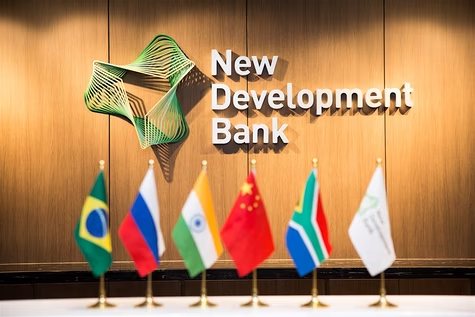
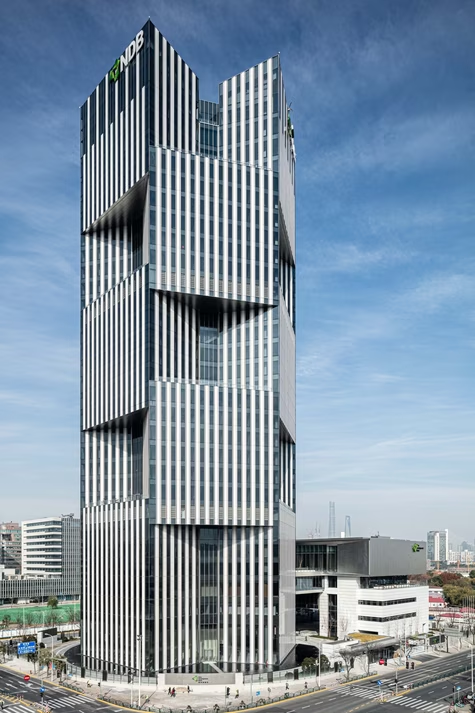
The ➡️ New Development Bank which was erstwhile known as the BRICS Development Bank is a multilateral financial institution established by the ➡️ BRICS nations. The bank is set to back both public and private projects by offering loans, guarantees, equity participation, and various other financial tools. With its headquarters in Shanghai (China) the first regional branch of the bank was opened in Johannesburg (South Africa) in 2016. Subsequently branches were opened in Sao Paolo (Brazil), Ahmedabad (India) and Moscow (Russia).
The idea of a multilateral bank for the bloc, which was initially proposed by India in the 4th BRICS Summit held in 2012 in New Delhi, was finally ratified by the leaders in the 5th BRICS Summit held in Durban. What catalysed its establishment as an alternate Bretton Woods institution, was the insignificant share of votes given to the representatives of the developing nations in these global financial institutions. This diminished the aspirations of the BRICS nations of building a sovereign financial architecture within the Bretton Woods framework.
In between 2021 to 2023, the New Development Bank expanded its membership to the petrostates in the Gulf and Middle East, including Egypt (2023) and the United Arab Emirates (2021). The recent expansion has proved to be particularly significant for the NDB as it is an advocate of stimulating intra and inter-BRICS currency for more local currency use and laid the milestones of institution building during the global crisis of the coronavirus pandemic.
Relevance
While a school of economists argues that the creation of the New Development Banks (NDB) could add to redundancies, create a further extension of agencies’ missions to do something different from what they were originally set out to accomplish, and lead to an increase in the number of institutions that have overlapping mandates, export credit giants like the Chinese and Indian ExIm Banks are willing to finance infrastructure in developing countries.
ExIm banks are government-owned agencies designed specifically to support the export performance of their home jurisdictions. For example, the Export-Import Bank of India explicitly states that its Lines of Credit (LOCs) to overseas governments are meant to "boost exports" and enable buyers to import projects, equipment, and services specifically from India. This is known as "tied aid."
But unlike the NDB, which is a Multilateral Development Bank, the financing of an ExIm bank is tied to the export target of the country that is funding the ExIm bank. The NDB thus offers untied loans to countries based on their own sustainable development priorities. However, relying exclusively on ExIm banks ties developing countries to sourcing materials and labour from the lender, often undermining local capacity development and limiting economic autonomy.
Furthermore, rather than suffering from "mission creep", the NDB was explicitly founded to offer a different lending model than the Bretton Woods institutions. The NDB mitigates exchange-rate risk by prioritizing local currency financing. According to NDB's annual report in 2024, out of all the projects approved by the bank, 43.5% were funded in the currency of the respective country members (South African Rand and Chinese Renminbi). The bank funds these projects by raising capital from the domestic bond market, which is a new concept that has not been considered by conventional banks.
"Rapid technological changes are reshaping development finance, and they call for a corresponding evolution in development finance institutions" - Enoch Gondongwana (NDB Governor for South Africa)
Achievements and shortcomings of the New Development Bank
The NDB, since its inception, has sanctioned over 120 projects amounting to $40 billion, covering various sectors like clean energy and energy efficiency, transport, environment, water, social and digital infrastructures. It has proven effective in addressing global challenges, notably supporting its five founding members through the COVID-19 crisis, while also prioritising sustainability by dedicating 40% of its net approvals to climate change mitigation and adaptation projects.
Furthermore, the NDB has given the green light to projects that are set to bring in 2,400 MW of renewable energy capacity, which will help cut down CO2 emissions by an impressive 14.7 million tonnes each year. One key feature of the NDB is that it doesn’t impose any conditions on its project funding. This approach respects the national sovereignty and territorial integrity of each state (NDB, 2022) by steering clear of interference in their political matters and avoiding any stipulations related to economic policies or social standards.
While the NDB represents a bold effort to amplify the influence of BRICS+ nations within global financial and diplomatic arenas, these countries remain inevitably intertwined with established Western-led institutions through globalisation, market reforms, and international trade. At the same time, the Bank faces challenges in creditworthiness, particularly when compared to regional peers like China’s Asian Infrastructure Investment Bank (AIIB), which enjoys stronger ratings and perceived stability.
Another major constraint faced by the NDB is that many of the constituent countries have poorly managed foreign exchange reserves. In this context, the NDB often falls short of playing a decisive role in addressing and resolving crises when member states face severe volatility in international capital flows, challenging their economic stability.
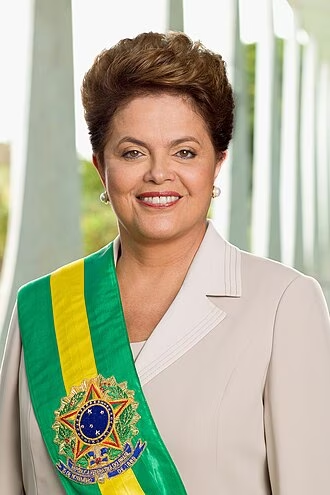
"NDB must adapt its funding strategy by actively exploring both traditional instruments and emerging digital alternatives to lower its cost of capital and improve its access to funding" - Mrs Dilma Rousseff (President of NDB)
Governance
The New Development Bank is administered by a Board of Directors and Board of Governors, both composed of five members, each representing a founding country. The presidency of NDB is rotated and is periodically held by an envoy from one of the BRICS countries, while the rest nominate the four vice-representatives. Dilma Rousseff from Brazil has served as president of NDB since 2023.
Each member nation has one vote, regardless of economic size, which differentiates it from traditional MDBs. Additionally, no country has a unilateral veto power. While membership is open to any UN member, the combined voting power of the original BRICS founders cannot fall below 55%.
Currently, NDB has 21 departments that are led by Director Generals or equivalents. These departments have been further categorised into 24 divisions, each led by a Chief. In addition to these 24 chiefs, there are 4 more chief positions under the corporate secretariat, internal audit, legal and the office of the president.
An Independent Evaluation Office plays a crucial role in enhancing the accountability, transparency, and overall effectiveness of the bank’s projects. In recent years, NDB has expanded its membership beyond its original founding members to include countries like Bangladesh, Egypt, and the United Arab Emirates, with others in the accession process.
"The Bank will be larger, greener and more digital, more innovative, more agile and more cooperative, while remaining grounded in pragmatism and focused on delivery" - Mrs Dilma Rousseff (President of the NDB)
Recommended Readings :
- Introduction – The evolution of New Development Bank (NDB): A decade plus in the making (Wiley)
- Are the New Development Bank and the BRICS Monetary Fund an alternative to the Bretton Woods institutions? (Committee for the Abolition of Illegitimate Debt)
- Analysing the New Development Bank's core objectives (2016-2022) (Africa Policy Research Institute)
- What is ‘new’ about the New Development Bank? (World Economic Forum)
- The role of the New Development Bank on Economic growth and Development in the BRICS states (Munich Personal RePec Archive)
- Financing Global Development: The BRICS New Development Bank (German Institute of Development and Sustainability)
Author: Tanuj Samaddar, 5.05.26 licensed under CC BY-SA 4.0.
For further reading on New Development Bank see below ⬇️
More Resources
Curated Directory & Deep-Dive Resources on New Development Bank (BRICS)
- Wikipedia - New Development Bank 152127
- Peoples Democracy - BRICS Bank 152131
- Could a BRICS Currency Work? - Project Syndicate 12.02.26 508958
- Russia Calls on BRICS Partners to Create Alternative to IMF - US News 10.10.24 437224
- De-Dollarization Bombshell: The Coming of BRICS+ Decentralized Monetary Ecosystem - Sputnik 13.05.24 416596
- BRICS bank’s inaugural 2024 loan of $500m – Interpretations? - Cryptopolitan 12.01.24 393794
- Video: BRICS destroying Dollar Hegemony as Russia and China Lead Multipolar World - Danny Haiphong 03.09.23 387155
- BRICS bank should be operational by August 2016: Business Council - Economic Times 02/15 152132
- A New Era of Development Finance - In Asia 02/15 152133
- BRICS New Development Bank Threatens Hegemony Of U.S. Dollar - Forbes 12/14 152137
- The Brics development bank can release Africa from World Bank tyranny - Guardian 07/14 152138
- Refusing to share: How the West created BRICS New Development Bank - RT 07/14 152139
- An acronym with capital: Setting up rivals to the IMF and World Bank is easier than running them - Economist 07/14 152143
- What the new bank of BRICS is all about - WP 07/14 152144
- BRICS announce $200B challenge to world financial order - Al Jazeera 07/14 152145
- Paper: A BRICS Development Bank: A Dream Come True? - UNCTAD 03/14 152149
- What the World Needs from the BRICS - Project Syndicate 04/13 152150
- New Development Bank’s Role in the International Financial Architecture - National University of Singapore 516628
- The New Development Bank from Conception to Establishment - BRICS Information Center 516629