

BELEM 2025 / COP30
In-depth guide to COP30 in Belém, Brazil. Discover key topics on global financial goals, NDCs, and controversy surrounding Amazon rainforest infrastructure.

COP30, 10 - 21 Nov 2025 - Belém, Brazil
Discover the hopes and frustrations surrounding climate action and the 2025 climate conference in Brazil. Our guide offers you in-depth information on the global summit, its successes and shortcomings, and how a lack of global consensus continues to block meaningful action.
Connect with valuable resources, initiatives and orgainsations - for a genuine phaseout fossil fuels, adequately funded climate mitigation, and a serious commitment to climate justice.
Jump straight to our resources on ➡️ COP30
*****
General Information
The 30th Conference of the Parties to the UNFCCC (United Nations Framework Convention on Climate Change) will take place in Belém, a remote, underdeveloped, and poor region of the Brazilian Amazon.
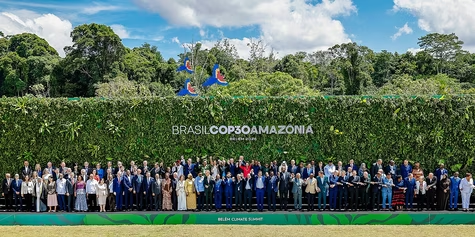
Delegates from over 190 countries, NGOs, Indigenous representatives and Brazil's President Lula, alongside, COP President André Corrêa do Lago, will all take part in this year's high-stakes climate negotiations.
Explore indepth coverage of the causes and consequences of climate change, the issue of climate debt, the fossil fuel companies working hard to rail the talks, and other key players.
Please share this important resource on Twitter, Bluesky, Instagram, Facebook, and LinkedIn.
Our work on climate change has been published by The Ecologist, Resilience, and Common Dreams.
Goals For COP30
With 2024 confirmed as the hottest year ever on record, the U.S. withdrawal from the Paris Agreement, and the massive financial shortfalls left by weak negotiations at COP29, this year's climate talks are pivotal.
A 2024 report by the UN revealed that current policies put the planet on track to reach a catastrophic 3.1°C warming by 2100 (Emissions Gap Report). This scenario would expose 600 million people to flooding, reduce food yields by half, cause severe water shortages, cause insurmountable habitat and biodiversity loss, create month-long brutal heat waves and wildfires, heightened risks of insect-borne diseases, and a profound deepening of inequalities.
At COP29 in 2024, it was agreed to mobilise at least $1.3 trillion in annual climate finance from public and private sources for developing countries by 2035. This funding is intended to support developing countries in their transition to clean energy, climate adaptation, and addressing loss and damage from climate change.
Tackling the climate crisis is IMPOSSIBLE without adequate funding. Since Trump has taken office, at least $18 billion has been stripped from climate finance - 6% of the new global $300 billion annual target.
All members of the UNFCCC are expected to publish their Nationally Determined Contributions (NDCs) outlining their national plans to reduce greenhouse gas emissions and adapt to climate impacts.
The NDC Synthesis Report will be released just before the conference and will show how far we still have to go to limit global warming to 1.5°C. There will also be more detailed reporting on previously vague or non-binding National Adaptation Plans.
Progress will be stalled unless the global climate investment gap can be closed and pledges are finally turned into real investments. This will prove even more difficult as militarisation grips the planet. NATO is planning on massively increasing contributions to the defence alliance and the EU Special Debts for Rearmament both siphon money for war mongering, posturing, and weapons stockpiling.
A new initiative, the Global Ethical Stocktake, launched by the President of Brazil, Lula da Silva, and the United Nations Secretary-General, António Guterres, aims to integrate ethical considerations into political decisions and technical measures.
Jaded by a lack of action in previous COPs, former UN Secretary-General Ban Ki-moon, along with other influential figures such as Mary Robinson and Christiana Figueres, labelled current climate policy process "no longer fit for purpose."
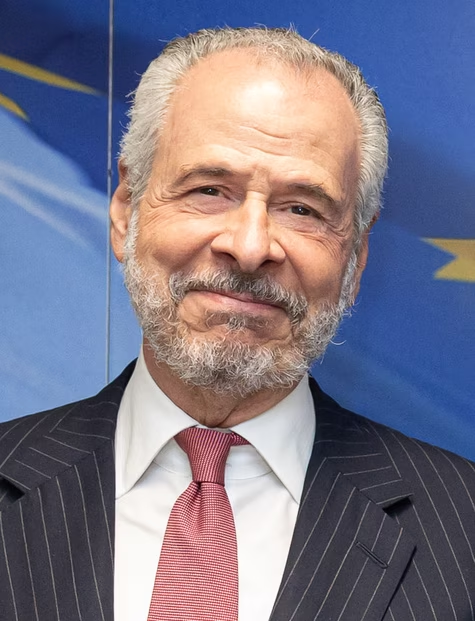
André Corrêa do Lago – COP30 President-Delegate
This year's COP president holds higher hopes than others. He is a veteran climate diplomat and serves as the current Secretary for Climate, Energy, and Environment at the Brazilian Ministry of External Affairs.
He has worked with Brazil's diplomatic corps since 1982 and has represented Brazil in similar negotiations, including as chief negotiator at Rio+20 and COP28 and COP29.
In a positive initial call to action, he has called on all stakeholders in the climate negotiations process to "act decisively in the face of climate urgency through an ambitious and integrated Action Agenda at COP30."
Brazil - A Controversial Host
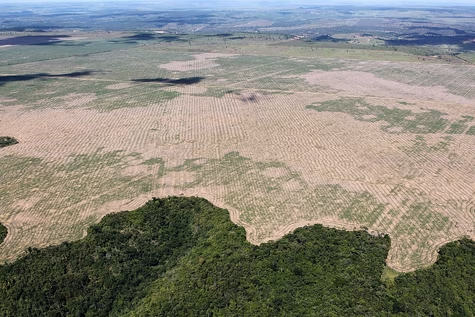
The location of this year's climate summit is highly controversial and has been labelled a COP built on deforestation - the very environment Brazil has pledged to protect. Rather than addressing the concerns, classic greenwashing terms like ‘sustainable’ are being used to describe the 8-mile road, which will cut through the Amazon rainforest.
The new four-lane highway will destroy thousands of acres of protected rainforest, fragment the ecosystem, disrupt the movement of wildlife, affect the livelihoods of local communities, and will be inaccessible to those who live on either side of the highway. It will, however, have bike lanes and solar-powered lights!
The lack of infrastructure in the area means that more than 30 large-scale construction projects will be taking place to accommodate and prepare for the 50,000 expected visitors. The port is being redeveloped for cruise ships, and $81 million will be spent on expanding the airport to double its current capacity.
After three climate conferences in countries with restrictions on protests, Amazonian leaders and social movements are wary that their participation may be discounted and silenced. Since February, Indigenous groups have been occupying the Secretary of Education and blocking roads that cut through their territories. The protests have already begun.
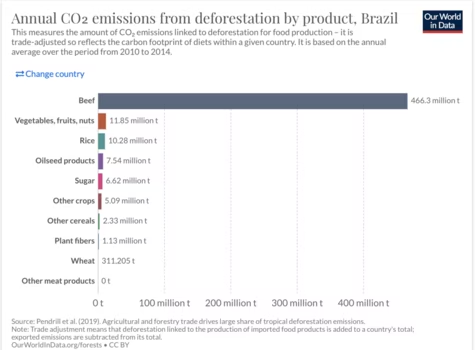
Regarding fossil fuels, Brazil is no climate leader. Their vast mining, oil, and agrobusiness sectors mean that Brazil is responsible for more than 4% of total global emissions. In 2023, they emitted 2.3 billion tonnes of greenhouse gases - the world's fifth worst polluter.
In this country of deep inequalities, the poor are disproportionately affected by climate change, including sea level rise, heat waves, and erratic rainfall.
Just weeks before the conference begins, a new bill to dismantle Brazil's environmental license framework has been passed. It eases restrictions on oil exploration and road development in the Amazon. A self-licensing process allows fossil fuel and construction companies to act with impunity and avoid the need for impact studies and mitigation measures.
Shortly after, the countries government-run Petrobras began drilling for oil a mere 200 miles away from Belém. The license was previously denied due to the risk of widespread biodiversity loss in this fragile ecosystem in the event of a spill. A new report reveals that since 2024, big banks have provided $2 billion in new financing for oil and gas in the Amazon.
Estimates suggest that up to 60 billion barrels of oil may exist in the Brazilian Amazon. If burned, they could emit 24 billion tonnes of CO2 - more than Brazil's emissions over the past 11 years. The expansion of the fossil fuel industry seriously contradicts the Brazilian government's climate narrative and threatens the country's credibility at COP30.
Some Progress But Still No Fossil Fuel Roadmap
This year's negotiations produced progress on financing, adaptation, and enabling a just transition. However, 30 years after the first COP, the world still can not reach a consensus on phasing out fossil fuels – the number one contributor to the climate crisis. The gap between the action needed and what governments are willing to commit continues to widen.
More than 80 nations rallied to push for a fossil fuel roadmap, but lobbying by major oil producers and emerging-market nations ensured that all mention of fossil fuels was absent from the final text.
Instead, the talks produced two much weaker voluntary roadmaps: one covering the fossil fuel transition and the other addressing deforestation. The voluntary aspect not only lacks authority but, as they are not included in the agreement, will be developed outside the UN.
Despite the absence of a binding deforestation roadmap, funding for Brazil's Tropical Forests Facility amounted to $9 billion. This considerable sum is a massive win for rainforest countries. However, it is still far short of the amount needed to halt deforestation completely and support local communities and their economies.
Regarding funding for developing nations, the commitment to mobilise $300 billion per annum by 2035 and a broader goal of $1.3 trillion per annum from public and private sectors was reaffirmed. There was also an agreement to triple adaptation finance by 2035. This is an important step; however, it is coming five years later than vulnerable nations had hoped.
An issue with climate funding in general is how these huge sums will be generated without the support of the U.S. Additionally, the money raised in the past has been notoriously difficult to access and slow to reach areas where it is needed most.
The Global Goal on Adaptation, developed over 2 years by experts, was significantly shortened and weakened, to the dismay of many African and Latin American countries. Delegates, however, agreed to improve monitoring and transparency regarding adaptation efforts, which should strengthen accountability.
Regarding the shift to renewable energy, a new just transition platform was launched to support employees and communities in areas reliant on fossil fuel industries and help them to reap the benefits of clean energy.
With the U.S. absent, the negotiations saw China, India, Russia, and Saudi Arabia taking on more assertive roles, leaving European countries somewhat isolated in their goals. Calls for reform of the consensus-based voting system are growing louder as the likelihood of reaching an ambitious agreement among almost 200 countries is proving unfeasible. A clear reflection of this is the failure to commit to a fossil-fuel phaseout, yet again.
As has become customary at these conferences, we are once again left with a considerable gap between ambition and outcome. As progress continues to be stalled, it is evident that the current COP model is not working. It has been announced that Türkiye will host COP31 in 2026, but with Australia leading the negotiations. This added complexity is a partnership which could provide a massive opportunity for two heavyweight countries to pull their influence together, or be a case of too many skippers sinking the ship.
Stay tuned for further updates.
Better World Info is an open platform – We invite experts, NGOs, campaigners, and activists to contribute their knowledge and top resources! We are a constantly expanding, work-in-progress, committed to spreading reliable, critical, and investigative resources to help create an informed, knowledgeable, and curious world.
Author: Rachael Mellor 24.06.25, latest update 19.08.26, licensed under CC BY-SA 4.0
More Resources