
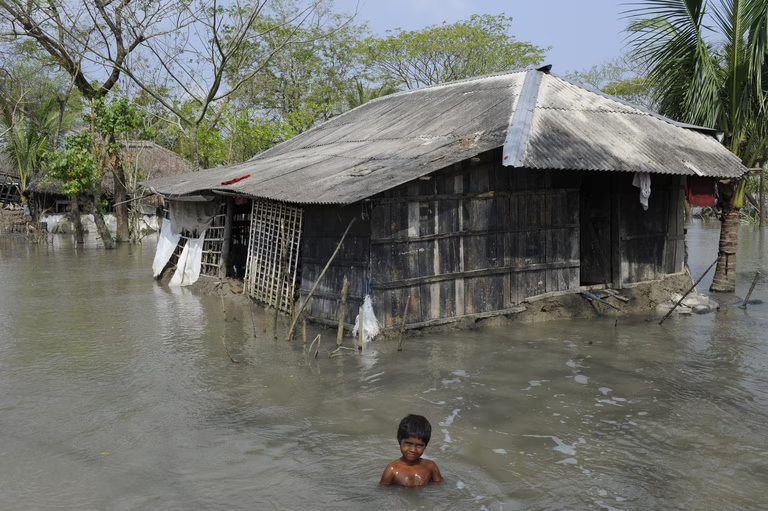
Climate Refugees
Over 250 million people have been displaced by climate change, yet they have no legal protection and do not get humanitarian assistance. We must protect climate refugees.
➡️ CLIMATE CHANGE & DISPLACEMENT - 250 Million Displaced by Environmental Changes, And Counting
The consequences of our planet's changing climate extend far beyond warming temperatures, rising sea levels, and extreme weather events. Human displacement as a result of the climate crisis is now one of the world's most pressing issues, as estimates predict that there could be more than one billion climate refugees by 2050.
The plight of these people is neglected and forgotten as they remain unprotected by the law and are excluded from international aid programmes.
Climate refugees are forced to flee their homes as the environment degrades, and climate-related disasters take hold. Climate change is now one of the leading causes of mass forced displacement around the world.
Climate change is also increasing rates of poverty, instability, and violence - further drivers of migration.
Those on the front lines of climate change are often in countries that contributed the least to it. The vast majority of climate migration is internal, which puts an unsustainable strain on the already limited resources of these nations.
Jump straight to our resources on ➡️ Climate Refugees
Explore our comprehensive guides on -
-
Guide to Refugees & Migrants
-
The Climate Crisis
-
Consequences of Climate Change
-
Organisations Supporting Refugees
"When people are driven out because their local environment has become uninhabitable, it might look like a process of nature, something inevitable... Yet the deteriorating climate is very often the result of poor choices and destructive activity, of selfishness and neglect." - Pope Francis
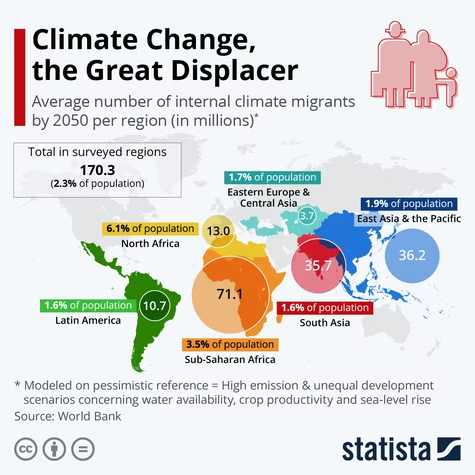
A Humanitarian Crisis
-
In 2022, climate-related disasters accounted for more than half of new reported displacements.
-
Almost 60% of existing refugees and IDPs live in countries that are among the most vulnerable to climate change.
-
The demand for humanitarian assistance due to climate-related disasters is predicted to double by 2050.
-
In 2023, the countries with the highest numbers of new internal displacements (IDPs) due to environmental disasters were China, Türkiye, the Philippines, Somalia, and Bangladesh.
-
Three out of four refugees and displaced people are in countries experiencing both conflict and high risk of climate hazards.
-
By 2030, water scarcity could displace 700 million people.
-
Up to 75% of Bangladesh sits below sea level. Rising water levels have already affected 25.9 million people.
-
Unpredictable rainfall patterns, desertification, and declining agricultural productivity undermine rural livelihoods and force migration to urban areas.
-
Climate change perpetuates poverty. The World Bank estimates that without urgent action, an additional 32 - 132 million people could be pushed into extreme poverty by 2030.
-
Climate migration is not just an issue in developing countries. In 2022, 3.2 million people were either displaced or evacuated due to wildfires, floods, and hurricanes in the U.S.A.
-
Within Europe, rising sea levels put 1.6-5.3 million people at risk of displacement by the end of the century.
Expansion of Legal Protections
Climate migrants remain in a murky legal space that neither recognises nor protects them. In fact, the term is not recognised at all in international law.
The Refugee Convention, which entered into force in 1954, was established to protect those who had fled persecution from the atrocities of World War II. Its protections extend only to those who must leave their home countries due to war, violence, conflict or any other kind of maltreatment. It also does not protect those who have been displaced in their own countries.
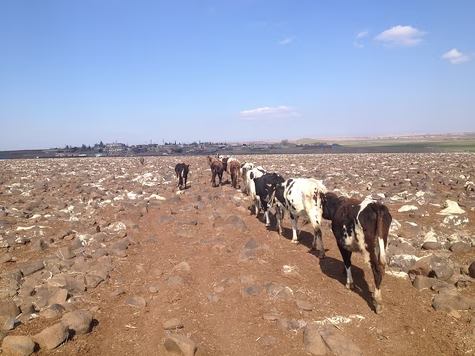
As the vast majority of climate refugees are not crossing borders nor fleeing violence, their status is outside of the convention's reach. These facts do not mean that these people are less in need of assistance or that their lives are not equally in danger, yet the law overlooks their plight.
Refugee advocates are pushing for an expansion to the convention to include the rights of those forced to move due to environmental factors, but have met with significant political pushback. Critics argue it would lead to the weakening of protection for those experiencing serious persecution. The difficulty in proving the causal factors of climate migration is a further barrier.
The 1998 Guiding Principles on Internal Displacement help bridge the gap in protecting climate refugees; however, its non-binding nature limits its practical effect and gives it no legal force. It also does not protect those who must cross borders.
The Global Compact for Migration was adopted in 2018. It was the first UN framework on international migration. For the first time, climate change was officially recognised as a driver of migration, but it still does not grant legal protection for climate refugees. Instead, the compact promotes safe, orderly pathways for migrants, including planned relocation, visa options, and humanitarian shelter.
The United Nations Framework Convention on Climate Change (UNFCCC) is both the process and the treaty that help countries mitigate the causes and consequences of the climate crisis. It was signed by 154 countries in 1992. Climate migrants aren't explicitly protected by the UNFCCC.
As it stands, although some countries have enacted domestic laws that provide temporary protection for climate refugees, the lack of recognition under the Refugee Convention means there is still no international, legally binding mechanism for them.
Countries are reluctant to sign up to yet another agreement, especially as it may make them responsible for climate migrants who arrive at their borders and promote larger migrant influxes to favoured countries. There are many political obstacles which ultimately exacerbate the humanitarian needs of millions.
We must begin to seriously address internal climate displacement in the most vulnerable countries. Tackling the issue at its root is imperative, and the nations historically responsible for the damage must be made to pay.
Climate migration is a form of adaptation. We can build new pathways for safe and regular migration.
The Loss and Damage Fund was created in 2022 at COP27 to help address the financial needs of communities severely impacted by climate change. The money would support rehabilitation, recovery, and human mobility. While a brilliant initiative, as of late 2025, rich nations have delivered less than half of what they initially committed to the fund.
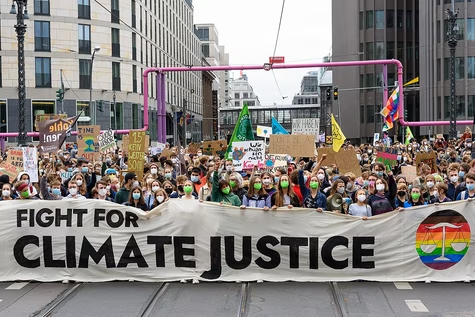
Climate Justice is Migrant Justice
The climate justice movement recognises that climate change disproportionately affects marginalised and vulnerable communities. It demands that the Global North, who have massive historical accountability, should bear the burden of the solutions. The movement brings social justice, racial justice, human rights, and economic equality into the climate debate.
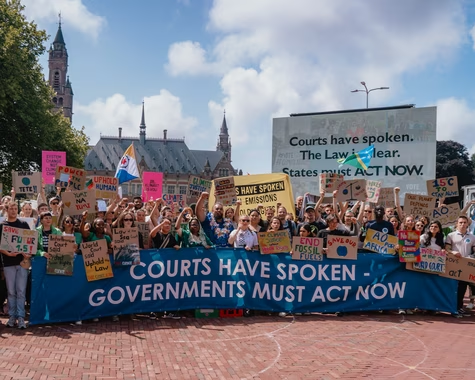
In July 2025, years of activism by a bold group of law students from the University of the South Pacific paid off. The Vanuatu ICJ Initiative spearheaded legal action that led to a historic advisory opinion from the International Court of Justice (ICJ).
The following was adopted unanimously by all 15 judges: Nations have a legal duty to combat the planetary crisis.
The ICJ has, for the first time, officially categorised the climate crisis as an "urgent and existential threat" and emphasised that "cooperation is not a matter of choice for states but a pressing need and a legal obligation." The ICJ opinion can now be used to demand more ambitious climate protection measures, to ensure compliance with the Paris Agreement, to implement national and international climate laws, and potentially to help protect climate migrants.
The initiative also highlighted the vulnerability of small island nations and demonstrated that collective action and legal accountability are important tools on the journey to justice and sustainable development.
Any justice for climate-induced migration must be human rights-focused. Humanitarian visas, temporary protection, authorisation to stay, and bilateral free movement agreements would all help to ease the suffering of those forced to leave their homes.
Invisible No Longer
"When we refugees are excluded, our voices are silenced, our experiences go unheard, and the reality of the climate situation in the Global South is blurred" - Ayebare Denise, Ugandan climate justice activist.
Climate migrants have remained invisible in climate and migration debates for years. The International Organisation for Migration have been working hard to bring climatic and environmental factors into the spotlight. They are establishing a body of evidence that will definitively prove that climate change, both directly and indirectly, affects human mobility.
The UN Refugee Agency advocates for states' responsibilities and obligations to address the migration crisis caused by climate change. They view climate change as a threat multiplier and are working towards protection frameworks.
The debate over establishing a climate refugee status is ongoing, and while a legal definition would be useful, it would be only a partial solution. The vast majority of climate migrants do not want to leave their homes, their livelihoods, or their communities. Admittedly, this is no easy feat, but we must fix the root of the problem - climate change itself.
Without urgent action, we are all at risk of becoming climate refugees.
Whilst working towards tackling immediate needs, climate discussions should continue to focus on preventative measures. Climate mitigation, adaptation, and a just energy transition are essential.
Countries must begin cooperating on this global issue and ensure the fair treatment of all refugees. We must demand a new comprehensive legal framework for climate refugees to safeguard vulnerable populations and protect those who may be at risk in the future.
The issue of climate refugees is our moral obligation.
Author: Rachael Mellor, 09.01.26 licensed under CC BY-SA 4.0
For further reading on Climate Refugees see below ⬇️
More Resources
Curated Directory & Deep-Dive Resources on Climate Refugees
- Refugee camps are at higher risk of extreme weather – new research - Conversation 06.06.23 350753
- after 2.7 °C global warming the purple areas will basically be too hot to live - @rahmstorf 23.05.23 378469
- Quantifying the human cost of global warming - Nature sustainability 22.05.23 378470
- Conflict and climate disasters combine to create record rise in displaced people - Guardian 11.05.23 345611
- Norwegian Refugee Council: Violence, Climate & Poverty Are Fueling Migration from Central America - DN! 24.04.23 343012
- 'More people displaced because of climate change than because of conflicts,' says UN migration chief - Euronews 21.04.23 343008
- Climate refugees are on the front line of a global emergency - Big Issue 21.04.23 343002
- ‘Without the ice cap, we cannot live’: the Andes community devastated by climate crisis - Guardian 18.04.23 341530
- Can this high-level task force drive a debate on climate migration? - Devex 18.04.23 343011
- Globe Climate: How Vietnam challenges what ‘climate refugees’ look like - The Globe And Mail 17.04.23 343005
- Why UK’s first climate refugees are wrong to believe that their village can be saved from rising sea - Scroll 07.04.23 343010
- Climate Refugees: An Introduction to Environmentally-Displaced Communities - Seaside Sustainability 07.04.23 343003
- Colombia considers first law on climate refugees in Latin America - El Pais 07.04.23 343004
- The UK’s first climate refugees: why more defences may not save this village from rising sea levels - The Conversation 31.03.23 343001
- USCRI releases joint report on climate-related displacement from field visit in Tijuana - U.S. Committee for Refugees and Immigrants 30.03.23 343006
- They grow America’s strawberries. A vicious flood made them climate migrants - The Guardian 27.03.23 343009
- UK Think Tank Proposes Visas for Climate Migrants - Ecowatch 26.03.23 338007
- Should Climate Refugees Be Recognised as Such? - Earth 23.03.23 339489
- International law doesn’t protect people fleeing environmental disaster – here’s how it could - Conversation 13.03.23 338454
- How Europe might cope with climate refugees - Info Migrants 13.03.23 339484
- The Great Climate Migration: How climate displacement will impact the future of Wales - IWA 08.03.23 343007
- Borders & Belonging: Should we call people climate refugees? - Open Democracy 08.03.23 339487
- The climate refugee crisis is landing on Europe’s shores — and we are far from ready - Politico 20.02.23 339481
- Podcast: The link between migration, the climate crisis, and human rights - UN News 17.02.23 331389
- Climate refugee crisis has landed on Europe’s shores – and we are far from ready - Euractiv 13.02.23 339493
- Video: Climate-change migrants: what can be done? - Economist 09.02.23 328826
- How to manage the world’s climate migrants - The Economist 09.02.23 339494
- Americans’ Climate Migration Has Begun - American Prospect 02.02.23 331622
- Stuck – climate change makes people too poor to migrate - Sonnenseite 24.01.23 326740
- Desperate choices in Guatemala - HRW, 2023 383918
- Pakistan’s Climate Migrants Face Tough Odds - Foreign Policy 21.12.22 339495
- Climate change could force 1.2 billion to move by 2050. Is the world even remotely ready? - Mongabay 09.12.22 319197
- A new kind of climate refugee is emerging - NPR 02.12.22 339482
- How AI can help us better prepare for climate migration - World Economic Forum 10.11.22 339490
- Act now: migrant inclusion in climate action is an obligation, not an option - WHO 03.11.22 339492
- Climate mitigation is not enough — focus on resilience now - Nature 11.10.22 310601
- Latino families, some of them climate refugees, found a home in southwest Florida - NBC News 07.10.22 310581
- Second wave of catastrophe: After the floods, disease stalks climate refugees - Samaa English 07.10.22 310580
- Climate change will displace millions of people - do we need to rethink attitudes to mass migration? - Euronews 06.10.22 339497
- Political inaction deepening displacement crisis, Failure to find peace and address conflict, climate change and other crises is increasing hardship and driving new displacem… 310177
- A need to legalise climate refugees - The Statesman 29.09.22 310582
- Book: Policymakers are failing ‘climate refugees’ - Cornell Edu 27.09.22 310583
- There could be 1.2 billion climate refugees by 2050 - Zurich.com 27.09.22 310589
- International Law on Refugees Has a Climate Change Problem - World Politics Review 22.09.22 310584
- Mass migration is an inevitable consequence of the climate crisis. For one writer, it is also the solution - The Parliament Magazine 19.09.22 310596
- As the Planet Warms, Canada Faces an Influx of Climate Refugees - Wired 10.09.22 310590
- In The Face of Climate Change, Migration offers an Adaptation Strategy in Africa - International Organization for Migration 05.09.22 304062
- Climate change may lead to staggering levels of migration - The Economist 01.09.22 310594
- Where We'll End Up Living as the Planet Burns - Time 31.08.22 310591
- Top Climate Emergencies Impacting Refugees in 2022 - UN Refugees 31.08.22 339485
- Drought in Africa threatens millions of children — UN - Deutsche Welle 23.08.22 301986
- The century of climate migration: why we need to plan for the great upheaval - The Guardian 18.08.22 310585
- Disaster Displacement and Climate Refugees - Environbuzz 05.08.22 310600
- Climate Migration Growing But Not Fully Recognized By World - Bloomberg 28.07.22 310595
- Climate change is already fueling global migration. The world isn’t ready to meet people’s changing needs, experts say - PBS 28.07.22 339483
- The Increased Imperative for International Law Protections Regarding Climate Induced Migration - Oxford Human Rights Hub 07/22 305884
- Climate Change Compounds Longstanding Displacement in Afghanistan - Migration Policy 29.06.22 339496
- “Intolerable tide” of people displaced by climate change: UN expert - OHCHR 23.06.22 339480
- Timely readings on global climate migration - Yale Climate Connection 17.06.22 310602
- Taiwan’s first climate refugees - CW 13.06.22 310592
- Climate Refugees: A Major Challenge of International Community and Africa - Policy Center 6/22 - PDF 310593
- FMR Online Climate crisis and displacement: from commitment to action - Forced Migration Review 6/22 - PDF 310597
- Climate change is devastating the Global South - Al Jazeera 11.05.22 310588
- The UK 'climate refugees' who won't leave - BBC 10.05.22 339488
- Video: The plight of refugees and migrants around the world - Al Jazeera 06.05.22 310587
- The climate crisis and displacement in Venezuela - ODIHPN 28.04.22 310603
- For Climate Migrants, Bangladesh Offers Promising Alternatives - The Diplomat 30.03.22 339491
- 'A journey with no end' Angola's climate refugees - Al Jazeera 23.02.22 310586
- Americans’ Climate Migration Has Begun - American Prospect 02.02.23 338021
- Groundswell (Part 1) : Preparing for Internal Climate Migration - World Bank 2021 256882
- Groundswell (Part 2) : Acting on Internal Climate Migration - World Bank 2021 256881
- Global warming and population change both heighten future risk of human displacement due to river floods - iopscience 2021 241628
- Displaced on the frontlines of the climate emergency - UNHCR 2021 241827
- Publication: Global Climate Wall: How the world’s wealthiest nations prioritise borders over climate action - Transnational Institute 10/2021 263008
- Photos: The Bangladesh town offering new life to climate migrants - Al Jazeera 30.03.22 280247
- Climate change will fuel greater displacement - Al Jazeera 08.03.22 276179
- Environmental disasters are fuelling migration — here’s why international law must recognize climate refugees - The Conversation 13.01.22 339486
- Climate migration will worsen the brutality in the Mediterranean - Al Jazeera 06.12.21 263938
- How ‘Climate Migrants’ Are Roiling American Politics - Politico 27.11.21 310598
- Why We Must Defund the Global Climate Wall - CD 01.11.21 263010
- Video: Forced to flee: Climate refugees - Doha Debates 20.10.21 396381
- Are Hondurans the new climate refugees? - Al Jazeera 18.10.21 258464
- South Sudanese refugees homeless again after Sudan floods - Al Jazeera 23.09.21 255722
- Climate Change Is Triggering a New Refugee Crisis—Inside the US - CD 22.09.21 257725
- Droughts or storms? The dire dilemma of Zimbabwe climate migrants - Al Jazeera 16.09.21 255252
- Climate Emergency May Displace 216 Million Within Countries by 2050 - CD 13.09.21 256883
- The climate crisis will create two classes: those who can flee, and those who cannot - Guardian 07.07.21 249568
- Erupting Congo Volcano Is Latest Crisis for DRC as It Faces “Largest Neglected Emergency on Earth” - DN! 28.05.21 246064
- Children and families at risk following huge volcano eruption in Goma, warns UNICEF - releifweb 23.05.21 245693
- Extreme weather displaces record numbers of people as temperatures rise - Eco Watch 21.05.21 245101
- Climate disasters ‘caused more internal displacement than war’ in 2020 - Guardian 20.05.21 248938
- Number of IDPs in the world reaches record high of 55m - Al Jazeera 20.05.21 245046
- Across Asia, People Displaced by Climate Disasters Continue to Be Vulnerable With Little Promise of Relief - CD 06.05.21 245344
- Immobility: The neglected flipside of the climate displacement crisis - New Humanitarian 27.04.21 242264
- “Shelter from the Storm”: Climate Change Is a Driving Force in Central American Migration - Democracy Now! 23.04.21 243829
- Climate change significantly increases population displacement risk - sonnenseite 04.04.21 241629
- Poor seasonal rains threatening ‘foundations’ of tens of thousands of Somali livelihoods - UN News 12.03.21 238273
- In Central America, women and girls bear the brunt of storm disaster fallout - New Humanitarian 09.03.21 237706
- In storm-hit Honduras, a climate crisis drives needs and fuels migration - New Humanitarian 18.11.20 232764
- Report: Quantifying environmental migration - Migration Data Portal 10.06.20 216120