
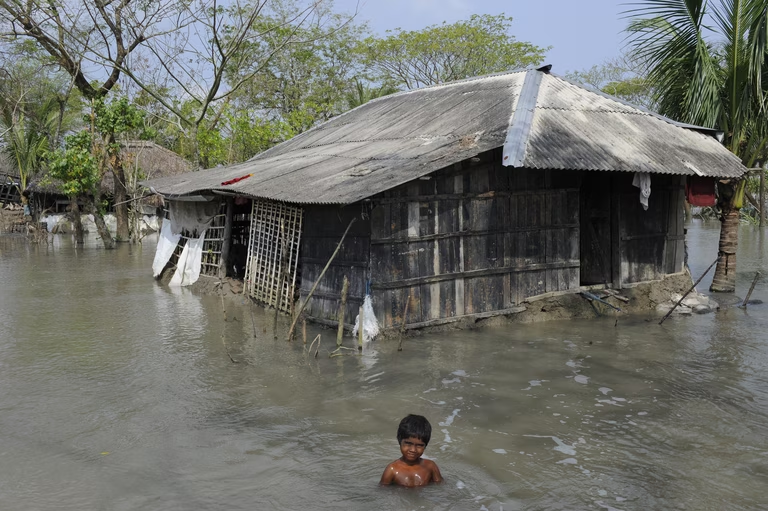
Climate Refugees
Over 250 million people have been displaced by climate change, yet they have no legal protection and do not get humanitarian assistance. We must protect climate refugees.
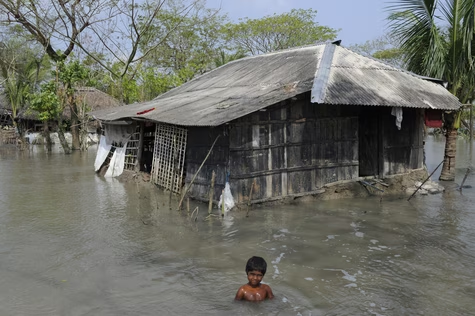
➡️ CLIMATE CHANGE & DISPLACEMENT - 250 Million Displaced by Environmental Changes, And Counting
The consequences of our planet's changing climate extend far beyond warming temperatures, rising sea levels, and extreme weather events. Human displacement as a result of the climate crisis is now one of the world's most pressing issues, as estimates predict that there could be more than one billion climate refugees by 2050.
The plight of these people is neglected and forgotten as they remain unprotected by the law and are excluded from international aid programmes.
Climate refugees are forced to flee their homes as the environment degrades, and climate-related disasters take hold. Climate change is now one of the leading causes of mass forced displacement around the world.
Climate change is also increasing rates of poverty, instability, and violence - further drivers of migration.
Those on the front lines of climate change are often in countries that contributed the least to it. The vast majority of climate migration is internal, which puts an unsustainable strain on the already limited resources of these nations.
Jump straight to our resources on ➡️ Climate Refugees
Explore our comprehensive guides on -
-
Guide to Refugees & Migrants
-
The Climate Crisis
-
Consequences of Climate Change
-
Organisations Supporting Refugees
"When people are driven out because their local environment has become uninhabitable, it might look like a process of nature, something inevitable... Yet the deteriorating climate is very often the result of poor choices and destructive activity, of selfishness and neglect." - Pope Francis
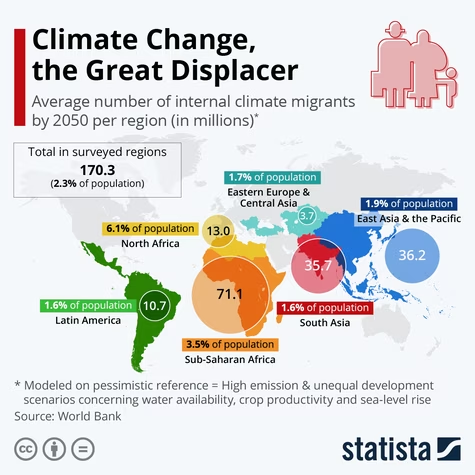
A Humanitarian Crisis
-
In 2022, climate-related disasters accounted for more than half of new reported displacements.
-
Almost 60% of existing refugees and IDPs live in countries that are among the most vulnerable to climate change.
-
The demand for humanitarian assistance due to climate-related disasters is predicted to double by 2050.
-
In 2023, the countries with the highest numbers of new internal displacements (IDPs) due to environmental disasters were China, Türkiye, the Philippines, Somalia, and Bangladesh.
-
Three out of four refugees and displaced people are in countries experiencing both conflict and high risk of climate hazards.
-
By 2030, water scarcity could displace 700 million people.
-
Up to 75% of Bangladesh sits below sea level. Rising water levels have already affected 25.9 million people.
-
Unpredictable rainfall patterns, desertification, and declining agricultural productivity undermine rural livelihoods and force migration to urban areas.
-
Climate change perpetuates poverty. The World Bank estimates that without urgent action, an additional 32 - 132 million people could be pushed into extreme poverty by 2030.
-
Climate migration is not just an issue in developing countries. In 2022, 3.2 million people were either displaced or evacuated due to wildfires, floods, and hurricanes in the U.S.A.
-
Within Europe, rising sea levels put 1.6-5.3 million people at risk of displacement by the end of the century.
Expansion of Legal Protections
Climate migrants remain in a murky legal space that neither recognises nor protects them. In fact, the term is not recognised at all in international law.
The Refugee Convention, which entered into force in 1954, was established to protect those who had fled persecution from the atrocities of World War II. Its protections extend only to those who must leave their home countries due to war, violence, conflict or any other kind of maltreatment. It also does not protect those who have been displaced in their own countries.
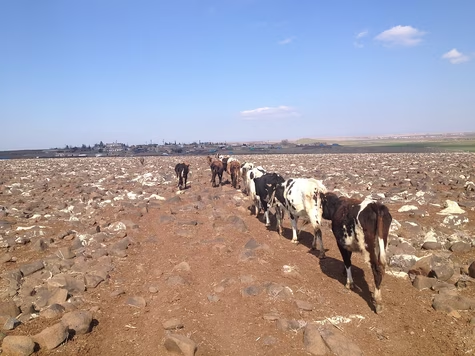
As the vast majority of climate refugees are not crossing borders nor fleeing violence, their status is outside of the convention's reach. These facts do not mean that these people are less in need of assistance or that their lives are not equally in danger, yet the law overlooks their plight.
Refugee advocates are pushing for an expansion to the convention to include the rights of those forced to move due to environmental factors, but have met with significant political pushback. Critics argue it would lead to the weakening of protection for those experiencing serious persecution. The difficulty in proving the causal factors of climate migration is a further barrier.
The 1998 Guiding Principles on Internal Displacement help bridge the gap in protecting climate refugees; however, its non-binding nature limits its practical effect and gives it no legal force. It also does not protect those who must cross borders.
The Global Compact for Migration was adopted in 2018. It was the first UN framework on international migration. For the first time, climate change was officially recognised as a driver of migration, but it still does not grant legal protection for climate refugees. Instead, the compact promotes safe, orderly pathways for migrants, including planned relocation, visa options, and humanitarian shelter.
The United Nations Framework Convention on Climate Change (UNFCCC) is both the process and the treaty that help countries mitigate the causes and consequences of the climate crisis. It was signed by 154 countries in 1992. Climate migrants aren't explicitly protected by the UNFCCC.
As it stands, although some countries have enacted domestic laws that provide temporary protection for climate refugees, the lack of recognition under the Refugee Convention means there is still no international, legally binding mechanism for them.
Countries are reluctant to sign up to yet another agreement, especially as it may make them responsible for climate migrants who arrive at their borders and promote larger migrant influxes to favoured countries. There are many political obstacles which ultimately exacerbate the humanitarian needs of millions.
We must begin to seriously address internal climate displacement in the most vulnerable countries. Tackling the issue at its root is imperative, and the nations historically responsible for the damage must be made to pay.
Climate migration is a form of adaptation. We can build new pathways for safe and regular migration.
The Loss and Damage Fund was created in 2022 at COP27 to help address the financial needs of communities severely impacted by climate change. The money would support rehabilitation, recovery, and human mobility. While a brilliant initiative, as of late 2025, rich nations have delivered less than half of what they initially committed to the fund.
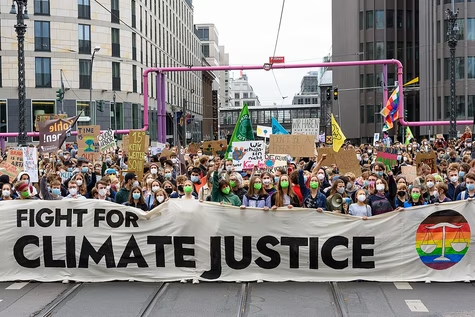
Climate Justice is Migrant Justice
The climate justice movement recognises that climate change disproportionately affects marginalised and vulnerable communities. It demands that the Global North, who have massive historical accountability, should bear the burden of the solutions. The movement brings social justice, racial justice, human rights, and economic equality into the climate debate.
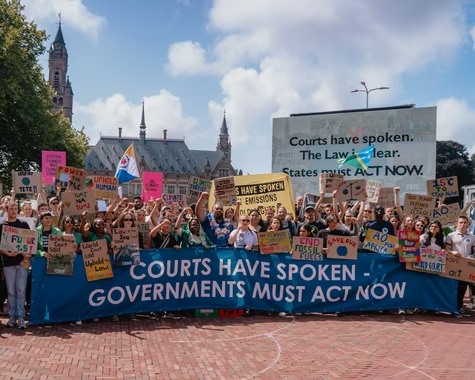
In July 2025, years of activism by a bold group of law students from the University of the South Pacific paid off. The Vanuatu ICJ Initiative spearheaded legal action that led to a historic advisory opinion from the International Court of Justice (ICJ).
The following was adopted unanimously by all 15 judges: Nations have a legal duty to combat the planetary crisis.
The ICJ has, for the first time, officially categorised the climate crisis as an "urgent and existential threat" and emphasised that "cooperation is not a matter of choice for states but a pressing need and a legal obligation." The ICJ opinion can now be used to demand more ambitious climate protection measures, to ensure compliance with the Paris Agreement, to implement national and international climate laws, and potentially to help protect climate migrants.
The initiative also highlighted the vulnerability of small island nations and demonstrated that collective action and legal accountability are important tools on the journey to justice and sustainable development.
Any justice for climate-induced migration must be human rights-focused. Humanitarian visas, temporary protection, authorisation to stay, and bilateral free movement agreements would all help to ease the suffering of those forced to leave their homes.
Invisible No Longer
"When we refugees are excluded, our voices are silenced, our experiences go unheard, and the reality of the climate situation in the Global South is blurred" - Ayebare Denise, Ugandan climate justice activist.
Climate migrants have remained invisible in climate and migration debates for years. The International Organisation for Migration have been working hard to bring climatic and environmental factors into the spotlight. They are establishing a body of evidence that will definitively prove that climate change, both directly and indirectly, affects human mobility.
The UN Refugee Agency advocates for states' responsibilities and obligations to address the migration crisis caused by climate change. They view climate change as a threat multiplier and are working towards protection frameworks.
The debate over establishing a climate refugee status is ongoing, and while a legal definition would be useful, it would be only a partial solution. The vast majority of climate migrants do not want to leave their homes, their livelihoods, or their communities. Admittedly, this is no easy feat, but we must fix the root of the problem - climate change itself.
Without urgent action, we are all at risk of becoming climate refugees.
Whilst working towards tackling immediate needs, climate discussions should continue to focus on preventative measures. Climate mitigation, adaptation, and a just energy transition are essential.
Countries must begin cooperating on this global issue and ensure the fair treatment of all refugees. We must demand a new comprehensive legal framework for climate refugees to safeguard vulnerable populations and protect those who may be at risk in the future.
The issue of climate refugees is our moral obligation.
Author: Rachael Mellor, 09.01.26 licensed under CC BY-SA 4.0
For further reading on Climate Refugees see below ⬇️
More Resources
Curated Directory & Deep-Dive Resources on Climate Refugees
- Environmental migrant - Wikipedia 216107
- Climate migration - Wikipedia 386746
- Climate and Migration Coalition 216117
- Climate Refugees - Othering & Belonging Institute 193830
- Climate Refugees 366889
- Climate Refugees - Executive Summary- Othering & Belonging Institute 193831
- Organizations helping climate refugees - The Borgen Project 216115
- How do you flee climate change? - UNHCR 386744
- Climate change and disaster displacement - UNHCR 216113
- The great climate migration - a warming planet and a shifting population - Pro Publica 229045
- Let’s talk about climate migrants, not climate refugees - Sustainable Development Goals 216109
- Climate refugee statistics: how many, where and when? - Climate and Migration Coalition 216121
- Climate refugees - The Conversation 216110
- Publication: Empowering refugee and migrant led organisations – recommendations to grant-giving foundations - Climate & Migration Coalition 263595
- @Climate_Refugee 366890
- Zimbabwe’s climate migrants fear eviction as crackdown intensifies - Al Jazeera 15.06.26 518378
- Rethinking Climate Migration - ENN 10.12.25 503268
- Video: Climate Crisis Displaces 250 Million Over a Decade While U.S. & Other Polluting Nations Close Borders - DN! 20.11.25 499544
- As Millions Face Climate Relocation, the Nation’s First Attempt Sparks Warnings and Regret - Inside Climate News 28.09.25 490487
- Pakistan Floods Highlight Urgent Need for Reforms - HRW 10.09.25 487352
- IOM Positions Migration as Key to Resilience at Africa Climate Summit in Ethiopia - IOM 08.09.25 487354
- As rising sea levels swallow Bangladesh’s land, its climate refugees are forced to adapt - PBS News 03.09.25 487353
- New Report Shows Anti-Immigrant and Anti-Climate U.S. Policies Contribute to Climate Harms and Displacement - International Refugee Assistance Project 28.05.25 471341
- As climate change in Africa forces more people from their homes, a new IFRC report says people can — and must — have more and better choices when it comes to their future - I… 471347
- Nearly a Third of Tuvalu Residents Seek Climate Visas to Australia as Sea Engulfs Their Home - CD 26.06.25 477322
- Climate Refugees: A Growing Concern - Number Analytics 25.05.25 471342
- Central American Climate Refugees: Implications for US National Security - Geopolitical Monitor 24.04.25 471343
- Video: Jeffrey Sachs harshly criticizes the United States and Israel at the Antalya Diplomacy Forum - DRM News 12.04.25 472976
- Fresh details emerge on Australia’s new climate migration visa for Tuvalu residents. An expert explains - The Conversation 10.04.25 471344
- How the Global Migration Crackdown Affects Climate Finance - Carnegie Endowment for International Peace 27.03.25 471345
- Habitability and Adaptation to a Changing Climate: Impacts of climate change on agriculture and human mobility in the Northern and Volta Regions, Ghana - IOM 10.03.25 471346
- UNHCR: Cyclone Chido has displaced 'thousands' in Mozambique - Info Migrants 24.12.24 447147
- Tweet: Publication @unmigration: Who are climate migrants? A global analysis of the profiles of communities affected by weather-related internal displacements - @UN_Water 24… 447144
- Tweet: Forced displacement of the Sami people has become a tradeoff for innovative climate-change mitigation in Sweden. - @ForeignPolicy 24.12.24 447145
- Undocumented people are among most vulnerable to climate-fueled disasters - NPR 23.12.24 447498
- Displacement and Justice: Bridging the Gap Between COP Negotiations and Local Realities - FES 23.12.24 447148
- Climate, migration and conflict mix to create ‘deadly’ intense tropical storms like Chido - The Conversation 20.12.24 447149
- The nexus between climate change, migration and social tensions in Zimbabwe - CGIAR 19.12.24 447072
- The World Must Recognize Climate Refugees - FP 18.12.24 447146
- Tweet: One year after severe floods in northern #France, residents of Blendecques face relocation as their neighborhood is demolished to become a stormwater basin. Some now … 444224
- Video: Why are millions at risk of displacement? - CGTN America 06.12.24 444222
- Video: Melting permafrost in Canadian Arctic town could lead to first climate refugees - France24 03.12.24 444223
- Climate refugees: The world’s forgotten displacement crisis - Concern Worldwide 30.11.24 444221
- Vulnerable Communities at Risk of Flooding in Ethiopia - International Organization for Migration 28.11.24 443009
- Maldives: Identifying Vulnerable Communities and Safe Islands in the Maldives, 9,000 people (4% of population outside the capital) who may be in vulnerable areas by 2050 - I… 443008
- Mapping the impact of climate change on global displacement - Al Jazeera 22.11.24 441665
- Struggling against the tide: Afghanistan’s battle against climate change and displacement: The country is facing immense challenges due to an ongoing economic crisis, high un… 441186
- National Strategy to Implement Solutions Pathways to Internal Displacement in Ethiopia; Solutions to Internal Displacement in Ethiopia 2024 - UNCHR 14.11.24 441185
- Who Are Climate Migrants? A Global Analysis of the Profiles of Communities Affected by Weather-related Internal Displacements - International Organization for Migration 14.1… 441134
- UN Agencies and Ethiopian Government Launch Durable Solutions Strategy for Internal Displacement - UN Development Programme 14.11.24 441168
- Who Are Climate Migrants? A Global Analysis of the Profiles of Communities Affected by Weather-related Internal Displacements - International Organization for Migration 14.11… 440652
- IOM and UNICEF Renew Partnership to Protect, Include and Empower Climate-Displaced Children - International Organization for Migration 12.11.24 441151
- A sisterhood of support: Improving maternity care in Ethiopia’s climate change-ravaged Somali region - United Nations Population Fund 11.11.24 440833
- Loss and Damage governance must account for displacement: Disaster displacement creates many losses and damages - Internal Displacement Monitoring Centre 05.11.24 440304
- Video: Understanding the Impact of Climate Change on Refugees - Australia for UNHCR 18.10.24 435566
- Tweet: Making #ecocide an int'l crime "would acknowledge the deep & enduring consequences of environmental damage, including climate-induced displacement" - @EcocideLaw 18.10… 435568
- Theo James visits Mauritania to spotlight refugees' climate challenges ahead of COP29 - UNHCR 17.10.24 435567
- Collaborative Effort to Tackle Climate Displacement: EU, IOM and Partners Launch Risk Index in Indonesia - IOM 16.10.24 435562
- Tweet: "Leveraging development finance is about minimizing displacement & ensuring communities have sustainable recovery pathways." – Mati Hashemee, our Regional Director (a… 435569
- Climate change impacts internal migration worldwide - IIASA 15.10.24 435563
- The U.S. already has millions of climate refugees. Helene and Milton could make it worse. - USA Today 14.10.24 435565
- Displaced by war, Syrian refugees are now casualties of the climate crisis. A photographer captured their resilience - CNN 12.10.24 435564
- Video: Ama Francis on How to Protect People Experiencing Climate Displacement - International Refugee Assistance Project 10.10.24 435138
- Uganda’s struggles resettling climate-displaced communities - African Arguments 09.10.24 435140
- I Wasn’t Prepared to Be a Climate Refugee - Scientific American 04.10.24 435137
- Podcast: How We Talk about Climate Migration Shapes Treatment of “Climate Refugees” - Migration Policy Center 04.10.24 435136
- Igniting hope for displaced communities in a changing climate - Practical Action 04.10.24 435139
- Tweet:#YouthVoices spotlighting Kaluba, a 23-year-old advocating for #ClimateMigration awareness. His voice sheds light on the effects of climate migration and his quest for … 433256
- Tweet: From Dhaka to São Paulo, already crowded cities are unprepared to absorb people fleeing the effects of climate change - @climate 27.09.24 433255
- Countries Should Broaden Their Policy Toolkits to Address Climate Displacement - MPI 25.09.24 433253
- Cities in Global South must prepare for climate migrants - Context 24.09.24 433251
- Climate crisis intensifies challenges for refugees and displaced populations - CGTN 19.09.24 433252
- Eight million climate migrants predicted to arrive in ten Global South cities by 2050 if emissions don’t fall - C40 Cities 18.09.24 433254
- Tweet: The amount of climate migration that we should expect to see in the US will be strongly influenced by the public investments we make in supporting and protecting peopl… 431977
- New Analysis Examines the Factors that Shape Public Opinion of Climate Migrants and How to Build the Space for Smart Policy Conversations - MPI 11.09.24 431984
- Tweet: What do people think of #climatemigrants? And how do they react? @nataliabbogdan & @Lawrence_Huang9 did a deep dive on global polls & data in our latest analysis. - @M… 431981
- South Sudan floods: the first example of a mass population permanently displaced by climate change? - The Conversation 10.09.24 431979
- Tweet: The #RICD Symposium highlighted the urgent need to address climate migration in Asia Pacific. By joining forces with experts & communities, we aim for lasting solution… 431978
- Tweet: When Nyombi Morris was 10 years old, he and his family had to flee their flooded farm in Uganda. More than 15 years since becoming a climate refugee himself, he’s now … 431983
- Climate Change in Bangladesh Shapes Internal Migration and Movement to India - MPI 04.09.24 431980
- How the climate crisis is driving forced displacement in these five countries - UN Refugees 29.08.24 431982
- Tweet: If you ever wondered what climate refugees look like, here it is! Every year, thousands of Bangladeshis have to flee their homes due to widespread flooding due to heav… 429703
- Tweet: How do you flee climate change? - @Refugees 25.08.24 429702
- We need urgent climate action in conflict zones - Al Jazeera 22.08.24 429697
- Climate migration amplifies gender inequalities - DIIS 19.08.24 429700
- Panama’s climate refugees are still without a school - El Pais 16.08.24 429699
- Linked to Climate Change, Brazil Floods Continue to Leave Many Displaced - Climate Refugees 14.08.24 429701
- Tweet: IOM’s proud to have supported such an impactful forum, highlighting the dynamic potential of youth. We held sessions on Climate & Migration, Protection & Regular Pathw… 429698
- Are ‘Climate Refugees’ Compatible with the 1951 Refugee Convention? - E-IR 13.08.24 429696
- Afghanistan: Extreme weather forces more people from their homes in first six months of 2024 than all 2023 - Relief Web 06.08.24 427454
- Tweet: The climate crisis impacts us all, but not equally. Join UNHCR and Theo James in showing your solidarity with millions on the frontlines of climate change. - @Refugees… 425777
- Tweet: "I didn't think my children would survive." The climate crisis is having a direct impact on people's lives in South Sudan. - @MSF_canada 30.07.24 425775
- The invisible victims of the climate crisis - Social Europe 30.07.24 425774
- Climate change is the culprit behind the displacement of mns of refugees - Enterprise 30.07.24 425778
- How Economic Damage Will Drive Climate Migration - Bloomberg 30.07.24 425779
- Displacement as a Development Issue Enabling Public Policy to Unlock Climate Finance in Asia and the Pacific - CGDEV 30.07.24 425780
- Climate mobility and migrant health in West Africa - Springer 18.07.24 423398
- Here’s what extreme weather means for life in three refugee camps - Washington Post 17.07.24 423396
- UNEP Foresight Report: Large-scale displacement of entire communities now the norm - Down to Earth 16.07.24 423401
- “Displacement due to environmental factors is one of the great tragedies of our time” - Verfassungs Blog 14.07.24 423400