International Women's Day - March 8
Celebrate International Women's Day (March 8). Discover resources, 2026 themes, gender equality campaigns, events, and top organisations for action.
INTERNATIONAL WOMEN'S DAY, March 8, 2026 – #RightsJusticeAction
Discover the vital global initiative International Women's Day. Our guide offers you in-depth information on women's rights, structural justice, and gender empowerment. We celebrate the groundbreaking achievements of women while confronting the urgent need to dismantle systemic legal and social barriers.
Connect with hundreds of valuable resources, initiatives, and organisations – for genuine gender equality, systemic legal reform, and a fairer future for all.
Jump straight to our resources on ➡️ International Women's Day
Women's Day honours the achievements and contributions of women throughout history and across nations. It also serves as a powerful reminder of the ongoing struggle for gender equality and women's rights. This United Nations observation day allows us to reflect on the progress made and to focus on accelerating action on the urgent issues women still face.
The 2026 theme 'Rights. Justice. Action' demands equal rights and equal justice in a world where women have only 64% of the legal rights that men hold. This affects all areas of women's lives, including employment, finances, safety, family life, property and land ownership, social mobility, and even in retirement. Time and time again, women are disadvantaged by the law simply because of their gender.
This day is a global call for action to dismantle the systematic barriers to equal justice. Gender equality and women's rights will remain a fantasy as long as discriminatory laws, weak legal protections, and harmful social norms exist.
Contributing to women's advancement not only helps to bridge the gender equality gap, but it is also proven that when women thrive, everyone thrives. The benefits are felt throughout families, communities, economies, and society as a whole.
"I think realising that you're not alone, that you are standing with millions of your sisters around the world is vital" – Malala Yousafzai
Please share this useful resource via ➡️ Twitter, Bluesky, Facebook, Instagram, and LinkedIn!
Explore our comprehensive guides to feminism, inspiring women, women's political participation, the importance of girls' education, sexual and reproductive rights, and harmful stereotypes.
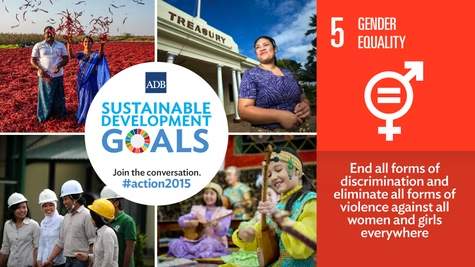
Rights. Justice. Action - 2026 Theme
This year's theme highlights women's role in achieving and accessing justice. Women are systematically underrepresented at every stage of the judicial process, accounting for only 28% of Supreme Court judges globally. In international courts, the percentage of female judges averages around 15–20%. Despite making up the majority of law students, the glass ceiling prevents them from taking on leadership roles in the profession.
Women judges strengthen accountability, bring new perspectives, and help to fight corruption. We must fight for equal participation at all levels. Not only are women denied access to top judicial positions, but the law also fails them when attempting to access legal support. Around the world, 70% of countries report that women face more barriers than men in accessing justice.
This Women's Day takes place just before the United Nations largest annual forum on gender equality and women's rights worldwide. The Commission on the Status of Women will take place from 9-19 March in New York.
The 'Give to Gain' campaign launched by the International Women’s Day organisation emphasises the power of reciprocity, generosity, and support to advance women’s rights and gender equality. The campaign promotes abundant giving through donations, knowledge, resources, protection, funding, visibility, advocacy, education, training, and mentoring.
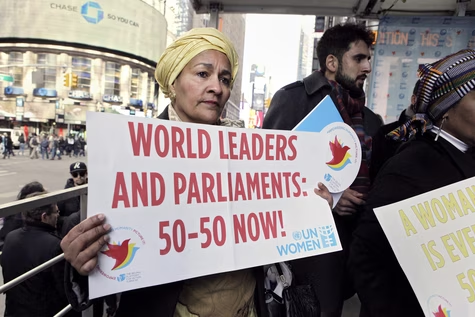
The State Of Women's Rights
-
Women still have only 64% of the legal rights of men.
-
More women and girls are forcibly displaced than ever before - 114 million.
-
More than one billion women of reproductive age live in countries with restrictions on abortion.
-
A woman or girl is killed every 10 minutes by a family member or intimate partner.
-
In the past decade, there has been a 50% increase in the number of women and girls directly exposed to conflict.
-
No country has reached the UN's 2030 goal for gender equality. Worryingly, between 2019 and 2022, almost 40% of countries saw no progress or a decline in gender equality. The situation for women has deteriorated in 18 countries, including Venezuela, Afghanistan, South Africa, and the U.S.A.
-
An estimated 110 million girls and young women will be out of school by 2030.
-
Approximately 10% of women live in extreme poverty. This figure has seen no improvement since 2020.
-
As of 2025, 102 countries have never had a woman serve as Head of State or Government.
-
Only 57% of the data needed to track SDG 5 is even available.
History Of International Women's Day
The first National Women's Day was observed in the United States on February 28, 1909, and stemmed from early labour movements, which were gaining popularity in North America and Europe. The idea for an international day was proposed at the International Socialist Women's Conference in Copenhagen a year later to help cement global efforts towards women's rights and suffrage.
The United Nations first marked the day in 1975, a move that bolstered momentum for positive change and recognition of women's rights around the world. Each year is now given a dedicated theme, such as 'Inspire Inclusion,' 'Gender Equality Today for a Sustainable Tomorrow,' and 'Women in Leadership'.
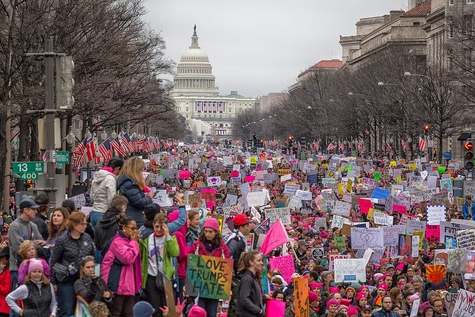
Not only does the day celebrate the achievements of women and raise awareness, but it has also been used for political action and activism. Demonstrators have gathered in their thousands to protest gender-based violence, better pay and work conditions, reproductive rights, and the recognition of women's rights as human rights.
The annual event has been instrumental in shaping gender equality policies by raising awareness and fostering dialogue on women's rights issues. It helped catalyse international agreements such as the Beijing Declaration and Platform for Action, adopted in 1995, which set strategic objectives for women's empowerment. It has also influenced the development of policies addressing gender-based violence, pay equity, and maternity rights.
*****
Celebrate IWD With Better World Info
As a key platform for gender equality and women's rights, we provide comprehensive information on women's issues, organisations, essential tools and resources, and networking opportunities. We help women, policymakers, NGOs, institutions, and universities make informed decisions, affect positive change, build connections, and find like-minded initiatives - a one-stop knowledge, sharing, and action network dedicated to the gender equality movement.
As well as staying informed and sharing our excellent resource, you can contribute to the gradual shift in societal attitudes by joining demonstrations, voting for progressive candidates in elections, spreading the word on social media, and giving respect and appreciation to the women in our lives, not just on this important day, but every day.
"Real change, enduring change, happens one step at a time" - Ruth Bader Ginsburg
Author: Rachael Mellor, 14.03.25, latest update 21.07.26, licensed under CC BY-SA 4.0
More Resources
Curated Directory & Deep-Dive Resources on International Women's Day - March 8
- General Info 41
- Social Media 34
- Organisations & Campaigns 24
- Feminist Strike 2018 (Spain) 6
- Articles 154
- Videos 42